Most interesting ‚thing‘ I watched in a while. Opinions ?
Leon
@leonwankum@BitcoinNostr.com
npub1v5k4...8rd9
Bitcoin. Real Estate. Philosophy & Ethics. Proof-of-Work. Newsletter: leonwankum.substack.com
„The difference between those who fail and those who succeed is their courage to act repeatedly“— @Carl B Menger


Joy of Compounding
Episode XVI. Block height: 844000. Everything, in time. Compounding is key because human time is scarce.
Thank you to everyone reading and supporting my work. The upcoming newsletter will provide an in-depth exploration of why Bitcoin and individual freedom matter.
Look for it at the end of this month!
https://leonawankum.substack.com/
🌘


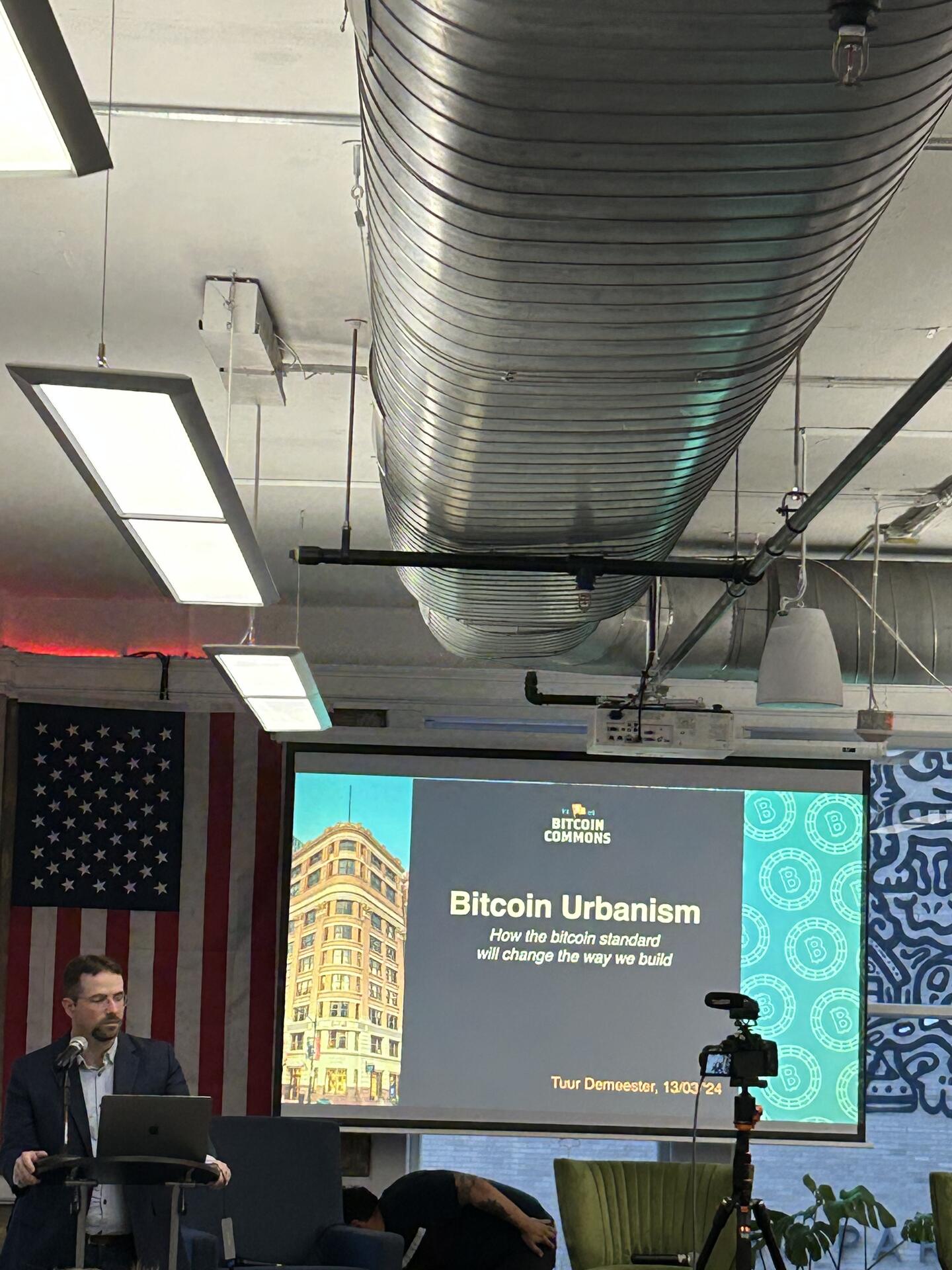
Great event at the Bitcoin Commons on Bitcoin & building culture.
#BitcoinUrbanism #realestate #housing 

The digital disruption Bitcoin embodies to the real estate industry can be likened to the advent of email. Just as email and other internet-based messaging services revolutionized communication by becoming the primary means of sending messages, bitcoin holds the potential to transform the way we store and send value.
It is conceivable that bitcoin could assume the role currently held by real estate as the foremost method of wealth preservation.
This potential shift in the paradigm of value storage and transfer is reminiscent of how email and digital messaging have largely replaced traditional postal services, underscoring the profound impact of technological advancements on societal norms.
#bitcoin #realestate
Bitcoin is the mental exit from the system.
It is not an inflation hedge it is a paradigm shift.
As Bitcoin makes its way into traditional financial markets, we can expect that its issuance plan will become increasingly important to financial markets and central bank's decision less important.
It has become the basis of my work and my life. When making economic decisions, I no longer base them on interest rates from central banks or government decrees, but rather on the supply plan of Bitcoin.
@gsovereignty when are you on at Bitcoin Atlantis ? 🙏
A beautiful day for ice diving today. 🥶


Whenever I see a trad-fi fund touting their annual returns of 8%, 10%, 25%, etc., I think to myself: I have outdone you all by doing literally nothing. #HODL


The nature of Bitcoin as a digital asset makes it impossible to fit 1:1 into the framework of property as we know it. One can possess Bitcoin, but not truly own it in the conventional sense.
Bitcoin is not about ownership, but about cryptographic control.
Here is my take on the subject via @Bitcoin Magazine.


Bitcoin Magazine
Bitcoin Is A Possession, Not Property
The nature of Bitcoin as a digital asset makes it impossible to fit 1:1 into the framework of property as we know it. One can possess Bitcoin, but ...
Bitcoin is primarily seen as an alternative to gold ($10-12 T) due to its limited supply and excellent monetary properties.
In fact, however, bitcoin is a competitor to the world's most used store of value, real estate ($330 T).
In the global financial landscape, gold has seen a shift from its traditional role as the primary store of value. Since 1971, this pivotal role has transitioned to real estate, characterized by its potent mix of scarcity and appealing financing opportunities, establishing it globally as the primary store of value.
The total value of global real estate has exceeded $330 trillion. In comparison, the value of all gold ever mined, estimated at $12.2 trillion, appears modest, accounting for just over 3% of global real estate value.
This development coincides with the “Nixxon shock” of August 15, 1971. When US President Richard Nixxon announced that the United States would end the convertibility of the US dollar into gold.
Since the adoption of a fiat-based monetary system globally, with floating exchange rates and no currency standards, the money supply has steadily increased. This has driven investors to seek protection against inflation, with real estate emerging as a favored asset.
Examining the annual growth rates of the money supply (M2) and housing prices in the U.S. reveals a discernible trend. Since 1971, the money supply (M2) had a compound annual growth rate of 6.9%, while housing prices had a compound annual growth rate of 5.7%.
This illustrates a direct correlation between monetary expansion and rising real estate prices, underscoring real estate's longstanding role as a preferred store of value for safeguarding wealth against inflationary pressures. However, this characteristic is increasingly challenged by the emergence of Bitcoin.
If you think about it, #bitcoin's characteristics reflect many of the value propositions of #realestate, in addition to inherently safer custody, easier maintenance, and, most importantly, the ability to liquidate or move your wealth in times of crisis.
Real estate cannot compete with bitcoin as a store of value. Bitcoin is rarer, cheaper to maintain, more liquid, easier to move and harder to confiscate, tax or destroy.
Given bitcoin’s vastly superior properties as a SoV, it has the potential to absorb a significant portion of the monetary premium that real estate carries as such.
If 1% of global real estate equity was reallocated to bitcoin it could drive the price to $18 million +/bitcoin. The math: $330 trillion market cap global RE x 1% = $3.3 trillion. $3.3 trillion x 118 Bank of America study multiplier = $390 trillion. Current #Bitcoin market cap = $1 trillion. Total hypothetical bitcoin supply = 21 million. 391 trillion / 21 million = $18 million per bitcoin. The price would probably be even higher as many coins were lost...
We can see in real time how the market recognizes the advantages of bitcoin over real estate for storing value. Swiss Bitcoin exchange Relai has reported that 75% of its OTC volumed came from real estate investors diversifying profits into bitcoin.
I expect this trend to continue, particularly in the current market environment. With bitcoin's price presenting an appealing prospect against its anticipated long-term growth, while real estate is facing challenges due to rising interest rates and lower demand, which encourages investors to look into Bitcoin.

Bitcoin Magazine
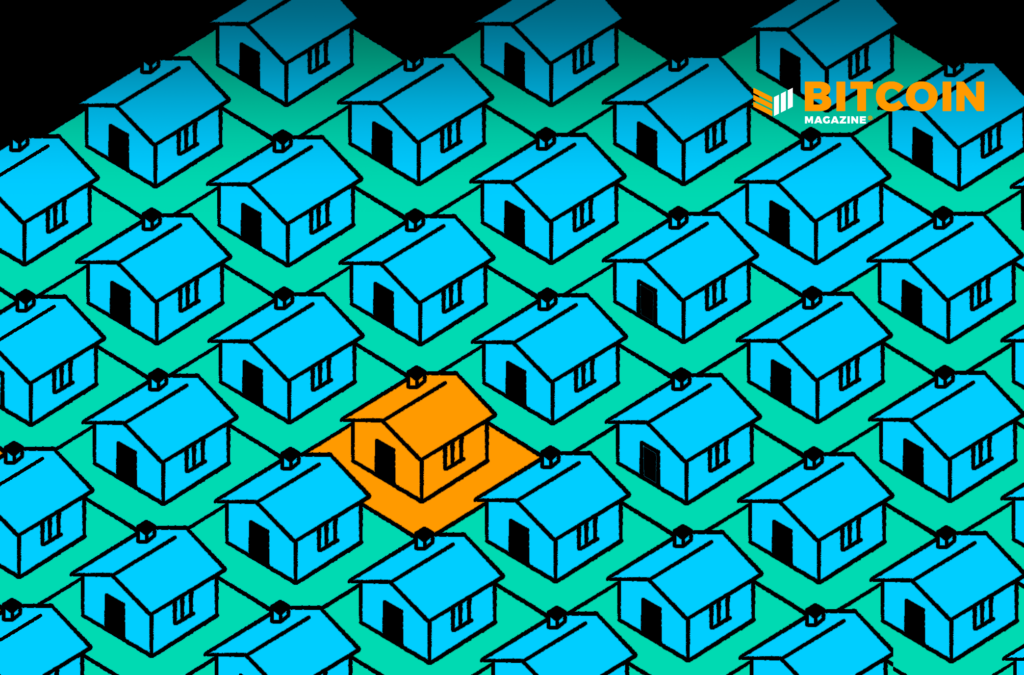
Why Bitcoin Is Digital Real Estate
The properties of bitcoin reflect many of real estate’s value offers on top of fundamentally more secure custody.
I'm working on a newsletter that will dismantle the "Bitcoin has no cash-flow" narrative. Coming ‘end of this month! If you would like to sign up for my monthly newsletter 👇.
#bitcoin #realestate #housing
https://leonawankum.substack.com/
Bitcoin is changing the investment landscape. Suddenly it's good for a company to be profitable so they can buy more bitcoin. Instead of just speculating on more growth and collected capital.
As a store of value, bitcoin has the capabilities of a house without the liabilities.
“There is no amount of money that can buy back your health once it has been severely disrupted.”— @The Conscious Contrarian
Very true! Living a lifestyle with low time preference doesn't come easy to me, no matter how much I like to talk about it :)


The perils of hustle porn
Hustling has a great reputation in our society.
It was brought to my attention that Bitcoin’s indestructibility makes it a more resilient SoV. Not a better one. Resiliency is just one feature. That's correct.
But resilience is very important in an unstable world where wealth has always been destroyed and is therefore a very important feature of an SOV. View quoted note →
Controlling the Bitcoin network would cost an attacker approx. $7.9 billion in equipment and around $2,000,0000 in energy costs per hour.
Destroying a #house is much easier.
It is obvious which is the better store of value.
The cost of the equipment ($7.9 billion) is based on a calculation that suggests the three largest pools together account for 66.87% of the network hashrate (in June 2023), a whopping 242.42 EH/s (242 million TH/ s).
An attacker would therefore need more power.
To achieve this, the attacker would need more than 941,634 S19 XP Hydros - which would mean a fixed cost of almost $7.9 billion, plus a building to house the equipment, maintenance staff, electricity and cooling etc.
The cost of the hashrate is based on an extremely simplified and unrealistic cost modeling based on the price of the SHA256 hashrate on nicehash (inspired by @Daniel aka Bitcoin Gandalf).
If someone tried to buy this much hashrate, the would rise massively, making it more costly.
In the process of writing my book, 'Digital Real Estate,' I find myself in search of comprehensive statistical analyses that accurately determine the portion of a property's value derived from its role as a store of value.
I welcome any assistance or pointers towards resources that could shed light on that aspect of property valuation. Than you!
Along with inflation and taxation, the destruction of physical wealth has historically been one of the greatest threats to the overall prosperity of humanity.
But, most of humanity still uses physical goods to store value. This baffles me. What to do if a war breaks out?
Even in ancient times, armies ruthlessly plundered cities and stole and destroyed the residents' belongings. I came across an interesting conversation on reddit about how war loot was divided among armies in ancient Rome.(https://reddit.com/r/AskHistorians/comments/3bdppz/how_was_war_loot_split_amongst_armies_in_the/).
The destruction of housing infrastructure during the Syrian Civil War, for example, offers a stark illustration of the problems associated with storing wealth in physical assets. Over 40% of the country's #realestate stock was reportedly damaged or destroyed, along with the value stored in it, resulting in billions of dollars in economic losses. By the end of 2019, the conflict had cost Syria $530.1 billion, or 9.7 times the country's GDP in 2010. The figure covers the loss of local production, estimated at $420.9 billion. As the civil war in Syria reaches the 10 year mark, the economic cost of the conflict has risen to close to $1.2 trillion.
This scenario highlights the risks associated with physical assets in conflict zones and highlights the advantage of Bitcoin as an immutable, indestructible and mobile store of value.