Did Bitcoin mining change forever yesterday 🤔
Hey @OceanSlim l, @npub1lh273a4wpkup00stw8dzqjvvrqrfdrv2v3v4t8pynuezlfe5vjnsnaa9nk, and @npub1wnlu28xrq9gv77dkevck6ws4euej4v568rlvn66gf2c428tdrptqq3n3wr, I watched the announcement yesterday but came away with a lot of unanswered questions that I'll detail below. I would legitimately love to hear the answers to these if at all possible!
How is Ocean non-custodial for the average miner?
On the stream it was mentioned that payout thresholds are 0.0108 BTC (but @Bitcoin Mechanic was unsure), a number that would take a pleb miner with an S9 ~470d to reach.
Until he reaches that payout point, all of his mined sats seem to be entirely custodied by Ocean.
How does Ocean decentralize mining today?
I was so excited by the teases and pre-announcements for Ocean as it sounded like exactly what I wanted in a Bitcoin pool. Unfortunately, it sounds like all of the decentralization possible is yet to be release, including StratumV2 and any ability for miners to submit block templates themselves.
Did I miss anything that makes Ocean more decentralized than other pools today?
Why is Ocean not open source?
If Ocean is as revolutionary and decentralizing as it's being made out to be, wouldn't the best thing for Bitcoin be that all pools switch over time to the same mode?
If so, why isn't Ocean open-sourcing any of it's protocol or code? In the announcement it seemed that @Bitcoin Mechanic was bragging that no competitor would be able to "reproduce" their lead dev's code, thus keeping their competitive edge.
There was no mention to my knowledge of open source, but it's possible I missed it!
What guarantee do miners have that you won't censor transactions?
As miners cannot submit their own block templates right now and the source is not open code, miners have to rely on manually checking a visual block template on your site to find censorship.
@Luke Dashjr has a history of censoring what he viewed as "spam," and there was a lot of time spent in the conference talking about how bad Ordinals are and how bad pools are that mine them.
What guarantees or promises do miners have that you won't censor transactions you don't like?
How will Ocean handle regulatory pressure to enact KYC?
In the event that regulators of the Feds come knocking and want you to implement KYC (as seems to be the case with other pools), what will you do?
What will Ocean's fee model be after the 0% period?
There was a lot of talk about how most pools subsidize larger miners and charge exhorbitant fees to smaller miners during the conference. One thing that wasn't ever mentioned was what Ocean's fee policy will be after the 2mo 0% fee period.
Could you explain how the fee model will work?
Conclusion
That's enough questions for now, I think, but I look forward to getting answers to these! We have a desperate need for decentralized mining in Bitcoin and a massive gap today.
I look forward to hearing back 🙂
Seth For Privacy
sethforprivacy@primal.net
npub1tr4d...2y5g
Privacy is a human right and necessary for freedom.
- VP of Operations at Cake Wallet
- Privacy advocate
- Host of optoutpod.com, a privacy-focused podcast
Haven’t updated my relay list in a while, what are some quality relays I should be using these days?
Using this now for my Zaps on Nostr 👀 View quoted note →
DIY hackable” and only “source available” 🥲
So what dev in their right mind will write and publish code/firmware for this locked behind a restrictive, source-available license? Do they expect someone else to make actual FOSS firmware?
Someone explain this paradox to me.
“Make it anything you want, you just can’t sell or monetize it in any way, ever”
I just… how is any of this in the spirit of Bitcoin or even simply encouraging proper innovation and a flourishing of ideas.
Pretty sure this is where Coinkite realizes the “find out” part of fucking around with restrictive, “source available” licenses instead of doing the right thing and actually leaning into freedom tech.


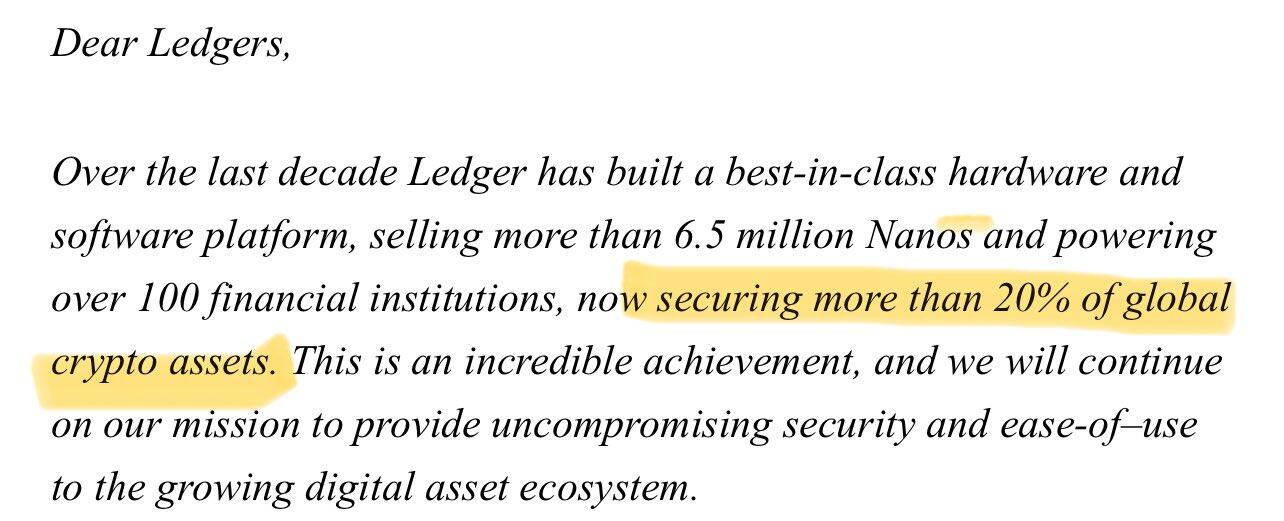
People should be terrified that Ledger can claim for marketing how much crypto their users collectively have 🙈
Is your Bitcoin part of their 20% figure? If so, get it out now. 👇 

Unfortunately, there has been a concerted effort by big tech to destroy the feasibility of privacy-preserving front-ends and open-source clients recently, including YouTube, X, and Reddit.
All three have taken steps that destroyed Invidious, Nitter, and Teddit usability.
As such I've simply taken down my instances of all three as they have been unusable for some time and have no realistic workarounds for public instances at this time. If that changes I will put them all back up, but for now it's just not possible to run public instances of any.
It's *extremely* sad to see the hard work of the contributors of these three projects destroyed by the flick of a switch by big tech companies, but is yet another reminder to stop relying on big tech and start taking social media and media itself into your own hands.
For a YouTube alternative, consider PeerTube.
For an X alternative, congrats, you're already on Nostr 👋
For a Reddit alternative, I honestly don't have a recommendation outside of some Lemmy and forum usage.
Note that both Nitter and Invidious are working hard on workarounds and fixes, but Teddit seems to be completely dead due to API monetization of Reddit. I'll try to keep updates on Nitter and Invidious status if workarounds that are feasible show up.
If you do still want to use YouTube, I highly recommend FreeTube as an open-source desktop client:
I don't touch YouTube without it since Invidious went down. You can easily import your subscriptions from YouTube and other clients like NewPipe here:
If you're on Android you should be using NewPipe, absolutely amazing FOSS client that blocks ads, allows downloads, etc.:
newpipe.net
Tips if you do need to use X on the go for some reason:
1. Use a VPN
2. Use a good browser with ad/cookie blocking
3. Use the progressive web app (simple add to home screen from Safari/Brave/etc) instead of the "proper" app
Not really any other options, sadly, but that prevents the majority of tracking!
GitHub
GitHub - FreeTubeApp/FreeTube: An Open Source YouTube app for privacy
An Open Source YouTube app for privacy. Contribute to FreeTubeApp/FreeTube development by creating an account on GitHub.
FreeTube Docs
Importing your Subscriptions
The Official Documents website for FreeTube, the Open Source YouTube client for Windows, Mac, and Linux built around privacy.
I have made a start on what I think is an excellent set of RSS feeds and will keep them up to date here as I add more:
Have some good feeds I missed? Drop them below and I’ll add those I like!

sethforprivacy.com
About
About Me My name is Seth, and I’ve started this blog to give me a space for longer-form analysis, thought, and content.
My aim overall is to educ...
Let's put to bed the myth perpetuated by Coinkite employees that COLDCARD is in any way open-source today.
Open-source has a clear and globally recognized definition, and being open-source *matters*.
How it started:
How it's going:
DISCLAIMER: Obviously I work for Foundation, a competitor to COLDCARD, but the views I lay out here were already true before joining Foundation.
I would be just as happy if this led to zero sales of Passport but got the truth out there.
Freedom and integrity matter.
For background, COLDCARD was started as a free and open-source project that forked some of Trezor's code base way back in the day, and inherited the copy-left GPL licensing from Trezor:

Copy-left licenses like GPL are a fantastic tool to ensure that your code and any derivative products others make using any part of it *must* remain open-source no matter what. No one can take your code and build a closed-source product.
GPL = good.
In 2020, a small team of 4 founders who loved the open-source movement and wanted to build a more approachable and easy to use HWW started Foundation, and leveraged some of the code from COLDCARD's open-source repos, specifically around PSBT signing.
This was *100%* above board, compliant, and within the spirit of both open-source and the specific licenses on COLDCARD's codebase, those being GPL.
Foundation gave clear and generous credit and committed to always keeping the code open-source:
When NVK realized that the open-source ethos allows for competitors to use parts of your code base and build better products (i.e. compete in a free market), he decided that he would rather build a legal moat and move to a "source-verifiable" license:
This move meant that COLDCARD was no longer open-source, and was instead merely available for download and viewing. While people could come along and contribute code as they saw fit, they could never build or sell *any* product using COLDCARD code, even if kept open-source.
How do I know this is what the MIT-CC (or "Commons Clause") license now used by COLDCARD means?
Because the website for the license created by the original authors of the license spells it out in plain text:

MIT-CC is an interesting license on its own right, and isn't evil or anything, but it is certainly not within the realm of open-source in any way.
It is a clear departure from the definition of open-source that is globally recognized:
Why does all this matter? First, it's important that companies in the Bitcoin space honestly and openly discuss their approach.
If Coinkite doesn't hold a core ethos with the open-source movement, they are able to do so *but users/customers must understand the implications*
Obviously I believe in freedom and Coinkite are free to do what they want with their software, but their stance is antithetical to the open-source movement and is made more clear by the day.
Not only do they prevent the free use of their software, they actively go out of their way to harass and attack others who do the same thing they did - use open-source code and build something awesome out of it.
In the image above, NVK attacks an open-source contributor (who also works at Foundation) for using his free time to help the Monero community with forking Foundation code and creating something they want from it.
AKA the entire purpose of FOSS being mocked and insulted.
Why does open-source matter?
When a project is open-source, it means that not only do they share a freedom-focused ethos with you, but it also incentivizes other developers and companies in the space to build on their work.
More eyes on the code and devs building around a codebase means more secure code, a better and flourishing ecosystem, and far better verification that the code actually does what it's supposed to do.
It also means that if the company producing the software goes under, someone can jump in and pick up where they left off.
If Foundation had to shut down for some reason, any one of you could start a new HWW company from our code and open-source schematics and we'd applaud.
Open-source also means that companies are forced to compete by prioritizing users needs, not building products locked behind laws or lawyers that don't have to keep up with the times.
More competition in a free market means you, the customer, wins.
When code is *not* open-source, it means that there is no core incentive for others outside of the company building the product to review the code, build around it, or contribute to it.
As no one could ever create something they can sell with it, why build around it?
When code is *not* open-source, it also means that the contribution made, even though technically visible, can never help to grow the broader ecosystem and benefit the whole of the Bitcoin space.
It builds monopolies, not free markets.
Bitcoin is about freedom, and Satoshi's decision to use permissive open-source licenses was intentional and fitting with his attempts to build an open and inclusive monetary network.
Open-source is the reason Bitcoin has flourished and so many amazing tools have been built.
While everyone within Bitcoin is free to choose the licenses they want for their projects, if they choose source-verifiable or closed-source they must be up front and honest about it, and users must understand the massive tradeoffs involved.
The information in this thread is all readily visible and I've linked to it all directly, so please feel free to do your own research and confirm my claims independently.
You absolutely should DYOR in situations like this.
Please note that @NVK has not replied to any of the claims made here and has instead chosen to block me, so I am unable to interact with any of his tweets.
I have no doubt he's subtweeting about this but be aware I have no way to respond to him or his personal attacks now.
Since sharing this on Twitter he has so far called me a "spook", a "white knight", a "FOSS commie", a "bitch", and a "grifter" in the span of 12h all while blocking me.
TIL FOSS is just "commie zealotry" 🙃

How it's going:
DISCLAIMER: Obviously I work for Foundation, a competitor to COLDCARD, but the views I lay out here were already true before joining Foundation.
I would be just as happy if this led to zero sales of Passport but got the truth out there.
Freedom and integrity matter.
For background, COLDCARD was started as a free and open-source project that forked some of Trezor's code base way back in the day, and inherited the copy-left GPL licensing from Trezor:
GitHub
trezor-firmware/LICENSE.md at main · trezor/trezor-firmware
:lock: Trezor Firmware Monorepo. Contribute to trezor/trezor-firmware development by creating an account on GitHub.
The GNU General Public License v3.0
- GNU Project - Free Software Foundation
GitHub
firmware/COPYING-CC at master · Coldcard/firmware
❄️ Firmware and simulator for Coldcard Hardware Wallet - Coldcard/firmware

Commons Clause License
MIT-CC is an interesting license on its own right, and isn't evil or anything, but it is certainly not within the realm of open-source in any way.
It is a clear departure from the definition of open-source that is globally recognized:
Open Source Initiative
The Open Source Definition - Open Source Initiative
Introduction Open source doesn’t just mean access to the source code. The distribution terms of open source software must comply with the fol...
In the image above, NVK attacks an open-source contributor (who also works at Foundation) for using his free time to help the Monero community with forking Foundation code and creating something they want from it.
AKA the entire purpose of FOSS being mocked and insulted.
Why does open-source matter?
When a project is open-source, it means that not only do they share a freedom-focused ethos with you, but it also incentivizes other developers and companies in the space to build on their work.
More eyes on the code and devs building around a codebase means more secure code, a better and flourishing ecosystem, and far better verification that the code actually does what it's supposed to do.
It also means that if the company producing the software goes under, someone can jump in and pick up where they left off.
If Foundation had to shut down for some reason, any one of you could start a new HWW company from our code and open-source schematics and we'd applaud.
Open-source also means that companies are forced to compete by prioritizing users needs, not building products locked behind laws or lawyers that don't have to keep up with the times.
More competition in a free market means you, the customer, wins.
When code is *not* open-source, it means that there is no core incentive for others outside of the company building the product to review the code, build around it, or contribute to it.
As no one could ever create something they can sell with it, why build around it?
When code is *not* open-source, it also means that the contribution made, even though technically visible, can never help to grow the broader ecosystem and benefit the whole of the Bitcoin space.
It builds monopolies, not free markets.
Bitcoin is about freedom, and Satoshi's decision to use permissive open-source licenses was intentional and fitting with his attempts to build an open and inclusive monetary network.
Open-source is the reason Bitcoin has flourished and so many amazing tools have been built.
While everyone within Bitcoin is free to choose the licenses they want for their projects, if they choose source-verifiable or closed-source they must be up front and honest about it, and users must understand the massive tradeoffs involved.
The information in this thread is all readily visible and I've linked to it all directly, so please feel free to do your own research and confirm my claims independently.
You absolutely should DYOR in situations like this.
Please note that @NVK has not replied to any of the claims made here and has instead chosen to block me, so I am unable to interact with any of his tweets.
I have no doubt he's subtweeting about this but be aware I have no way to respond to him or his personal attacks now.
Since sharing this on Twitter he has so far called me a "spook", a "white knight", a "FOSS commie", a "bitch", and a "grifter" in the span of 12h all while blocking me.
TIL FOSS is just "commie zealotry" 🙃

Somehow it's already Sunday, and thus time for #SkepticismSundays 🤔
The goal of this thread (which I'll post weekly on Sunday's) is for discussing the uncertainties, shortcomings, and concerns some may have about Bitcoin.
NOT the positive aspects of it.
Discussing things with a critical thinking approach and level-headed discussion helps us learn where Bitcoin and it's community can improve and go from there. We had a *fantastic* amount of good conversations last week so I can't wait to see this week's!
What's gotten you thinking, has you concerned, or always irked you about Bitcoin, its ecosystem, etc. this week?
Think I've got non-custodial fully self-hosted Zaps working 👀
Can anyone Zap a sat to test Zaps to BTCPay Server??