*Praxeozoology*
/ˌpræk.si.oʊ.zoʊˈɑː.lə.dʒi/
Noun.
1. An extension of praxeology (the logic of human action) that explicitly incorporates animal spirits, our evolved impulses such as fear, status-seeking, optimism/pessimism, and desire into means–to-ends analysis. It treats emotions and instincts as primary inputs advising choices, expectations, and market coordination under uncertainty. Let's dive in.
Have you ever wondered what really drives human behavior? Are we creatures of reason, calmly weighing our choices in pursuit of optimal outcomes, or are we animals first, propelled by instinct and emotion beneath our polished rationality?
A bit of both.
To explore this, we need a new perspective. One that connects the clean logic of economics with the raw impulses of biology. Welcome to Praxeozoology: the study of human action through the combined lenses of praxeology and zoology.
But before diving into this peculiar fusion of fields, we should start, not with Adam Smith, as tradition might suggest, but with a lesser-known economic philosopher who beat him to the punch.
In 1765—eleven years before The Wealth of Nations—Finnish priest and politician Anders Chydenius published The National Gain. In it, he described how individuals acting in their self-interest could unknowingly contribute to the prosperity of society. This was the original formulation of what would later be immortalized as the “invisible hand.”
“... that every individual spontaneously tries to find the place and the trade in which he can best increase National gain, if laws do not prevent him from doing so.”
—Anders Chydenius, The National Gain
Chydenius saw freedom of trade and expression not just as moral imperatives, but as natural extensions of human nature. He wanted to leave people to their own devices, and let good emerge as a—sometimes unintended—consequence.
It was a proto-praxeozoological view that recognized human economic behavior as both rational and instinctive, deeply rooted in our animal nature.
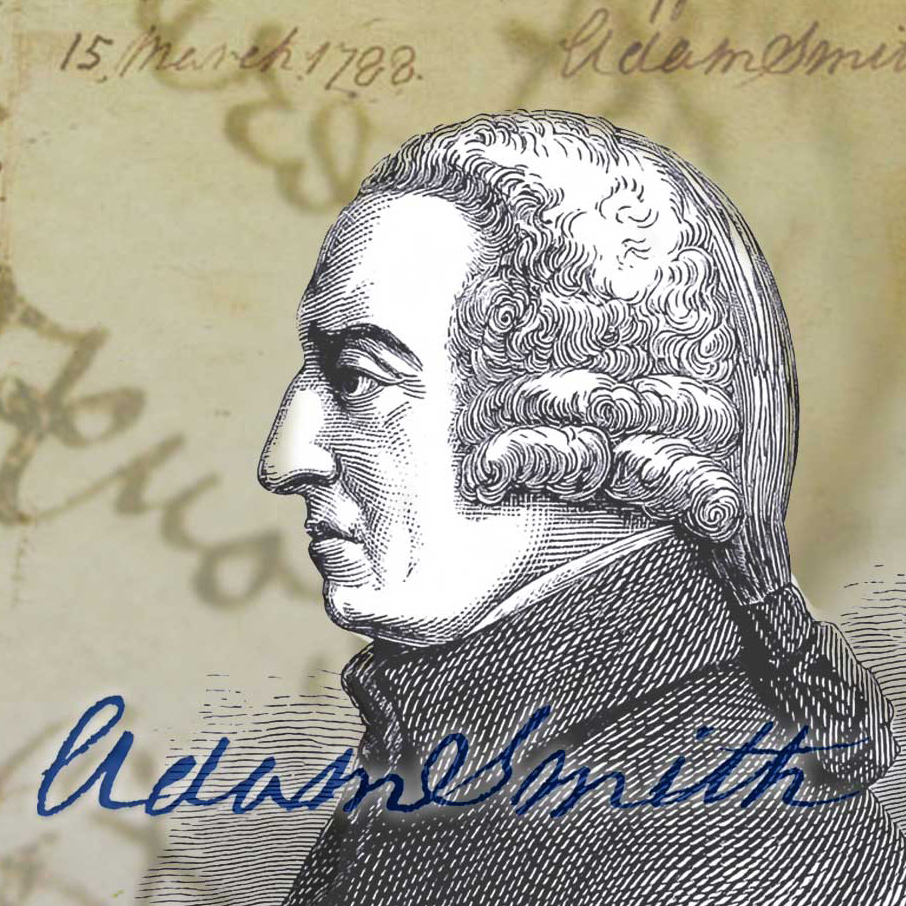
*Adam Smith and Rational Self-Interest*
Adam Smith refined this idea into the elegant theory of market equilibrium, the concept that individuals pursuing self-interest in competitive markets create benefits for the whole economy.
“It is not from the benevolence of the butcher, the brewer, or the baker, that we expect our dinner, but from their regard to their own interest.”
—Adam Smith, The Wealth of Nations
Smith emphasized rational self-interest, but even he was aware of its limits. His lesser-cited work, The Theory of Moral Sentiments, explores the emotional foundations of our ethical judgments, revealing that economic man was never entirely rational to begin with.
“Man naturally desires, not only to be loved, but to be lovely.”
—Adam Smith, The Theory of Moral Sentiments
Where Smith provided the intellectual foundation of praxeology, he also hinted at the animal impulses that complicate it.
*Introducing Praxeozoology*
Praxeozoology is a thought experiment-a hybrid theory. It accepts that
☑️ humans act purposefully to achieve chosen ends,
☑️ but also that we possess animal instincts honed over millions of years of evolution.
It accepts and embraces that every market decision is a negotiation between our inner beast and our calculating mind.
This framework leaves space to emotion, intuition, status-seeking, fear, and pleasure, not as irrational anomalies, but as foundational inputs to economic action.
*Nash Equilibrium: Structural Self-Interest*
Let’s journey forward to the 20th century to meet John Nash, who provides a mathematical framework to understand how competing interests can reach a balance. The Nash Equilibrium is a state in which no actor has anything to gain by changing their strategy alone, given the strategies of others.
Nash proved that complex, even selfish behaviors can lead to stable systems in which cooperation and competition coexist. It’s a beautiful realization: we don’t need perfect rationality for coherent outcomes-just consistent patterns of behavior.
“An equilibrium point is an n-tuple s such that each player’s mixed strategy maximizes his payoff if the strategies of the others are held fixed. Thus each player’s strategy is optimal against those of the others.”
—John Nash, Non-cooperative Games
This fits neatly within praxeozoology. Nash doesn’t ignore animalistic behavior either. He demonstrates how human action, through the taming of our animal spirits, evolves into systems, expectations, and societal norms.
*Rothbard and the Action Principle*
For the Austrian School, Murray Rothbard extended Ludwig von Mises’ ideas into a comprehensive theory of human action. Praxeology, in this tradition, views all economic behavior as intentional, purposeful, and deeply personal.
Rothbard’s brilliance lies in defending subjectivity. He didn’t claim humans always act rationally, only that they act according to their values, even if those values seem strange or contradictory from the outside.
As well as instinctually, we know this to be true empirically: acting like an asshat bears a real cost. What is human interaction if not trading something of value for other, even more valuable things? Praxeozoologically speaking, modifying and compartmentalizing our behavior to best respond to the game afoot.
“Selection will discriminate against the cheater if cheating has later adverse effects on his life which outweigh the benefit of not reciprocating.”
—Robert L. Trivers, The Evolution of Reciprocal Altruism (1971)
To deny our (albeit tamed) animal spirits is to discard what made humans the apex predator in the first place: the ability to empathize with irrational actors and adjust our behavior accordingly. Politics, essentially.
Your desire for fame, your fear of missing out, and your desire to be lovely are not glitches but survival heuristics from your inner animal.
*Keynes and the Return of the Beast*
Where the Austrians emphasized individual calculation, John Maynard Keynes emphasized emotion, uncertainty, and confidence. He coined the now-famous term “animal spirits” to describe the primal urges that drive economic decisions, particularly in uncertain situations.
From investor euphoria to consumer panic, Keynes saw that instinct often overwhelms reason, especially in volatile times. His insight helps explain bubbles, manias, crashes, and why purely rational models fail to predict them.
Praxeozoology adopts Keynes' concept of animal spirits, but not as a catch-all explanation for anything difficult to explain. Where Keynes used “animal spirits” to get away with economic-theoretical murder, praxeozoology treats the economy not as a machine, but as an ecosystem of creatures striving to survive, signal, mate, and avoid shame. A system that is impossible to accurately predict or control. The pretense of such ability is the cardinal sin of modern economic theory.
“Even apart from the instability due to speculation, there is the instability due to the characteristic of human nature that a large proportion of our positive activities depend on spontaneous optimism rather than on a mathematical expectation, whether moral or hedonistic or economic. Most, probably, of our decisions to do something positive… can only be taken as a result of animal spirits-a spontaneous urge to action rather than inaction, and not as the outcome of a weighted average of quantitative benefits multiplied by quantitative probabilities.”
—John Maynard Keynes, The General Theory of Employment, Interest and Money
*Hayek and Subjective Value*
To fence in our theoretical zoo, F.A. Hayek brings in the insight that value is never objective. It’s personal, contextual, and constantly changing.
Hayek argued that prices are a communication system—signals passed through the noise of time, place, and ignorance. However, this also means that those signals are interpreted and garbled by deeply flawed, emotional, and instinctive creatures.
Through praxeozoology, Hayek’s insight becomes even more powerful. Markets don’t merely reflect supply and demand-they reflect fear, lust, pride, nostalgia, and pain.
Prices are stories of our conquest to tame our animal spirits in pursuit of better individual outcomes.
*The Rational Animal, Still an Animal*
Praxeozoology isn’t a rejection of praxeology or rational economics-it’s an expansion of them. It reminds us that we are neither angels nor computers, but animals who act. We evolved to survive, signal, and navigate uncertainty, not to be perfectly consistent or purely logical.
By weaving together the timeless insights of Chydenius, Smith, Nash, Mises, Rothbard, Trivers, Keynes, Hayek, and many others, we begin to see a more complete picture of human behavior. One that is layered, intuitive, emotional, and most importantly, alive.
So the next time you find yourself making a “rational” choice, consider that your inner animal may just be rationalizing its appetite.

 Resources:


 https://t.co/8FhXnBZhoL
https://t.co/ka0VEzjxFb
https://mises.org/library/book/man-economy-and-state-power-and-market
https://t.co/tmoZN6Yj73
https://t.co/8FhXnBZhoL
https://t.co/ka0VEzjxFb
https://mises.org/library/book/man-economy-and-state-power-and-market
https://t.co/tmoZN6Yj73
Internet Archive
The Wealth Of Nations : Adam Smith : Free Download, Borrow, and Streaming : Internet Archive
Book Source: Digital Library of India Item 2015.207956dc.contributor.author: Adam Smithdc.date.accessioned: 2015-07-09T15:29:03Zdc.date.available:...
Chydenius
Kansallinen voitto | Chydenius
[:fi] Alkuperäinen dokumentti: Anders Chydeniuksen painettu kirjoitus Den Nationnale Winsten, Wördsamast öfwerlemnad Til Riksens H&o...
Chapter II | Adam Smith Works
Of the love of Praise, and of that of Praise-worthiness; and of the dread of blame, and of that of Blame-worthiness
The General Theory of Employment, Interest and Money by John Maynard Keynes