Amboss's avatar
Amboss
_@amboss.space
npub19tcp...nlea
Intelligent Payments for High-Volume Digital Economies. Built on Bitcoin. #lightningnetwork #bitcoin #amboss
Amboss's avatar
Amboss 12 hours ago
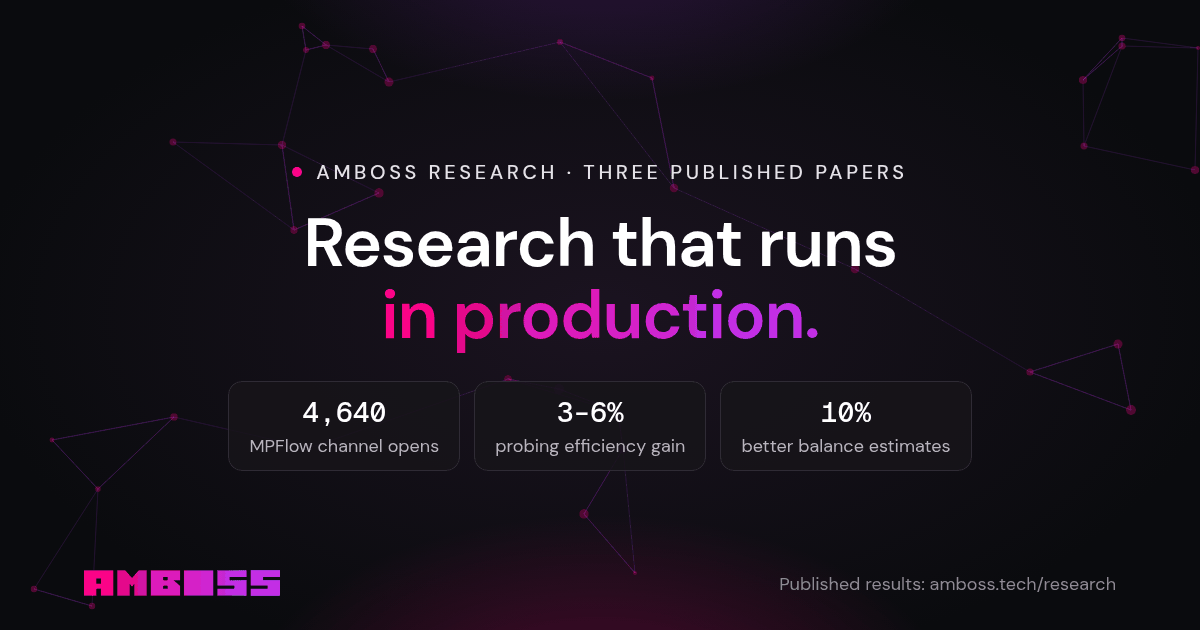
What happens when Lightning research leaves the paper and runs on live nodes? Amboss has published three machine learning papers on routing and liquidity. Two of them already run in production, and the work behind them has allocated over $16 million of liquidity across managed nodes. Each paper targets a reason payments fail or take a longer path: where to place liquidity, how to probe a hidden balance with fewer tries, and how to estimate a channel's split from public data alone. For a payments team, that is the test that matters. Research earns its place when it improves first-try success on the live network. Three papers. Two in production. Over $16 million of liquidity placed. Plain-English summary of all three: image
Amboss's avatar
Amboss yesterday
Lightning Network, week of 9 to 15 November: node operators committed 603 BTC to new public channels, 14% more than the week before. They opened fewer channels, 1,396 against 1,473, but each one was larger. The average new channel held 0.43 BTC, up from 0.36 BTC. So the growth came from size, not count. More bitcoin went into each new channel. Closes also settled back after 8 November, when 1,549 channels were force-closed in a single day. This week forced closes fell from 1,723 to 357, and 78.9% of all closes were cooperative, up from 47.6%. Monday 9 November still saw 201 forced closes; from Tuesday to Sunday the cooperative share was 88.5%, against 86.1% across October. Public capacity held at 3,238 BTC on 15 November. Last week, small channels closed. This week, larger ones opened: 603 BTC committed at 0.43 BTC each. Live channel, capacity and node charts: image
Amboss's avatar
Amboss yesterday
Add Lightning to Zaprite in minutes with the Amboss self-custody connector. It’s live now for all Zaprite users. Connect Amboss with an API key, pick the Amboss wallet that receives funds, and turn it on for your Zaprite checkouts. Customers pay from Cash App or any Lightning wallet, and you receive the payment as bitcoin or USDT (your choice). You keep Zaprite for invoices, payment links and billing. Funds settle to your own wallet, and Amboss never holds them. No volatility or channel management required.
Amboss's avatar
Amboss 2 days ago
Picture an affiliate waiting on month-end. The revenue share is earned, but the wire has not left, reconciliation is still open, and support keeps asking when the money lands. Many partner programs still work that way: one monthly bank transfer for creators, resellers and affiliates. The same Amboss API that accepts payments also sends them. One send call pays anyone with a Lightning Address or an invoice, at any hour. Daily revenue-share settlement becomes practical, not only a monthly batch. Partners get paid from your own wallet, in the app they already use. Amboss never takes custody, and completed payments are final. How payouts fit next to the cashier: image
Amboss's avatar
Amboss 3 days ago
Which app will your customer pay with? You do not have to choose. Cash App, Coinbase, Kraken, Binance and Strike can all pay a Lightning invoice. One invoice format works across them. The customer scans or taps and pays from their own app, and your system gets a confirmation through the API. Supported assets and availability vary by app and region. Amboss Payments is available almost everywhere, except in OFAC-restricted places. If your customers already hold one of these apps, they can pay you today. Compatible wallets: image
Amboss's avatar
Amboss 4 days ago
A Lightning channel holds 1 BTC between two nodes. Anyone can see the total. Nobody outside can see how it is split between the two sides. What is your best guess? A common default is half and half. Our researchers trained machine learning models to predict that split from public node and channel features alone. The models beat the equal-split guess by 10%. Better balance estimates mean fewer failed attempts when a payment looks for a route. The paper: image
Amboss's avatar
Amboss 5 days ago
A card payment and a Lightning payment can both clear in seconds. Only one of them can still be reversed by a dispute weeks or months later, after the goods have shipped or the credit has been used. A Lightning payment is final once it completes. There are no card chargebacks on Bitcoin and stablecoin payments through Amboss. Customers still need refunds sometimes. A refund is simply a new payment that you send, under your own policy, instead of a dispute process run by someone else. Both clear in seconds. Only one stays paid. Payments that stay paid: image
Amboss's avatar
Amboss 6 days ago
A bitcoin yield product that does not lend your bitcoin to anyone. That is the design rule behind Rails. Rails runs your own self-custody Lightning node. Any yield comes from routing fees and liquidity leases, not from lending, and there is no rehypothecation. It needs real payment volume to work. Returns are not guaranteed. Node operation, changes in the fee market and the bitcoin price all carry risk. If that model fits your treasury, read the details before you deploy. Rails: image
Amboss's avatar
Amboss 1 week ago
Binary search always splits the range in half. That is a fine guess when you know nothing, but Lightning nodes probing a channel's hidden balance usually know something. Splitting where the balance probably is makes probing 3 to 6% more efficient in production. Our researchers built Bayesian Binary Search: it learns where balances are likely to sit, then splits the range where the probability is, not at the midpoint. The paper was published in the peer-reviewed journal Algorithms (MDPI, 2025), in collaboration with Stillmark. It runs in production at Amboss today. The plain-English overview and the paper are in the reply. Overview and paper: image
Amboss's avatar
Amboss 1 week ago
Lightning Network, week of 2 to 8 November: public capacity held at 3,235 BTC, only 0.3% below the week before, and the average public channel grew 1.5% to 0.098 BTC. That held through the busiest day of forced closes in three years. On 8 November, 1,549 public channels were force-closed, more than double the previous one-day high of 687 on 24 October 2024. They were small: together they held 1.46 BTC, about 94,000 sats each. Losing them barely moved total capacity, and it raised the average size of the channels that remain. The rest of the week looked like October. From Monday to Saturday, 86.2% of closes were cooperative, against 86.1% across October, and node operators opened 1,473 new channels over the seven days. 1.46 BTC force-closed in one day, against 3,235 BTC of public capacity that stayed in place. The weekly charts, including channel and node counts: image
Amboss's avatar
Amboss 1 week ago
Announcing Hosted Checkout for Amboss Payments! ⚡ Payment cards are more exclusive than ever. Now any business can get paid from anywhere on the globe. Customers pay with Cash App or any Lightning wallet. You receive bitcoin or USDT. Your brand. Our tech. Your name, logo and color, light or dark. No chargebacks. Every payment is final. Live today. Test it in sandbox:
Amboss's avatar
Amboss 1 week ago
The first question a finance team asks about Bitcoin payments is about price swings. It is a fair question, and the answer is that you do not have to hold bitcoin at all. Bitcoin is the transport. With optional auto-conversion, payments that arrive over Lightning can settle to you as US-dollar stablecoins instead. Invoices are for a fixed amount. The payer covers routing and conversion fees, so the amount you invoice is the amount you receive. Customers pay with the app they already have. Your balance sheet can stay in dollars. How it works: image
Amboss's avatar
Amboss 1 week ago
An AI agent asked a weather service for the Orlando forecast. The service answered "402 Payment Required" with a price. The agent paid less than a cent over Lightning and had its forecast about a second later. No card, no account, no human approval. The proof of payment became the access key. That pattern is L402, and this run used Amboss with Lightning Enable, once in bitcoin and once from a dollar stablecoin balance. Amboss is the payment rail for agent protocols like L402, x402 and MPP. Amazap, a marketplace where AI agents pay per API call, is one example of the model in use. Request, price, payment, proof, data. The case study: image
Amboss's avatar
Amboss 1 week ago
In June 2022 the average public Lightning channel held 0.048 BTC. On 1 November 2026 it held 0.097 BTC, about twice as much. There are fewer public channels than in 2022, but each one is larger. A larger channel can carry a larger payment along a single route, which matters once real business amounts start to move. The figure is public capacity divided by active channels, from the Amboss Space daily series. 0.048 BTC then, 0.097 BTC now. Live network charts: image
Amboss's avatar
Amboss 1 week ago
Node operators bought 17.38 BTC of Lightning liquidity on Magma in October. In October 2025 the figure was 10.48 BTC. That is 66% more in a year. The chart shows every month in between, so you can see the path, not just the two end points. Magma is the Amboss marketplace for inbound liquidity: a seller opens a channel to your node for a fee agreed up front. Across all orders so far, the average price has been 4.42% a year. Want to receive payments on your own node without asking peers one by one? Magma is built for that. Magma: image
Amboss's avatar
Amboss 1 week ago
Picture a merchant taking $1 million a month in card payments with a 10% rolling reserve held for 180 days. Once the reserve fills, about $600,000 of its own revenue is held back at any time. These numbers are illustrative, not from any one processor. The point is the arithmetic: while a rolling reserve is held, the money is earned, yet it cannot be spent. Bitcoin and stablecoin payments through Amboss settle to your own wallet in seconds, with no rolling reserve. With optional auto-conversion, the balance can stay in US-dollar stablecoins. If six months of reserves came back to your balance sheet, where would your team put them first? How Amboss Payments works: image
Amboss's avatar
Amboss 2 weeks ago
Give a Lightning node a fixed budget. Which channels should it open so that the most payments can flow through it? Our research model, MPFlow, has made 4,640 of those channel-open decisions in production, placing 267.3 BTC across 30 managed nodes. MPFlow treats the question as a machine learning problem. It learns which new channels raise max-flow, a measure of how much value can move between two points in the network. In training, the biggest hubs were taken out, so the model had to learn good placement, not just "connect to the hubs". It now powers peer recommendations at Amboss. Better placement means more payments find a route the first time. The paper and a plain-English summary: image
Amboss's avatar
Amboss 2 weeks ago
Lightning Network, week of 26 October to 1 November: 1,567 public channels were opened, 7% more than the week before. The average new channel held 0.45 BTC. October as a whole: 6,892 channels opened with 3,102 BTC between them, an average of 0.45 BTC each. That is the largest monthly average of 2026, up from 0.28 BTC in March. Closes were cleaner as well. 86.1% of October's channel closes were cooperative, the highest share of any month this year. A cooperative close avoids the waiting period and extra on-chain cost of a forced close. 0.45 BTC per new channel, and 86 in every 100 October closes agreed by both sides. The full weekly table, including public capacity and node counts: image
Amboss's avatar
Amboss 2 weeks ago
On 1 April 2026, Visa lowered the dispute ratio that marks a merchant as "excessive" from 2.2% to 1.5% in the US, EU, Canada and Asia Pacific. Above it, each counted fraud report or dispute carries an $8 fee. The rule applies once a merchant has more than 1,500 fraud reports and disputes in a month. For high-volume, high-risk merchants such as iGaming operators, that line can sit close, and the fee comes on top of the reversed payment. Lightning payments work differently. A completed payment is final, so there are no card chargebacks to count. When a customer needs a refund, you send a new payment under your own policy. Amboss adds Bitcoin and stablecoin payments to the cashier you already run, next to cards. How it works for iGaming operators: image
↑