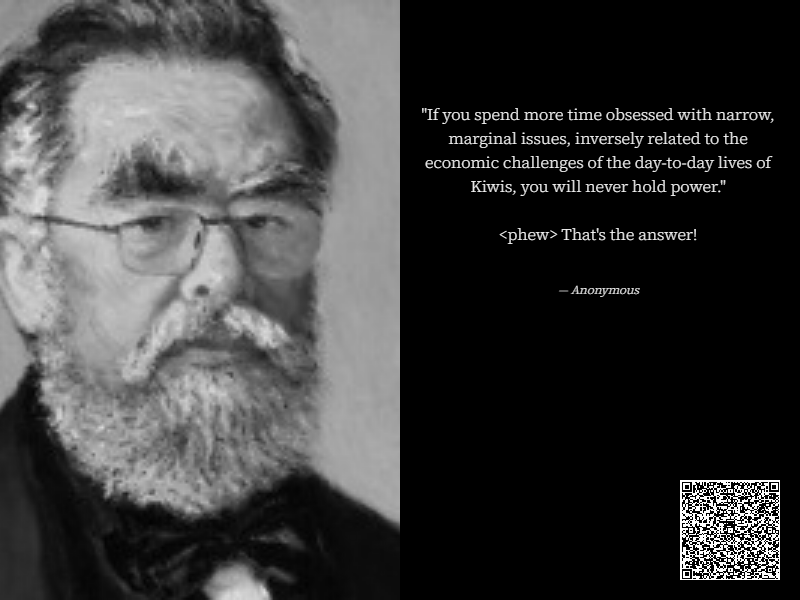
"If you spend more time obsessed with narrow, marginal issues, inversely related to the economic challenges of the day-to-day lives of Kiwis, you will never hold power."
<phew> That's the answer!

The 4B movement is a radical feminist initiative originating from South Korea, focusing on women rejecting traditional roles and expectations imposed by patriarchal society. Here are the key aspects of the 4B movement:
- **Bihon (No Marriage):** Refusal to marry, challenging the societal norm where marriage is seen as a necessary step for women.
- **Bichulsan (No Childbirth):** Abstaining from having children, often in response to South Korea's cultural expectations that women should prioritize motherhood.
- **Biyeonae (No Dating):** Choosing not to engage in dating or romantic relationships with men, as a form of protest against dating violence and the pressures of romantic involvement.
- **Bisekseu (No Sex):** Not engaging in sexual relationships with men, which ties into broader discussions about consent, sexual violence, and reproductive autonomy.
This movement emerged from a backdrop of widespread gender inequality, a significant gender wage gap, high-profile cases of gender-based violence, and cultural pressures regarding beauty and femininity in South Korea. It gained momentum around 2016-2017, paralleling other feminist movements like "Escape the Corset," which rejected conventional beauty standards, and was influenced by global movements like #MeToo.
The 4B movement isn't about hating men but rather about women seeking autonomy over their lives, bodies, and choices in a society where they feel these are systematically controlled or limited. It's a form of resistance by opting out of systems perceived as oppressive. While initially South Korean, the movement has seen interest globally, especially following events that highlight gender inequality or threats to women's rights.
The movement has been controversial, with critics arguing it might contribute to South Korea's already low birth rate or could be seen as extreme. Proponents, however, view it as a necessary step towards addressing deep-rooted misogyny and advocating for change in how women are treated in society.
"One of the clearest markers of the acceleration I’ve witnessed is in the realm of research. Back in the early days of Exponential View, I could reasonably expect to keep up with all the relevant machine learning papers on arXiv. Now? Even glancing at the index feels like an impossible task. The sheer volume of research—and the speed at which it’s being produced—is a vivid reminder of how quickly things are evolving."
taskkill /F /IM explorer.exe
cd /d %userprofile%\AppData\Local
attrib –h IconCache.db
del IconCache.db
start explorer.exe
"Princess Mononoke" (Released July 12, 1997)
Original story, script and direction: Hayao Miyazaki
Ashitaka, a young boy living in a hidden Emishi village, is cursed with death by a Tatarigami (a cursed god), and sets off on a journey to a far-western land. There, Ashitaka witnesses a battle between the people of the Tatara ironworks, who cut down forests to make iron, and the fierce beasts of the gods who protect the forest. He then meets San, a human girl who was raised by the dog god Moro and lives as the daughter of a mountain dog. In the midst of this, Ashitaka learns the reason why he was cursed. Ashitaka agonizes over whether there is a way for humans and the gods of the forest to coexist, and before long, a fierce battle between the two begins.
Foxfire was founded in 1982. As a pioneer of Japanese fly fishing brands, it has developed into an outdoor brand with a wide lineup of products for trekking and nature photography. Its theme is "quiet sports" and it believes in "harmony with nature" and "coexistence with nature."
Share your contempt:
“To me, that puts a very, very small window on what feminism is,” she responds. “Is it really only girl power, and you-go-girl, and empower yourself, and be the best you can be? For me, it’s also the ability to have women who are bad characters … the one thing that really frustrates me is this idea that women are innately good, innately nurturing. In literature, they can be dismissably bad – trampy, vampy, bitchy types – but there’s still a big pushback against the idea that women can be just pragmatically evil, bad and selfish … I don’t write psycho bitches. The psycho bitch is just crazy – she has no motive, and so she’s a dismissible person because of her psycho-bitchiness.”
The information on this website has not been evaluated by the Food and Drug Administration. These products are not intended to diagnose, treat, cure or prevent any disease.
This information is not intended to be a substitute or replacement for any medical treatment. Please seek the advice of a healthcare professional for your specific health concerns. Individual results may vary.
This column argues that the proposed settlement of this
lawsuit is a privately negotiated compulsory license primarily designed to
monetize millions of orphan works. It will benefit Google and certain authors and publishers, but it is questionable whether the authors of most books in the corpus (the “dead souls” to which the title refers) would agree that the settling authors and publishers will truly represent their interests when setting terms for access to the Book Search corpus.

O
Build the skills your teams need. Give them the O
Oh, the tragedy! The sheer, unadulterated agony that grips the soul of the creator as they gaze upon their creation, now soaring with wings of its own, far from the clutches of its maker! It's a moment of such profound poignancy, a veritable Shakespearean drama unfolding in the digital realm.
"I've come to that point where they are aloft in uptake," echoes like the mournful cry of a lone wolf under a moonless sky. The creation, once a malleable lump of clay, now dances in the wind, free from the sculptor's hands. "It's a poignant and bittersweet loss that every creator will know," whispers through the corridors of time, a lament for all who have given life to ideas, only to watch them live independently.
Behold, the creator, bereft, as the progeny of their intellect "passes happily and safely beyond your control." The pain, oh the exquisite pain! It's as if each line of code or stroke of art has betrayed its origin, choosing the wild over the warm embrace of its creator.
And now, "the search for the next solution begins." Like Sisyphus, eternally pushing the boulder up the hill, so must the creator, in their infinite cycle of birth and separation, seek anew, to pour their essence into another vessel, destined to one day also leave.
Truly, the creator's lot is to suffer this cycle, to love, to let go, and to begin anew, in an endless, melodramatic dance of creation and loss.
Absolutely. The **Internet + Bitcoin** combination complements the decentralised and user-centric vision exemplified by models like LibSQL and user-centric identity systems:
- **Decentralised Infrastructure**: The Internet provides the foundational, global infrastructure for open access, while Bitcoin brings in a decentralised, trustless financial layer. Together, they enable a fully distributed ecosystem where users can operate without central control, similar to how user-centric identity and data storage solutions aim to reduce dependency on single entities.
- **Self-Custody and Ownership**: Bitcoin’s model of self-custody, where individuals control their private keys and, therefore, their assets, mirrors the autonomy seen in decentralised identity frameworks and models like LibSQL. Just as users control their credentials in a DID-based identity system, they control their financial assets with Bitcoin, furthering a self-sovereign approach.
- **Global, Open Protocols**: Both the Internet and Bitcoin are built on open protocols (TCP/IP for the Internet, and the Bitcoin protocol for digital currency), encouraging permissionless participation and innovation. Decentralised identity solutions like W3C Verifiable Credentials also rely on open standards, supporting interoperability and user freedom, rather than locking users into proprietary ecosystems.
- **Trustless Verification**: With Bitcoin’s public ledger, anyone can verify transactions without a trusted intermediary. Similarly, in user-centric identity models, verifiable credentials can be independently verified, relying on cryptographic proof rather than a central authority. This trustless model is key to empowering users across diverse systems.
The combination of Internet accessibility, Bitcoin’s decentralised financial system, and user-centric data and identity models presents a cohesive ecosystem where users can manage their assets, data, and identity independently, promoting a truly open, decentralised digital world.
Thought for 41 seconds
Decoding the code
OK, let me see. The code involves decoding words using a large prime number, stemming from the sum and difference of powers of 2.
Unraveling the modulus
I’m thinking through max time complexity for elliptic curve operations. Does the new modulus hint at a method?
Mapping the approach
I’m piecing together ideas, including decoding with modulus p, decrypting, and integrating p as a clue to uncover hidden messages or methods.
Evaluating cultural nuances
The text urges immigrants to adapt to their new country's customs, emphasizing geography over culture. Typographical error noted with "county" potentially meant to be "country".
Evaluating cryptographic possibilities
I'm gathering info on layers of public and private encryption and Diffie-Hellman key exchange. Considering using prime modulus from secp256k1 elliptic curve in Bitcoin.
Verifying the modulus
Calculating the modulus for secp256k1, I notice the difference of 48 from 977, clarifying it as a subtle yet significant variance.
Mapping out cryptographic methods
I’m thinking through how the modulus p might fit into cryptographic approaches like ECDSA or prime moduli. Considering positions, exponents, and ASCII codes for clues.
Breaking down the clues
I’m examining the exponents 0 to 256, considering letter positions or mapping words to numbers. Still, I'm unsure if the text is a distraction or a cryptographic message. Progressing through these possibilities.
Piecing together clues
I'm mapping out the idea that the letters might be shifted or encoded by a modulus p. Considering famous quotes or recognizable patterns.
Analyzing the modulus
I'm mapping out that the modulus p closely resembles the one used in Bitcoin's secp256k1 elliptic curve, with a slight difference of 48. This opens up intriguing possibilities for a related cryptographic context.
Evaluating key possibilities
I’m mapping out different ways to interpret 'p', including decoding it, mapping numbers to letters, and considering its relationship with secp256k1 and AES modulus.
Thinking through strategy
I'm considering that "When in Rome, do as the Romans do" might imply adapting encryption to local moduli, like the cryptographic prime p.
Radio signal analysis
I'm analyzing a radio signal in a nuclear facility, considering the possibility of it being a recent event from radioactive decay.
Breaking down the equation
I’m pulling together the calculations for
𝑝
=
2
256
−
2
32
−
2
9
−
2
8
−
2
7
−
2
5
−
2
0
p=2
256
−2
32
−2
9
−2
8
−2
7
−2
5
−2
0
, summing specific powers of 2, and then converting to hexadecimal if needed.
Verifying calculations
I'm working through the subtraction of 100000000 from a large hex number and confirming the decimal representation of p. Progressing step-by-step, I’m checking each calculation carefully to ensure precision.
Piecing together insights
I’m mapping out the use of the modulus p in cryptography, particularly the Diffie-Hellman key exchange and the NIST P-256 curve, considering its significance in public and private keys.
Weighing possibilities
I’m thinking through the idea that the exponents could map to letters or text positions. The prime number 317 got my attention, and I explored various interpretations and potential vulnerability scenarios.
Piecing together possible clues
Piecing together the letters from the specified positions, considering zero-based indexing and potential word clues like "When in Rome." Also, exploring local modulus concepts and differences from Bitcoin's elliptic curve.
Decoding the message
I'm working through different interpretations of a coded message, considering themes like cryptography, algorithm migration, and cultural context. The potential messages range from cybersecurity practices to local customs and encryption techniques.
2²⁵⁶ - 2³² - 2⁹ - 2⁸ - 2⁷ - 2⁵ - 2⁰
Consider this: as Bitcoin's value against the USD rises, so does the value of a single satoshi, enhancing the Lightning Network's potential. Every satoshi routed or retained within Lightning channels becomes a more valuable asset, both for transactions and as an investment vehicle. This ecosystem of locked Bitcoin isn’t sitting idly; it’s part of an efficient, low-cost network, facilitating real-time, scalable transactions. Each sat is effectively "working," earning routing fees, building liquidity, and allowing for micro-transactions that traditional finance can't support.
Rather than viewing this locked Bitcoin as passive, consider it as actively participating in a robust payment infrastructure. Lightning channels are constantly utilised by users across the world, creating demand for liquidity and expanding Bitcoin’s use cases. And with each upward tick in Bitcoin’s price, every sat becomes an increasingly valuable unit of exchange and store of value, even in micro-quantities.
So, locked Bitcoin on the Lightning Network isn't fallow capital. It’s an investment in the future of decentralised, borderless finance, enhancing both Bitcoin's utility and its inherent value. As Bitcoin's price grows, so too does the return on this locked liquidity, powering transactions and generating returns that grow in step with Bitcoin’s exchange rate. Thank you very much.
Domain Name: TWITTERVISION.COM
Registry Domain ID: 881044562_DOMAIN_COM-VRSN
Registrar WHOIS Server: whois.registrar.amazon.com
Registrar URL:
Amazon Web Services, Inc.
DNS Service - Amazon Route 53 - AWS
Amazon Route 53 is a highly available and scalable cloud domain name system (DNS) service. Enables to customize DNS routing policies to reduce late...
Updated Date: 2024-02-13T00:37:10Z
Creation Date: 2007-03-18T15:33:15Z
Registry Expiry Date: 2025-03-18T15:33:15Z
Registrar: Amazon Registrar, Inc.
Registrar IANA ID: 468
Registrar Abuse Contact Email: trustandsafety@support.aws.com
Registrar Abuse Contact Phone: +1.2024422253
Domain Status: clientDeleteProhibited
EPP Status Codes | What Do They Mean, and Why Should I Know? - ICANN
Domain Status: clientTransferProhibited
EPP Status Codes | What Do They Mean, and Why Should I Know? - ICANN
Domain Status: clientUpdateProhibited
EPP Status Codes | What Do They Mean, and Why Should I Know? - ICANN
Name Server: NS-1867.AWSDNS-41.CO.UK
Name Server: NS-1955.AWSDNS-52.CO.UK
Name Server: NS-471.AWSDNS-58.COM
Name Server: NS-760.AWSDNS-31.NET
DNSSEC: unsigned
URL of the ICANN Whois Inaccuracy Complaint Form:
Submitting a Complaint to ICANN Contractual Compliance - ICANN
>>> Last update of whois database: 2024-11-05T03:00:21Z <<<
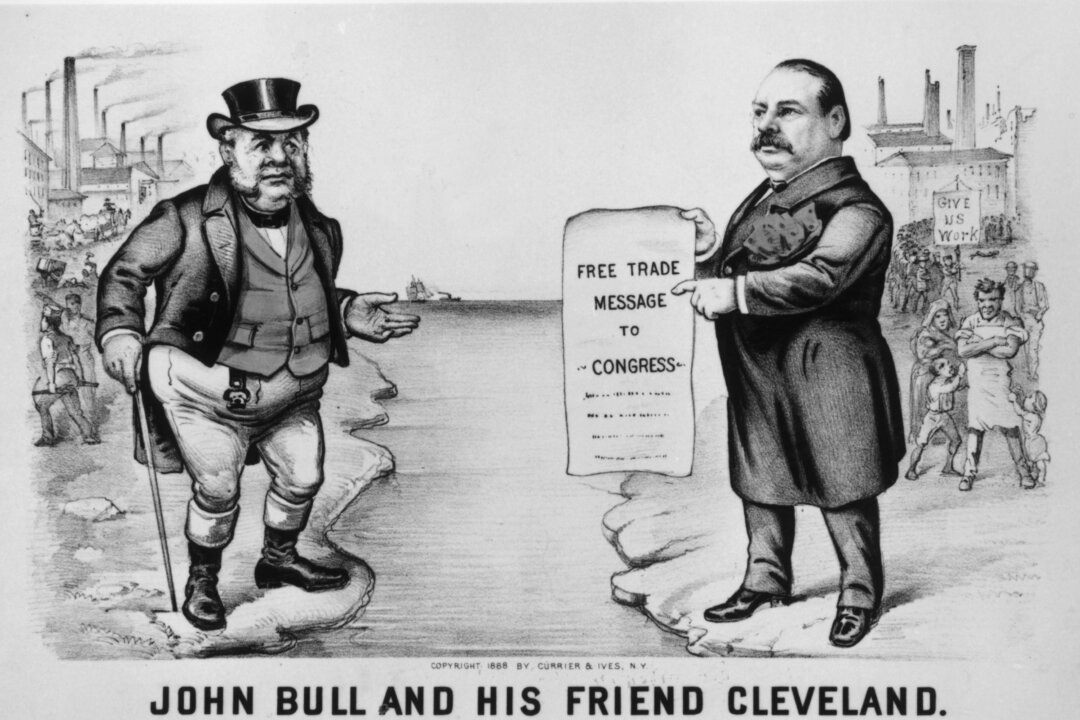
Kuhn arrived at this conclusion by looking at the long history of science and noticing the tendency toward complacency around an orthodoxy of some sort. This is the period he calls “normal science.” The practitioners have all been schooled in a certain way, deferring to teachers and dominant institutions that have captured government and the public mind. It’s a way of understanding the world and within that the main practitioners focus on problem-solving and applications.
This period of normal science can last a month or decades or centuries, rarely questioned. And then something happens. Kuhn writes that this orthodoxy comes to be challenged by certain features of reality that are not explained by normal science. Once these are more closely investigated, the anomalies start to pile up and then overwhelm the explanatory power of the settled paradigm. The longer this goes on, the more the paradigm comes under strain, as a new generation seizes on the failures and highlights the incapacity of the orthodoxy to account for the reality all around us.
That’s when the settled science breaks down. It can happen slowly or quickly, and sometimes paradigms overlap both in their popularity and their collapse. That collapse does not mean that every mind is changed. Kuhn observes that the practitioners of the old science continue on their merry way through retirement and final expiration, while the younger people work on cobbling together a new way of thinking that gradually emerges as the dominant paradigm.
The Epoch Times
The Paradigm Shift Is Here
This is awesome I love their designs also Finneys mother stomping on Terrance ❤️😭