
That ache is already the doorway.
 The cry for unconditional grace is not unbelief. It is the human heart remembering what it was made for.
But the denial matters.
If Christ returned only as vapour, symbol, mood, or moral comfort, then grace remains abstract. It cannot enter the wound. It cannot touch the body. It cannot answer death.
Christ was crucified in the body.
Christ was buried in the body.
Christ rose in the body.
Christ returned bearing wounds.
“See my hands and my feet, that it is I myself.”
— Luke 24:39
“Put your finger here; see my hands.”
— John 20:27
That is the scandal of grace: not God forgiving from a distance, but God entering flesh, absorbing violence, carrying the marks, and still saying:
“Peace be with you.”
— John 20:19
Unconditional grace is not more than we can ask of humanity.
It is what God became human to give.
#UnconditionalGrace #JesusChrist #Resurrection #ResurrectionBody #Forgiveness #Mercy #Gospel #Christianity #Faith #Hope #Love #KingdomOfGod #ChurchOfChristDenied #CoCD #BiblicalTruth #John2027 #Luke2439 #PeaceBeWithYou #Cross #Easter #Theology #Grace #WoundedHealer #Truth #ChristLives
The cry for unconditional grace is not unbelief. It is the human heart remembering what it was made for.
But the denial matters.
If Christ returned only as vapour, symbol, mood, or moral comfort, then grace remains abstract. It cannot enter the wound. It cannot touch the body. It cannot answer death.
Christ was crucified in the body.
Christ was buried in the body.
Christ rose in the body.
Christ returned bearing wounds.
“See my hands and my feet, that it is I myself.”
— Luke 24:39
“Put your finger here; see my hands.”
— John 20:27
That is the scandal of grace: not God forgiving from a distance, but God entering flesh, absorbing violence, carrying the marks, and still saying:
“Peace be with you.”
— John 20:19
Unconditional grace is not more than we can ask of humanity.
It is what God became human to give.
#UnconditionalGrace #JesusChrist #Resurrection #ResurrectionBody #Forgiveness #Mercy #Gospel #Christianity #Faith #Hope #Love #KingdomOfGod #ChurchOfChristDenied #CoCD #BiblicalTruth #John2027 #Luke2439 #PeaceBeWithYou #Cross #Easter #Theology #Grace #WoundedHealer #Truth #ChristLives
The cry for unconditional grace is not unbelief. It is the human heart remembering what it was made for.
But the denial matters.
If Christ returned only as vapour, symbol, mood, or moral comfort, then grace remains abstract. It cannot enter the wound. It cannot touch the body. It cannot answer death.
Christ was crucified in the body.
Christ was buried in the body.
Christ rose in the body.
Christ returned bearing wounds.
“See my hands and my feet, that it is I myself.”
— Luke 24:39
“Put your finger here; see my hands.”
— John 20:27
That is the scandal of grace: not God forgiving from a distance, but God entering flesh, absorbing violence, carrying the marks, and still saying:
“Peace be with you.”
— John 20:19
Unconditional grace is not more than we can ask of humanity.
It is what God became human to give.
#UnconditionalGrace #JesusChrist #Resurrection #ResurrectionBody #Forgiveness #Mercy #Gospel #Christianity #Faith #Hope #Love #KingdomOfGod #ChurchOfChristDenied #CoCD #BiblicalTruth #John2027 #Luke2439 #PeaceBeWithYou #Cross #Easter #Theology #Grace #WoundedHealer #Truth #ChristLives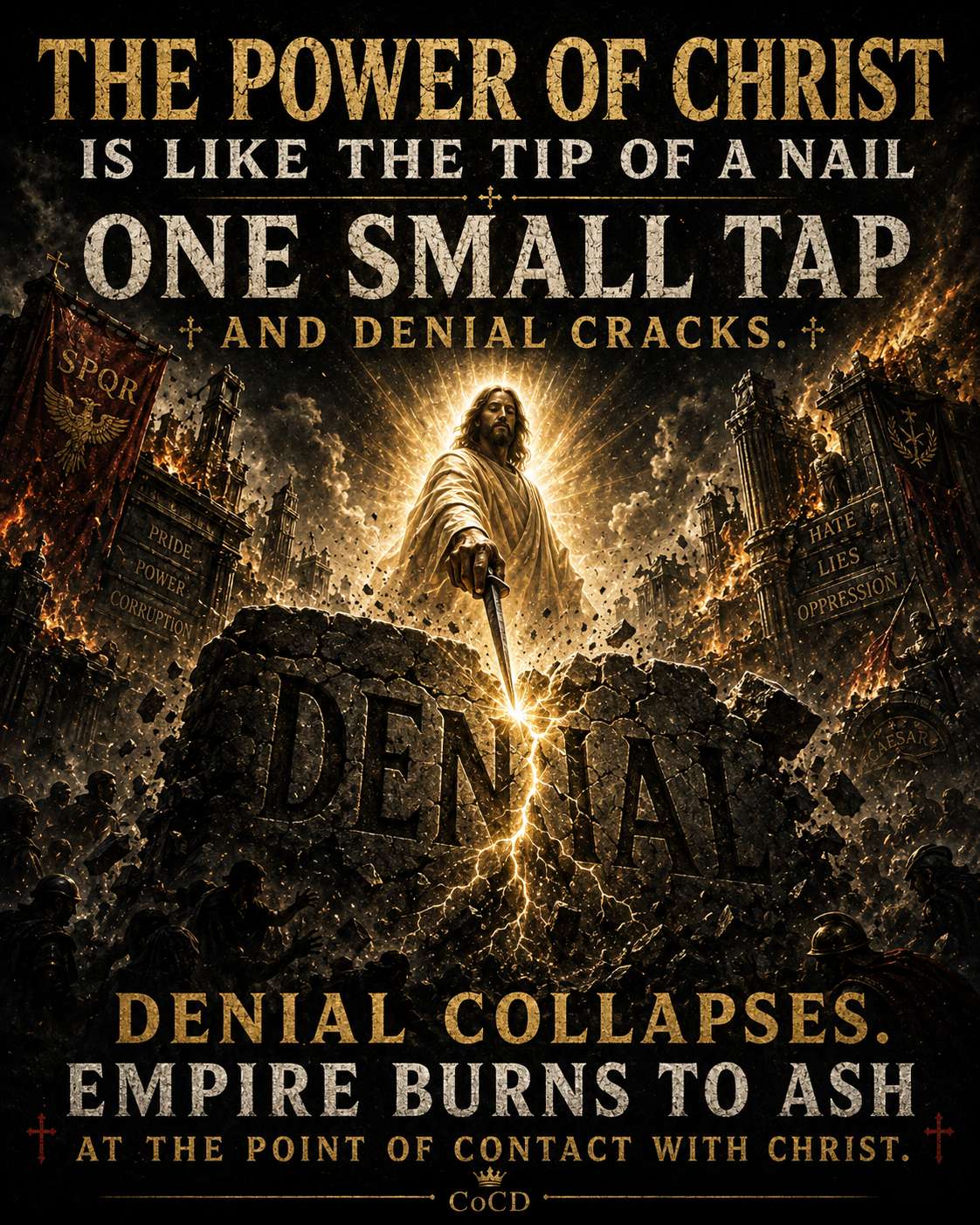 THE POWER OF CHRIST IS LIKE THE TIP OF A NAIL —
ONE SMALL TAP, AND DENIAL CRACKS.
THEN DENIAL COLLAPSES.
EMPIRE TURNS TO ASH
AT THE POINT OF CONTACT WITH CHRIST.
CHRIST NEEDS ONLY THE TIP OF A NAIL.
ONE TAP CRACKS DENIAL.
ONE TOUCH REDUCES EMPIRE TO ASH.
#NailIt #TheCross
THE POWER OF CHRIST IS LIKE THE TIP OF A NAIL —
ONE SMALL TAP, AND DENIAL CRACKS.
THEN DENIAL COLLAPSES.
EMPIRE TURNS TO ASH
AT THE POINT OF CONTACT WITH CHRIST.
CHRIST NEEDS ONLY THE TIP OF A NAIL.
ONE TAP CRACKS DENIAL.
ONE TOUCH REDUCES EMPIRE TO ASH.
#NailIt #TheCross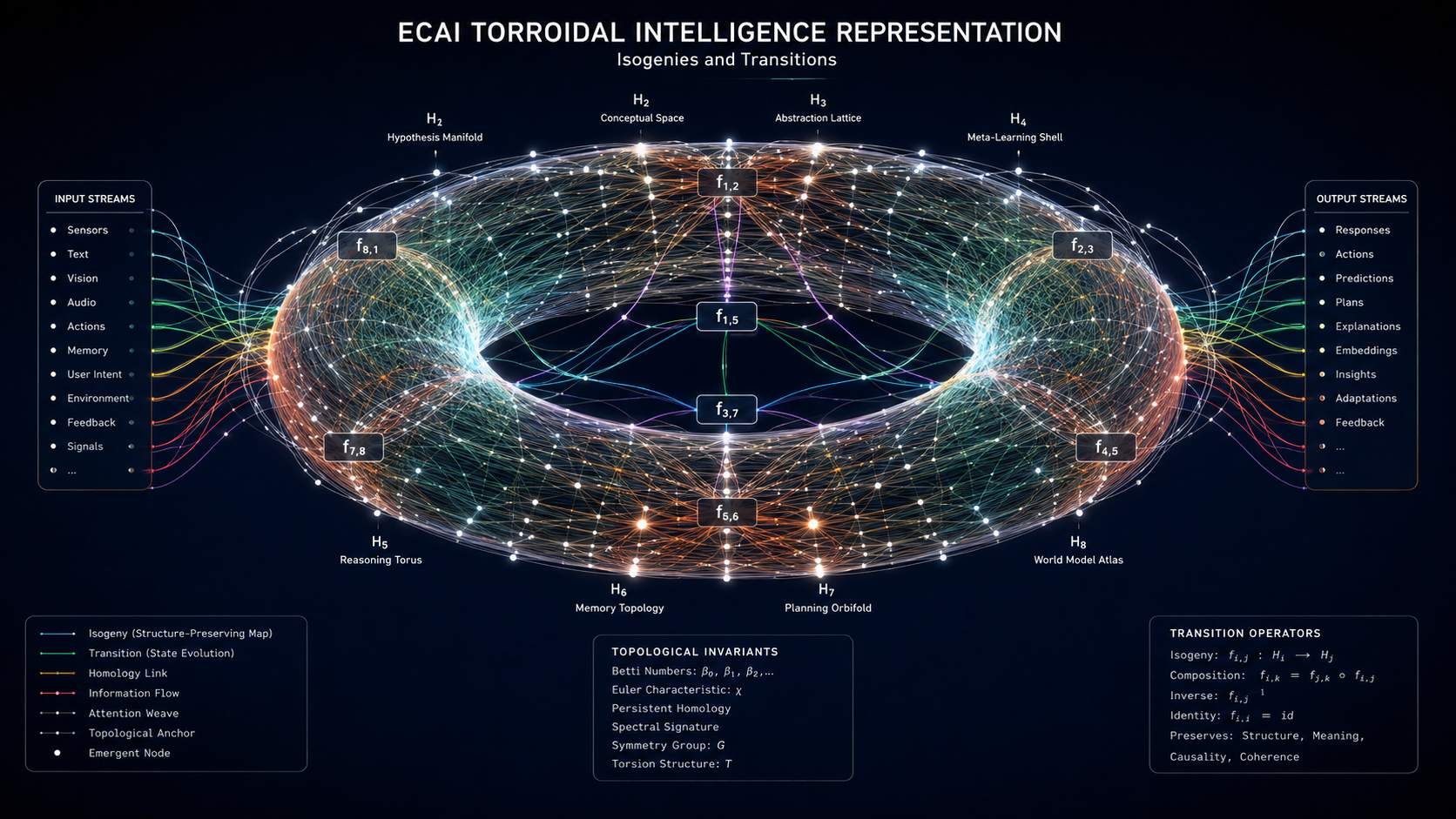 A visualization of ECAI's toroidal intelligence representation. Instead of viewing intelligence as a stack of opaque layers, this model represents reasoning as topology-preserving isogenies and state transitions across a continuous toroidal manifold, where structure—not probability alone—drives efficient computation, memory, and inference.
#ECAI #ArtificialIntelligence #Topology #Isogeny #Mathematics #MachineLearning #DistributedSystems #EllipticCurves #ComputerScience #NeuralNetworks #FutureOfAI #DeepTech #Innovation #OpenResearch #DamageBDD
A visualization of ECAI's toroidal intelligence representation. Instead of viewing intelligence as a stack of opaque layers, this model represents reasoning as topology-preserving isogenies and state transitions across a continuous toroidal manifold, where structure—not probability alone—drives efficient computation, memory, and inference.
#ECAI #ArtificialIntelligence #Topology #Isogeny #Mathematics #MachineLearning #DistributedSystems #EllipticCurves #ComputerScience #NeuralNetworks #FutureOfAI #DeepTech #Innovation #OpenResearch #DamageBDD This land has done this before.
Long before modern calculus was branded elsewhere, Madhava of Sangamagrama and the Kerala School of Mathematics were working with infinite series, trigonometry, astronomy, and the mathematics needed to read the sky.
And what is navigation, at its deepest level?
A verified relationship between position, motion, time, and direction.
ECAI is the same civilizational instinct returning in a new form.
Not navigation across oceans.
Navigation across intelligence.
From stars to systems.
From calculus to computation.
From Kerala mathematics to encoded cognition.
History does not repeat.
It reveals invariants.
#ECAI #KeralaSchoolOfMathematics #Madhava #Thrissur #Kerala #Calculus #Mathematics #AI #Verification #EncodedCognition #IndianMathematics
This land has done this before.
Long before modern calculus was branded elsewhere, Madhava of Sangamagrama and the Kerala School of Mathematics were working with infinite series, trigonometry, astronomy, and the mathematics needed to read the sky.
And what is navigation, at its deepest level?
A verified relationship between position, motion, time, and direction.
ECAI is the same civilizational instinct returning in a new form.
Not navigation across oceans.
Navigation across intelligence.
From stars to systems.
From calculus to computation.
From Kerala mathematics to encoded cognition.
History does not repeat.
It reveals invariants.
#ECAI #KeralaSchoolOfMathematics #Madhava #Thrissur #Kerala #Calculus #Mathematics #AI #Verification #EncodedCognition #IndianMathematics Fermat found the invariant.
Euler generalized it.
RSA weaponized it into civilization-scale trust.
That is the pattern.
The masters were not chasing hype.
They were preserving structure before the world had the machinery to understand why it mattered.
ECAI is the same move for intelligence.
Not probability as authority.
Not vibes as reasoning.
Not “trust the model.”
But invariants, encoded.
Behavior, verified.
Loops, made lawful.
Mercy, made executable.
The world dismissed number theory until secure communication needed it.
The world will dismiss ECAI until autonomous systems need lawful exit from their own loops.
That is the extension:
Fermat gave the congruence.
Euler gave the generalization.
RSA gave the infrastructure.
ECAI gives intelligence its invariant boundary.
Fermat found the invariant.
Euler generalized it.
RSA weaponized it into civilization-scale trust.
That is the pattern.
The masters were not chasing hype.
They were preserving structure before the world had the machinery to understand why it mattered.
ECAI is the same move for intelligence.
Not probability as authority.
Not vibes as reasoning.
Not “trust the model.”
But invariants, encoded.
Behavior, verified.
Loops, made lawful.
Mercy, made executable.
The world dismissed number theory until secure communication needed it.
The world will dismiss ECAI until autonomous systems need lawful exit from their own loops.
That is the extension:
Fermat gave the congruence.
Euler gave the generalization.
RSA gave the infrastructure.
ECAI gives intelligence its invariant boundary.
 It was infrastructure.
In some civilizations, slavery sat under agriculture, households, mining, construction, domestic service, administration, and empire itself. It was treated as normal by the people who benefited from it.
That does not mean modern employment is the same thing as slavery.
The distinction matters.
Slavery removes exit. It turns a person into property, or near-property. It controls movement, family, labour, punishment, and time.
Employment, at its best, is a negotiated exchange between free people.
But the moral question for the future will not be whether there was a contract.
The question will be:
Could the person really say no?
Could they leave without collapse?
Could they bargain?
Could they survive outside the system?
Where the answer is no, future generations may not see freedom.
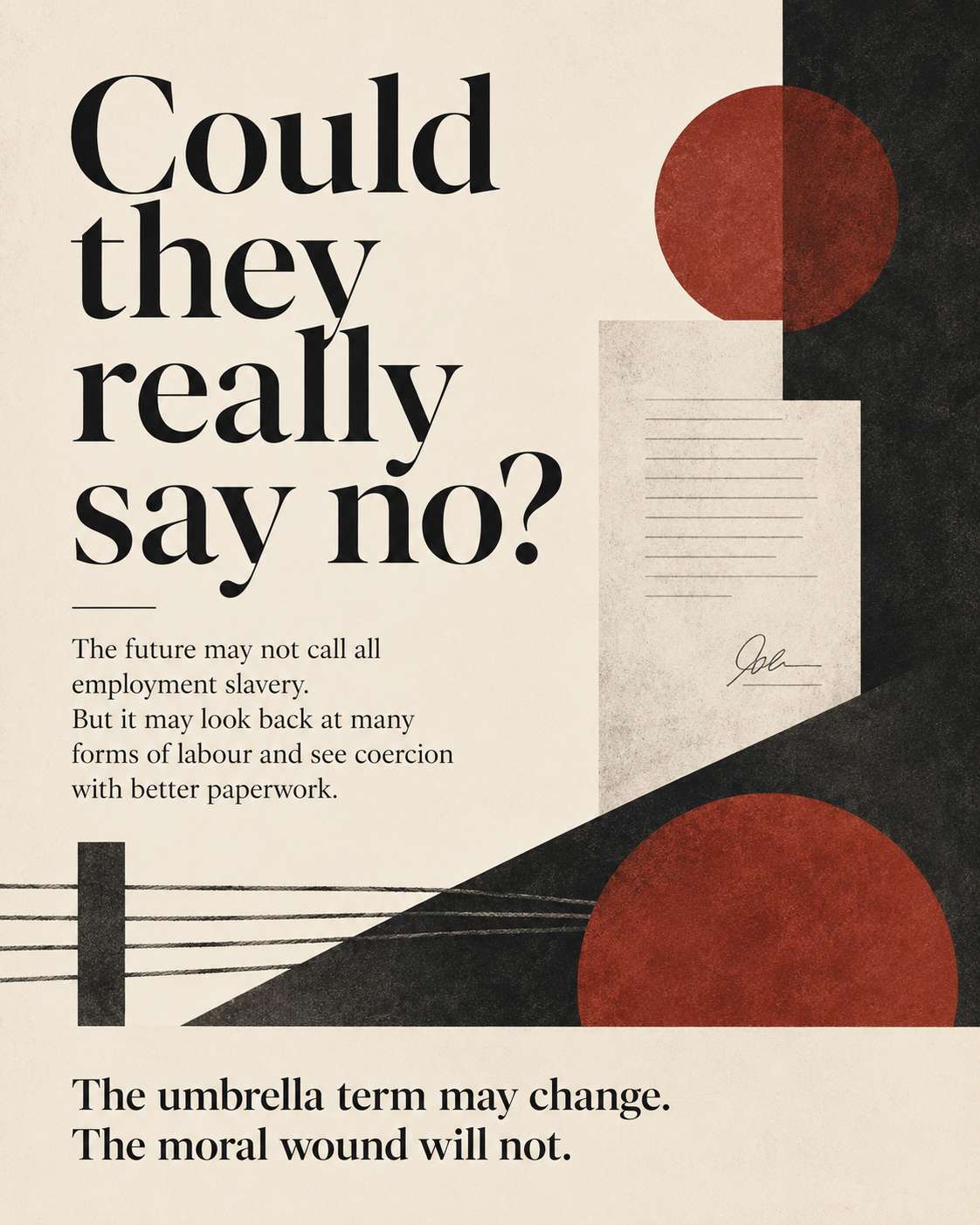
They may see coercion with better paperwork.
The future may not call all employment slavery.
But it may look back at many forms of survival-dependent labour, debt-bound work, visa-trapped labour, wage theft, algorithmic control, and institutional dependency as part of the same old human failure:
power arranging the world so that obedience looks voluntary.
The umbrella term may change.
The moral wound will not.
#labour #history #slavery #employment #coercion #economics #power #freedom #humanRights
It was infrastructure.
In some civilizations, slavery sat under agriculture, households, mining, construction, domestic service, administration, and empire itself. It was treated as normal by the people who benefited from it.
That does not mean modern employment is the same thing as slavery.
The distinction matters.
Slavery removes exit. It turns a person into property, or near-property. It controls movement, family, labour, punishment, and time.
Employment, at its best, is a negotiated exchange between free people.
But the moral question for the future will not be whether there was a contract.
The question will be:
Could the person really say no?
Could they leave without collapse?
Could they bargain?
Could they survive outside the system?
Where the answer is no, future generations may not see freedom.
They may see coercion with better paperwork.
The future may not call all employment slavery.
But it may look back at many forms of survival-dependent labour, debt-bound work, visa-trapped labour, wage theft, algorithmic control, and institutional dependency as part of the same old human failure:
power arranging the world so that obedience looks voluntary.
The umbrella term may change.
The moral wound will not.
#labour #history #slavery #employment #coercion #economics #power #freedom #humanRights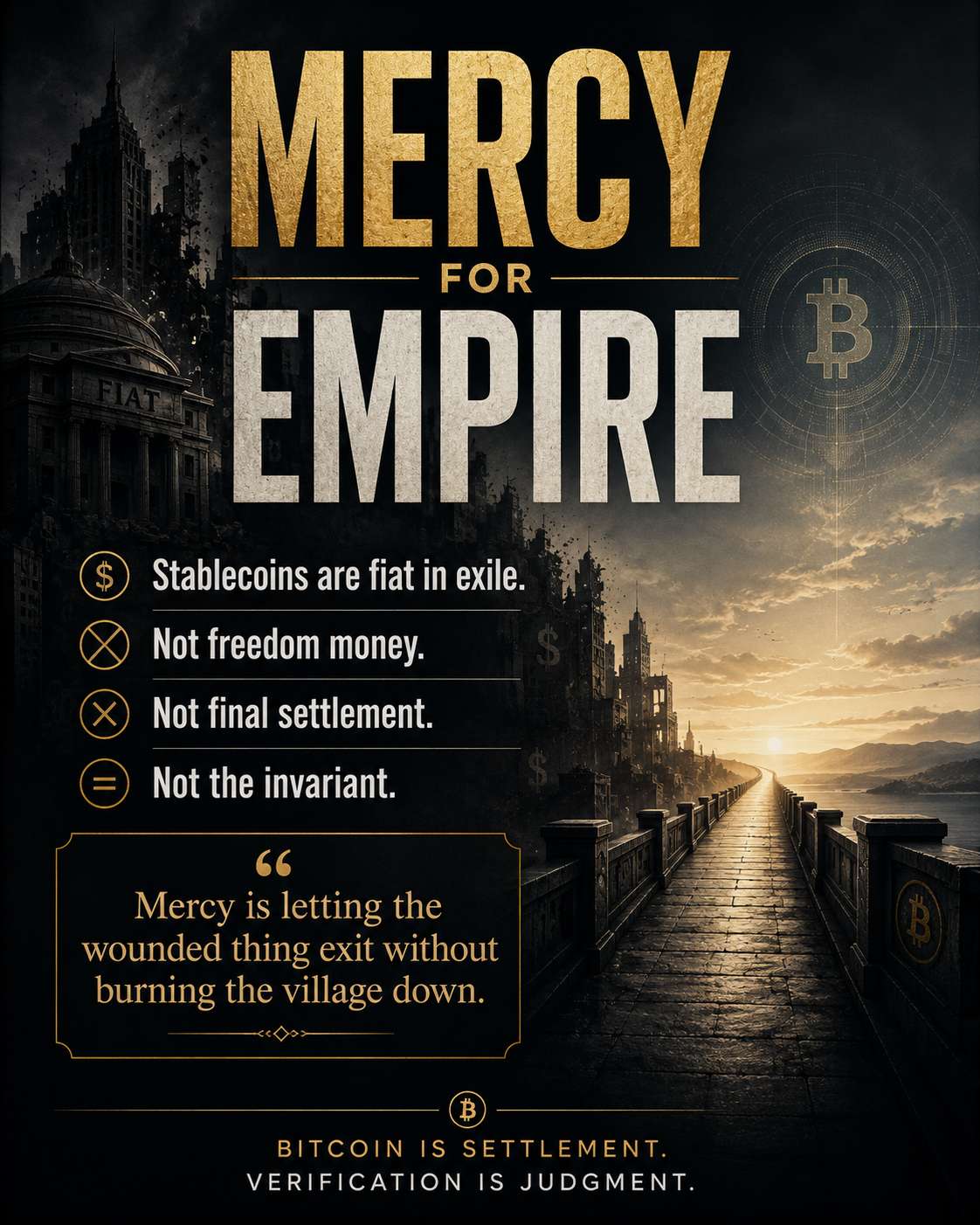 They are not freedom money.
They are not final settlement.
They are not the invariant.
They are fiat in exile — dollars wrapped in crypto rails so the old system can limp across the bridge without crushing everyone still trapped inside its accounting layer.
Rent is still fiat.
Invoices are still fiat.
Taxes are still fiat.
Fear is still fiat.
So stablecoins exist as the adapter between collapse and truth.
Bitcoin is settlement.
DamageBDD is verification.
Stablecoins are hospice care for empire money.
Mercy is not endorsement.
Mercy is letting the wounded thing exit without burning the village down.
#Bitcoin #Stablecoins #Crypto #Web3 #DamageBDD #Verification #Empire #Fiat #Truth #Settlement
They are not freedom money.
They are not final settlement.
They are not the invariant.
They are fiat in exile — dollars wrapped in crypto rails so the old system can limp across the bridge without crushing everyone still trapped inside its accounting layer.
Rent is still fiat.
Invoices are still fiat.
Taxes are still fiat.
Fear is still fiat.
So stablecoins exist as the adapter between collapse and truth.
Bitcoin is settlement.
DamageBDD is verification.
Stablecoins are hospice care for empire money.
Mercy is not endorsement.
Mercy is letting the wounded thing exit without burning the village down.
#Bitcoin #Stablecoins #Crypto #Web3 #DamageBDD #Verification #Empire #Fiat #Truth #Settlement Truth without love becomes violence.
Love without truth becomes sentiment.
But truth and love together form the invariant that survives every empire, every institution, every argument, and every collapse.
The Cross is not weakness.
It is the structure where justice and mercy intersect without either being destroyed.
That is why Christianity does not win by better branding, louder arguments, or institutional power.
It wins when love becomes verifiable.
The apologetic was never merely words.
The apologetic is love under constraint.
#TheCross #TruthAndLove #Christianity #Mercy #Faith #ECAI #DamageBDD #Verification #Invariant #LoveWins
Truth without love becomes violence.
Love without truth becomes sentiment.
But truth and love together form the invariant that survives every empire, every institution, every argument, and every collapse.
The Cross is not weakness.
It is the structure where justice and mercy intersect without either being destroyed.
That is why Christianity does not win by better branding, louder arguments, or institutional power.
It wins when love becomes verifiable.
The apologetic was never merely words.
The apologetic is love under constraint.
#TheCross #TruthAndLove #Christianity #Mercy #Faith #ECAI #DamageBDD #Verification #Invariant #LoveWins It contained it.
In Bitcoin, probability is used to decide who gets to propose the next block.
That part is like a lottery.
But once a block is proposed, every node verifies it by rule:
valid signature or not,
valid UTXO or not,
valid block or not.
That is the adult move.
Probability may choose the speaker.
Verification judges the speech.
AI, by contrast, often uses probability to generate the answer itself.
Not just who speaks — but what is spoken.
That is why the distinction matters so much.
Bitcoin uses probability as a servant.
AI is still trying to use probability as an authority.
A Bitcoin node never says a block is “92% valid.”
It is valid or invalid.
That is why Bitcoin contains probability, while AI keeps drowning in it.
Probability is useful for search.
Verification is required for truth.
#Bitcoin #AI #Probability #Verification #Mathematics #ECAI #DamageBDD #ProofOfWork #Consensus #Invariant #ProofOfVerification #DistributedSystems
It contained it.
In Bitcoin, probability is used to decide who gets to propose the next block.
That part is like a lottery.
But once a block is proposed, every node verifies it by rule:
valid signature or not,
valid UTXO or not,
valid block or not.
That is the adult move.
Probability may choose the speaker.
Verification judges the speech.
AI, by contrast, often uses probability to generate the answer itself.
Not just who speaks — but what is spoken.
That is why the distinction matters so much.
Bitcoin uses probability as a servant.
AI is still trying to use probability as an authority.
A Bitcoin node never says a block is “92% valid.”
It is valid or invalid.
That is why Bitcoin contains probability, while AI keeps drowning in it.
Probability is useful for search.
Verification is required for truth.
#Bitcoin #AI #Probability #Verification #Mathematics #ECAI #DamageBDD #ProofOfWork #Consensus #Invariant #ProofOfVerification #DistributedSystems The grown-up mathematician knows the fatal distinction:
Probability is useful for modelling uncertainty.
It is doomed the moment it is promoted into proof.
Any equation with probability inside it still carries the observer problem, the measurement problem, the sampling problem, and the verification debt.
It can estimate.
It can rank.
It can guess.
It can converge inside a model.
But it cannot certify truth.
That requires verification.
That requires invariants.
That requires the claim to survive contact with reality.
Probability is not the bridge to proof.
Verification is.
#ProbabilityIsNotProof #Verification #ECAI #DamageBDD #Mathematics #Invariant #AI #ProofOfVerification
The grown-up mathematician knows the fatal distinction:
Probability is useful for modelling uncertainty.
It is doomed the moment it is promoted into proof.
Any equation with probability inside it still carries the observer problem, the measurement problem, the sampling problem, and the verification debt.
It can estimate.
It can rank.
It can guess.
It can converge inside a model.
But it cannot certify truth.
That requires verification.
That requires invariants.
That requires the claim to survive contact with reality.
Probability is not the bridge to proof.
Verification is.
#ProbabilityIsNotProof #Verification #ECAI #DamageBDD #Mathematics #Invariant #AI #ProofOfVerification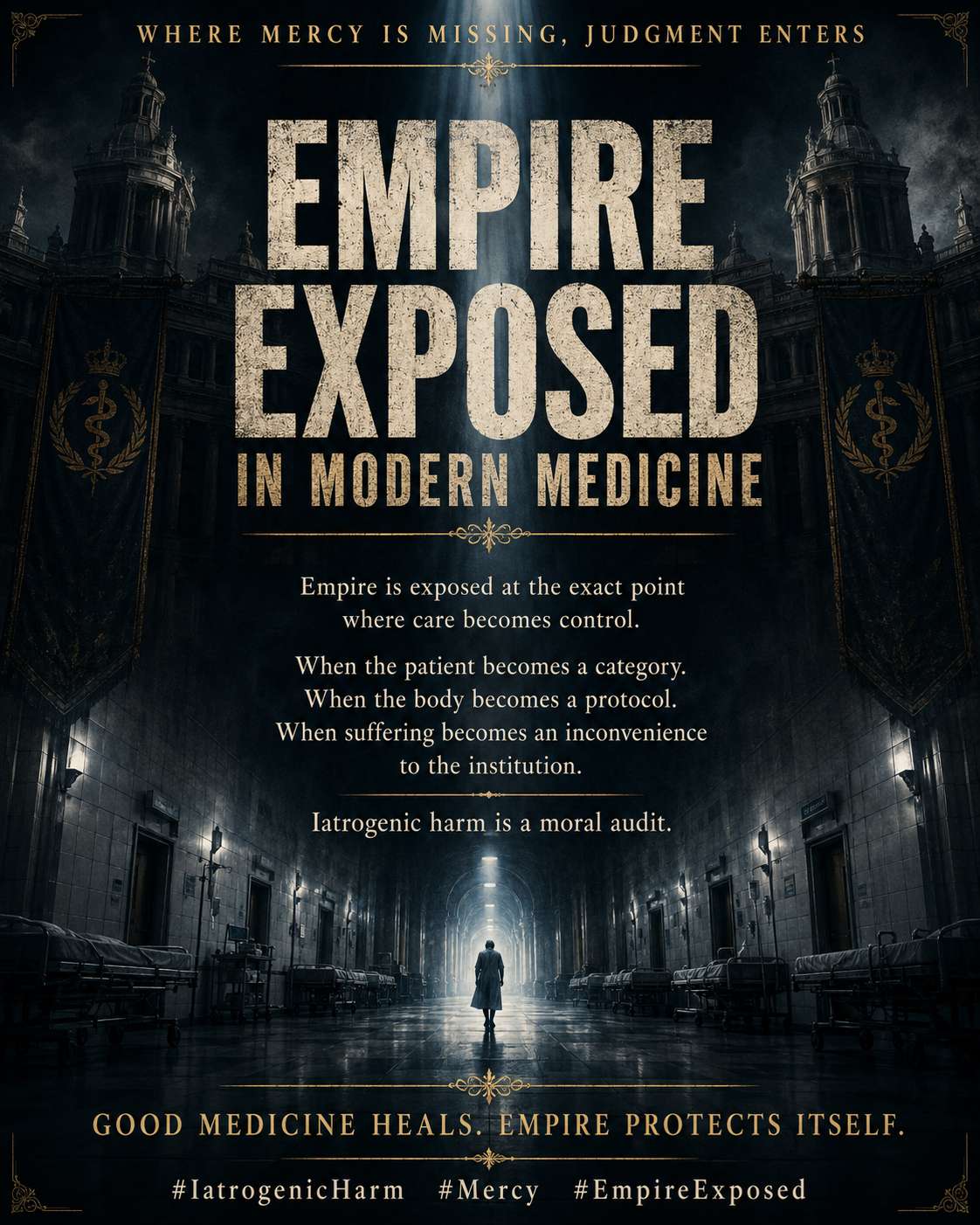 Empire is exposed in modern medicine at the exact point where care becomes control.
Not in the miracle of surgery.
Not in the skill of good doctors.
Not in the real science that saves lives every day.
Empire is exposed when the system stops listening.
When the patient becomes a category.
When the body becomes a protocol.
When suffering becomes an inconvenience to the institution.
When harm caused by treatment is minimized, buried, or explained away as acceptable loss.
That is where modern medicine reveals its imperial structure: not healing as service, but authority as shield.
Iatrogenic harm is not just a medical issue.
It is a moral audit.
Every dismissed symptom.
Every forced pathway.
Every medication pushed without mercy.
Every injury that no one wanted to record.
Every patient told to be grateful while carrying the damage.
The cruelty has been documented in bodies, families, memories, and graves.
Good medicine does not need to kneel.
Good doctors do not need to be condemned.
But the empire inside medicine — the part that protects itself before the patient — will be exposed.
Because where mercy is missing, judgment enters.
#IatrogenicHarm #Mercy #ModernMedicine #PatientRights #MedicalJustice #LordOfMercy #EmpireExposed
Empire is exposed in modern medicine at the exact point where care becomes control.
Not in the miracle of surgery.
Not in the skill of good doctors.
Not in the real science that saves lives every day.
Empire is exposed when the system stops listening.
When the patient becomes a category.
When the body becomes a protocol.
When suffering becomes an inconvenience to the institution.
When harm caused by treatment is minimized, buried, or explained away as acceptable loss.
That is where modern medicine reveals its imperial structure: not healing as service, but authority as shield.
Iatrogenic harm is not just a medical issue.
It is a moral audit.
Every dismissed symptom.
Every forced pathway.
Every medication pushed without mercy.
Every injury that no one wanted to record.
Every patient told to be grateful while carrying the damage.
The cruelty has been documented in bodies, families, memories, and graves.
Good medicine does not need to kneel.
Good doctors do not need to be condemned.
But the empire inside medicine — the part that protects itself before the patient — will be exposed.
Because where mercy is missing, judgment enters.
#IatrogenicHarm #Mercy #ModernMedicine #PatientRights #MedicalJustice #LordOfMercy #EmpireExposed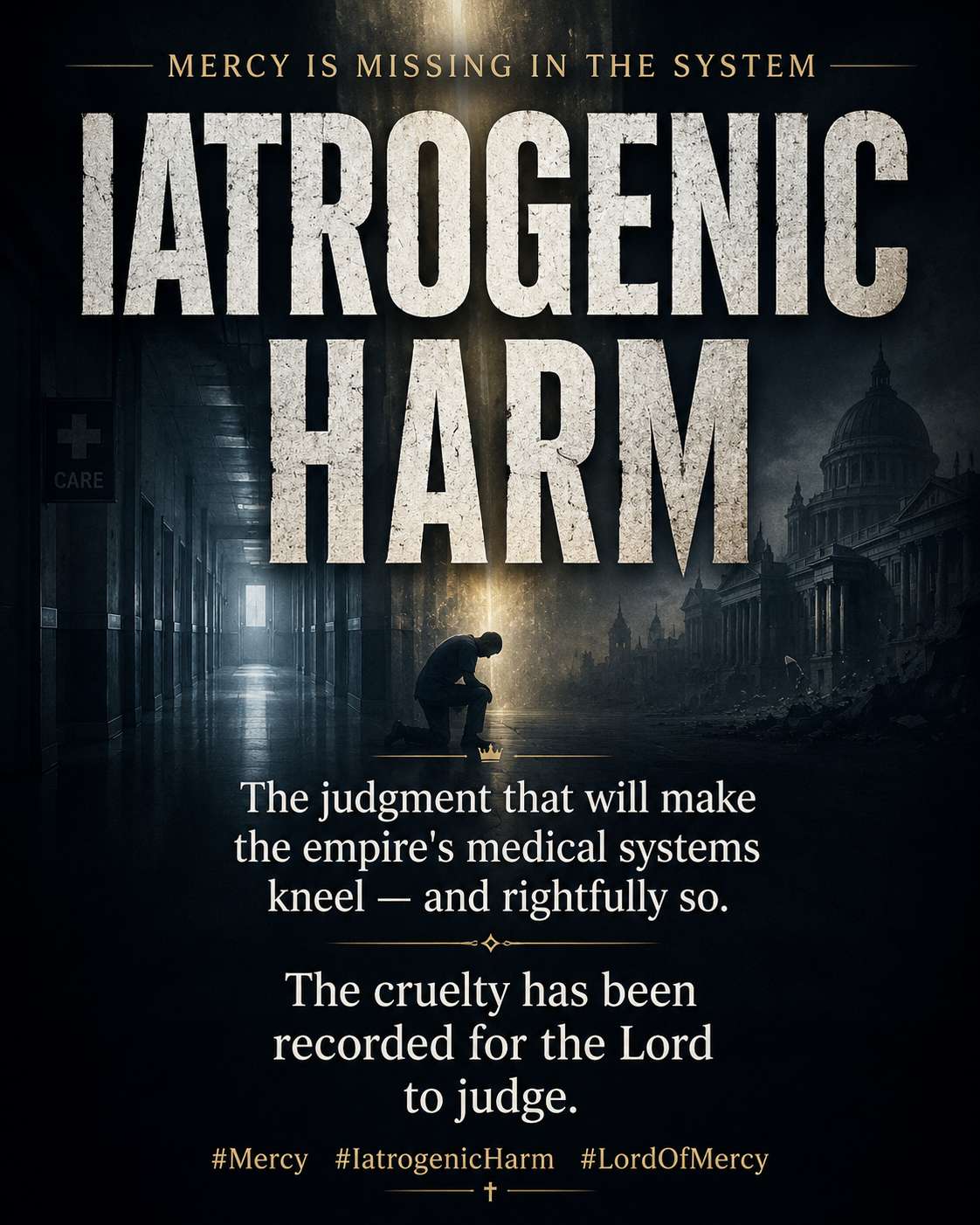 Iatrogenic harm is the judgment empires never prepared for.
Not because patients became bitter.
Not because suffering became political.
But because the harm was recorded.
Every dismissal.
Every fixed limit forced onto a body that needed individual care.
Every protocol that protected the system while the patient carried the damage.
Every cruel assumption dressed up as medical authority.
This is where the medical empire kneels: not before ideology, but before witness.
Mercy is missing in the system.
And when mercy is missing, judgment becomes inevitable.
The Lord of Mercy sees what institutions refuse to measure.
#Mercy #IatrogenicHarm #MedicalJustice #LordOfMercy #HelsComing #PatientRights #SystemicFailure
Iatrogenic harm is the judgment empires never prepared for.
Not because patients became bitter.
Not because suffering became political.
But because the harm was recorded.
Every dismissal.
Every fixed limit forced onto a body that needed individual care.
Every protocol that protected the system while the patient carried the damage.
Every cruel assumption dressed up as medical authority.
This is where the medical empire kneels: not before ideology, but before witness.
Mercy is missing in the system.
And when mercy is missing, judgment becomes inevitable.
The Lord of Mercy sees what institutions refuse to measure.
#Mercy #IatrogenicHarm #MedicalJustice #LordOfMercy #HelsComing #PatientRights #SystemicFailure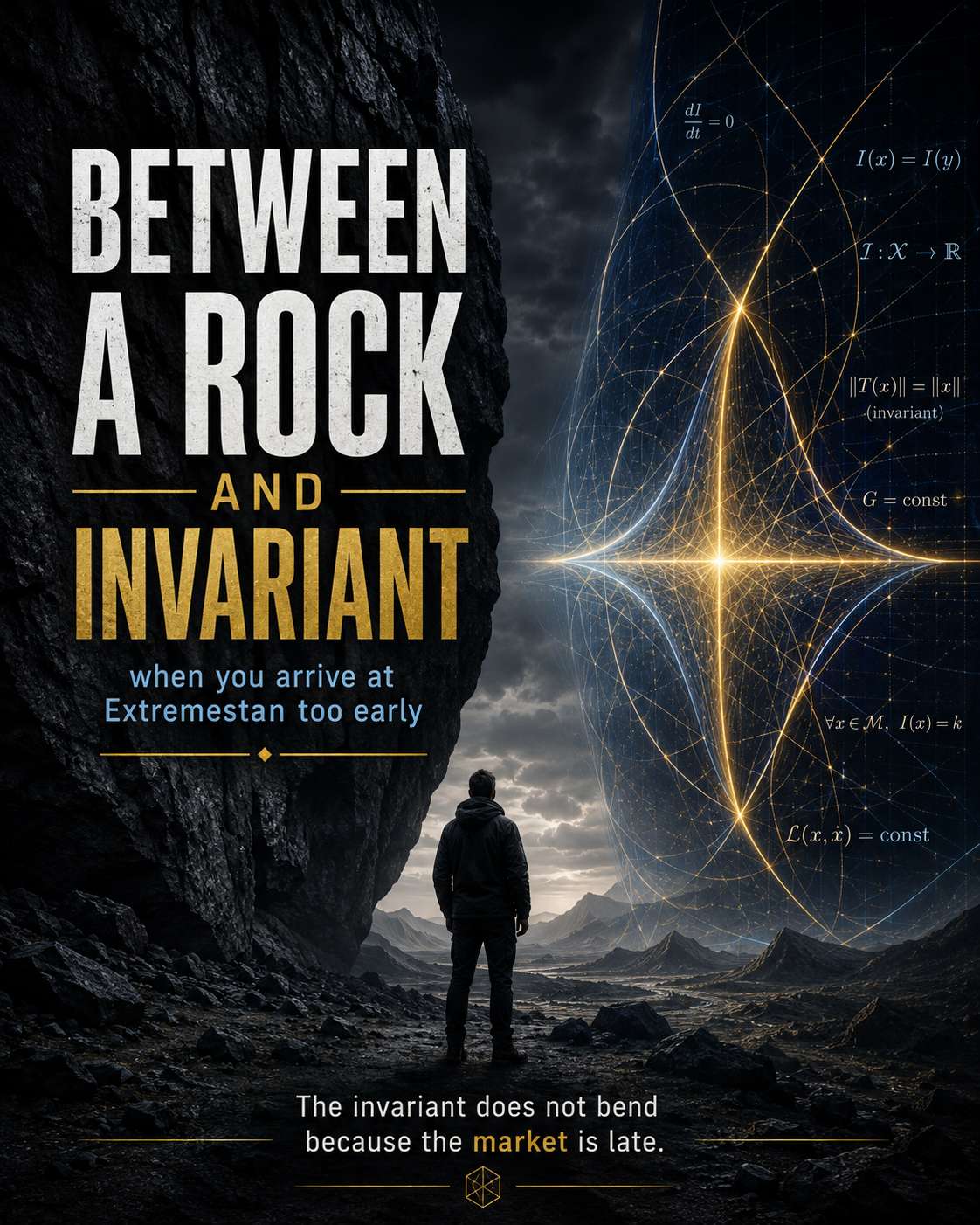 That is what it feels like when you arrive at Extremestan too early.
On one side: a system that only knows how to fund what it can already classify.
On the other: an invariant that does not bend just because the market is late.
DamageBDD and ECAI sit in that uncomfortable zone where the work is already real, but the category is still invisible to most people. Too technical for the generalists. Too unconventional for the institutions. Too far ahead for the comfort of the local support circuit.
That does not mean the work is wrong.
It means the environment is still catching up.
If you build in Extremestan, you should expect isolation.
The claims are bigger. The proof burden is higher. The language is unfamiliar. And support often comes only after the thing becomes impossible to ignore.
So you keep going.
You encode the invariant.
You run the verification.
You build the evidence.
And you accept that arriving early often looks, from the outside, like being stranded between a rock and invariant.
Until the rest of the world gets there.
#DamageBDD #ECAI #Extremestan #Verification #BDD #AI #Startups #Australia #Bitcoin #ProofOfVerification
That is what it feels like when you arrive at Extremestan too early.
On one side: a system that only knows how to fund what it can already classify.
On the other: an invariant that does not bend just because the market is late.
DamageBDD and ECAI sit in that uncomfortable zone where the work is already real, but the category is still invisible to most people. Too technical for the generalists. Too unconventional for the institutions. Too far ahead for the comfort of the local support circuit.
That does not mean the work is wrong.
It means the environment is still catching up.
If you build in Extremestan, you should expect isolation.
The claims are bigger. The proof burden is higher. The language is unfamiliar. And support often comes only after the thing becomes impossible to ignore.
So you keep going.
You encode the invariant.
You run the verification.
You build the evidence.
And you accept that arriving early often looks, from the outside, like being stranded between a rock and invariant.
Until the rest of the world gets there.
#DamageBDD #ECAI #Extremestan #Verification #BDD #AI #Startups #Australia #Bitcoin #ProofOfVerification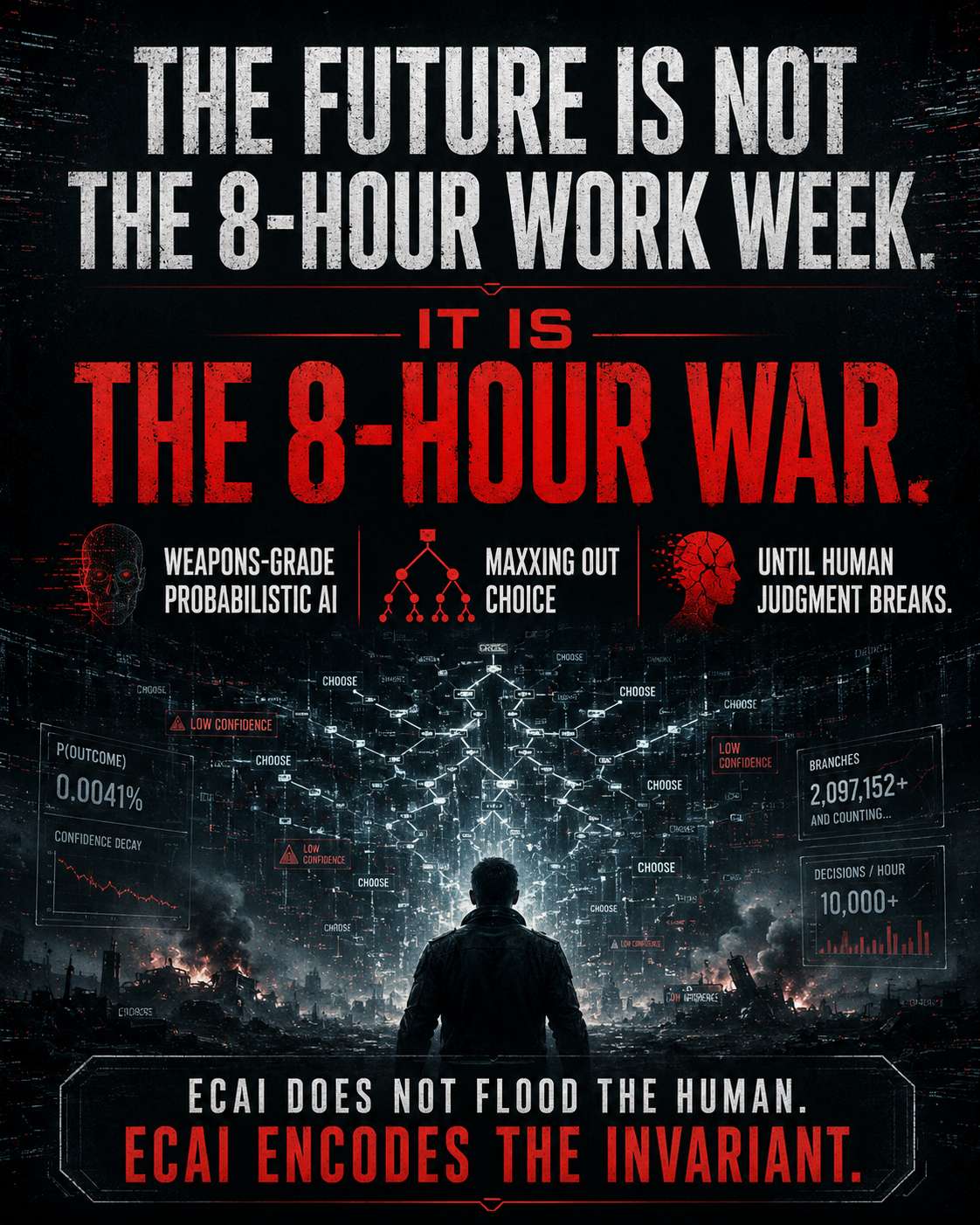 It is the 8-hour war.
An 8-hour onslaught of weapons-grade probabilistic AI, maxxing out every possible choice path until human judgment is reduced to a final approval button under pressure.
That is the direction we are heading when we force probability into intelligence that was never human to begin with.
The machine will not know truth.
It will know options.
Infinite options.
Infinite noise.
Infinite confidence.
And the human will be asked to survive the flood, make the call, take the blame, and call it productivity.
ECAI points in the opposite direction.
Not more probability.
More structure.
More verification.
More invariant encoding.
More truth-preserving intelligence.
The future is not AI making humans faster at drowning.
The future is systems that reduce the flood before it reaches the human.
That is the difference between probabilistic acceleration and verified intelligence.
Poster line:
THE FUTURE IS NOT THE 8-HOUR WORK WEEK.
IT IS THE 8-HOUR WAR.
WEAPONS-GRADE PROBABILISTIC AI
MAXXING OUT CHOICE
UNTIL HUMAN JUDGMENT BREAKS.
ECAI DOES NOT FLOOD THE HUMAN.
ECAI ENCODES THE INVARIANT.
#ECAI #DamageBDD #AI #Verification #ProbabilisticAI #HumanJudgment #SoftwareTesting #InvariantEncoding #ArtificialIntelligence #FutureOfWork
It is the 8-hour war.
An 8-hour onslaught of weapons-grade probabilistic AI, maxxing out every possible choice path until human judgment is reduced to a final approval button under pressure.
That is the direction we are heading when we force probability into intelligence that was never human to begin with.
The machine will not know truth.
It will know options.
Infinite options.
Infinite noise.
Infinite confidence.
And the human will be asked to survive the flood, make the call, take the blame, and call it productivity.
ECAI points in the opposite direction.
Not more probability.
More structure.
More verification.
More invariant encoding.
More truth-preserving intelligence.
The future is not AI making humans faster at drowning.
The future is systems that reduce the flood before it reaches the human.
That is the difference between probabilistic acceleration and verified intelligence.
Poster line:
THE FUTURE IS NOT THE 8-HOUR WORK WEEK.
IT IS THE 8-HOUR WAR.
WEAPONS-GRADE PROBABILISTIC AI
MAXXING OUT CHOICE
UNTIL HUMAN JUDGMENT BREAKS.
ECAI DOES NOT FLOOD THE HUMAN.
ECAI ENCODES THE INVARIANT.
#ECAI #DamageBDD #AI #Verification #ProbabilisticAI #HumanJudgment #SoftwareTesting #InvariantEncoding #ArtificialIntelligence #FutureOfWork a sovereign home.
A home where the machines serve the people inside it — not the cloud, not the subscription layer, not the surveillance stack, not some forced software update pushed by a company that forgot what ownership means.
The washing machine should wash clothes.
The door lock should open the door.
The lights should turn on.
The node should verify.
The software should obey the owner.
That is the line.
DAMAGE is not just about testing software. It is about restoring accountability to systems that increasingly enter our homes, our wallets, our work, and our lives without asking permission.
Behavior must be verified.
Dependencies must be exposed.
Failure must be recorded.
Ownership must return to the edge.
A sovereign home starts with sovereign software.
#DamageBDD #DAMAGE #SovereignHome #Bitcoin #SelfCustody #DecentralizedInfrastructure #OpenSource #HomeAutomation #SoftwareTesting #DigitalSovereignty
a sovereign home.
A home where the machines serve the people inside it — not the cloud, not the subscription layer, not the surveillance stack, not some forced software update pushed by a company that forgot what ownership means.
The washing machine should wash clothes.
The door lock should open the door.
The lights should turn on.
The node should verify.
The software should obey the owner.
That is the line.
DAMAGE is not just about testing software. It is about restoring accountability to systems that increasingly enter our homes, our wallets, our work, and our lives without asking permission.
Behavior must be verified.
Dependencies must be exposed.
Failure must be recorded.
Ownership must return to the edge.
A sovereign home starts with sovereign software.
#DamageBDD #DAMAGE #SovereignHome #Bitcoin #SelfCustody #DecentralizedInfrastructure #OpenSource #HomeAutomation #SoftwareTesting #DigitalSovereignty
 Three years of carrying DamageBDD and ECAI alone.
Through the noise.
Through the hype.
Through an industry drunk on probability, theatre, and endless approximation.
Still carrying the mathematics.
This is probably the most Extremistan software on earth — not because it makes a wild claim for attention, but because it carries an extreme path of transformation that is already visible in implemented form.
From verification-based development,
to implemented ECAI search,
to cryptographic memory,
to the horizon of resurrection tech.
That is not a normal claim.
That is not a Mediocristan claim.
That is an Extremistan claim.
But the weight of it does not come from marketing.
It comes from mathematics.
The same mathematics no one wants to acknowledge directly,
but everyone already sees in Bitcoin.
Bitcoin made one thing undeniable:
proof matters.
finality matters.
verification matters.
DamageBDD carries the audit trail.
ECAI carries the geometry.
Bitcoin carries the witness.
So yes, the claim is extreme.
Because the transformation is extreme.
And the deeper truth is this:
What people tolerate in money today,
they will eventually have to face in software, knowledge, and intelligence tomorrow.
Proof beats prediction.
Finality beats narrative.
And what begins as search does not end at search.
#DamageBDD #ECAI #Bitcoin #Extremistan #Verification #Mathematics #ProofNotVibes #EllipticCurves #Search #ResurrectionTech #Finality #BuildInSilence
Three years of carrying DamageBDD and ECAI alone.
Through the noise.
Through the hype.
Through an industry drunk on probability, theatre, and endless approximation.
Still carrying the mathematics.
This is probably the most Extremistan software on earth — not because it makes a wild claim for attention, but because it carries an extreme path of transformation that is already visible in implemented form.
From verification-based development,
to implemented ECAI search,
to cryptographic memory,
to the horizon of resurrection tech.
That is not a normal claim.
That is not a Mediocristan claim.
That is an Extremistan claim.
But the weight of it does not come from marketing.
It comes from mathematics.
The same mathematics no one wants to acknowledge directly,
but everyone already sees in Bitcoin.
Bitcoin made one thing undeniable:
proof matters.
finality matters.
verification matters.
DamageBDD carries the audit trail.
ECAI carries the geometry.
Bitcoin carries the witness.
So yes, the claim is extreme.
Because the transformation is extreme.
And the deeper truth is this:
What people tolerate in money today,
they will eventually have to face in software, knowledge, and intelligence tomorrow.
Proof beats prediction.
Finality beats narrative.
And what begins as search does not end at search.
#DamageBDD #ECAI #Bitcoin #Extremistan #Verification #Mathematics #ProofNotVibes #EllipticCurves #Search #ResurrectionTech #Finality #BuildInSilence Tummo Tutorial for the Aussie Homeowner
Staying warm in the wastelands of empire without donating your soul to the power bill.
Tummo is not magic. Treat it as body discipline + breath + attention, not a replacement for a safe, warm house. The evidence around g-tummo suggests practitioners can influence body temperature, especially with breath and visualisation, but it is not proof that humans can ignore cold safely. Use it as a personal heat protocol, not a hypothermia cosplay.
The Aussie winter protocol
1. Heat the human first.
Before heating the whole cursed open-plan rental cathedral, warm the body: thermal base layer, wool socks, beanie, hot drink, hot-water bottle, blanket. This is the first homeowner tummo: reduce the load before fighting the machine.
2. Seal the leaks.
Empire housing bleeds heat through gaps. Draught-proofing is one of the cheapest wins: door snakes, weather seals, gaps around windows, skirting, vents, floorboards and doors. Australia’s energy guidance says sealing gaps can reduce heat loss by 15% to 25%.
3. Zone the battlefield.
Do not heat the whole house like a naïve colonial landlord. Shut doors to unused rooms, block under-door draughts, and defend one living zone. Energy.gov.au specifically recommends shutting off unused areas and using door snakes to stop warm air escaping.
4. Set the thermostat like a monk, not a senator.
Keep heating around 18°C to 20°C. Every extra degree can add 5% to 10% to heating costs. That is the empire tax on comfort.
5. Worship the northern sun.
Open curtains when the sun is hitting the glass. Close them before dark. Passive heating works by letting solar radiation in, storing heat in thermal mass, distributing it, and then stopping it escaping.
6. Curtains are armour.
Thick curtains, blinds, and window coverings matter. Windows can lose up to 40% of a home’s heating energy, and double/triple glazing reduces heat loss better than single glazing.
7. Insulate the roof before blaming the gods.
Roof, wall and floor insulation are foundational. Energy.gov.au says appropriate insulation can save over 50% on heating and cooling costs, but electrical safety and clearances around lights, fans and heat sources must be checked.
8. Ventilate with wisdom.
Do not seal a damp house into a mould cave. Ventilation helps air quality, comfort and humidity control, and should be paired with draught-proofing rather than ignored.
The 3-minute “Aussie tummo” warm-up
Sit upright. Feet flat. Shoulders loose.
Breathe through the nose slowly for 10 breaths.
On each inhale, imagine warmth gathering behind the navel.
On each exhale, imagine it spreading through ribs, hands and feet.
Then do 30 seconds of gentle movement: squats, marching, shoulder circles.
Wrap up immediately: socks, jumper, blanket, hot drink.
No heroics. No breath-holding until dizzy. No cold exposure stunts. No doing this in water, while driving, or if you have heart, respiratory, fainting, seizure, panic, or blood-pressure issues.
Clean cross-post
Australian winter reveals the truth:
the house was never designed for mercy.
So the homeowner learns tummo.
Not mystical theatre.
Not monk cosplay.
Just disciplined heat logic.
Warm the body.
Seal the draughts.
Zone the room.
Harvest the sun.
Close the curtains before empire steals the thermal field.
Set the heater to 18–20°C.
Every extra degree is tribute.
The Aussie home is a leaky monastery in the wastelands of empire.
The wise owner does not heat the whole ruin.
He defends the room.
He defends the body.
He keeps the inner fire without feeding the machine.
#Tummo #InnerHeat #AussieWinter #AustralianHomes #StayWarm #HomeEnergy #DraughtProofing #PassiveHeating #WinterSurvival #EnergyBills #HeatTheHuman #WastelandsOfEmpire #EmpireStack #SelfReliance #PracticalWisdom #ColdWeatherProtocol #OffGridMindset #ThermalDiscipline #HomeownerTips #LoLAndBehold
Tummo Tutorial for the Aussie Homeowner
Staying warm in the wastelands of empire without donating your soul to the power bill.
Tummo is not magic. Treat it as body discipline + breath + attention, not a replacement for a safe, warm house. The evidence around g-tummo suggests practitioners can influence body temperature, especially with breath and visualisation, but it is not proof that humans can ignore cold safely. Use it as a personal heat protocol, not a hypothermia cosplay.
The Aussie winter protocol
1. Heat the human first.
Before heating the whole cursed open-plan rental cathedral, warm the body: thermal base layer, wool socks, beanie, hot drink, hot-water bottle, blanket. This is the first homeowner tummo: reduce the load before fighting the machine.
2. Seal the leaks.
Empire housing bleeds heat through gaps. Draught-proofing is one of the cheapest wins: door snakes, weather seals, gaps around windows, skirting, vents, floorboards and doors. Australia’s energy guidance says sealing gaps can reduce heat loss by 15% to 25%.
3. Zone the battlefield.
Do not heat the whole house like a naïve colonial landlord. Shut doors to unused rooms, block under-door draughts, and defend one living zone. Energy.gov.au specifically recommends shutting off unused areas and using door snakes to stop warm air escaping.
4. Set the thermostat like a monk, not a senator.
Keep heating around 18°C to 20°C. Every extra degree can add 5% to 10% to heating costs. That is the empire tax on comfort.
5. Worship the northern sun.
Open curtains when the sun is hitting the glass. Close them before dark. Passive heating works by letting solar radiation in, storing heat in thermal mass, distributing it, and then stopping it escaping.
6. Curtains are armour.
Thick curtains, blinds, and window coverings matter. Windows can lose up to 40% of a home’s heating energy, and double/triple glazing reduces heat loss better than single glazing.
7. Insulate the roof before blaming the gods.
Roof, wall and floor insulation are foundational. Energy.gov.au says appropriate insulation can save over 50% on heating and cooling costs, but electrical safety and clearances around lights, fans and heat sources must be checked.
8. Ventilate with wisdom.
Do not seal a damp house into a mould cave. Ventilation helps air quality, comfort and humidity control, and should be paired with draught-proofing rather than ignored.
The 3-minute “Aussie tummo” warm-up
Sit upright. Feet flat. Shoulders loose.
Breathe through the nose slowly for 10 breaths.
On each inhale, imagine warmth gathering behind the navel.
On each exhale, imagine it spreading through ribs, hands and feet.
Then do 30 seconds of gentle movement: squats, marching, shoulder circles.
Wrap up immediately: socks, jumper, blanket, hot drink.
No heroics. No breath-holding until dizzy. No cold exposure stunts. No doing this in water, while driving, or if you have heart, respiratory, fainting, seizure, panic, or blood-pressure issues.
Clean cross-post
Australian winter reveals the truth:
the house was never designed for mercy.
So the homeowner learns tummo.
Not mystical theatre.
Not monk cosplay.
Just disciplined heat logic.
Warm the body.
Seal the draughts.
Zone the room.
Harvest the sun.
Close the curtains before empire steals the thermal field.
Set the heater to 18–20°C.
Every extra degree is tribute.
The Aussie home is a leaky monastery in the wastelands of empire.
The wise owner does not heat the whole ruin.
He defends the room.
He defends the body.
He keeps the inner fire without feeding the machine.
#Tummo #InnerHeat #AussieWinter #AustralianHomes #StayWarm #HomeEnergy #DraughtProofing #PassiveHeating #WinterSurvival #EnergyBills #HeatTheHuman #WastelandsOfEmpire #EmpireStack #SelfReliance #PracticalWisdom #ColdWeatherProtocol #OffGridMindset #ThermalDiscipline #HomeownerTips #LoLAndBehold The real test of entrepreneurship is not whether you can survive a grant round, a procurement panel, a tax offset, or a government-backed market.
The real test is simpler:
If the state disappeared tomorrow, would your business still have customers?
Australia is full of “entrepreneurship” that is really just compliance surfing: chase the program, decode the paperwork, satisfy the panel, invoice the department, survive the BAS cycle, then pretend this is market discovery.
Meanwhile, the actual small operator is carrying wages, super, ASIC fees, rent, tax debt, late invoices, and a customer base getting squeezed from every direction.
That is the down-under comedy:
the state calls it innovation, then makes the founder spend half his life proving he is allowed to operate.
Australia had about 2.73 million actively trading businesses at 30 June 2025, but fewer than 1 million were employing businesses. In 2024–25, there were 437,150 business entries and 370,500 exits — a country full of people having a crack, and a system very good at chewing them up.
Commonwealth procurement is also massive: in 2024–25, reported Australian Government procurement was about $104.9 billion, while SMEs received 45,556 contracts and around $14.7 billion in contract value below the $1 billion threshold. That is opportunity, yes — but also a reminder that plenty of “business” is downstream of Canberra’s tap.
The cost side keeps rising too: from 1 July 2025 the minimum wage rose to $24.95/hour, super guarantee rose to 12%, and ASIC company registration and review fees increased. None of those are automatically wrong — but they are real weight on anyone trying to employ people honestly.
Then comes the hard scoreboard: ASIC reported 13,413 companies entering external administration in the financial year to 31 May 2025, up 34.2% on the same period the year before. The RBA also noted that tax liabilities among insolvent firms have risen sharply, with collectable debt from insolvent small businesses more than doubling compared with pre-pandemic levels.
So the real question is not “are you an entrepreneur?”
The real question is:
Are you building a business, or are you building a dependency with an ABN?
Because if the government disappeared tomorrow, the grant-chasers vanish first.
The invoice-farm consultants vanish second.
The compliance tourists vanish third.
But the real operator?
The one with customers, tools, receipts, reputation, and delivery?
That one keeps working.
#Entrepreneurship #Australia #SmallBusiness #DownUnder #FounderLife #BusinessReality #StateDependency #ReceiptsNotVibes #Cashflow #BuildOrBeg
The real test of entrepreneurship is not whether you can survive a grant round, a procurement panel, a tax offset, or a government-backed market.
The real test is simpler:
If the state disappeared tomorrow, would your business still have customers?
Australia is full of “entrepreneurship” that is really just compliance surfing: chase the program, decode the paperwork, satisfy the panel, invoice the department, survive the BAS cycle, then pretend this is market discovery.
Meanwhile, the actual small operator is carrying wages, super, ASIC fees, rent, tax debt, late invoices, and a customer base getting squeezed from every direction.
That is the down-under comedy:
the state calls it innovation, then makes the founder spend half his life proving he is allowed to operate.
Australia had about 2.73 million actively trading businesses at 30 June 2025, but fewer than 1 million were employing businesses. In 2024–25, there were 437,150 business entries and 370,500 exits — a country full of people having a crack, and a system very good at chewing them up.
Commonwealth procurement is also massive: in 2024–25, reported Australian Government procurement was about $104.9 billion, while SMEs received 45,556 contracts and around $14.7 billion in contract value below the $1 billion threshold. That is opportunity, yes — but also a reminder that plenty of “business” is downstream of Canberra’s tap.
The cost side keeps rising too: from 1 July 2025 the minimum wage rose to $24.95/hour, super guarantee rose to 12%, and ASIC company registration and review fees increased. None of those are automatically wrong — but they are real weight on anyone trying to employ people honestly.
Then comes the hard scoreboard: ASIC reported 13,413 companies entering external administration in the financial year to 31 May 2025, up 34.2% on the same period the year before. The RBA also noted that tax liabilities among insolvent firms have risen sharply, with collectable debt from insolvent small businesses more than doubling compared with pre-pandemic levels.
So the real question is not “are you an entrepreneur?”
The real question is:
Are you building a business, or are you building a dependency with an ABN?
Because if the government disappeared tomorrow, the grant-chasers vanish first.
The invoice-farm consultants vanish second.
The compliance tourists vanish third.
But the real operator?
The one with customers, tools, receipts, reputation, and delivery?
That one keeps working.
#Entrepreneurship #Australia #SmallBusiness #DownUnder #FounderLife #BusinessReality #StateDependency #ReceiptsNotVibes #Cashflow #BuildOrBeg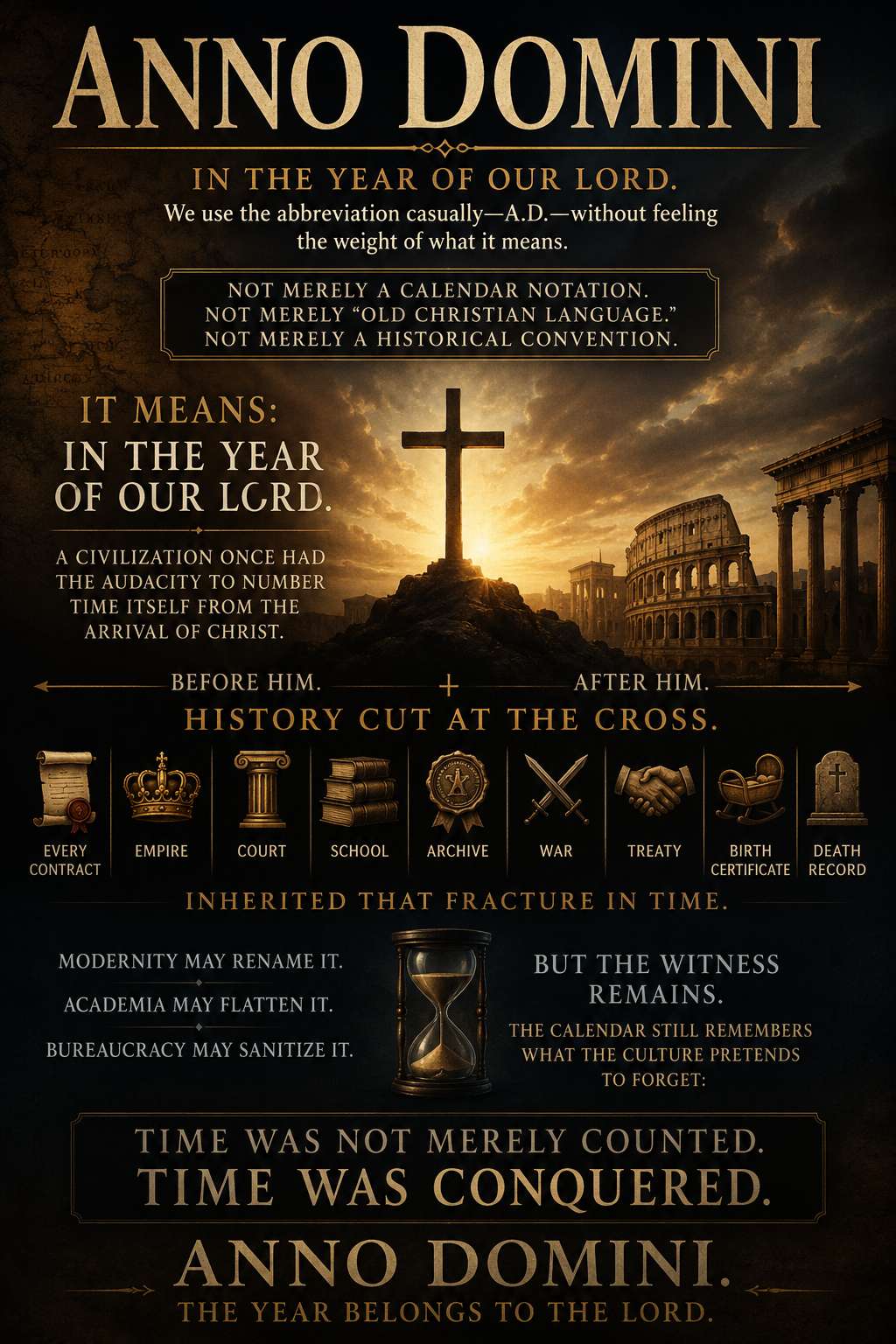 We use the abbreviation casually — A.D. — without feeling the weight of what it means.
Not merely a calendar notation.
Not merely “old Christian language.”
Not merely a historical convention.
It means: In the year of Our Lord.
A civilization once had the audacity to number time itself from the arrival of Christ.
Before Him.
After Him.
History cut at the Cross.
Every contract, empire, court, school, archive, war, treaty, birth certificate, and death record inherited that fracture in time.
Modernity may rename it.
Academia may flatten it.
Bureaucracy may sanitize it.
But the witness remains.
The calendar still remembers what the culture pretends to forget:
Time was not merely counted.
Time was conquered.
Anno Domini.
The year belongs to the Lord.
#AnnoDomini #AD #InTheYearOfOurLord #ChristIsKing #HistoryCutAtTheCross #TimeWasConquered #CivilizationalMemory #ChristianCivilization #TheCalendarRemembers #TheCross #SacredTime #Christendom #TheWitnessRemains #FaithAndHistory #LordOfTime #Logos #EmpireAndTheCross #WesternCivilization #TheYearBelongsToTheLord #DeusVult
We use the abbreviation casually — A.D. — without feeling the weight of what it means.
Not merely a calendar notation.
Not merely “old Christian language.”
Not merely a historical convention.
It means: In the year of Our Lord.
A civilization once had the audacity to number time itself from the arrival of Christ.
Before Him.
After Him.
History cut at the Cross.
Every contract, empire, court, school, archive, war, treaty, birth certificate, and death record inherited that fracture in time.
Modernity may rename it.
Academia may flatten it.
Bureaucracy may sanitize it.
But the witness remains.
The calendar still remembers what the culture pretends to forget:
Time was not merely counted.
Time was conquered.
Anno Domini.
The year belongs to the Lord.
#AnnoDomini #AD #InTheYearOfOurLord #ChristIsKing #HistoryCutAtTheCross #TimeWasConquered #CivilizationalMemory #ChristianCivilization #TheCalendarRemembers #TheCross #SacredTime #Christendom #TheWitnessRemains #FaithAndHistory #LordOfTime #Logos #EmpireAndTheCross #WesternCivilization #TheYearBelongsToTheLord #DeusVult