GN

GN Pura Vida

"Exit To Community"
law: rules enforced with violence.
code: rules enforced with logic.
code > law
Popping this into my feed. I am shopping for relay implementations.
View quoted note →Today, it's more like:
"User doesn't know what the Platform Provider knows about the User and what the User doesn't know about their own self."
View quoted note →SDLC assumes humans excel at detailed planning and consistent execution. We’re not. We’re good at creative problem-solving and adapting to changing requirements. AI-DLC leverages our strengths instead of opposing them.
https://medium.com/data-science-collective/sdlc-is-dead-heres-what-killed-it-and-what-s-coming-next-ca97613d5a3e
Militaries Try Out Alternatives to GPS
BY MIKE CHERNEY
The Wall Street Journal
Nov 20, 2025
GRIFFITH, Australia—At a tiny airport in the Australian countryside last month, a small plane took off carrying a device that could transform how U.S. drones, aircraft and navy ships navigate across future battlefields.
The flight carried an instrument that shines lasers at atoms, which behave like compass needles to measure Earth’s magnetic field in real time. Readings from the device can be compared to a magnetic-field map, helping a user determine their location—and offering a backup to satellite navigation like the Global Positioning System, or GPS.
For the U.S. and allies, finding new ways to navigate is crucial. In Ukraine, Russia is jamming and spoofing—blocking and faking signals—so frequently that satellite navigation isn’t dependable. Other potential adversaries, including China and North Korea, possess similar capabilities.
GPS spoofing by militaries has become a civilian hazard as well, presenting a risk to commercial aircraft.
“This problem hasn’t been as urgent until right now, when we are seeing the end of reliable GPS,” said Russell Anderson, a principal scientist at QCTRL, the Australian startup that ran the test flight. “It is the arms race of the current day, in terms of navigation.”
Scientists around the world are exploring whether harnessing the quantum properties of atoms can help navigate accurately in so-called contested environments. But it is still unclear whether the devices, which work well in labs and field tests, would perform reliably on actual military missions.
The Pentagon is hoping to solve that problem. In August, the research and development agency at the Defense Department launched a program to help make quantum sensors more robust.
The agency said the extraordinary sensitivity of the devices makes them fragile in real-world environments, where vibrations or electromagnetic interference can degrade performance. Australiabased Q-CTRL was selected to participate; another company, Safran Federal Systems in Rochester, N.Y., also said it was awarded a contract.
The work is taking on increasing urgency. Russia and China have advanced their electronic-warfare capabilities. European officials have accused Russia of widespread jamming of aircraft.
The problem with GPS is the signals are typically weak, making them easy to block. The U.S. has been rolling out a more powerful GPS signal for the military called M-code that is more resilient to jamming, but there has been a holdup in getting funding for the receivers needed to use it, said Todd Harrison, a senior fellow at the American Enterprise Institute.
“The U.S. military now realizes future battlefields will be
fully contested in the electromagnetic domain unlike anything we have seen before,” he said.
Quantum devices, potentially working together, could tip the balance, proponents say. Quantum clocks, for example, could boost the precision and accuracy of timekeeping. Another quantum sensor, also being developed by Q-CTRL, can navigate by detecting small changes in gravity.
“Quantum sensing is a priority,” said Tanya Monro, the chief scientist for Australia’s Department of Defence, which hosted a trial of the Q-CTRL gravity sensor on one ship. “There is an absolute, driving need to be able to operate with complete denial of GPS.”
The Q-CTRL device on the plane in Griffith is called an optically pumped magnetometer. It shoots lasers at atoms of rubidium, a soft, silvery-white metal, that are held in a gaseous form in a small glass vial. The lasers help measure changes in the atoms’ internal compass needle, which is used to calculate the strength of the magnetic field.
Q-CTRL’s software then removes interference from outside sources, such as the aircraft itself, producing an accurate measurement of the Earth’s magnetic field in that location, which can be compared to a magnetic map. Such maps show deviations from the average field strength over the surface of the Earth.
“You can go out in the woods, and with a map and your eyes identify, ‘Well, there’s a hill and there’s a valley and there’s a stream, so I think I’m right here on the map,’ ” said Michael J. Biercuk, the American quantum physicist who founded Q-CTRL. “You can do exactly the same thing with these magnetic signals.”
Biercuk said there is no realistic way to jam quantum magnetometers or gravimeters from a distance, short of an energy pulse that would fry all the electronics on a plane and cause it to crash. He said QCTRL has subjected the sensors to shaking and dynamic maneuvers with good results—including more than 140 hours of continuous operation on the Australian ship.
In Griffith, Q-CTRL engineers tested three magnetometers in different locations on the plane, given that the external interference in each spot is different. The units were tested against a high-end inertial navigation system—which estimates position by using gyroscopes and accelerometers. These systems are already used as GPS backups and on submarines, which can’t access GPS when underwater.
All three locations performed comparably, Biercuk said. Over an 80-mile test window, a sensor on the tip of the plane’s wing resulted in an average position estimate within about 620 feet of the true position, and the margin of error didn’t increase with the duration of the flight, he said. The performance was more than 10 times better than the inertial navigation system.
There are challenges with the magnetometer approach. One is the need to have detailed magnetic maps. Another is to make the device inexpensive enough for cheap drones.
“Quantum offers a lot of potential,” said Allison Kealy, a professor at Swinburne University of Technology in Melbourne. She noted, though, that “I think they’re like any other sensor. They have their strengths and weaknesses.”
In Griffith, not everything went smoothly. At one point, there was a communication issue involving the wingtip sensor, and it was swapped out for a different unit. More work is ahead, some of the Q-CTRL scientists said.
“Can it survive a rocket launch? Can it survive a crash landing?” said Yuval Cohen, a Q-CTRL researcher. “You don’t really know, until you do the testing.”
Shared via PressReader
connecting people through news
forgive them, for they know not zaps on nostr…

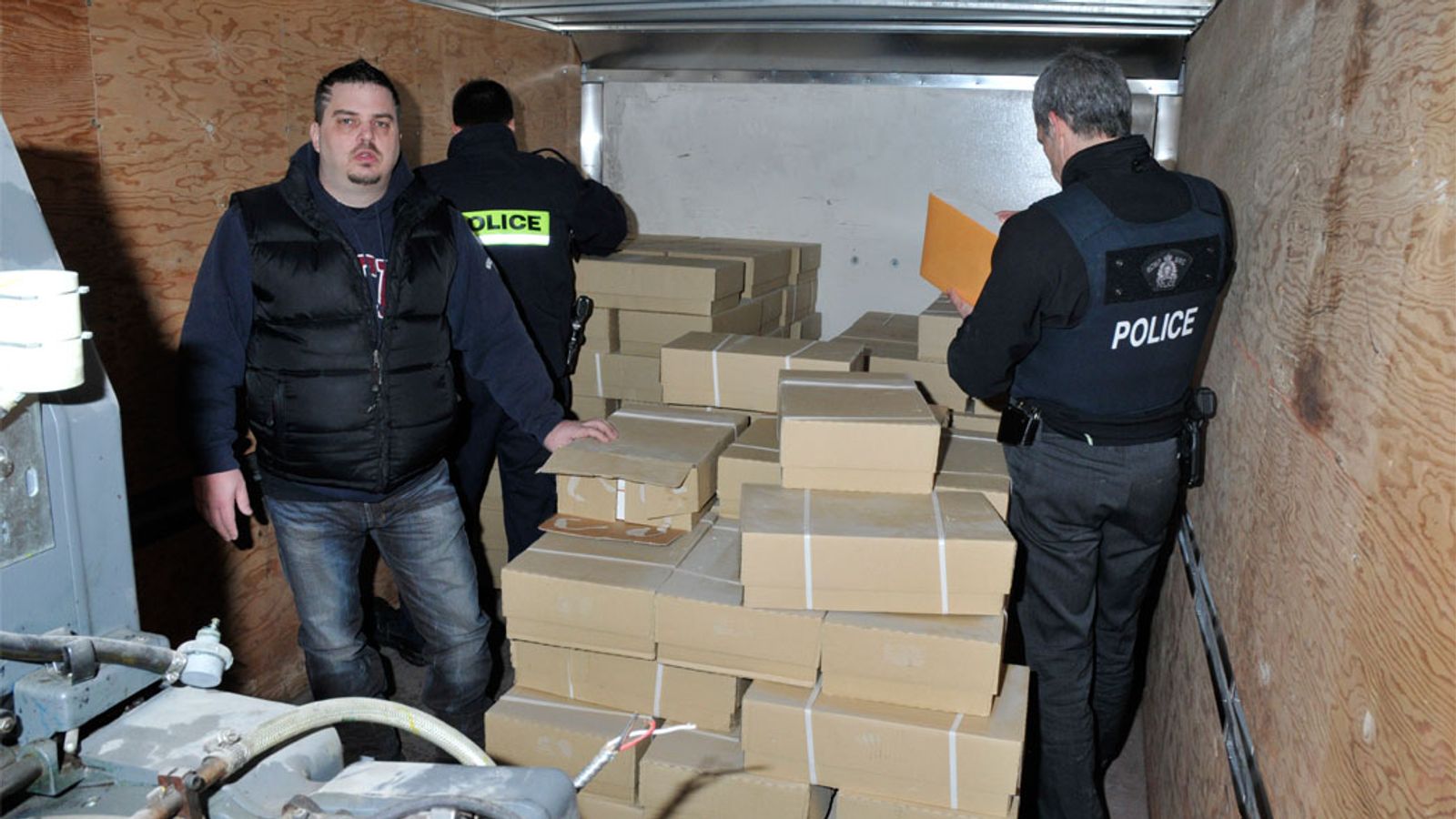
Crown wins legal battle for $1.2M buried under garage
National Post
Nov 19, 2025
The government gets to keep stacks of cash found by police on an Ontario man’s property — including $1.2 million buried in a tub under the floor of his garage — even though the owner was found not guilty of possessing the proceeds of crime and other charges.
After 16 years of fighting to get it back, Marcel Breton lost his legal appeal on Monday over his mysterious mounds of money.
A police discovery in 2009 of huge amounts of cash on a rural property surrounded by forest just outside of Thunder Bay was eye catching.
Stacks and bundles of money, mostly in $20 bills, was found hidden in various spots of a home and detached buildings on the property, but the centrepiece was the contents of a large Rubbermaid tub buried about 20 centimetres under the dirt floor of a detached garage.
It was stuffed with cash packaged in bundles of $5,000 and $10,000 each, court heard. Police seized $1,235,600.
The officers “were flabbergasted, to say the least,” an Ontario Provincial Police officer told local media at the time.
Breton, then 44 years old, was arrested and charged with drug offences and possession of property obtained by crime. An OPP news release sent Dec. 4, 2009, announced that officers found cocaine, ecstasy pills, marijuana and cannabis resin with an estimated street value of $22,000 — and lots of cash.
The case had a twisting path in court.
When police arrived at the nearly seven-hectare property for the search, officers weren’t officially looking for cash or drugs. They had a warrant to search for a gun. They didn’t find a gun.
But they sure found money. Wads of cash were found in the heating vents, in a suitcase, in Breton’s pockets, in a tool box, under a drawer, in a black bag, and in the buried, sealed tub. It took police 18 hours to count it, as some was mouldy, damp and sticking together, an officer said in court.
Fighting over the money soon began.
Before his trial, Breton applied to use the money to fund his legal defence.
“The currency seized is mine,” he told court in 2012. “I was the only one who was aware of its location in the garage. I have no other assets or means available for the purpose of paying my reasonable legal expenses.”
The Canada Revenue Agency also laid claim to the money, telling court Breton hadn’t filed tax returns from 2001 to 2009, but for one income statement for $14,796, and the money should be applied as outstanding taxes. The judge set aside both claims.
In pretrial motions, Breton complained to the judge that the court should reject the search warrant, but this was denied and the case went to trial in 2014 with Breton sitting without a lawyer.
He was convicted of several charges and sentenced to nine and a half years of incarceration.
The Ontario government sought a forfeiture order that year to keep items seized in the search — the cash, a tractor, a backhoe, a Camaro sports car, a boat, and other vehicles.
But Breton appealed his convictions. He argued the judge failed to provide adequate assistance to him as a self-represented accused. The Crown conceded he deserved a new trial and he again pleaded not guilty.
After delays in 2019 when he fired lawyers and in 2020 when the pandemic slowed court proceedings, his case was heard in 2021 and Breton’s complaints about the search warrant were heard again. This time there was a different outcome.
It was revealed that perhaps officers were not as flabbergasted as they made out. Before the search, a joint federal-provincial-municipal organized crime task force heard allegations from a confidential informant that Breton had a gun on the premises and, two years earlier, another informant alleged he was involved in the drug trade.
Judge F. Bruce Fitzpatrick of Ontario’s Superior Court of Justice said the property was large, buildings on it were big, and that a second person had ownership ties to the property, a man alleged to be a member of the Hells Angels Motorcycle Club.
Fitzpatrick said the police affidavit to obtain the search warrant did not consider the ownership issue, raising questions on the “actual possession of the different buildings that were sought to have been searched,” he ruled.
A residential search “is a significant intrusion of the state into a place where Canadians have a high reasonable expectation of privacy. That expectation is not a shield against criminal activity. It is however something that must be only carefully breached,” Fitzpatrick wrote.
“The police were not really searching for a gun on Dec, 1, 2009. They had a preconceived idea that Mr. Breton was a drug dealer. They were looking for drugs and proceeds of crime,” he wrote in that decision.
He found the search was “an impermissible degree of overreach on the part of the police” that violated Breton’s right against unreasonable search or seizure. That made items seized inadmissible at trial.
With the drugs and money off the table, prosecutors called no evidence at Breton’s re-trial, and he was found not guilty of all charges.
The provincial government, however, maintained it should still keep the cash, sparking another round of hearings.
Fitzpatrick said a different balancing of interest was in play at a forfeiture hearing than at a criminal trial where guilt or innocence are on the line, meaning the outcome can’t deprive someone of their liberty, only of property.
It didn’t change the wrongful nature of the Charter breaches, he wrote, but it changed the remedy. Breton has already benefited from the Charter remedy by having charges dropped. The forfeiture case heard evidence on the characteristics of the cash being consistent with drug trafficking and on the lack of alternative sources of Breton’s income.
This time, Fitzpatrick ruled that prosecutors had proven the cash found in the garage was the proceeds of crime and should be forfeited, although Breton could keep the $16,000 found in the house and in his pockets.
Breton appealed to the Ontario Court of Appeal. He argued his acquittal should preclude the judge from finding his money was unlawful.
The appeal court disagreed, finding the trial judge had ruled the money couldn’t be used as evidence at trial, but the money was never ruled to be lawfully obtained since it was no longer in evidence.
In other words, Breton was deemed innocent, not his money.
The court of appeal dismissed Breton’s appeal.
Breton could not be reached for comment and his lawyer did not respond to a request for comment prior to publication deadline.
Shared via PressReader
connecting people through news
Price of a banana has skyrocketed these last few days. Now 188 sats/banana. I was hoping that it would soon be 100 sats/banana.
#satsbanana

“We know they are lying. They know they are lying. They know that we know they are lying. We know that they know that we know they are lying. And still they continue to lie.”

Why Authoritarians Fear Common Knowledge
An excerpt from Steven Pinker’s new book “When Everyone Knows That Everyone Knows…”
Be like Benjamin Franklin. Don’t use Cloudflare.
This just in: EU Decentralization Committee launches inquiry into most recent Cloudflare failure.
The chair of the committee said, ‘We cannot have decentralization threatened by this failure. We are considering the maximum fine possible, as we need the funds for the upkeep of our headquarters estate, recently seized from oligarchs.’
#satire
Benjamin Franklin used to get up at 4am in the morning and shitpost for 2 hours before having breakfast.
Stop obeying texts.