Can Bitcoin Be Sent Without the Internet? Absolutely! 🌐🚫
Bitcoin’s versatility makes it unstoppable, even in offline environments. Here are some innovative ways to send Bitcoin
1️⃣ Radio Waves:
Bitcoin transactions can be transmitted over long-range through radio frequencies. Perfect for remote areas with no internet.
2️⃣ Satellite:
With Blockstream Satellite, Bitcoin is beamed from space! Users can connect via specialized hardware to send and receive Bitcoin anywhere on Earth.
3️⃣ Text Messages (SMS):
Platforms like CoinText allow you to send Bitcoin via a simple SMS. No apps, no data just your phone number.
4️⃣ Physical Transfer:
Save a Bitcoin transaction file on a USB or SD card, then deliver it physically to someone who can broadcast it online.
5️⃣ Mesh Networks:
Devices like GoTenna create local mesh networks, letting Bitcoin users relay transactions without relying on the internet or cellular networks.
These methods prove that Bitcoin isn’t just digital it’s adaptable, resilient, and ready to serve in any scenario. No internet? No problem. Bitcoin works everywhere. Stack Harder ⚡️
Login to reply
Replies (12)
Mesh networks are underrated I think.
That's one rabbit hole I've been putting off for a while now.
Have you explored them?
hi, nor explored mesh network.. I am exploring thus option
option


Damus
TollGate on nostr
## What is a TollGate? TollGate is a set of tools that enables
TollGate enables anyone to be an internet service provider. If you have internet, you can sell internet. If your neighbor is selling you internet, you can resell it and basically act as a range extender for the other neighbors who can't reach him.
The goal is to make the market for connectivity as accessible as the market for hashrate, so that anyone who sees an opportunity to deliver value can act on it.
This is under development.. if interested you guys can join the signal group to interact with developers of the tool.. and also help in testing the tools..
Oh yeah it's def something I want to check out
For clients that can handle nevents directly
## What is a TollGate?
TollGate is a set of tools that enables WiFi routers to accept Bitcoin payments for internet access. This allows anyone with suitable hardware and an internet gateway to operate as an internet service provider.
## What is nostr?
[Nostr](https://github.com/nostr-protocol/nips/blob/master/01.md) (Notes and Other Stuff Transmitted by Relays) is a simple yet powerful decentralised protocol that enables seamless JSON based communication between public keys through relay servers. In the context of TollGate, nostr serves as the perfect foundation for handling WiFi access payments by eliminating the need for traditional captive portals and providing instant, reliable connections through websocket technology. The protocol's relay-based architecture reduces common firewall issues while offering standardised payment methods. Its flexible nature means components can be deployed almost anywhere with minimal configuration, making it ideal for TollGate operators to set up and developers to maintain their services.
### What are the hardware requirements?
A TollGate must have at least two network interfaces. One interface connects to an internet gateway, while the other interface acts as a WiFi access point for users or other TollGates. Each TollGate runs its own DHCP server with a unique address range to avoid collisions with its gateway or its clients (who could also be running a DHCP server). Hence, each TollGate is a stand-alone system from a networking perspective. Finally, each TollGate has gate-keeping logic that manages firewall rules for allowing clients to access the internet gateway once they have paid and to cut them off again when their session ends.
Currently we are targeting [GL-AR300m](https://www.gl-inet.com/products/gl-ar300m/), [GL-MT300](https://www.gl-inet.com/products/gl-mt3000/?utm_source=website&utm_medium=menubar) and [GL-MT600](https://www.gl-inet.com/products/gl-mt6000/) because they come with `uboot` for system recovery and they support OpenWRT out of the box.
### TollGate's New Architecture
Previously we used WiFi captive portals like [nodogsplash](https://github.com/nodogsplash/nodogsplash) and [OpenNDS](https://github.com/openNDS/openNDS) for managing access to the internet gateway. These captive portals allowed us to quickly build a proof of concept. However, both captive portals came with severe UX and maintainability limitations - see [limitations of captive portals](#benefits-of-using-crows-nest-over-captive-portal).
A key benefit of building on `nostr` is that `services` can generate their own public key based identity (`npub`) in order to send and receive `json` content from other services as long as they have an outbound internet connection that can connect to public IP addresses. Nostr abstracts away the networking layer entirely, so developers don't need to think about things like firewalls, IP-addresses, ports and network boundaries.
Thanks to recent success that @origami74 had in running a nostr [relay](https://github.com/fiatjaf/khatru) and a [client](https://github.com/OpenTollGate/tollgate-module-valve-go) on the GL-AR300m, we are now able to build in ways that we could only have dreamt of before.
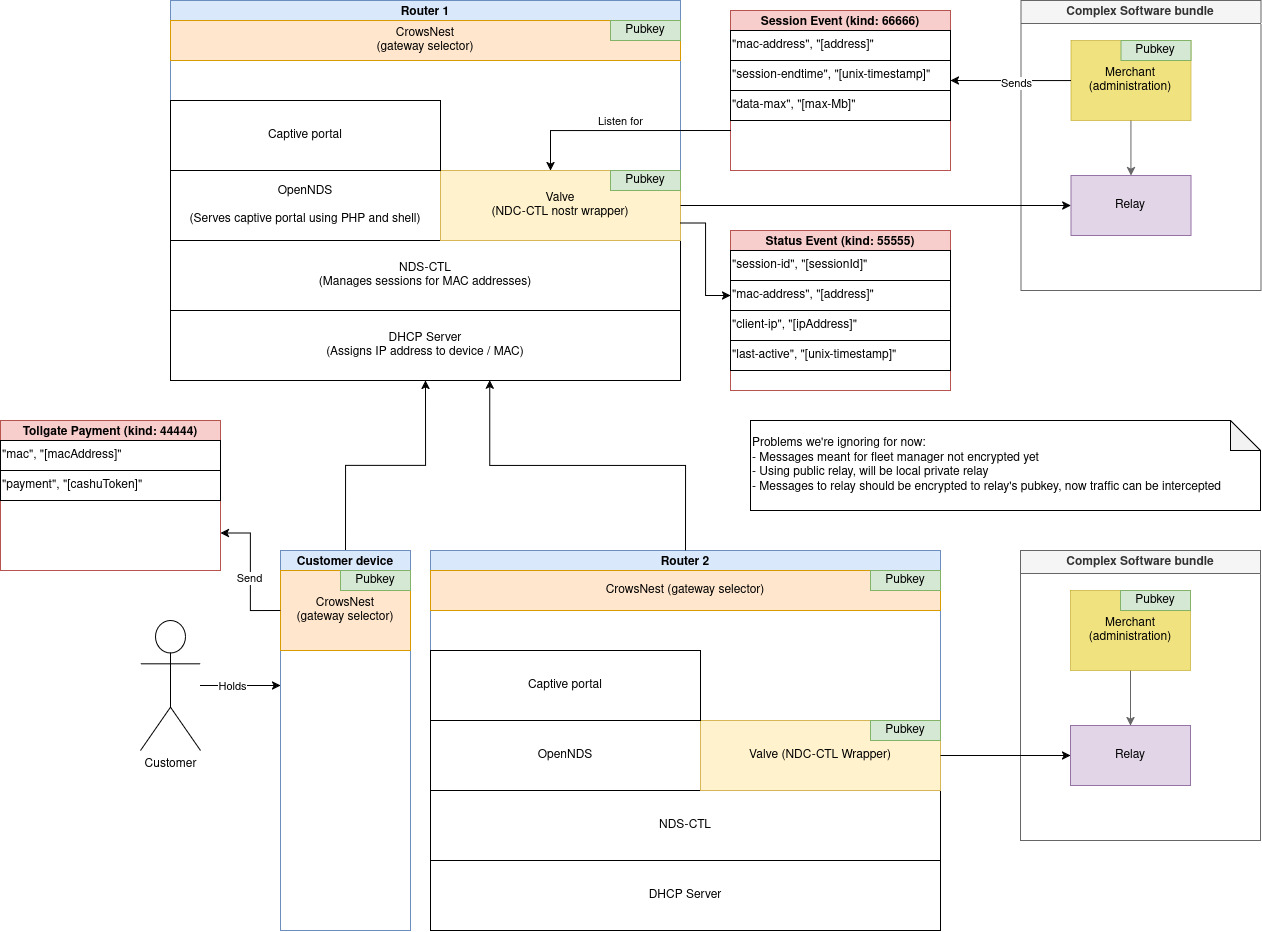
This figure illustrates the modules that TollGate is now comprised of:
And this sequence diagram illustrates the interaction between the services:
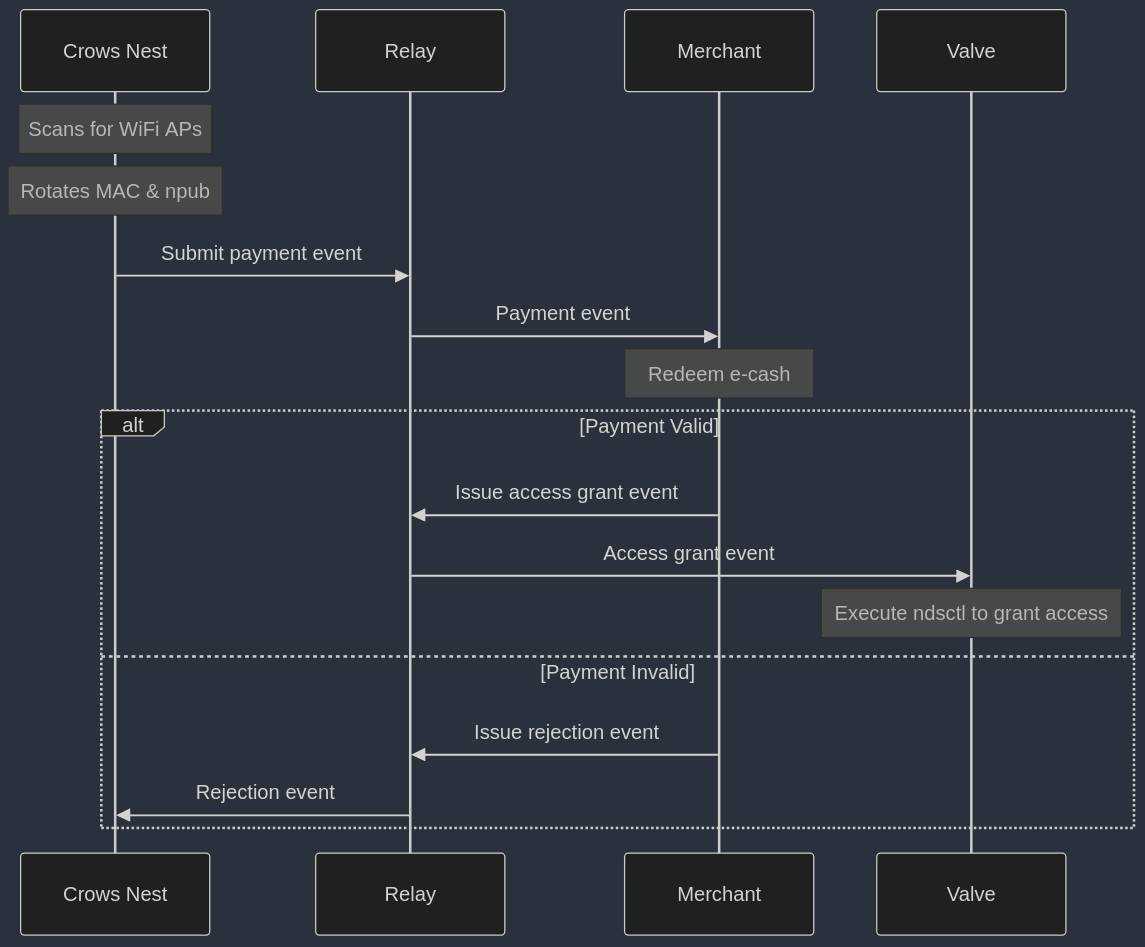
TollGate is now comprised of three main types of services and a relay:
* **Crows Nest:** scans for available WiFi access points in search of gateways that are worth connecting to. Upon finding a suitable gateway, the crows nest rotates this devices `MAC address` and `npub` (for privacy), connects to the WiFi access point and submits a `payment event` if required.
* **Valve:** manages access to the internet gateway. Currently the valve is just a `nostr` wrapper around a CLI tool called [ndsctl](https://opennds.readthedocs.io/en/stable/ndsctl.html) for managing user sessions in captive portals. Thanks to the fact that the valve now has an `npub`, it can be controlled via events that are issued by the `merchant` service.
* **Merchant:** sets prices, redeems e-cash notes from `payment events` that customers issued and it issues events that the valve responds to. Merchants can be light weight and fit on the router if they outsource the e-cash redemption logic to third party APIs. However, thanks to nostr, the merchants don't strictly need to run on the router.
* **Relay:** simplifies connectivity for services. Nostr relays usually have a public IP address, though TollGates will also have a local relay so critical services that are in the local network continue to function when the TollGate loses internet access.
### What runs where?
Now that merchants are controlling `valves` via nostr events, it is perfectly fine for the merchant to be a more complex software bundle with an e-cash wallet and lightning support on an `x86 machine`. The merchant can just issue `nostr events` that control the valve irrespective of how the network connecting the `x86 machine` with the `router` looks. Having the ability to shuffle services around between devices like this enables TollGate contributors to create value with the skill sets that they already have.
#### Order in which devices are being targeted
The following table provides an overview of the order in which we hope to target various devices for each of TollGate's services:
<table>
<tr>
<th>Module</th>
<th>Low hanging fruits</th>
<th>Mid term targets</th>
<th>Long term targets</th>
</tr>
<tr>
<td>Crows Nest</td>
<td>Router, Mobile</td>
<td>x86, armhf</td>
<td>IoT</td>
</tr>
<tr>
<td>Valve</td>
<td>Router</td>
<td>x86, armhf</td>
<td>mobile</td>
</tr>
<tr>
<td>Full Merchant</td>
<td>x86, armhf</td>
<td>router</td>
<td>mobile</td>
</tr>
<tr>
<td>Legacy Merchant</td>
<td>router</td>
<td>-</td>
<td>-</td>
</tr>
</table>
##### Crows Nest
Routers need the ability to buy from other routers so that the network can grow outwards from the gateway. Hence, routers need a crows nest for TollGate based networks to scale. Previously, users interacted with the WiFi captive portals manually and they still can if they like, but it isn't recommended (see section [crows nest vs captive portal](#benefits-of-using-crows-nest-over-captive-portal)).
Users who own a TollGate can have the WiFi UX that they are already used to because they can connect to their own device using a WiFi password like they already do with their home router. They are not making any compromises since they are authenticating their devices on their own TollGate. The crows nest of their TollGate now purchases internet on their behalf without their client devices needing to know anything about TollGate.
Requiring that users own a router to get the full TollGate experience could hinder adoption. Sure, they can paste e-cash into the captive portal manually or with a script, but the UX depends on their client device and they have all the down sides of not making granular payments. Hence, users who want good UX without owning a TollGate would benefit from having the ability to install a [crows nest on their client devices](https://github.com/delcin-raj/tollgate-ui) (`mobile` and `x86`) for more granular and reliable data purchases.
##### Valve
Each TollGate needs to have a valve in order to manage access to the internet gateway. The valve runs on the router since that's currently our gate-keeping device. However, ndsctl seems to already have [debian support](https://manpages.debian.org/testing/opennds-daemon-common/ndsctl.1.en.html) so turning an `x86` or `armhf` machine into a TollGate might just be a question of getting the network interfaces and configurations under control on debian.
> Currently there isn't a clear line between ndsctl (which we rely on for gate-keeping) and the captive portal which brings a lot of complexity to TollGate. Hopefully the valve becomes more of a stand alone solution rather than a wrapper around part of a captive portal in future (see section [captive portal](#benefits-of-using-crows-nest-over-captive-portal)).
##### Merchants
##### Legacy Merchant
The "legacy merchant" is what we have been using so far. Its just a shell script that runs on the router and [submits incoming e-cash](https://github.com/OpenTollGate/tollgate-outdated-build-environment/blob/ebb875697ff7bb078382ece6107060f91e240809/files/cgi-bin/curl_request.sh#L287-L291) notes to a 3rd party API that redeems the notes over lightning and returns a HTTP response informing the TollGate whether the payment was redeemed successfully. This worked since day 1 of TollGate thanks to the robust and accessible cashu ecosystem and the fact that no cryptographic libraries or wallets need to run on the router. However, it meant that TollGate's feature set depended on the APIs of cashu developers who are also busy.
##### Full Merchant
Now that TollGate has full nostr support, operators can easily run their own e-cash wallet, lightning node and gateway selection business logic on an `x86 machine` and continue to interact with other components of TollGate as if this complex software bundle was running on the router. Clearly this model is more self sovereign and a faster route to building robust TollGates. We can still consider moving (part of) the merchant onto the router for more powerful routers or for `x86/armhf` based TollGates.
#### Benefits of using crows nest over captive portal
* **Lightning-Fast Connections:** crows nest eliminates the painful waiting and clicking associated with captive portals, enabling near-instant internet access. As a nostr client, it handles payments and authentication in the background without any user interaction.
* **True Privacy & Flexibility:** the crows nest architecture enables:
* Seamless switching between TollGates without wasting large amounts of prepaid data
* Identity (npub + MAC address) rotation between sessions making ISP data retention more challenging
* Protection against potential abuse since payments are small and frequent, with automatic verification of service delivery
* **Reliable & Consistent Experience:** captive portals are notoriously inconsistent across different devices, operating systems, and browsers. The crows nest provides a dependable experience by moving critical functionality to the client side, where we have full control over the implementation.
* **Universal Compatibility:** each crows nest comes with its own npub and produces nostr events, making it straightforward to add support for new devices. There's no need to deal with the complexities of scraping captive portals - devices can even pre-purchase data before switching networks.
* **Superior Performance:** our testing shows significantly faster session initialisation compared to traditional captive portal solutions, as we bypass the multi-second processing delays typically associated with router-based portals.
While a captive portal remains valuable as an on-boarding tool for first-time users, the crows nest enables seamless WiFi access. We believe this approach will eventually make the traditional captive portal experience obsolete for regular users. More detailed information about the issues we faced with captive portals and the solutions we already considered can be found [here](https://opentollgate.github.io/tollgate/early-development-and-mistakes-to-be-avoided).
Huge thanks to @Arjen for making nostr so accessible for TollGate!
View quoted note →
Hadn’t heard of Tollgate yet, but sounds very inter. Will get to Googling. Used to do a lot with OpenWRT.
note1llv56kpkk4l7tauyt3cqvht9v2y766vt93x0daexft56sdn7uh0qpzndl2
Tollgate npub
npub1zzt0d0s2f4lsanpd7nkjep5r79p7ljq7aw37eek64hf0ef6v0mxqgwljrv
Feel free to ping us if you have any questions. A public Q&A could benefit others as well. We are learning about OpenWRT as we go. Experienced insights are most welcome 😀
Initially, TollGate used WiFi captive portals to accept e-cash for access to a gateway. TollGates were also able to buy internet access from each other using curl requests to their respective captive portals, thus allowing the user to be multiple hops away from a KYC internet connection.
Now TollGates are more modular and they use nostr events for interoperability between services. This enables users to make small, frequent data purchases without the bad UX of captive portals:
## What is a TollGate?
TollGate is a set of tools that enables WiFi routers to accept Bitcoin payments for internet access. This allows anyone with suitable hardware and an internet gateway to operate as an internet service provider.
## What is nostr?
[Nostr](https://github.com/nostr-protocol/nips/blob/master/01.md) (Notes and Other Stuff Transmitted by Relays) is a simple yet powerful decentralised protocol that enables seamless JSON based communication between public keys through relay servers. In the context of TollGate, nostr serves as the perfect foundation for handling WiFi access payments by eliminating the need for traditional captive portals and providing instant, reliable connections through websocket technology. The protocol's relay-based architecture reduces common firewall issues while offering standardised payment methods. Its flexible nature means components can be deployed almost anywhere with minimal configuration, making it ideal for TollGate operators to set up and developers to maintain their services.
### What are the hardware requirements?
A TollGate must have at least two network interfaces. One interface connects to an internet gateway, while the other interface acts as a WiFi access point for users or other TollGates. Each TollGate runs its own DHCP server with a unique address range to avoid collisions with its gateway or its clients (who could also be running a DHCP server). Hence, each TollGate is a stand-alone system from a networking perspective. Finally, each TollGate has gate-keeping logic that manages firewall rules for allowing clients to access the internet gateway once they have paid and to cut them off again when their session ends.
Currently we are targeting [GL-AR300m](https://www.gl-inet.com/products/gl-ar300m/), [GL-MT300](https://www.gl-inet.com/products/gl-mt3000/?utm_source=website&utm_medium=menubar) and [GL-MT600](https://www.gl-inet.com/products/gl-mt6000/) because they come with `uboot` for system recovery and they support OpenWRT out of the box.
### TollGate's New Architecture
Previously we used WiFi captive portals like [nodogsplash](https://github.com/nodogsplash/nodogsplash) and [OpenNDS](https://github.com/openNDS/openNDS) for managing access to the internet gateway. These captive portals allowed us to quickly build a proof of concept. However, both captive portals came with severe UX and maintainability limitations - see [limitations of captive portals](#benefits-of-using-crows-nest-over-captive-portal).
A key benefit of building on `nostr` is that `services` can generate their own public key based identity (`npub`) in order to send and receive `json` content from other services as long as they have an outbound internet connection that can connect to public IP addresses. Nostr abstracts away the networking layer entirely, so developers don't need to think about things like firewalls, IP-addresses, ports and network boundaries.
Thanks to recent success that @origami74 had in running a nostr [relay](https://github.com/fiatjaf/khatru) and a [client](https://github.com/OpenTollGate/tollgate-module-valve-go) on the GL-AR300m, we are now able to build in ways that we could only have dreamt of before.
This figure illustrates the modules that TollGate is now comprised of:

And this sequence diagram illustrates the interaction between the services:

TollGate is now comprised of three main types of services and a relay:
* **Crows Nest:** scans for available WiFi access points in search of gateways that are worth connecting to. Upon finding a suitable gateway, the crows nest rotates this devices `MAC address` and `npub` (for privacy), connects to the WiFi access point and submits a `payment event` if required.
* **Valve:** manages access to the internet gateway. Currently the valve is just a `nostr` wrapper around a CLI tool called [ndsctl](https://opennds.readthedocs.io/en/stable/ndsctl.html) for managing user sessions in captive portals. Thanks to the fact that the valve now has an `npub`, it can be controlled via events that are issued by the `merchant` service.
* **Merchant:** sets prices, redeems e-cash notes from `payment events` that customers issued and it issues events that the valve responds to. Merchants can be light weight and fit on the router if they outsource the e-cash redemption logic to third party APIs. However, thanks to nostr, the merchants don't strictly need to run on the router.
* **Relay:** simplifies connectivity for services. Nostr relays usually have a public IP address, though TollGates will also have a local relay so critical services that are in the local network continue to function when the TollGate loses internet access.
### What runs where?
Now that merchants are controlling `valves` via nostr events, it is perfectly fine for the merchant to be a more complex software bundle with an e-cash wallet and lightning support on an `x86 machine`. The merchant can just issue `nostr events` that control the valve irrespective of how the network connecting the `x86 machine` with the `router` looks. Having the ability to shuffle services around between devices like this enables TollGate contributors to create value with the skill sets that they already have.
#### Order in which devices are being targeted
The following table provides an overview of the order in which we hope to target various devices for each of TollGate's services:
<table>
<tr>
<th>Module</th>
<th>Low hanging fruits</th>
<th>Mid term targets</th>
<th>Long term targets</th>
</tr>
<tr>
<td>Crows Nest</td>
<td>Router, Mobile</td>
<td>x86, armhf</td>
<td>IoT</td>
</tr>
<tr>
<td>Valve</td>
<td>Router</td>
<td>x86, armhf</td>
<td>mobile</td>
</tr>
<tr>
<td>Full Merchant</td>
<td>x86, armhf</td>
<td>router</td>
<td>mobile</td>
</tr>
<tr>
<td>Legacy Merchant</td>
<td>router</td>
<td>-</td>
<td>-</td>
</tr>
</table>
##### Crows Nest
Routers need the ability to buy from other routers so that the network can grow outwards from the gateway. Hence, routers need a crows nest for TollGate based networks to scale. Previously, users interacted with the WiFi captive portals manually and they still can if they like, but it isn't recommended (see section [crows nest vs captive portal](#benefits-of-using-crows-nest-over-captive-portal)).
Users who own a TollGate can have the WiFi UX that they are already used to because they can connect to their own device using a WiFi password like they already do with their home router. They are not making any compromises since they are authenticating their devices on their own TollGate. The crows nest of their TollGate now purchases internet on their behalf without their client devices needing to know anything about TollGate.
Requiring that users own a router to get the full TollGate experience could hinder adoption. Sure, they can paste e-cash into the captive portal manually or with a script, but the UX depends on their client device and they have all the down sides of not making granular payments. Hence, users who want good UX without owning a TollGate would benefit from having the ability to install a [crows nest on their client devices](https://github.com/delcin-raj/tollgate-ui) (`mobile` and `x86`) for more granular and reliable data purchases.
##### Valve
Each TollGate needs to have a valve in order to manage access to the internet gateway. The valve runs on the router since that's currently our gate-keeping device. However, ndsctl seems to already have [debian support](https://manpages.debian.org/testing/opennds-daemon-common/ndsctl.1.en.html) so turning an `x86` or `armhf` machine into a TollGate might just be a question of getting the network interfaces and configurations under control on debian.
> Currently there isn't a clear line between ndsctl (which we rely on for gate-keeping) and the captive portal which brings a lot of complexity to TollGate. Hopefully the valve becomes more of a stand alone solution rather than a wrapper around part of a captive portal in future (see section [captive portal](#benefits-of-using-crows-nest-over-captive-portal)).
##### Merchants
##### Legacy Merchant
The "legacy merchant" is what we have been using so far. Its just a shell script that runs on the router and [submits incoming e-cash](https://github.com/OpenTollGate/tollgate-outdated-build-environment/blob/ebb875697ff7bb078382ece6107060f91e240809/files/cgi-bin/curl_request.sh#L287-L291) notes to a 3rd party API that redeems the notes over lightning and returns a HTTP response informing the TollGate whether the payment was redeemed successfully. This worked since day 1 of TollGate thanks to the robust and accessible cashu ecosystem and the fact that no cryptographic libraries or wallets need to run on the router. However, it meant that TollGate's feature set depended on the APIs of cashu developers who are also busy.
##### Full Merchant
Now that TollGate has full nostr support, operators can easily run their own e-cash wallet, lightning node and gateway selection business logic on an `x86 machine` and continue to interact with other components of TollGate as if this complex software bundle was running on the router. Clearly this model is more self sovereign and a faster route to building robust TollGates. We can still consider moving (part of) the merchant onto the router for more powerful routers or for `x86/armhf` based TollGates.
#### Benefits of using crows nest over captive portal
* **Lightning-Fast Connections:** crows nest eliminates the painful waiting and clicking associated with captive portals, enabling near-instant internet access. As a nostr client, it handles payments and authentication in the background without any user interaction.
* **True Privacy & Flexibility:** the crows nest architecture enables:
* Seamless switching between TollGates without wasting large amounts of prepaid data
* Identity (npub + MAC address) rotation between sessions making ISP data retention more challenging
* Protection against potential abuse since payments are small and frequent, with automatic verification of service delivery
* **Reliable & Consistent Experience:** captive portals are notoriously inconsistent across different devices, operating systems, and browsers. The crows nest provides a dependable experience by moving critical functionality to the client side, where we have full control over the implementation.
* **Universal Compatibility:** each crows nest comes with its own npub and produces nostr events, making it straightforward to add support for new devices. There's no need to deal with the complexities of scraping captive portals - devices can even pre-purchase data before switching networks.
* **Superior Performance:** our testing shows significantly faster session initialisation compared to traditional captive portal solutions, as we bypass the multi-second processing delays typically associated with router-based portals.
While a captive portal remains valuable as an on-boarding tool for first-time users, the crows nest enables seamless WiFi access. We believe this approach will eventually make the traditional captive portal experience obsolete for regular users. More detailed information about the issues we faced with captive portals and the solutions we already considered can be found [here](https://opentollgate.github.io/tollgate/early-development-and-mistakes-to-be-avoided).
Huge thanks to @Arjen for making nostr so accessible for TollGate!

View quoted note →