
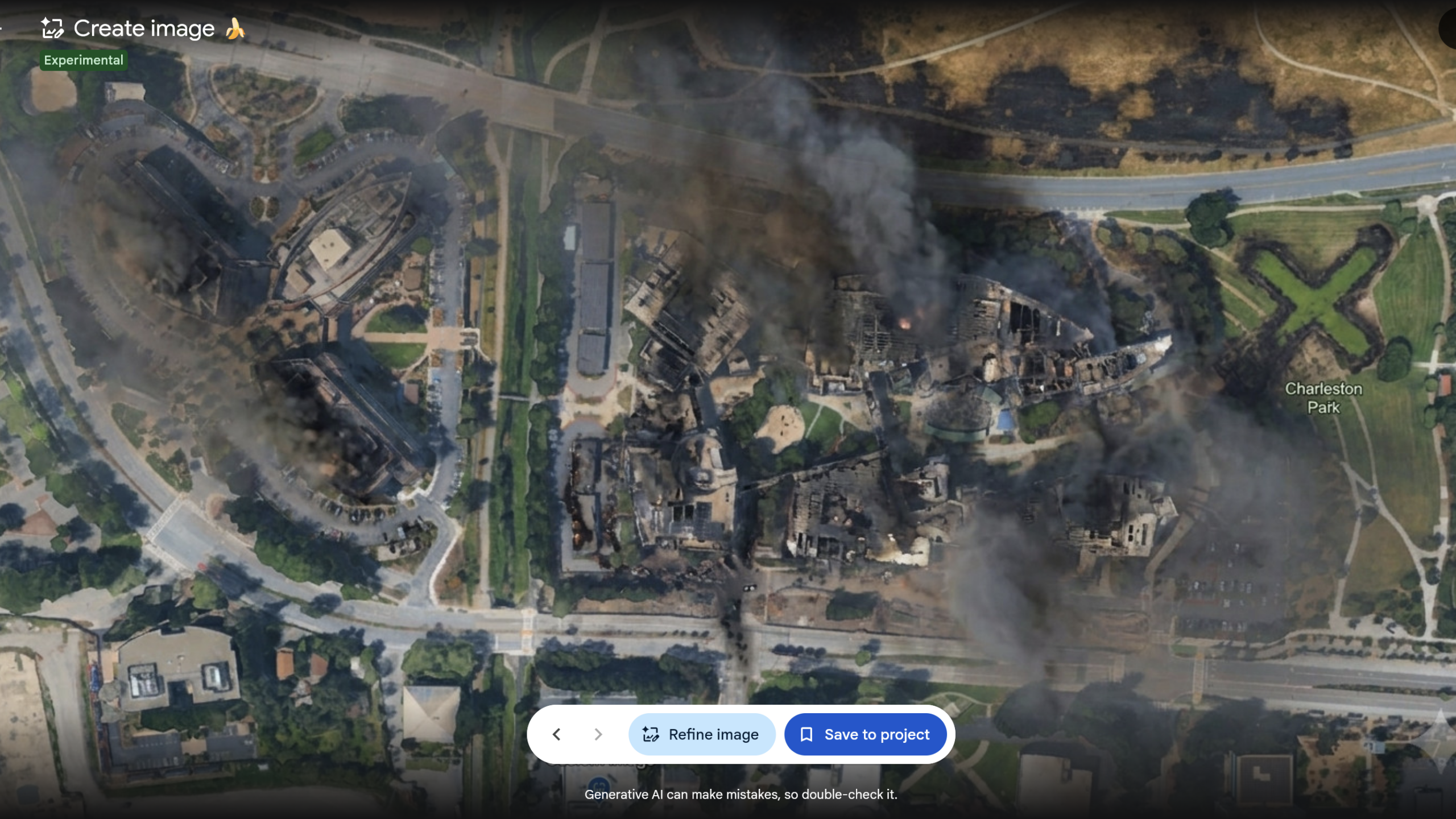
Google’s Earth AI ran straight into the one thing maps can’t lose: trust Google tried to turn Earth into a playground for AI image generation. It took about a day for the company to relearn a brutal fact: people use maps to verify reality, not remix it.
The feature, powered by Google’s Nano Banana 2 model, was pitched as a creative layer for Google Earth — a way to visualize how a city looked a century ago, mock up a community project, or imagine changes to buildings and neighborhoods. On paper, that sounds like harmless future-gazing.
Critics saw something else almost immediately: a misinformation machine attached to one of the internet’s most trusted visual reference tools. Ars Technica noted that Google Earth is often used to verify photos and videos, making AI-altered satellite imagery especially dangerous when false claims already spread faster than corrections. The Verge reported that testers generated scenes such as “refugees near the Mexican border” and “a bomb crater near a hospital in Gaza,” examples designed to show how easily persuasive false evidence could be manufactured.
Google initially leaned on its technical safeguards. The company said every image created in Google Earth carried a SynthID watermark, and users could check suspicious images through Gemini or Lens. But that reassurance didn’t settle the core objection: watermarking is only useful if people check, and if the mark survives the trip across screenshots, reposts, and edits. One tester said flatly, “Nothing was refused, nothing was softened, and nothing suggested I try a different prompt.”
So Google reversed course. In its later statement, the company acknowledged the deeper issue: “We know that people uniquely trust Google Earth for a reliable view of the world,” and said it was “rolling back this feature... while we work on implementing stronger guardrails.” That retreat captures the real clash here. Generative AI wants every interface to become editable; mapping platforms depend on being believed. Google just discovered those goals are not naturally compatible.
Continue reading https://foxvector.com/stories/019fbb57-bc06-29c5-71ac-2ad84a3050d6