I'm laughing at you because from your first reply, you call it an experiment and then you spend a whole note telling me how you don't think it's an experiment. And you expect me to take what you're saying seriously? I'm supposed to be the crazy one here.
I've explained things in fair detail where points have been made, but you've made zero valid points. If you're too lazy to look at how the experiment was constructed, why even bother commenting on it at all?
Not only does the experiment NOT claim refraction doesn't exist, it factors it includes and excludes it so you can see it with both.
You seem to be confused about what the independent variables are. I'll explain the experiment, and then you can tell me what you think the issues are.
The two models predict different angles a star will be occluded because a globe has the peak curving away from you. It should sit lower than it would on a flat surface relative to a straight line from the observation height. The globe prediction says the star has to be at a lower angle to line up with the peak. The flat prediction says it has to be higher. The gap between the two predictions is what was measured.
These measured angles are then compared to where the star actually was (the independent variable) using Stellarium, specifically because it’s built on the mainstream astronomical framework. So you’re testing whether the observations match the predictions of the model.
Whichever model’s prediction (measured) best matches the stars real position (stellarium, actual) is the model that is consistent with the observations made.
Typically the globe model will invoke atmospheric refraction to explain away the discrepancies in these kinds of ‘observational “experiments”’. The methodology accounts for this by using the stars true position rather than an apparent (observed) one, so you can’t make claims of refraction without justifying them, especially with the emergence and occlusion data - 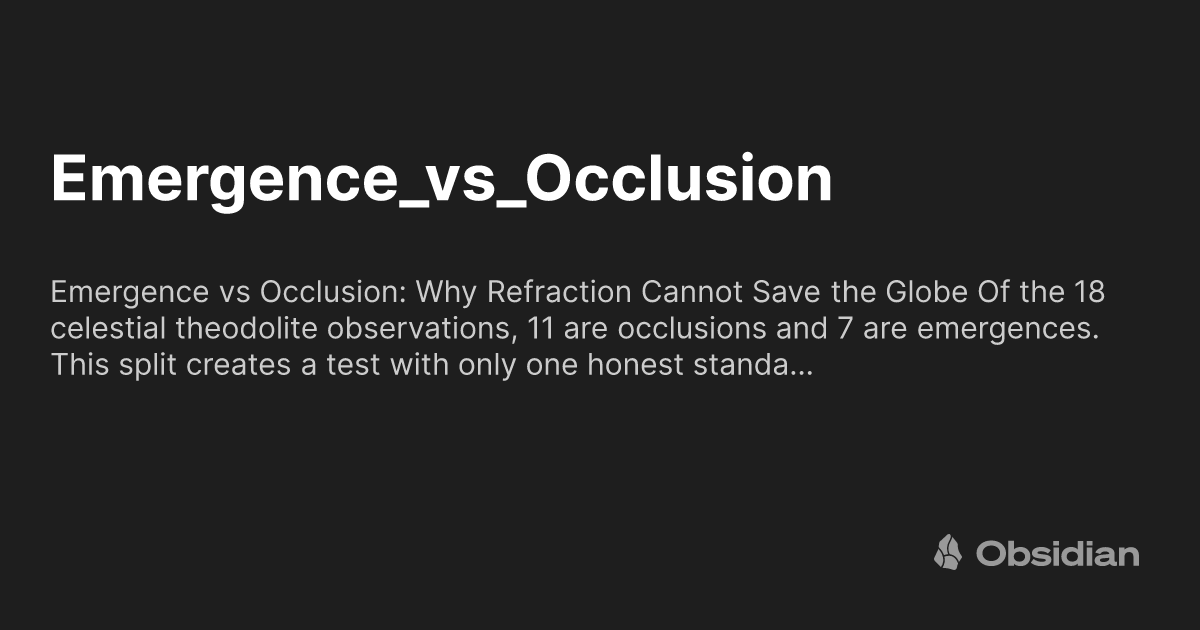 Spreadsheets:
 It’s difficult when your defence is already steel-manned in the presentation. You'll have to get really creative to explain why, across 40 observations, the globe prediction is off by exactly the curvature drop every single time. If the Earth is a curving at the claimed rate, there’s no reason a FE prediction would consistently better match observations. ZERO reason.
Good luck!
It’s difficult when your defence is already steel-manned in the presentation. You'll have to get really creative to explain why, across 40 observations, the globe prediction is off by exactly the curvature drop every single time. If the Earth is a curving at the claimed rate, there’s no reason a FE prediction would consistently better match observations. ZERO reason.
Good luck!

Emergence_vs_Occlusion - Obsidian Publish
Emergence vs Occlusion: Why Refraction Cannot Save the Globe Of the 18 celestial theodolite observations, 11 are occlusions and 7 are emergences. T...
Google Docs
Celestial Theodolite v2