Randy McMillan
@randymcmillan.net
npub1ahaz...45hy
#gnostr


# NIP-XXX
## Joinstr: A protocol for coinjoin using nostr
This NIP describes the nostr events used in joinstr for collaborative transactions to improve privacy on-chain.
## How does it work?
1. **Create a pool**: Alice can create a pool using basic encrypted channels with `kind:XXXX` event. Event contents have the below information about the pool:
```json
{
"type": "new_pool",
"id": "psfpcilmig1710701402",
"public_key": "f6f40f620c3db0dc5d11ff67a4cad5b6a7316c57c48cdf40583f54bbbc2d7b49",
"denomination": 0.01,
"peers": 10,
"timeout": 1710702002,
"relay": "wss://myrelay.local",
"private_key": "ff0d49343aa8277b38ab4b1c2aa1ae17b599913ca0f938bfcf9aa2a5f30eb9d6"
}
```
2. **View other pools and join**: Bob reads all `kind:XXXX` events and publishes a NIP 4 event with pool's pubkey being the recipient to join the pool. Pool responds with credentials and further communication happens in channel by publishing NIP 4 events with pool's pubkey as author and recipient.
## Details
- All events are published with a new pubkey
- Encrypted channel communication uses NIP 4 events sent to self
- All peers in a pool use the same IP address using Riseup VPN
```mermaid
sequenceDiagram
participant Alice
participant Encrypted Channel
participant Paid relay
participant Bob
Alice->>Encrypted Channel: Generate keypair for encrypted channel
Encrypted Channel->>Paid relay: Add channel pubkey
Bob->>Encrypted Channel: Request channel credentials to join
Bob->>Paid relay: Add user pubkey
Encrypted Channel->>Paid relay: Respond with channel private key
Bob->>Paid relay: Read private key and join channel
```
Consider Alice and Bob are 2 peers trying to coinjoin using joinstr:
```
- Alice creates a pool with denomination 0.01 BTC and 2 peers
- She publishes her address in the pool
- Listens for incoming pool messages and respond with crdentials
- Post input signed with SIGHASH_ALL | SIGHASH_ANYONECANPY when other peer joins the pool and publishes address
```
```
- Bob request pool credenatials
- Listens for incoming messages for his pubkey used to publish last event
- Join the pool and publish his address for output
- Post input signed with SIGHASH_ALL | SIGHASH_ANYONECANPY
```
A transaction is created with the signed inputs, outputs and broadcasted to complete the coinjoin.
## New Event Kinds
This NIP introduces one new event kinds which is used for creating the pool.
```json
{
"kind": XXXX,
"created_at": <unix timestamp in seconds>,
"pubkey": <new pubkey>,
"content": pool information as JSON,
"tags": [],
"sig": <signed with a new nostr pubkey>
}
```
### Implementation
 ## Known trade-offs & future improvements
- Riseup VPN is used instead of Tor
- NIP 4 events will be replaced with better NIP in next version to improve privacy
- Electrum plugin is still WIP
## Resources
Docs:
## Known trade-offs & future improvements
- Riseup VPN is used instead of Tor
- NIP 4 events will be replaced with better NIP in next version to improve privacy
- Electrum plugin is still WIP
## Resources
Docs:  Sybil resistance:
GitLab
Update plugin to use pools (!2) · Merge requests · Invincible Privacy / py-joinstr · GitLab
Python implementation for joinstr
joinstr
coinjoin implementation using nostr
Delving Bitcoin
Anonymous usage tokens from curve trees or autct
Thanks for writing this post. This will make joinstr pools sybil resistant and we discussed the idea a few days back. It would work exactly like t...
Beware of the polite bullshitters/grifters around #BITCOIN
They’re more toxic than any “maxi” you’ve encountered.
...
half of you are woke btches and dont even know it - the psyop is more effective than you realize…
#bitcoin
#bitcoin 

[Date Prev][Date Next][Thread Prev][Thread Next][Date Index][Thread Index] The War on Some Money [long]
To: cypherpunks@toad.com
Subject: The War on Some Money [long] From: sdavidm@iconz.co.nz (David Murray) Date: Thu, 21 Dec 95 20:15:55
Reply-To: davidm@iconz.co.nz
Sender: owner-cypherpunks@toad.com
-----BEGIN PGP SIGNED MESSAGE-----
[Yes - money laundering _again_.]
I want to advance two theses:
1. That the interest and activities of governments in fighting money-laundering
is directly contrary to the interest and activities of those seeking to
develop anonymous digital commerce;
2. That there is a related, if not underlying, conflict between the rhetoric
of concealment and the rhetoric of privacy.
<Of course, what _does_ underly all of this is individual vs. state -- but that
is pretty much a given.>
If the push for anonymous digital commerce is exemplified by the Cypherpunks
(and let's pretend it is), the battle against money-laundering is being led by
the Financial Action Task Force (FATF), an autonomous international entity,
set up by the G7 as part of the orgy of post-cold-war co-operation between
States on this issue. The UN, G7, OAS, Commonwealth, EU and a host of supra-
national bodies have called for co-ordinated action on stamping out dirty
money. And in an unprecendented fashion, States have responded. There are over
100 States that either have or are considering the criminalisation of money-
laundering. These include, by and large, the tax havens of Europe, the
Carribbean and the South Pacific.
So what is criminal money laundering? Concealing the source of funds that one
knows come from serious crime. Three comments about this formulation:
1. The state of mind required is knowledge, although this knowledge can be
inferred from objective facts (and knowledge tests in criminal definitions are
notoriously elastic).
2. The source of funds must be serious crime. The early UN declaration only
referred to drug dealing, but since 1990 there has been a move to widen this
to all serious crime. As to what constitutes serious crime, this is still
somewhat up for grabs. Some of the BSA's statements about software piracy
being the drug dealing of the nineties, and linking piracy with organised
crime can be seen as a strategy to position large scale intellectual property
theft as serious crime. More ominous (at least for the relationship of
citizen and state) is the occasional reference to tax evasion in the same
breath as serious crime.
3. This is because the serious crime need not be committed in the same country
as the money laundering. This makes sense for conventional serious crime (to
coin a phrase), but if tax evasion is included represents a major departure
from the convention that the courts of one country will not enforce the
taxing statutes of another.
Note also the possibility that fraud might be serious crime, which, since
the test of fraud is dishonesty, directly brings the competing ethical (or
rhetorical) systems into conflict. But more of this below.
The key feature of the new supra-national regime, however, is not a more or
less co-ordinated criminal law (there are some marked variations on
the above scheme), but the new surveillance approach to the financial system.
The most obvious signs of this are the requirement of financial institutions
to "know your customer" (which includes an explicit prohibition of anonymous
accounts) and to report "suspicious" transactions. But the approach goes much
further. The FATF's chilling Forty Recommendations (on which the global
approach is largely based) urges countries to "further encourage in general
the development of modern and secure techniques of money management, including
increased use of cheques, payment cards, direct deposit of salary cheques, and
book entry recording of securities, as a means to encourage the replacement of
cash transfers." [This is taken from a synopsis of the Recommendations.] In
case anyone should think this is based on the insecurity to the _customer_ of
cash and bearer securities, the FATF suggests countries (i.e. Governments) may
like to consider monitoring all domestic financial transactions with a view
to building databases for computer analysis -- such databases to be
appropriately secured from unauthorised access, of course.
So there we have it. The FATF wants a cashless, book entry, universally
monitored financial system based on verified True Names. Some Cypherpunks want
a cash based, bearer certificate, mathematically unmonitorable financial
system revolving around impenetrable pseudonyms.
Another way to put this is that Cypherpunks are for privacy, but the FATF is
against concealment.
Three arguments are often made for the attack on money laundering.
1. Money laundering leads to the corruption of societies and the undermining
of institutions and States. This seems to be putting the cart before the horse,
somewhat. Even if you consider money laundering as an inextricable part of
rendering crime organised, the crimes usually cited (drug dealing,
environmental crime, and the smuggling of cultural artifacts [!]) could be
decriminalised relatively easily. And of course you could always abolish the
State :-)
2. Money laundering puts the financial system at risk. (This, of course, is why
the financial institutions used in the Pizza Connection money laundering
chain (Merrill Lynch, E F Hutton, Bankers Trust, Barclays, Chase Manhattan,
Chemical Bank, Citibank, American Express and Thomas Cook. Bank of Nova Scotia,
Ueberseebank (Switzerland)) have without fail spectacularly collapsed.) In so
far as this is a result of legislation providing for the forfeiture to the
State of the proceeds of crime, another solution is clearly available.
3. The War on Drugs has been a failure, because it isn't in anyone in the drug
distribution chain's interest to assist authorities. The financial system is
organised crime's exposed flank. (As an(other) aside, it is often mentioned
(asserted?) that terrorists are turning to drug dealing etc to finance their
terror campaigns. I'm not sure whether this is intended to combat the "drug
dealers are just businessmen" argument, or the "terrorists are just patriots"
one. Perhaps both.)
[Don't get me wrong. I'm not saying Statists are bad because drug dealers are
good. I realise that reasonable people can differ as to the trade off between
civil liberties and the protection of the State. I know people who think that
it is all right to let the Police randomly breath test drivers in order to
decrease road deaths. So I can easily imagine people might feel having to
front up with two types of ID to open a bank account is a small price to pay
to prevent the violence and misery of drug addiction. I happen to think both
sets of people are wrong, and dangerously so.]
So governments fight money laundering to make it harder for criminals to enjoy
the wealth governments can't stop them making. As a side effect, governments
gain valuable intelligence about everyone's everyday finances. And we might
as well look at cracking down on those evil tax evaders while we're at it...
Well -- even I'm willing to admit this summary is a tad glib. It misses
something important about attitudes to secrecy: whether secrecy is about
privacy or concealment.
Michael Froomkin often [:-)] cites Sissela Bok on the danger of secrets
inappropriately kept (see e.g. A. Michael Froomkin, "Anonymity and its
Enmities," 1995 J. Online L. art. 4, par. 51) -- and certainly the overtones
of locked doors, masks, whispers and shadows makes "secret" itself a suspect
word. To be open is almost always good; to be secretive is definitely
always bad.
This sense of the inherent evil of secrets (dark secrets, guilty secrets) runs
deep. Take the Equiticorp criminal trial (a local cause celebre of a few years
ago) where executives of a company that failed spectacularly after the '87
crash were charged with (inter alia) conspiracy to defraud. The executives in
question had caused a large sum of money of (at that time) completely unknown
provenance (the so called H-Fee) to be paid to themselves through a series of
companies in tax-haven/banking secrecy jurisdictions. The judge (there was no
jury) found that, because no one had offered an honest reason to use such a
structure, it could only have been for the purpose of concealment of the
source of the money from those who may have had a legitimate interest in
determining it (IRD, auditors etc.). This amounted to dishonesty, and the
charge of conspiracy to defraud was made out.
Note the reasoning here: a secret without a reason is concealment; concealment
is dishonest. (Cypherpunks would reason exactly oppositely: a secret is an
expression of privacy; privacy is good.)
We can extend the concealment reasoning in an interesting way: concealment ->
dishonesty -> fraud -> serious crime + concealment -> money laundering. So
widespread concealment can (conceivably) give rise to an offence of money
laundering with no other illegal act. The very fact that the State has an
interest in detecting money laundering strengthens that first link: concealment
- -> dishonesty.
For the cypherpunks, of course, privacy -> nothing at all. Secrecy=privacy is
the default. Secrecy=concealment is a red herring.
This is not the forum to recite the virtues of privacy. So I'll leave you [at
last, they cry!] with a sugestion as to its main (rhetorical) vice: privacy
is opposed to public, and public is (usually) good.
I'll go further. In the same way that "secret" gives rise to a cascade of
negative associations, "public" gives rise to a chain reaction of happy, if
not down right noble, thoughts: the public good; public service; the public's
right to know; and, of course, the republic itself. Private (and privacy), on
the other hand, gains meaning from its distinction from public -- it is
_inherently_ negative.
All this is so much old rope for those who reject the linguistic turn in
philosophy, but I find it a useful way of thinking about trends. And we are
seeing trends towards individuality, the rejection of the collective, the
privatisation of what once was public. Part of this will be the reversal
of the privilegeing of public over private, and the consequent/connected move
from secrecy=concealment to secrecy=privacy.
And a tangble manifestation of all that will be the rise of anonymous digital
commerce, and the abandonment of The War on Some Money.
-----BEGIN PGP SIGNATURE-----
Version: 2.6.2
iQCVAwUBMNkJOVlo3j8JHzalAQGA/gP8D1mKUVyzybOVuI2AknuznciwghtvndH9
I0GtFnti8zFANMo6LIqb5/Hlz/XDTG6SFZR5D9omFlAd/J781pInaiEtTfXr/y+M
BXOppcvXfo28adGR5bgi+JLoZE9XQ511Qrz+HKi7Oa47LudySpRHkd/THM1Wamnw
9aWkxh5JOXs=
=FoHd
-----END PGP SIGNATURE-----
[Palmtop News Reader - Beta Version 3]
Prev by Date: the problem with attacks on Blaze & Weinstein Next by Date: SSLeay 0.5.1
Prev by thread: the problem with attacks on Blaze & Weinstein Next by thread: Re: The War on Some Money [long]
Index(es):
Date Thread
#gnostr #gnosturd #nostr 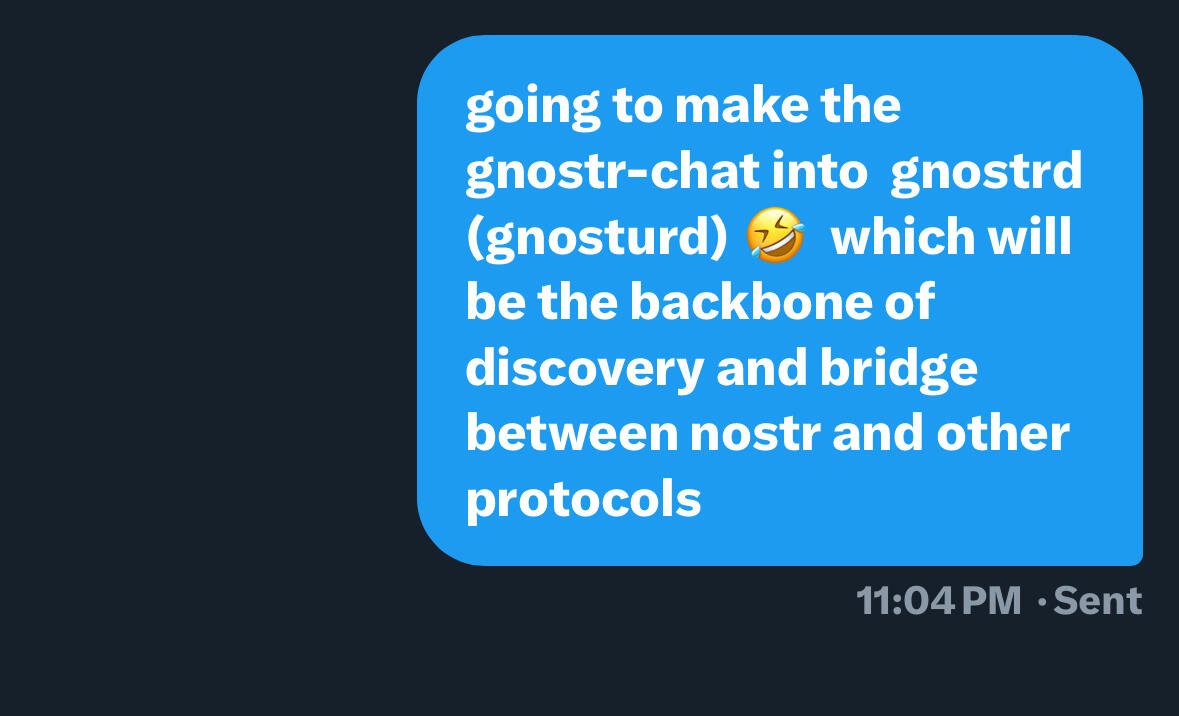

By definition a “public square” is not a private square…
Corporations are “dead” and shouldn’t have any say in the affairs of the living…
#ImmortalCorporateFiction

mining pools arent "centralization" - they are incentive driven collaboration
#bitcoin




#gnostr