
Scientific American Magazine's Endorsement of Kamala Harris
~
Scientific American
Monday 16 September, 2024
In the November election, the U.S. faces two futures. In one, the new president offers the country better prospects, relying on science, solid evidence and the willingness to learn from experience. She pushes policies that boost good jobs nationwide by embracing technology and clean energy. She supports education, public health and reproductive rights. She treats the climate crisis as the emergency it is and seeks to mitigate its catastrophic storms, fires and droughts.
In the other future, the new president endangers public health and safety and rejects evidence, preferring instead nonsensical conspiracy fantasies. He ignores the climate crisis in favor of more pollution. He requires that federal officials show personal loyalty to him rather than upholding U.S. laws. He fills positions in federal science and other agencies with unqualified ideologues. He goads people into hate and division, and he inspires extremists at state and local levels to pass laws that disrupt education and make it harder to earn a living.
Only one of these futures will improve the fate of this country and the world. That is why, for only the second time in our magazine’s 179-year history, the editors of Scientific American are endorsing a candidate for president. That person is Kamala Harris.
Before making this endorsement, we evaluated Harris’s record as a U.S. senator and as vice president under Joe Biden, as well as policy proposals she’s made as a presidential candidate. Her opponent, Donald Trump, who was president from 2017 to 2021, also has a record—a disastrous one. Let’s compare.
Health Care
The Biden-Harris administration shored up the popular Affordable Care Act (ACA), giving more people access to health insurance through subsidies. During Harris’s September 10 debate with Trump, she said one of her goals as president would be to expand it. Scores of studies have shown that people with insurance stay healthier and live longer because they can afford to see doctors for preventive and acute care. Harris supports expansion of Medicaid, the U.S. health-care program for low-income people. States that have expanded this program have seen health gains in their populations, whereas states that continue to restrict eligibility have not. To pay for Medicare, the health insurance program primarily for older Americans, Harris supports a tax increase on people who earn $400,000 or more a year. And the Biden-Harris administration succeeded in passing the Inflation Reduction Act (IRA), which caps the costs of several expensive drugs, including insulin, for Medicare enrollees. Harris’s vice presidential pick, Tim Walz, signed into law a prohibition against excessive price hikes on generic drugs as governor of Minnesota.
When in office, Trump proposed cuts to Medicare and Medicaid (Congress, to its credit, refused to enact them.) He also pushed for a work requirement as a condition for Medicaid eligibility, making it harder for people to qualify for the program. As a candidate, both in 2016 and this year, he pledged to repeal the ACA, but it’s not clear what he would replace it with. When prodded during the September debate, he said, “I have concepts of a plan” but didn’t elaborate. Like Harris, however, he has voiced concern about drug prices, and in 2020 he signed an executive order designed to lower prices of drugs covered by Medicare.
The COVID pandemic has been the greatest test of the American health-care system in modern history. Harris was vice president of an administration that boosted widespread distribution of COVID vaccines and created a program for free mail-order COVID tests. Wastewater surveillance for viruses has improved, allowing public health officials to respond more quickly when levels are high. Bird flu now poses a new threat, highlighting the importance of the Biden-Harris administration’s Office of Pandemic Preparedness and Response Policy.
Trump touted his pandemic efforts during his first debate with Harris, but in 2020 he encouraged resistance to basic public health measures, spread misinformation about treatments and suggested injections of bleach could cure the disease. By the end of that year about 350,000 people in the U.S. had died of COVID; the current national total is well over a million. Trump and his staff had one great success: Operation Warp Speed, which developed effective COVID vaccines extremely quickly. Remarkably, however, Trump plans billion-dollar budget cuts to the Centers for Disease Control and Prevention and the National Institutes of Health, which started the COVID-vaccine research program. These steps are in line with the guidance of Project 2025, an extreme conservative blueprint for the next presidency drawn up by many former Trump staffers. He’s also talked about ending the Office of Pandemic Preparedness and Response Policy, calling it a pork project.
Reproductive Rights
Harris is a staunch supporter of reproductive rights. During the September debate, she spoke plainly about her desire to reinstate “the protections of Roe v. Wade” and added, “I think the American people believe that certain freedoms, in particular the freedom to make decisions about one’s own body, should not be made by the government.” She has vowed to improve access to abortion. She has defended the right to order the abortion pill mifepristone through the mail under authorization by the U.S. Food and Drug Administration, even as MAGA Republican state officials have tried—so far unsuccessfully—to revoke those rights. As a U.S. senator, she co-sponsored a package of bills to reduce rising rates of maternal mortality. In August, Trump said he would vote against a ballot measure expanding access to abortions in Florida, where he lives. The current Florida “heartbeat” law makes most abortions illegal after six weeks of pregnancy, before many people even know they are pregnant.
Trump appointed the conservative U.S. Supreme Court justices who overturned Roe v. Wade, removing the constitutional right to a basic health-care procedure. He spreads misinformation about abortion—during the September debate, he said some states support abortion into the ninth month and beyond, calling it “execution after birth.” No state allows this. He also refused to answer the question of whether he would veto a federal abortion ban, saying Congress would never approve such a ban in the first place. He made no mention of an executive order and praised the Supreme Court, three justices of which he placed, for sending abortion back to states to decide. This ruling led to a patchwork of laws and entire sections of the country where abortion is dangerously limited.
Gun Safety
The Biden-Harris administration closed the gun-show loophole, which had allowed people to buy guns without a license. The evidence is clear that easy access to guns in the U.S. has increased the risk of suicides, murder and firearm accidents. Harris supports a program that temporarily removes guns from people deemed dangerous by a court.
Trump promised the National Rifle Association that he would get rid of all Biden-Harris gun measures. Even after Trump was injured and a supporter was killed in an attempted assassination, the former president remained silent on gun safety. His running mate, J. D. Vance, said the increased number of school shootings was an unhappy “fact of life” and the solution was stronger school security.
Environment and Climate
Harris said pointedly during the September debate that climate change was real. She would continue the responsible leadership shown by Biden, who has undertaken the most substantial climate action of any president. The Biden-Harris administration restored U.S. membership in the Paris Agreement on coping with climate change. Harris’s election would continue IRA tax credits for clean energy, as well as regulations to reduce power-plant emissions and coal use. This approach puts the country on course to spend the authorized billions of dollars for renewable energy that should cut U.S. carbon emissions in half by 2030. The IRA also includes a commitment to broadening electric vehicle technology.
Trump has said climate change is a hoax, and he dodged the question “What would you do to fight climate change?” during the September debate. He pulled the U.S. out of the Paris Agreement. Under his direction the Environmental Protection Agency and other federal agencies abandoned more than 100 environmental policies and rules, many designed to ensure clean air and water, restrict the dangers of toxic chemicals and protect wildlife. He has also tried to revoke funding for satellite-based climate-research projects.
Technology
The Biden-Harris administration’s 2023 Executive Order on Safe, Secure and Trustworthy Development and Use of Artificial Intelligence requires that AI-based products be safe for consumers and national security. The CHIPS and Science Act invigorates the chipmaking industry and semiconductor research while growing the workforce. A new Trump administration would undo all of this work and quickly. Under the devious and divisive Project 2025 framework, technology safeguards on AI would be overturned. AI influences our criminal justice, labor and health-care systems. As is the rightful complaint now, there would be no knowing how these programs are developed, how they are tested or whether they even work.
The 2024 U.S. ballots are also about Congress and local officials—people who make decisions that affect our communities and families. Extremist state legislators in Ohio, for instance, have given politicians the right to revoke any rule from the state health department designed to limit the spread of contagious disease. Other states have passed similar measures. In education, many states now forbid lessons about racial bias. But research has shown such lessons reduce stereotypes and do not prompt schoolchildren to view one another negatively, regardless of their race. This is the kind of science MAGA politicians ignore, and such people do not deserve our votes.
At the top of the ballot, Harris does deserve our vote. She offers us a way forward lit by rationality and respect for all. Economically, the renewable-energy projects she supports will create new jobs in rural America. Her platform also increases tax deductions for new small businesses from $5,000 to $50,000, making it easier for them to turn a profit. Trump, a convicted felon who was also found liable of sexual abuse in a civil trial, offers a return to his dark fantasies and demagoguery, whether it’s denying the reality of climate change or the election results of 2020 that were confirmed by more than 60 court cases, including some that were overseen by judges whom he appointed.
One of two futures will materialize according to our choices in this election. Only one is a vote for reality and integrity. We urge you to vote for Kamala Harris.
~
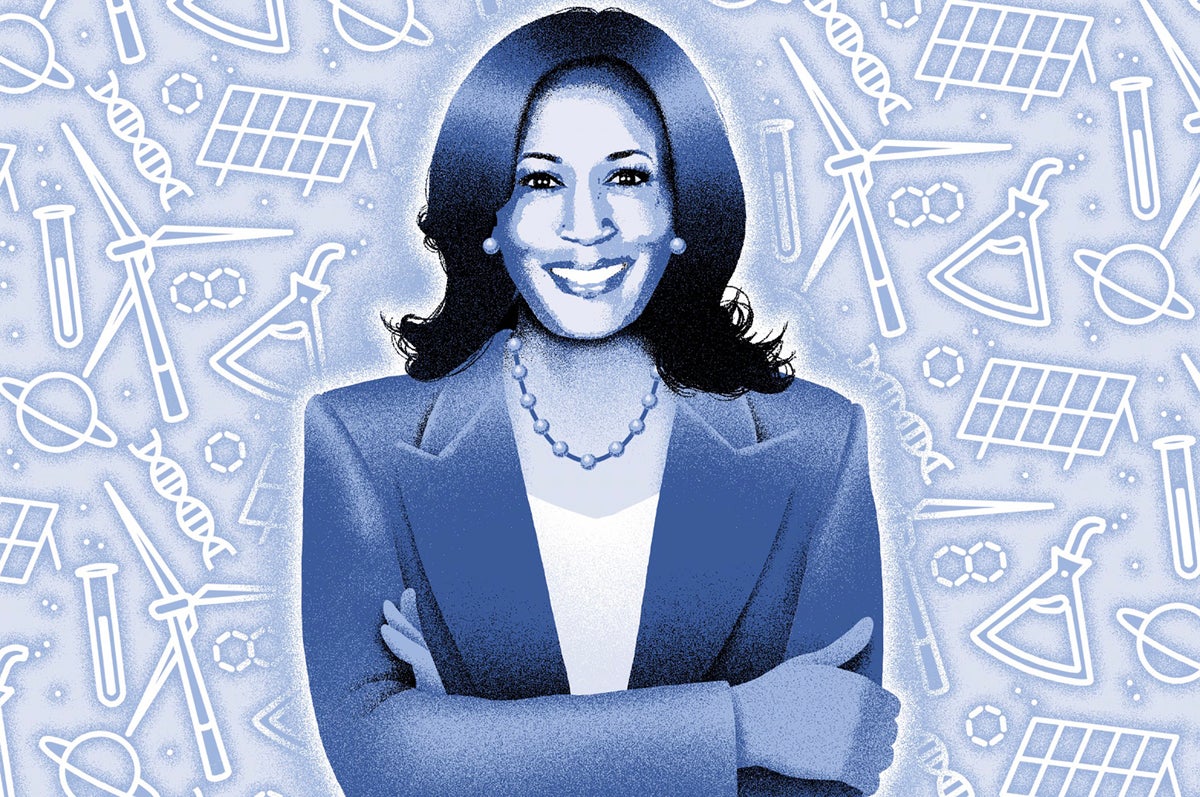
Scientific American
Vote for Kamala Harris to Support Science, Health and the Environment
Kamala Harris has plans to improve health, boost the economy and mitigate climate change. Donald Trump has threats and a dangerous record
NY Times Editorial Board
Thursday 11 July, 2024
Next week, for the third time in eight years, Donald Trump will be nominated as the Republican Party’s candidate for president of the United States. A once great political party now serves the interests of one man, a man as demonstrably unsuited for the office of president as any to run in the long history of the Republic, a man whose values, temperament, ideas and language are directly opposed to so much of what has made this country great.
It is a chilling choice against this national moment. For more than two decades, large majorities of Americans have said they are dissatisfied with the direction of the country, and the post-Covid era of stubborn inflation, high interest rates, social division and political stagnation has left many voters even more frustrated and despondent.
The Republican Party once pursued electoral power in service to solutions for such problems, to building “the shining city on a hill,” as Ronald Reagan liked to say. Its vision of the United States — embodied in principled public servants like George H.W. Bush, John McCain and Mitt Romney — was rooted in the values of freedom, sacrifice, individual responsibility and the common good. The party’s conception of those values was reflected in its longstanding conservative policy agenda, and today many Republicans set aside their concerns about Mr. Trump because of his positions on immigration, trade and taxes. But the stakes of this election are not fundamentally about policy disagreements. The stakes are more foundational: what qualities matter most in America’s president and commander in chief.
Mr. Trump has shown a character unworthy of the responsibilities of the presidency. He has demonstrated an utter lack of respect for the Constitution, the rule of law and the American people. Instead of a cogent vision for the country’s future, Mr. Trump is animated by a thirst for political power: to use the levers of government to advance his interests, satisfy his impulses and exact retribution against those who he thinks have wronged him.
He is, quite simply, unfit to lead.
The Democrats are rightly engaged in their own debate about whether President Biden is the right person to carry the party’s nomination into the election, given widespread concerns among voters about his age-related fitness. This debate is so intense because of legitimate concerns that Mr. Trump may present a danger to the country, its strength, security and national character — and that a compelling Democratic alternative is the only thing that would prevent his return to power. It is a national tragedy that the Republicans have failed to have a similar debate about the manifest moral and temperamental unfitness of their standard-bearer, instead setting aside their longstanding values, closing ranks and choosing to overlook what those who worked most closely with the former president have described as his systematic dishonesty, corruption, cruelty and incompetence.
That task now falls to the American people. We urge voters to see the dangers of a second Trump term clearly and to reject it. The stakes and significance of the presidency demand a person who has essential qualities and values to earn our trust, and on each one, Donald Trump fails.
*I. Moral Fitness Matters*
Presidents are confronted daily with challenges that require not just strength and conviction but also honesty, humility, selflessness, fortitude and the perspective that comes from sound moral judgment.
If Mr. Trump has these qualities, Americans have never seen them in action on behalf of the nation’s interests. His words and actions demonstrate a disregard for basic right and wrong and a clear lack of moral fitness for the responsibilities of the presidency.
He lies blatantly and maliciously, embraces racists, abuses women and has a schoolyard bully’s instinct to target society’s most vulnerable. He has delighted in coarsening and polarizing the town square with ever more divisive and incendiary language. Mr. Trump is a man who craves validation and vindication, so much that he would prefer a hostile leader’s lies to his own intelligence agencies’ truths and would shake down a vulnerable ally for short-term political advantage. His handling of everything from routine affairs to major crises was undermined by his blundering combination of impulsiveness, insecurity and unstudied certainty.
This record shows what can happen to a country led by such a person: America’s image, credibility and cohesion were relentlessly undermined by Mr. Trump during his term.
None of his wrongful actions are so obviously discrediting as his determined and systematic attempts to undermine the integrity of elections — the most basic element of any democracy — an effort that culminated in an insurrection at the Capitol to obstruct the peaceful transfer of power.
On Jan. 6, 2021, Mr. Trump incited a mob to violence with hateful lies, then stood by for hours as hundreds of his supporters took his word and stormed the Capitol with the aim of terrorizing members of Congress into keeping him in office. He praised these insurrectionists and called them patriots; today he gives them a starring role at campaign rallies, playing a rendition of the national anthem sung by inmates involved with Jan. 6., and he has promised to consider pardoning the rioters if re-elected. He continues to wrong the country and its voters by lying about the 2020 election, branding it stolen, despite the courts, the Justice Department and Republican state officials disputing him. No man fit for the presidency would flog such pernicious and destructive lies about democratic norms and values, but the Trumpian hunger for vindication and retribution has no moral center.
To vest such a person with the vast powers of the presidency is to endanger American interests and security at home as well as abroad. The nation’s commander in chief must uphold the oath to “preserve, protect and defend the Constitution.” It is the closest thing that this secular nation has to a sacred trust. The president has several duties and powers that are his alone: He has the sole authority to launch a nuclear weapon. He has the authority to send American troops into harm’s way and to authorize the use of lethal force against individuals and other nations. Americans who serve in the military also take an oath to defend the Constitution, and they rely on their commander in chief to take that oath as seriously as they do.
Mr. Trump has shown, repeatedly, that he does not. On numerous occasions, he asked his defense secretary and commanders in the American armed forces to violate that oath. On other occasions, he demanded that members of the military violate norms that preserve the dignity of the armed services and protect the military from being used for political purposes. They largely refused these illegal and immoral orders, as the oath requires.
The lack of moral grounding undermines Mr. Trump even in areas where voters view him as stronger and trust him more than Mr. Biden, like immigration and crime. Veering into a kind of brutal excess that is, at best, immoral and, at worst, unconstitutional, he has said that undocumented immigrants were “poisoning the blood of our country,” and his advisers say he would aim to round them up in mass detention camps and end birthright citizenship. He has indicated that, if faced with episodes of rioting or crime surges, he would unilaterally send troops into American cities. He has asked aides if the United States could shoot migrants below the waist to slow them down, and he has said that he would use the Insurrection Act to deploy the military against protesters.
During his time in office, none of those things happened because there were enough people in military leadership with the moral fitness to say “no” to such illegal orders. But there are good reasons to worry about whether that would happen again, as Mr. Trump works harder to surround himself with people who enable rather than check his most insidious impulses.
The Supreme Court, with its ruling on July 1 granting presidents “absolute immunity” for official acts, has removed an obstacle to Mr. Trump’s worst impulses: the threat of legal consequences. What remains is his own sense of right and wrong. Our country’s future is too precious to rely on such a broken moral compass.
*II. Principled Leadership Matters*
Republican presidents and presidential candidates have used their leadership at critical moments to set a tone for society to live up to. Mr. Reagan faced down totalitarianism in the 1980s, appointed the first woman to the Supreme Court and worked with Democrats on bipartisan tax and immigration reforms. George H.W. Bush signed the Americans With Disabilities Act and decisively defended an ally, Kuwait, against Iraqi aggression. George W. Bush, for all his failures after Sept. 11, did not stoke hate against or demonize Muslims or Islam.
As a candidate during the 2008 race, Mr. McCain spoke out when his fellow conservatives spread lies about his opponent, Barack Obama. Mr. Romney was willing to sacrifice his standing and influence in the party he once represented as a presidential nominee, by boldly calling out Mr. Trump’s failings and voting for his removal from office.
These acts of leadership are what it means to put country first, to think beyond oneself.
Mr. Trump has demonstrated contempt for these American ideals. He admires autocrats, from Viktor Orban to Vladimir Putin to Kim Jong-un. He believes in the strongman model of power — a leader who makes things happen by demanding it, compelling agreement through force of will or personality. In reality, a strongman rules through fear and the unprincipled use of political might for self-serving ends, imposing poorly conceived policies that smother innovation, entrepreneurship, ideas and hope.
During his four years in office, Mr. Trump tried to govern the United States as a strongman would, issuing orders or making decrees on Twitter. He announced sudden changes in policy — on who can serve in the military, on trade policy, on how the United States deals with North Korea or Russia — without consulting experts on his staff about how these changes would affect America. Indeed, nowhere did he put his political or personal interests above the national interest more tragically than during the pandemic, when he faked his way through a crisis by touting conspiracy theories and pseudoscience while ignoring the advice of his own experts and resisting basic safety measures that would have saved lives.
He took a similar approach to America’s strategic relationships abroad. Mr. Trump lost the trust of America’s longstanding allies, especially in NATO, leaving Europe less secure and emboldening the far right and authoritarian leaders in Europe, Latin America and Asia. He pulled out of the Iran nuclear deal, leaving that country, already a threat to the world, more dangerous, thanks to a revived program that has achieved near-weapons-grade uranium.
In a second term, his willingness to appease Mr. Putin would leave Ukraine’s future as a democratic and independent country in doubt. Mr. Trump implies that he could single-handedly end the catastrophic war in Gaza but has no real plan. He has suggested that in a second term he’d increase tariffs on Chinese goods to 60 percent or higher and that he would put a 10 percent tariff on all imported goods, moves that would raise prices for American consumers and reduce innovation by allowing U.S. industries to rely on protectionism instead.
The worst of the Trump administration’s policies were often blocked by Congress, by court challenges and by the objections of honorable public servants who stepped in to thwart his demands when they were irresponsible or did not follow the law. When Mr. Trump wanted an end to Obamacare, a single Republican senator, Mr. McCain, saved it, preserving health care for millions of Americans. Mr. Trump demanded that James Comey, his F.B.I. director, pledge loyalty to him and end an investigation into a political ally; Mr. Comey refused. Scientists and public health officials called out and corrected his misinformation about climate science and Covid. The Supreme Court sided against the Trump administration more times than any other president since at least Franklin D. Roosevelt.
A second Trump administration would be different. He intends to fill his administration with sycophants, those who have shown themselves willing to obey Mr. Trump’s demands or those who lack the strength to stand up to him. He wants to remove those who would be obstacles to his agenda, by enacting an order to make it easier to fire civil servants and replace them with those more loyal to him.
This means not only that Americans would lose the benefit of their expertise but also that America would be governed in a climate of fear, in which government employees must serve the interests of the president rather than the public. All cabinet secretaries follow a president’s lead, but Mr. Trump envisions a nation in which public service as Americans understand it would cease to exist — where individual civil servants and departments could no longer make independent decisions and where research by scientists and public health experts and investigations by the Justice Department and others in federal law enforcement would be more malleable to the demands of the White House.
Another term under Mr. Trump’s leadership would risk doing permanent damage to our government. As Mr. Comey, a longtime Republican, wrote in a 2019 guest essay for Times Opinion, “Accomplished people lacking inner strength can’t resist the compromises necessary to survive Mr. Trump and that adds up to something they will never recover from.” Very few who serve under him can avoid this fate “because Mr. Trump eats your soul in small bites,” Mr. Comey wrote. “Of course, to stay, you must be seen as on his team, so you make further compromises. You use his language, praise his leadership, tout his commitment to values. And then you are lost. He has eaten your soul.” America will get nowhere with a strongman. It needs a strong leader.
*III. Character Matters*
Character is the quality that gives a leader credibility, authority and influence. During the 2016 campaign, Mr. Trump’s petty attacks on his opponents and their families led many Republicans to conclude that he lacked such character. Other Republicans, including those who supported the former president’s policies in office, say they can no longer in good conscience back him for the presidency. “It’s a job that requires the kind of character he just doesn’t have,” Paul Ryan, a former Republican House speaker, said of Mr. Trump in May.
Those who know Mr. Trump’s character best — the people he appointed to serve in the most important positions of his White House — have expressed grave doubts about his fitness for office.
His former chief of staff John Kelly, a retired four-star Marine Corps general, described Mr. Trump as “a person who admires autocrats and murderous dictators. A person that has nothing but contempt for our democratic institutions, our Constitution and the rule of law.” Bill Barr, whom Mr. Trump appointed as attorney general, said of him, “He will always put his own interest and gratifying his own ego ahead of everything else, including the country’s interest.” James Mattis, a retired four-star Marine general who served as defense secretary, said, “Donald Trump is the first president in my lifetime who does not try to unite the American people — does not even pretend to try.”
Mike Pence, Mr. Trump’s vice president, has disavowed him. No other vice president in modern American history has done this. “I believe that anyone who puts themselves over the Constitution should never be president of the United States,” Mr. Pence has said. “And anyone who asked someone else to put them over the Constitution should never be president of the United States again.”
These are hardly exceptions. In any other American administration, a single cabinet-level defection is rare. But an unprecedented number of Mr. Trump’s appointees have publicly criticized his leadership, opposed his 2024 presidential candidacy or ducked questions about his fitness for a second term. More than a dozen of his most senior appointees — those he chose to work alongside him and who saw his performance most closely — have spoken out against him, serving as witnesses about the kind of leader he is.
There are many ways to judge leaders’ character; one is to see whether they accept responsibility for their actions. As a general rule, Mr. Trump abhors accountability. If he loses, the election is rigged. If he is convicted, it’s because the judges are out to get him. If he doesn’t get his way in a deal, as happened multiple times with Congress in his term, he shuts down the government or threatens to.
Americans do not expect their presidents to be perfect; many of them have exhibited hubris, self-regard, arrogance and other character flaws. But the American system of government is more than just the president: It is a system of checks and balances, and it relies on everyone in government to intervene when a president’s personal failings might threaten the common good.
Mr. Trump tested those limits as president, and little has changed about him in the four years since he lost re-election. He tries to intimidate anyone with the temerity to testify as a witness against him. He attacks the integrity of judges who are doing their duty to hold him accountable to the law. He mocks those he dislikes and lies about those who oppose him and targets Republicans for defeat if they fail to bend the knee.
It may be tempting for Americans to believe that a second Trump presidency would be much like the first, with the rest of government steeled to protect the country and resist his worst impulses. But the strongman needs others to be weak, and Mr. Trump is surrounding himself with yes men.
The American public has a right to demand more from their president and those who would serve under him.
*IV. A President's Words Matter*
When America saw white nationalists and neo-Nazis march through the streets of Charlottesville, Va., in 2017 and activists were rallying against racism, Mr. Trump spoke of “very fine people on both sides.” When he was pressed about the white supremacist Proud Boys during a 2020 debate, Mr. Trump told them to “stand back and stand by,” a request that, records show, they took literally in deciding to storm Congress. This winter, the former president urged Iowans to vote for him and score a victory over their fellow Americans — “all of the liars, cheaters, thugs, perverts, frauds, crooks, freaks, creeps.” And in a Veterans Day speech in New Hampshire, he used the word “vermin,” a term he has deployed to describe both immigrants and political opponents.
What a president says reflects on the United States and the kind of society we aspire to be.
In 2022 this board raised an urgent alarm about the rising threat of political violence in the United States and what Americans could do to stop it. At the time, Mr. Trump was preparing to declare his intention to run for president again, and the Republican Party was in the middle of a fight for control, between Trumpists and those who were ready to move on from his destructive leadership. This struggle within the party has consequences for all Americans. “A healthy democracy requires both political parties to be fully committed to the rule of law and not to entertain or even tacitly encourage violence or violent speech,” we wrote.
A large faction of one party in our country fails that test, and that faction, Mr. Trump’s MAGA extremists, now control the party and its levers of power. There are many reasons his conquest of the Republican Party is bad for American democracy, but one of the most significant is that those extremists have often embraced violent speech or the belief in using violence to achieve their political goals. This belief led to the Jan. 6 attack on the Capitol, and it has resulted in a rising number of threats against judges, elected officials and prosecutors.
This threat cannot be separated from Mr. Trump’s use of language to encourage violence, to dehumanize groups of people and to spread lies. A study by researchers at the University of California, Davis, released in October 2022, came to the conclusion that MAGA Republicans (as opposed to those who identified themselves as traditional Republicans) “are more likely to hold extreme and racist beliefs, to endorse political violence, to see such violence as likely to occur and to predict that they will be armed under circumstances in which they consider political violence to be justified.”
The Republican Party had an opportunity to renounce Trumpism; it has submitted to it. Republican leaders have had many opportunities to repudiate his violent discourse and make clear that it should have no place in political life; they failed to. Sizable numbers of voters in Republican primaries abandoned Mr. Trump for other candidates, and independent and undecided voters have said that Mr. Trump’s language has alienated them from his candidacy.
But with his nomination by his party all but assured, Mr. Trump has become even more reckless in employing extreme and violent speech, such as his references to executing generals who raise questions about his actions. He has argued, before the Supreme Court, that he should have the right to assassinate a political rival and face no consequences.
*V. The Rule of Law Matters*
The danger from these foundational failings — of morals and character, of principled leadership and rhetorical excess — is never clearer than in Mr. Trump’s disregard for rule of law, his willingness to do long-term damage to the integrity of America’s systems for short-term personal gain.
As we’ve noted, Mr. Trump’s disregard for democracy was most evident in his attempts to overturn the results of the 2020 election and to encourage violence to stop the peaceful transfer of power. What stood in his way were the many patriotic Americans, at every level of government, who rejected his efforts to bully them into complying with his demands to change election results. Instead, they followed the rules and followed the law. This respect for the rule of law, not the rule of men, is what has allowed American democracy to survive for more than 200 years.
In the four years since losing the election, Mr. Trump has become only more determined to subvert the rule of law, because his whole theory of Trumpism boils down to doing whatever he wants without consequence. Americans are seeing this unfold as Mr. Trump attempts to fight off numerous criminal charges. Not content to work within the law to defend himself, he is instead turning to sympathetic judges — including two Supreme Court justices with apparent conflicts over the 2020 election and Jan. 6-related litigation. The playbook: delay federal prosecution until he can win election and end those legal cases. His vision of government is one that does what he wants, rather than a government that operates according to the rule of law as prescribed by the Constitution, the courts and Congress.
As divided as America is, people across the political spectrum generally recoil from rigged rules, favoritism, self-dealing and abuse of power. Our country has been so stable for so long in part because most Americans and most American leaders follow the rules or face the consequences.
So much in the past two decades has tested these norms in our society — the invasion of Iraq under false pretenses, the failures that led to the 2008 financial crisis and the recession that followed, the pandemic and all the fractures and inequities that it revealed. We need a recommitment to the rule of law and the values of fair play. This election is a moment for Americans to decide whether we will keep striving for those ideals.
Mr. Trump rejects them. If he is re-elected, America will face a new and precarious future, one that it may not be prepared for. It is a future in which intelligence agencies would be judged not according to whether they preserved national security but by whether they served Mr. Trump’s political agenda. It means that prosecutors and law enforcement officials would be judged not according to whether they follow the law to keep Americans safe but by whether they obey his demands to “go after” political enemies. It means that public servants would be judged not according to their dedication or skill but by whether they show sufficient loyalty to him and his MAGA agenda.
Even if Mr. Trump’s vague policy agenda would not be fulfilled, he could rule by fear. The lesson of other countries shows that when a bureaucracy is politicized or pressured, the best public servants will run for the exits.
This is what has already happened in Mr. Trump’s Republican Party, with principled leaders and officials retiring, quitting or facing ouster. In a second term, he intends to do that to the whole of government.
Election Day is less than four months away. The case against Mr. Trump is extensive, and this board urges Americans to perform a simple act of civic duty in an election year: Listen to what Mr. Trump is saying, pay attention to what he did as president and allow yourself to truly inhabit what he has promised to do if returned to office.
Voters frustrated by inflation and immigration or attracted by the force of Mr. Trump’s personality should pause and take note of his words and promises. They have little to do with unity and healing and a lot to do with making the divisions and anger in our society wider and more intense than they already are.
The Republican Party is making its choice next week; soon all Americans will be able to make their own choice. What would Mr. Trump do in a second term? He has told Americans who he is and shown them what kind of leader he would be.
When someone fails so many foundational tests, you don’t give him the most important job in the world.