
**Astronomy Picture of the Day**
20 November 2025
**Alnitak, Alnilam, Mintaka**
 Image Credit & Copyright: Aygen Erkaslan
Alnitak, Alnilam, and Mintaka are the bright bluish stars from east to west (upper right to lower left) along the diagonal in this cosmic vista. Otherwise known as the Belt of Orion, these three blue supergiant stars are hotter and much more massive than the Sun. They lie from 700 to 2,000 light-years away, born of Orion's well-studied interstellar clouds. In fact, clouds of gas and dust adrift in this region have some surprisingly familiar shapes, including the dark Horsehead Nebula and Flame Nebula near Alnitak at the upper right. The famous Orion Nebula itself is off the right edge of this colorful starfield. The telescopic frame spans almost 4 degrees on the sky.
#APOD #NASA #Astrobiology #Astrotheory #SpaceTravel
Image Credit & Copyright: Aygen Erkaslan
Alnitak, Alnilam, and Mintaka are the bright bluish stars from east to west (upper right to lower left) along the diagonal in this cosmic vista. Otherwise known as the Belt of Orion, these three blue supergiant stars are hotter and much more massive than the Sun. They lie from 700 to 2,000 light-years away, born of Orion's well-studied interstellar clouds. In fact, clouds of gas and dust adrift in this region have some surprisingly familiar shapes, including the dark Horsehead Nebula and Flame Nebula near Alnitak at the upper right. The famous Orion Nebula itself is off the right edge of this colorful starfield. The telescopic frame spans almost 4 degrees on the sky.
#APOD #NASA #Astrobiology #Astrotheory #SpaceTravel
Image Credit & Copyright: Aygen Erkaslan
Alnitak, Alnilam, and Mintaka are the bright bluish stars from east to west (upper right to lower left) along the diagonal in this cosmic vista. Otherwise known as the Belt of Orion, these three blue supergiant stars are hotter and much more massive than the Sun. They lie from 700 to 2,000 light-years away, born of Orion's well-studied interstellar clouds. In fact, clouds of gas and dust adrift in this region have some surprisingly familiar shapes, including the dark Horsehead Nebula and Flame Nebula near Alnitak at the upper right. The famous Orion Nebula itself is off the right edge of this colorful starfield. The telescopic frame spans almost 4 degrees on the sky.
#APOD #NASA #Astrobiology #Astrotheory #SpaceTravel
APOD: 2025 November 20 - Alnitak, Alnilam, Mintaka
A different astronomy and space science
related image is featured each day, along with a brief explanation.
 Image Credit & Copyright:
Xinran Li &
Houbo Zhao
Sometimes the dark dust of interstellar space has an angular elegance. Such is the case toward the far-south constellation of Chamaeleon. Normally too faint to see, dark dust is best known for blocking visible light from stars and galaxies behind it. In this 11.4-hour exposure, however, the dust is seen mostly in light of its own, with its strong red and near-infrared colors creating a brown hue. Contrastingly blue, a bright star Beta Chamaeleontis is visible on the upper right of the V, with the dust that surrounds it preferentially reflecting blue light from its primarily blue-white color. All of the pictured stars and dust occur in our own Milky Way Galaxy with one notable exception: a white spot just below Beta Chamaeleontis is the galaxy IC 3104, which lies far in the distance. Interstellar dust is mostly created in the cool atmospheres of giant stars and dispersed into space by stellar light, stellar winds, and stellar explosions such as supernovas.
#APOD #Astrophoto #RocketScience #AstronomyFacts #Astroeducation
Image Credit & Copyright:
Xinran Li &
Houbo Zhao
Sometimes the dark dust of interstellar space has an angular elegance. Such is the case toward the far-south constellation of Chamaeleon. Normally too faint to see, dark dust is best known for blocking visible light from stars and galaxies behind it. In this 11.4-hour exposure, however, the dust is seen mostly in light of its own, with its strong red and near-infrared colors creating a brown hue. Contrastingly blue, a bright star Beta Chamaeleontis is visible on the upper right of the V, with the dust that surrounds it preferentially reflecting blue light from its primarily blue-white color. All of the pictured stars and dust occur in our own Milky Way Galaxy with one notable exception: a white spot just below Beta Chamaeleontis is the galaxy IC 3104, which lies far in the distance. Interstellar dust is mostly created in the cool atmospheres of giant stars and dispersed into space by stellar light, stellar winds, and stellar explosions such as supernovas.
#APOD #Astrophoto #RocketScience #AstronomyFacts #Astroeducation
 *Image creditor details unavailable via API. Visit linked page below for full info.*
What has happened to Comet Lemmon's tail? The answer is blowing in the wind — the wind from the Sun in this case. This continuous outflow of charged particles from the Sun has been quite variable of late, as the Sun emits bursts of energy, CMEs, that push out and deflect charged particles emitted by the comet itself. The result is a blue hued ion tail for Comet C/2025 A6 (Lemmon) that is not only impressively intricate but takes some unusual turns. This long-duration composite image taken from Alfacar, Spain last month captured this inner Solar System ionic tumult. Comet Lemmon is now fading as it heads out away from the Earth and Sun and back into the outer Solar System.
#APOD #Astrophoto #SpaceMissions #Astrozone #Astroinformatics
*Image creditor details unavailable via API. Visit linked page below for full info.*
What has happened to Comet Lemmon's tail? The answer is blowing in the wind — the wind from the Sun in this case. This continuous outflow of charged particles from the Sun has been quite variable of late, as the Sun emits bursts of energy, CMEs, that push out and deflect charged particles emitted by the comet itself. The result is a blue hued ion tail for Comet C/2025 A6 (Lemmon) that is not only impressively intricate but takes some unusual turns. This long-duration composite image taken from Alfacar, Spain last month captured this inner Solar System ionic tumult. Comet Lemmon is now fading as it heads out away from the Earth and Sun and back into the outer Solar System.
#APOD #Astrophoto #SpaceMissions #Astrozone #Astroinformatics
 *Image creditor details unavailable via API. Visit linked page below for full info.*
If this is Saturn, where are the rings? When Saturn's "appendages" disappeared in 1612, Galileo did not understand why. Later that century, it became understood that Saturn's unusual protrusions were rings and that when the Earth crosses the ring plane, the edge-on rings will appear to disappear. This is because Saturn's rings are confined to a plane many times thinner, in proportion, than a razor blade. In modern times, the robotic Cassini spacecraft that orbited Saturn frequently crossed Saturn's ring plane during its mission to Saturn, from 2004 to 2017. A series of plane crossing images from 2005 February was dug out of the vast online Cassini raw image archive by interested Spanish amateur Fernando Garcia Navarro. Pictured here, digitally cropped and set in representative colors, is the striking result. Saturn's thin ring plane appears in blue, bands and clouds in Saturn's upper atmosphere appear in gold. Details of Saturn's rings can be seen in high dark shadows. The moons Dione and Enceladus appear as bumps in the rings.
#APOD #SpaceIndustry #NASAInspires #SpaceResearch #OuterSpace
*Image creditor details unavailable via API. Visit linked page below for full info.*
If this is Saturn, where are the rings? When Saturn's "appendages" disappeared in 1612, Galileo did not understand why. Later that century, it became understood that Saturn's unusual protrusions were rings and that when the Earth crosses the ring plane, the edge-on rings will appear to disappear. This is because Saturn's rings are confined to a plane many times thinner, in proportion, than a razor blade. In modern times, the robotic Cassini spacecraft that orbited Saturn frequently crossed Saturn's ring plane during its mission to Saturn, from 2004 to 2017. A series of plane crossing images from 2005 February was dug out of the vast online Cassini raw image archive by interested Spanish amateur Fernando Garcia Navarro. Pictured here, digitally cropped and set in representative colors, is the striking result. Saturn's thin ring plane appears in blue, bands and clouds in Saturn's upper atmosphere appear in gold. Details of Saturn's rings can be seen in high dark shadows. The moons Dione and Enceladus appear as bumps in the rings.
#APOD #SpaceIndustry #NASAInspires #SpaceResearch #OuterSpace
 Image Credit & Copyright: Piotr Czerski
This magnificent extragalactic skyscape looks toward the Andromeda Galaxy, the closest large spiral galaxy to the Milky Way. It also accomplishes a Messier catalog trifecta by including Andromeda, cataloged as Messier 31 (M31), along with Messier 32 (M32), and Messier 110 (M110) in the same telescopic field of view. In this frame, M32 is just left of the Andromeda Galaxy's bright core with M110 below and to the right. M32 and M110 are both elliptical galaxies themselves and satellites of the larger spiral Andromeda. By combining 60 hours of broadband and narrowband image data, the deep telescopic view also reveals tantalizing details of dust lanes, young star clusters, and star-forming regions along Andromeda's spiral arms, and faint, foreground clouds of glowing hydrogen gas. For now, Andromeda and friends are some 2.5 million light-years from our own large spiral Milky Way.
#APOD #Astroinformatics #StarFormation #Research #Astrotheory
Image Credit & Copyright: Piotr Czerski
This magnificent extragalactic skyscape looks toward the Andromeda Galaxy, the closest large spiral galaxy to the Milky Way. It also accomplishes a Messier catalog trifecta by including Andromeda, cataloged as Messier 31 (M31), along with Messier 32 (M32), and Messier 110 (M110) in the same telescopic field of view. In this frame, M32 is just left of the Andromeda Galaxy's bright core with M110 below and to the right. M32 and M110 are both elliptical galaxies themselves and satellites of the larger spiral Andromeda. By combining 60 hours of broadband and narrowband image data, the deep telescopic view also reveals tantalizing details of dust lanes, young star clusters, and star-forming regions along Andromeda's spiral arms, and faint, foreground clouds of glowing hydrogen gas. For now, Andromeda and friends are some 2.5 million light-years from our own large spiral Milky Way.
#APOD #Astroinformatics #StarFormation #Research #Astrotheory
 Image Credit & Copyright: Samil Cabrera
Northern lights have come to Florida skies. In fact, the brilliant streak of a Northern Taurid meteor flashes through the starry night sky above the beach in this sea and skyscape, captured from Shired Island, Florida on November 11. Meteors from the annual Northern Taurid meteor shower are expected this time of year. But the digital camera exposure also records the shimmering glow of aurora, a phenomenon more often seen from our fair planet's higher geographical latitudes. Also known as aurora borealis, these northern lights are part of recent, wide spread auroral activity caused by strong geomagnetic storms. In the last few days, stormy spaceweather has been triggered by multiple Earth impacting coronal mass ejections and intense solar activity.
#APOD #SpaceWeather #Astroinformatics #SpaceObservatory #SpaceAdventures
Image Credit & Copyright: Samil Cabrera
Northern lights have come to Florida skies. In fact, the brilliant streak of a Northern Taurid meteor flashes through the starry night sky above the beach in this sea and skyscape, captured from Shired Island, Florida on November 11. Meteors from the annual Northern Taurid meteor shower are expected this time of year. But the digital camera exposure also records the shimmering glow of aurora, a phenomenon more often seen from our fair planet's higher geographical latitudes. Also known as aurora borealis, these northern lights are part of recent, wide spread auroral activity caused by strong geomagnetic storms. In the last few days, stormy spaceweather has been triggered by multiple Earth impacting coronal mass ejections and intense solar activity.
#APOD #SpaceWeather #Astroinformatics #SpaceObservatory #SpaceAdventures
 Image Credit & Copyright: R. Jay Gabany
Few cosmic vistas can excite the imagination like The Great Nebula in Orion. Visible as a faint, bland celestial smudge to the naked-eye, the nearest large star-forming region sprawls across this sharp colorful telescopic image. Designated M42 in the Messier Catalog, the Orion Nebula's glowing gas and dust surrounds hot, young stars. About 40 light-years across, M42 is at the edge of an immense interstellar molecular cloud only 1,500 light-years away that lies within the same spiral arm of our Milky Way galaxy as the Sun. Including dusty bluish reflection nebula NGC 1977, also known as the Running Man nebula at left in the frame, the natal nebulae represent only a small fraction of our galactic neighborhood's wealth of star-forming material. Within the well-studied stellar nursery, astronomers have also identified what appear to be numerous infant solar systems.
#APOD #Astroeducation #Astroinformatics #SpaceMission #Astronauts
Image Credit & Copyright: R. Jay Gabany
Few cosmic vistas can excite the imagination like The Great Nebula in Orion. Visible as a faint, bland celestial smudge to the naked-eye, the nearest large star-forming region sprawls across this sharp colorful telescopic image. Designated M42 in the Messier Catalog, the Orion Nebula's glowing gas and dust surrounds hot, young stars. About 40 light-years across, M42 is at the edge of an immense interstellar molecular cloud only 1,500 light-years away that lies within the same spiral arm of our Milky Way galaxy as the Sun. Including dusty bluish reflection nebula NGC 1977, also known as the Running Man nebula at left in the frame, the natal nebulae represent only a small fraction of our galactic neighborhood's wealth of star-forming material. Within the well-studied stellar nursery, astronomers have also identified what appear to be numerous infant solar systems.
#APOD #Astroeducation #Astroinformatics #SpaceMission #Astronauts

 Image Credit & Copyright:
Brian Meyers
Ten thousand years ago, before the dawn of recorded human history, a new light would suddenly have appeared in the night sky and faded after a few weeks. Today we know this light was from a supernova, or exploding star, and record the expanding debris cloud as the Veil Nebula, a supernova remnant. This sharp telescopic view is centered on a western segment of the Veil Nebula cataloged as NGC 6960 but less formally known as the Witch's Broom Nebula. Blasted out in the cataclysmic explosion, an interstellar shock wave plows through space sweeping up and exciting interstellar material. Imaged with narrow band filters, the glowing filaments are like long ripples in a sheet seen almost edge on, remarkably well separated into atomic hydrogen (red) and oxygen (blue-green) gas. The complete supernova remnant lies about 1400 light-years away towards the constellation Cygnus. This Witch's Broom actually spans about 35 light-years. The bright star in the frame is 52 Cygni, visible with the unaided eye from a dark location but unrelated to the ancient supernova remnant.
#APOD #Astrogeek #Cosmology #Research #Space
Image Credit & Copyright:
Brian Meyers
Ten thousand years ago, before the dawn of recorded human history, a new light would suddenly have appeared in the night sky and faded after a few weeks. Today we know this light was from a supernova, or exploding star, and record the expanding debris cloud as the Veil Nebula, a supernova remnant. This sharp telescopic view is centered on a western segment of the Veil Nebula cataloged as NGC 6960 but less formally known as the Witch's Broom Nebula. Blasted out in the cataclysmic explosion, an interstellar shock wave plows through space sweeping up and exciting interstellar material. Imaged with narrow band filters, the glowing filaments are like long ripples in a sheet seen almost edge on, remarkably well separated into atomic hydrogen (red) and oxygen (blue-green) gas. The complete supernova remnant lies about 1400 light-years away towards the constellation Cygnus. This Witch's Broom actually spans about 35 light-years. The bright star in the frame is 52 Cygni, visible with the unaided eye from a dark location but unrelated to the ancient supernova remnant.
#APOD #Astrogeek #Cosmology #Research #Space
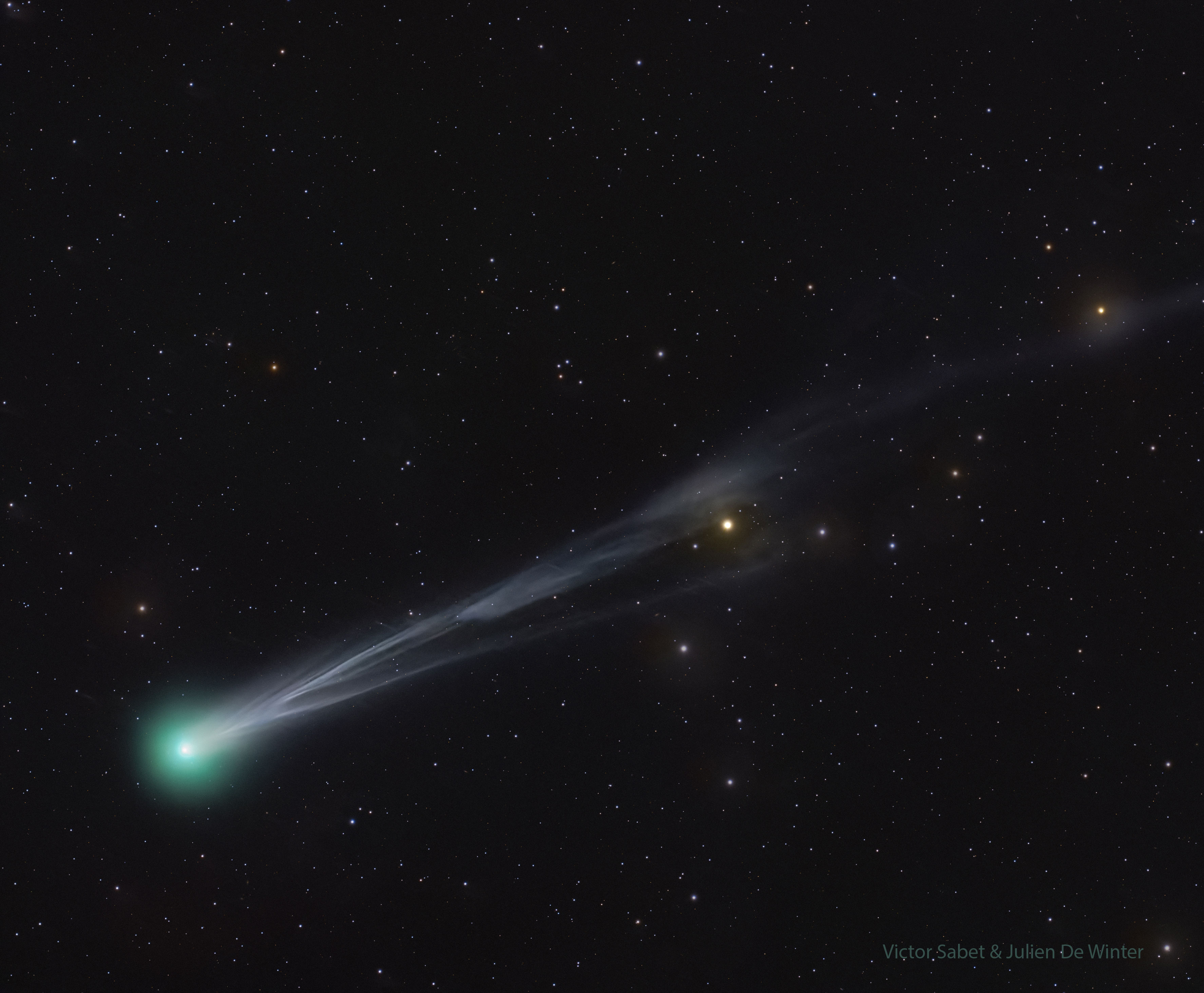 Image Credit & Copyright:
Victor Sabet &
Julien De Winter
Comet Lemmon is brightening and moving into morning northern skies. Besides Comet SWAN25B and Comet ATLAS, Comet C/2025 A6 (Lemmon) is now the third comet currently visible with binoculars and on long camera exposures. Comet Lemmon was discovered early this year and is still headed into the inner Solar System. The comet will round the Sun on November 8, but first it will pass its nearest to the Earth -- at about half the Earth-Sun distance -- on October 21. Although the brightnesses of comets are notoriously hard to predict, optimistic estimates have Comet Lemmon then becoming visible to the unaided eye. The comet should be best seen in predawn skies until mid-October, when it also becomes visible in evening skies. The featured image showing the comet's split and rapidly changing ion tail was taken in Texas, USA late last week. Growing Gallery: Comet Lemmon in 2025
#APOD #Astrophotography #NASAInspires #Astrobiology #AstronautLife
Image Credit & Copyright:
Victor Sabet &
Julien De Winter
Comet Lemmon is brightening and moving into morning northern skies. Besides Comet SWAN25B and Comet ATLAS, Comet C/2025 A6 (Lemmon) is now the third comet currently visible with binoculars and on long camera exposures. Comet Lemmon was discovered early this year and is still headed into the inner Solar System. The comet will round the Sun on November 8, but first it will pass its nearest to the Earth -- at about half the Earth-Sun distance -- on October 21. Although the brightnesses of comets are notoriously hard to predict, optimistic estimates have Comet Lemmon then becoming visible to the unaided eye. The comet should be best seen in predawn skies until mid-October, when it also becomes visible in evening skies. The featured image showing the comet's split and rapidly changing ion tail was taken in Texas, USA late last week. Growing Gallery: Comet Lemmon in 2025
#APOD #Astrophotography #NASAInspires #Astrobiology #AstronautLife
 Image Credit & Copyright:
Luc Perrot
(TWAN)
It may look like these comets are racing, but they are not. Comets C/2025 K1 ATLAS (left) and C/2025 R2 SWAN (right) appeared near each other by chance last week in the featured image taken from France's Reunion Island in the southern Indian Ocean. Fainter Comet ATLAS is approaching our Sun and will reach its closest approach in early October when it is also expected to be its brightest -- although still only likely visible with long exposures on a camera. The brighter comet, nicknamed SWAN25B, is now headed away from our Sun, although its closest approach to Earth is expected in mid-October, when optimistic estimates have it becoming bright enough to see with the unaided eye. Each comet has a greenish coma of expelled gas and an ion tail pointing away from the Sun. Growing Gallery: Comet SWAN25B
#APOD #Astroengineering #Astrogeek #SpaceFacts #Astrogeology
Image Credit & Copyright:
Luc Perrot
(TWAN)
It may look like these comets are racing, but they are not. Comets C/2025 K1 ATLAS (left) and C/2025 R2 SWAN (right) appeared near each other by chance last week in the featured image taken from France's Reunion Island in the southern Indian Ocean. Fainter Comet ATLAS is approaching our Sun and will reach its closest approach in early October when it is also expected to be its brightest -- although still only likely visible with long exposures on a camera. The brighter comet, nicknamed SWAN25B, is now headed away from our Sun, although its closest approach to Earth is expected in mid-October, when optimistic estimates have it becoming bright enough to see with the unaided eye. Each comet has a greenish coma of expelled gas and an ion tail pointing away from the Sun. Growing Gallery: Comet SWAN25B
#APOD #Astroengineering #Astrogeek #SpaceFacts #Astrogeology
 *Image creditor details unavailable via API. Visit linked page below for full info.*
What is creating these unusual spots? Light-colored spots on Martian rocks, each surrounded by a dark border, were discovered last year by NASA's Perseverance Rover currently exploring Mars. Dubbed leopard spots because of their seemingly similarity to markings on famous Earth-bound predators, these curious patterns are being studied with the possibility they were created by ancient Martian life. The pictured spots measure only millimeters across and were discovered on a larger rock named Cheyava Falls. The exciting but unproven speculation is that long ago, microbes generated energy with chemical reactions that turned rock from red to white while leaving a dark biosignature ring, like some similarly appearing spots on Earth rocks. Although other non-biological explanations have not been ruled out, speculation focusing on this potential biological origin is causing much intrigue.
#APOD #RocketLaunch #Cosmology #AstronautLife #CosmicWonders
*Image creditor details unavailable via API. Visit linked page below for full info.*
What is creating these unusual spots? Light-colored spots on Martian rocks, each surrounded by a dark border, were discovered last year by NASA's Perseverance Rover currently exploring Mars. Dubbed leopard spots because of their seemingly similarity to markings on famous Earth-bound predators, these curious patterns are being studied with the possibility they were created by ancient Martian life. The pictured spots measure only millimeters across and were discovered on a larger rock named Cheyava Falls. The exciting but unproven speculation is that long ago, microbes generated energy with chemical reactions that turned rock from red to white while leaving a dark biosignature ring, like some similarly appearing spots on Earth rocks. Although other non-biological explanations have not been ruled out, speculation focusing on this potential biological origin is causing much intrigue.
#APOD #RocketLaunch #Cosmology #AstronautLife #CosmicWonders
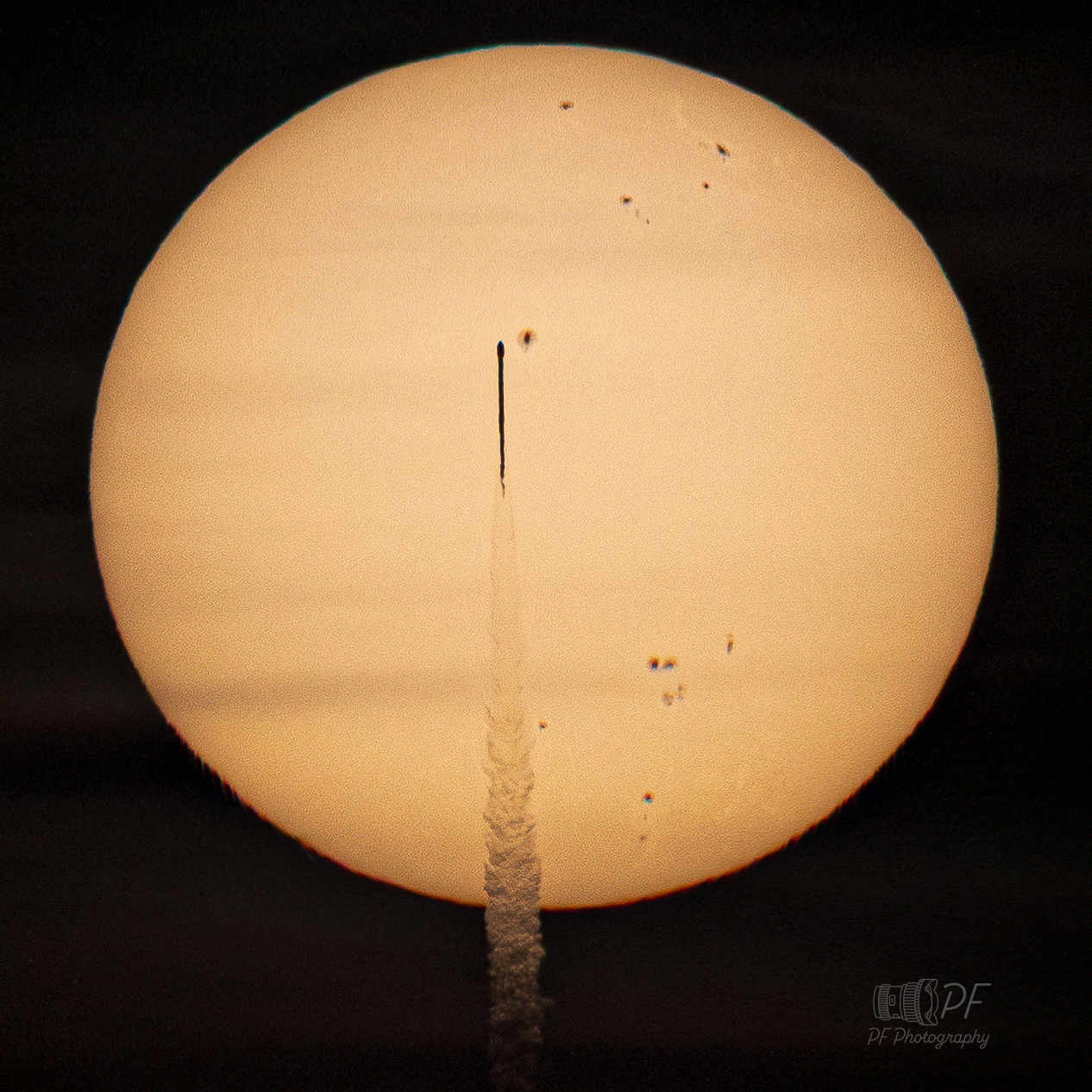 Image Credit & Copyright: Pascal Fouquet
On the morning of September 24 a rocket crosses the bright solar disk in this long range telescopic snapshot captured from Orlando, Florida. That's about 50 miles north of its Kennedy Space Center launch site. This rocket carried three new space weather missions to space. Signals have now been successfully acquired from all three - NASA's Interstellar Mapping and Acceleration Probe, NASA’s Carruthers Geocorona Observatory, and the National Oceanic and Atmospheric Administration (NOAA) Space Weather Follow-On Lagrange 1 (SWFO-L1) - as they begin their journey to L1, an Earth-Sun lagrange point. L1 is about 1.5 million kilometers in the sunward direction from planet Earth. Appropriately, major space weather influencers, aka dark sunspots in active regions across the Sun, are posing with the transiting rocket. In fact, large active region AR4225 is just right of the rocket's nose.
#APOD #SpaceInnovation #Galaxy #Astrospace #NASA
Image Credit & Copyright: Pascal Fouquet
On the morning of September 24 a rocket crosses the bright solar disk in this long range telescopic snapshot captured from Orlando, Florida. That's about 50 miles north of its Kennedy Space Center launch site. This rocket carried three new space weather missions to space. Signals have now been successfully acquired from all three - NASA's Interstellar Mapping and Acceleration Probe, NASA’s Carruthers Geocorona Observatory, and the National Oceanic and Atmospheric Administration (NOAA) Space Weather Follow-On Lagrange 1 (SWFO-L1) - as they begin their journey to L1, an Earth-Sun lagrange point. L1 is about 1.5 million kilometers in the sunward direction from planet Earth. Appropriately, major space weather influencers, aka dark sunspots in active regions across the Sun, are posing with the transiting rocket. In fact, large active region AR4225 is just right of the rocket's nose.
#APOD #SpaceInnovation #Galaxy #Astrospace #NASA
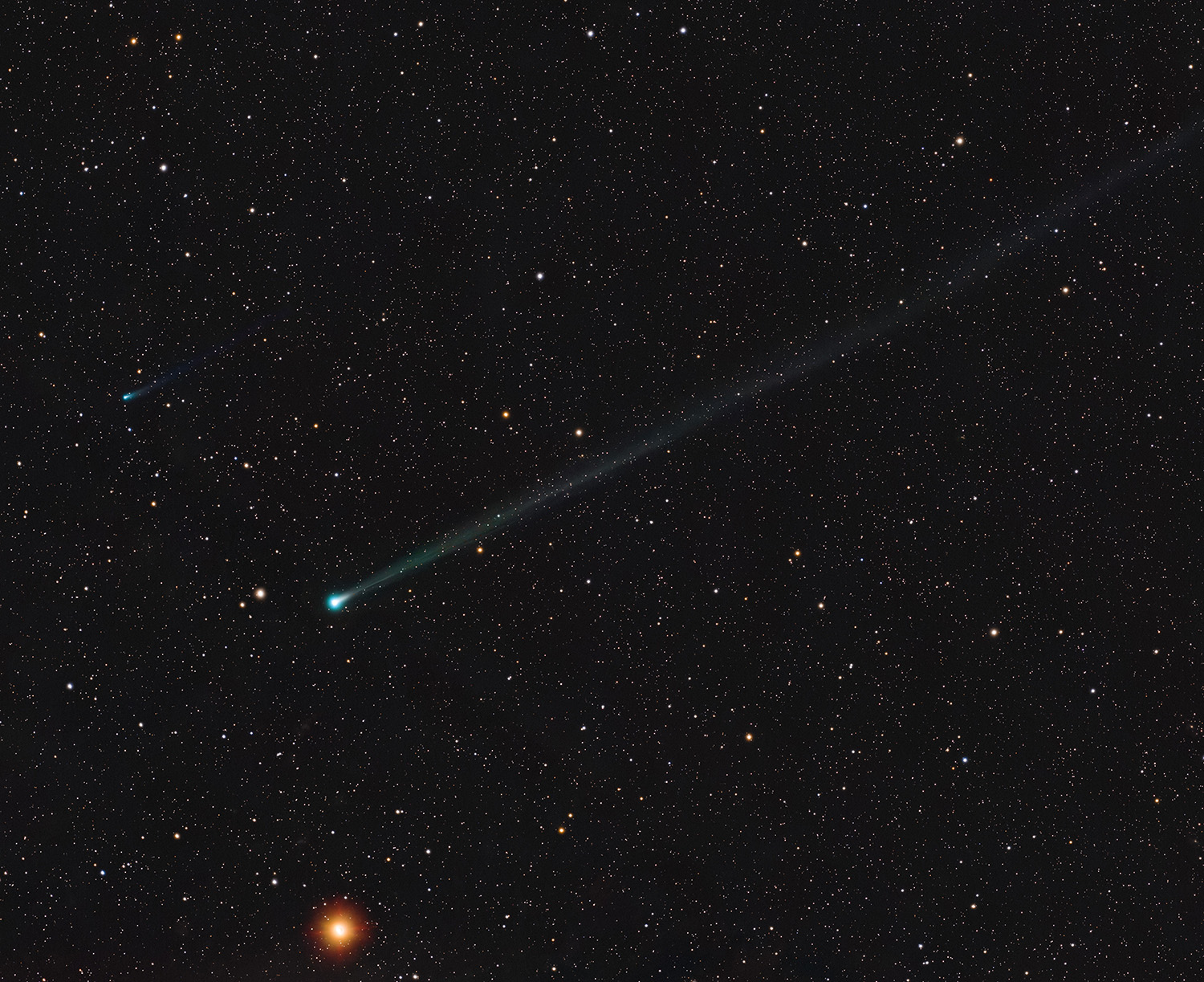 Image Credit & Copyright: Adam Block
A new visitor to the inner Solar System, comet C/2025 R2 (SWAN) sports a long ion tail extending diagonally across this almost 7 degree wide telescopic field of view recorded on September 21. A fainter fellow comet also making its inner Solar System debut, C/2025 K1 (ATLAS), can be spotted above and left of SWAN's greenish coma, just visible against the background sea of stars in the constellation Virgo. Both new comets were only discovered in 2025 and are joined in this celestial frame by ruddy planet Mars (bottom), a more familiar wanderer in planet Earth's night skies. The comets may appear to be in a race, nearly neck and neck in their voyage through the inner Solar System and around the Sun. But this comet SWAN has already reached its perihelion or closest approach to the Sun on September 12 and is now outbound along its orbit. This comet ATLAS is still inbound though, and will make its perihelion passage on October 8.
#APOD #Astroengineer #Astronomy #Galaxy #Research
Image Credit & Copyright: Adam Block
A new visitor to the inner Solar System, comet C/2025 R2 (SWAN) sports a long ion tail extending diagonally across this almost 7 degree wide telescopic field of view recorded on September 21. A fainter fellow comet also making its inner Solar System debut, C/2025 K1 (ATLAS), can be spotted above and left of SWAN's greenish coma, just visible against the background sea of stars in the constellation Virgo. Both new comets were only discovered in 2025 and are joined in this celestial frame by ruddy planet Mars (bottom), a more familiar wanderer in planet Earth's night skies. The comets may appear to be in a race, nearly neck and neck in their voyage through the inner Solar System and around the Sun. But this comet SWAN has already reached its perihelion or closest approach to the Sun on September 12 and is now outbound along its orbit. This comet ATLAS is still inbound though, and will make its perihelion passage on October 8.
#APOD #Astroengineer #Astronomy #Galaxy #Research
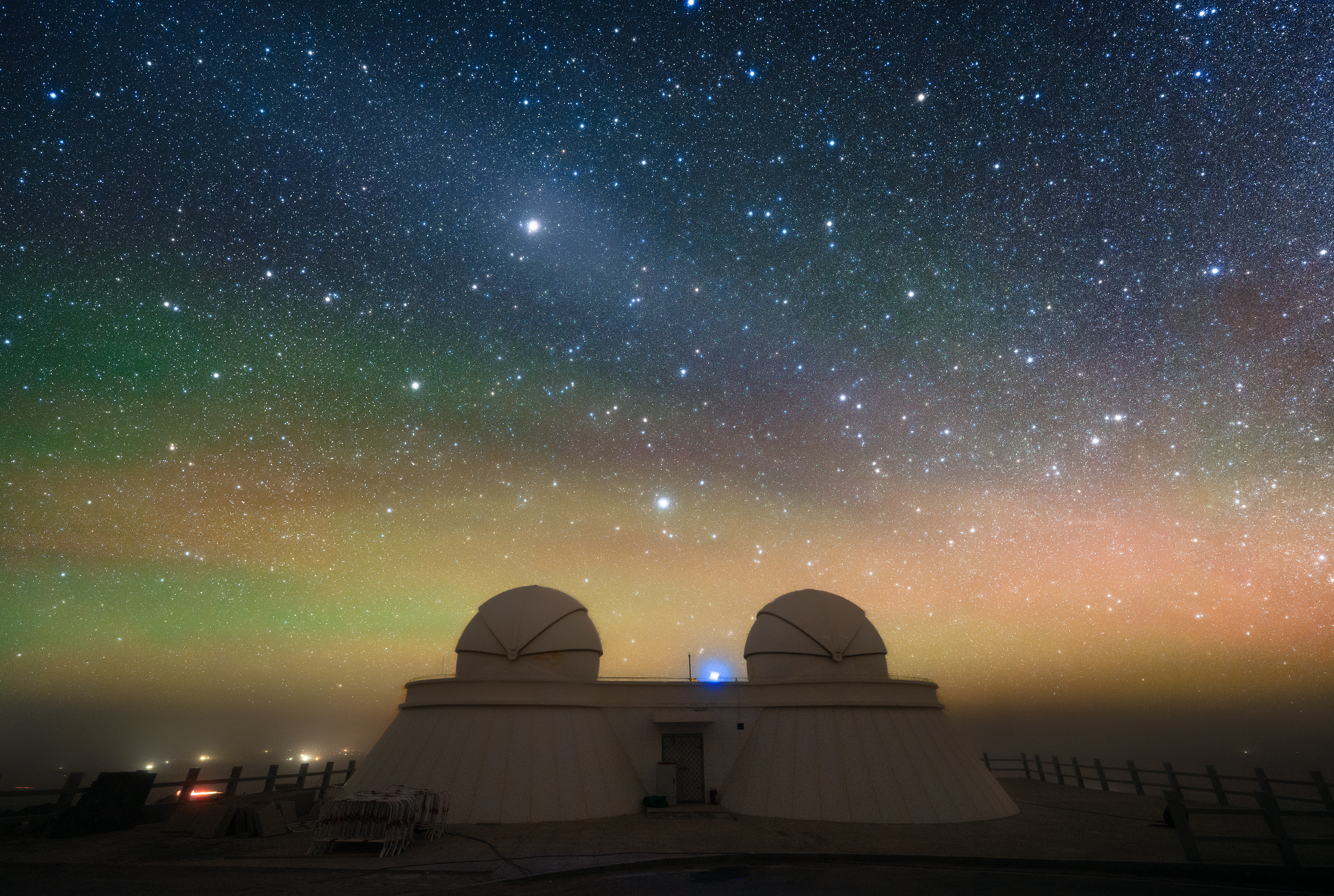 Image Credit & Copyright: Jin Wang
This year Saturn was at opposition on September 21, opposite the Sun in planet Earth's sky. At its closest to Earth, Saturn was also at its brightest of the year, rising as the Sun set and shining above the horizon all night long among the fainter stars of the constellation Pisces. In this snapshot from the Qinghai Lenghu Observatory, Tibetan Plateau, southwestern China, the outer planet is immersed in a faint, diffuse oval of light known as the gegenschein or counter glow. The diffuse gegenschein is produced by sunlight backscattered by interplanetary dust along the Solar System's ecliptic plane, opposite the Sun in planet Earth's sky. Like a giant eye, on this dark night Saturn and gegenschein seem to stare down on the observatory's telescope domes seen against a colorful background of airglow along the horizon.
#APOD #RocketScience #Stargazing #Cosmological #CosmicWonders
Image Credit & Copyright: Jin Wang
This year Saturn was at opposition on September 21, opposite the Sun in planet Earth's sky. At its closest to Earth, Saturn was also at its brightest of the year, rising as the Sun set and shining above the horizon all night long among the fainter stars of the constellation Pisces. In this snapshot from the Qinghai Lenghu Observatory, Tibetan Plateau, southwestern China, the outer planet is immersed in a faint, diffuse oval of light known as the gegenschein or counter glow. The diffuse gegenschein is produced by sunlight backscattered by interplanetary dust along the Solar System's ecliptic plane, opposite the Sun in planet Earth's sky. Like a giant eye, on this dark night Saturn and gegenschein seem to stare down on the observatory's telescope domes seen against a colorful background of airglow along the horizon.
#APOD #RocketScience #Stargazing #Cosmological #CosmicWonders
 *Image creditor details unavailable via API. Visit linked page below for full info.*
It was the strongest gravitational wave signal yet measured -- what did it show? GW250114 was detected by both arms of the Laser Interferometer Gravitational-wave Observatory (LIGO) in Washington and Louisiana USA earlier this year. Analysis showed that the event was created when two black holes, each of mass around 33 times the mass of the Sun, coalesced into one larger black hole with a mass of around 63 solar masses. Even though the event happened about a billion light years away, the signal was so strong that the spin of all black holes, as well as initial ringing of the final black hole, was deduced with exceptional accuracy. Furthermore, it was confirmed better than before, as previously predicted, that the total event horizon area of the combined black hole was greater than those of the merging black holes. Featured, an artist's illustration depicts an imaginative and conceptual view from near one of the black holes before collision.
#APOD #Astrobiology #Cosmos #Astrocosmos #Space
*Image creditor details unavailable via API. Visit linked page below for full info.*
It was the strongest gravitational wave signal yet measured -- what did it show? GW250114 was detected by both arms of the Laser Interferometer Gravitational-wave Observatory (LIGO) in Washington and Louisiana USA earlier this year. Analysis showed that the event was created when two black holes, each of mass around 33 times the mass of the Sun, coalesced into one larger black hole with a mass of around 63 solar masses. Even though the event happened about a billion light years away, the signal was so strong that the spin of all black holes, as well as initial ringing of the final black hole, was deduced with exceptional accuracy. Furthermore, it was confirmed better than before, as previously predicted, that the total event horizon area of the combined black hole was greater than those of the merging black holes. Featured, an artist's illustration depicts an imaginative and conceptual view from near one of the black holes before collision.
#APOD #Astrobiology #Cosmos #Astrocosmos #Space
 Image Credit & Copyright: Wang Letian
The dark, inner shadow of planet Earth is called the umbra. Shaped like a cone extending into space, it has a circular cross section most easily seen during a lunar eclipse. And on the night of September 7/8 the Full Moon passed near the center of Earth's umbral cone, entertaining eclipse watchers around much of our fair planet, including parts of Antarctica, Australia, Asia, Europe, and Africa. Recorded from Zhangjiakou City, China, this timelapse composite image uses successive pictures from the total lunar eclipse, progressing left to right, to reveal the curved cross-section of the umbral shadow sliding across the Moon. Sunlight scattered by the atmosphere into Earth's umbra causes the lunar surface to appear reddened during totality. But close to the umbra's edge, the limb of the eclipsed Moon shows a distinct blue hue. The blue eclipsed moonlight originates as rays of sunlight pass through layers high in the upper stratosphere, colored by ozone that scatters red light and transmits blue. In the total phase of this leisurely lunar eclipse, the Moon was completely within the Earth's umbra for about 83 minutes.
#APOD #Astrogeology #Exploration #Astrotheory #Cosmos
Image Credit & Copyright: Wang Letian
The dark, inner shadow of planet Earth is called the umbra. Shaped like a cone extending into space, it has a circular cross section most easily seen during a lunar eclipse. And on the night of September 7/8 the Full Moon passed near the center of Earth's umbral cone, entertaining eclipse watchers around much of our fair planet, including parts of Antarctica, Australia, Asia, Europe, and Africa. Recorded from Zhangjiakou City, China, this timelapse composite image uses successive pictures from the total lunar eclipse, progressing left to right, to reveal the curved cross-section of the umbral shadow sliding across the Moon. Sunlight scattered by the atmosphere into Earth's umbra causes the lunar surface to appear reddened during totality. But close to the umbra's edge, the limb of the eclipsed Moon shows a distinct blue hue. The blue eclipsed moonlight originates as rays of sunlight pass through layers high in the upper stratosphere, colored by ozone that scatters red light and transmits blue. In the total phase of this leisurely lunar eclipse, the Moon was completely within the Earth's umbra for about 83 minutes.
#APOD #Astrogeology #Exploration #Astrotheory #Cosmos
 Image Credit & Copyright:
Ian Moehring & Kevin Roylance
It is one of the largest nebulas on the sky -- why isn't it better known? Roughly the same angular size as the Andromeda Galaxy, the Great Lacerta Nebula can be found toward the constellation of the Lizard (Lacerta). The emission nebula is difficult to see with wide-field binoculars because it is so faint, but also usually difficult to see with a large telescope because it is so great in angle -- spanning about three degrees. The depth, breadth, waves, and beauty of the nebula -- cataloged as Sharpless 126 (Sh2-126) -- can best be seen and appreciated with a long duration camera exposure. The featured image is one such combined exposure -- in this case taken over three nights in August through dark skies in Moses Lake, Washington, USA. The hydrogen gas in the Great Lacerta Nebula glows red because it is excited by light from the bright star 10 Lacertae, one of the bright blue stars just to the left of the red-glowing nebula's center. Most of the stars and nebula are about 1,200 light years distant. Jigsaw Universe: Astronomy Puzzle of the Day
#APOD #SpaceTech #SpaceObservatory #Science #SpaceTravel
Image Credit & Copyright:
Ian Moehring & Kevin Roylance
It is one of the largest nebulas on the sky -- why isn't it better known? Roughly the same angular size as the Andromeda Galaxy, the Great Lacerta Nebula can be found toward the constellation of the Lizard (Lacerta). The emission nebula is difficult to see with wide-field binoculars because it is so faint, but also usually difficult to see with a large telescope because it is so great in angle -- spanning about three degrees. The depth, breadth, waves, and beauty of the nebula -- cataloged as Sharpless 126 (Sh2-126) -- can best be seen and appreciated with a long duration camera exposure. The featured image is one such combined exposure -- in this case taken over three nights in August through dark skies in Moses Lake, Washington, USA. The hydrogen gas in the Great Lacerta Nebula glows red because it is excited by light from the bright star 10 Lacertae, one of the bright blue stars just to the left of the red-glowing nebula's center. Most of the stars and nebula are about 1,200 light years distant. Jigsaw Universe: Astronomy Puzzle of the Day
#APOD #SpaceTech #SpaceObservatory #Science #SpaceTravel
 *Image creditor details unavailable via API. Visit linked page below for full info.*
What's that rising up from the Earth? When circling the Earth on the International Space Station early in July, astronaut Nicole Ayers saw an unusual type of lightning rising up from the Earth: a gigantic jet. The powerful jet appears near the center of the featured image in red, white, and blue. Giant jet lightning has only been known about for the past 25 years. The atmospheric jets are associated with thunderstorms and extend upwards towards Earth's ionosphere. The lower part of the frame shows the Earth at night, with Earth's thin atmosphere tinted green from airglow. City lights are visible, sometimes resolved, but usually creating diffuse white glows in intervening clouds. The top of the frame reveals distant stars in the dark night sky. The nature of gigantic jets and their possible association with other types of Transient Luminous Events (TLEs) such as blue jets and red sprites remain active topics of research.
#APOD #Astrogeek #Astronauts #Universe #Exploration
*Image creditor details unavailable via API. Visit linked page below for full info.*
What's that rising up from the Earth? When circling the Earth on the International Space Station early in July, astronaut Nicole Ayers saw an unusual type of lightning rising up from the Earth: a gigantic jet. The powerful jet appears near the center of the featured image in red, white, and blue. Giant jet lightning has only been known about for the past 25 years. The atmospheric jets are associated with thunderstorms and extend upwards towards Earth's ionosphere. The lower part of the frame shows the Earth at night, with Earth's thin atmosphere tinted green from airglow. City lights are visible, sometimes resolved, but usually creating diffuse white glows in intervening clouds. The top of the frame reveals distant stars in the dark night sky. The nature of gigantic jets and their possible association with other types of Transient Luminous Events (TLEs) such as blue jets and red sprites remain active topics of research.
#APOD #Astrogeek #Astronauts #Universe #Exploration
 *Image creditor details unavailable via API. Visit linked page below for full info.*
This butterfly can hatch planets. The nebula fanning out from the star IRAS 04302+2247 may look like the wings of a butterfly, while the vertical brown stripe down the center may look like the butterfly's body -- but together they indicate an active planet-forming system. The featured picture was captured recently in infrared light by the Webb Space Telescope. Pictured, the vertical disk is thick with the gas and dust from which planets form. The disk shades visible and (most) infrared light from the central star, allowing a good view of the surrounding dust that reflects out light. In the next few million years, the dust disk will likely fragment into rings through the gravity of newly hatched planets. And a billion years from now, the remaining gas and dust will likely dissipate, leaving mainly the planets -- like in our Solar System. Explore the Universe: Random APOD Generator
#APOD #Astroknowledge #Astroeducation #Celestial #SpaceFacts
*Image creditor details unavailable via API. Visit linked page below for full info.*
This butterfly can hatch planets. The nebula fanning out from the star IRAS 04302+2247 may look like the wings of a butterfly, while the vertical brown stripe down the center may look like the butterfly's body -- but together they indicate an active planet-forming system. The featured picture was captured recently in infrared light by the Webb Space Telescope. Pictured, the vertical disk is thick with the gas and dust from which planets form. The disk shades visible and (most) infrared light from the central star, allowing a good view of the surrounding dust that reflects out light. In the next few million years, the dust disk will likely fragment into rings through the gravity of newly hatched planets. And a billion years from now, the remaining gas and dust will likely dissipate, leaving mainly the planets -- like in our Solar System. Explore the Universe: Random APOD Generator
#APOD #Astroknowledge #Astroeducation #Celestial #SpaceFacts