
**Astronomy Picture of the Day**
26 September 2025
**A SWAN, an ATLAS, and Mars**
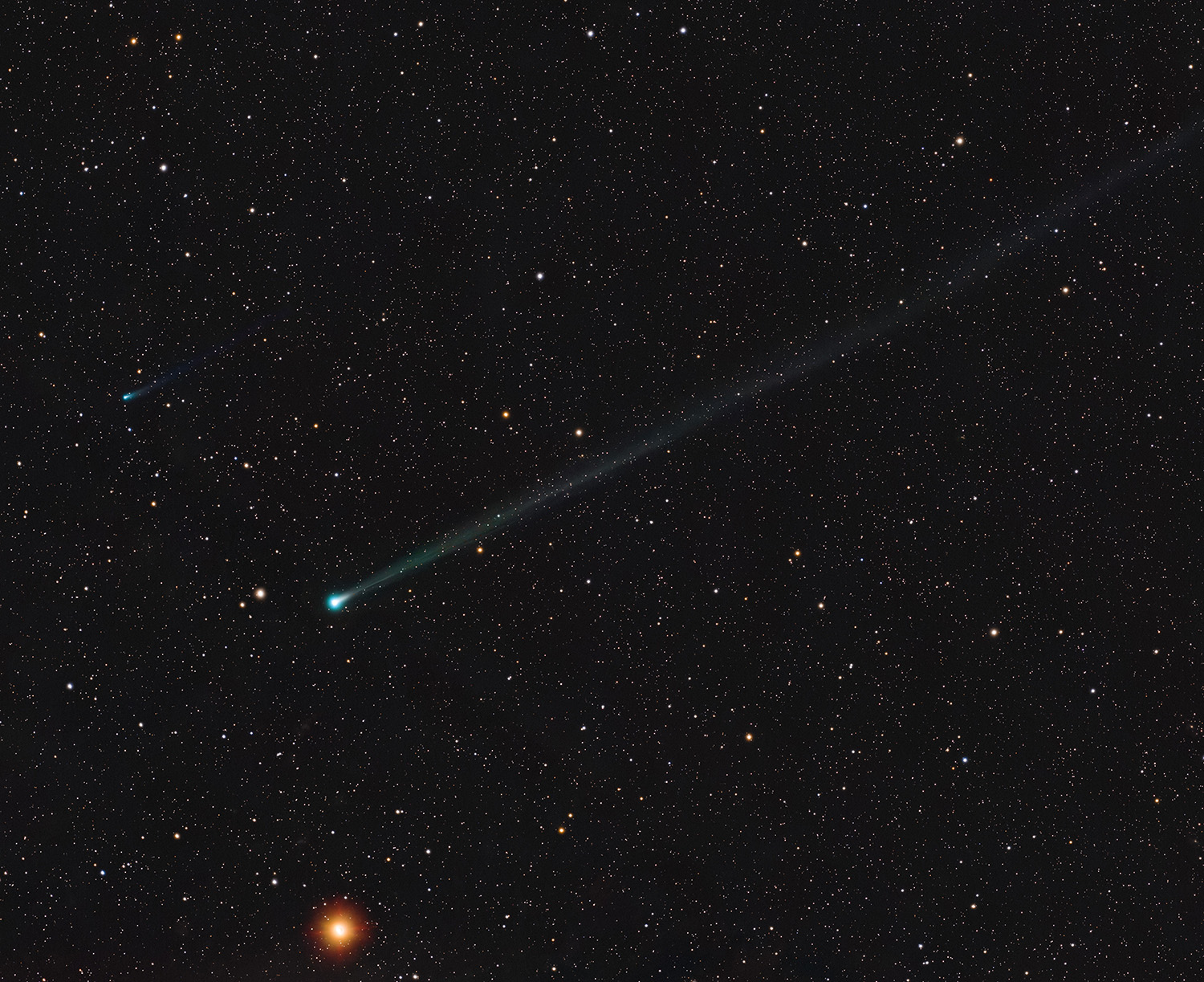 Image Credit & Copyright: Adam Block
A new visitor to the inner Solar System, comet C/2025 R2 (SWAN) sports a long ion tail extending diagonally across this almost 7 degree wide telescopic field of view recorded on September 21. A fainter fellow comet also making its inner Solar System debut, C/2025 K1 (ATLAS), can be spotted above and left of SWAN's greenish coma, just visible against the background sea of stars in the constellation Virgo. Both new comets were only discovered in 2025 and are joined in this celestial frame by ruddy planet Mars (bottom), a more familiar wanderer in planet Earth's night skies. The comets may appear to be in a race, nearly neck and neck in their voyage through the inner Solar System and around the Sun. But this comet SWAN has already reached its perihelion or closest approach to the Sun on September 12 and is now outbound along its orbit. This comet ATLAS is still inbound though, and will make its perihelion passage on October 8.
#APOD #Astroengineer #Astronomy #Galaxy #Research
Image Credit & Copyright: Adam Block
A new visitor to the inner Solar System, comet C/2025 R2 (SWAN) sports a long ion tail extending diagonally across this almost 7 degree wide telescopic field of view recorded on September 21. A fainter fellow comet also making its inner Solar System debut, C/2025 K1 (ATLAS), can be spotted above and left of SWAN's greenish coma, just visible against the background sea of stars in the constellation Virgo. Both new comets were only discovered in 2025 and are joined in this celestial frame by ruddy planet Mars (bottom), a more familiar wanderer in planet Earth's night skies. The comets may appear to be in a race, nearly neck and neck in their voyage through the inner Solar System and around the Sun. But this comet SWAN has already reached its perihelion or closest approach to the Sun on September 12 and is now outbound along its orbit. This comet ATLAS is still inbound though, and will make its perihelion passage on October 8.
#APOD #Astroengineer #Astronomy #Galaxy #Research
Image Credit & Copyright: Adam Block
A new visitor to the inner Solar System, comet C/2025 R2 (SWAN) sports a long ion tail extending diagonally across this almost 7 degree wide telescopic field of view recorded on September 21. A fainter fellow comet also making its inner Solar System debut, C/2025 K1 (ATLAS), can be spotted above and left of SWAN's greenish coma, just visible against the background sea of stars in the constellation Virgo. Both new comets were only discovered in 2025 and are joined in this celestial frame by ruddy planet Mars (bottom), a more familiar wanderer in planet Earth's night skies. The comets may appear to be in a race, nearly neck and neck in their voyage through the inner Solar System and around the Sun. But this comet SWAN has already reached its perihelion or closest approach to the Sun on September 12 and is now outbound along its orbit. This comet ATLAS is still inbound though, and will make its perihelion passage on October 8.
#APOD #Astroengineer #Astronomy #Galaxy #Research
APOD: 2025 September 26 – A SWAN an ATLAS and Mars
A different astronomy and space science
related image is featured each day, along with a brief explanation.
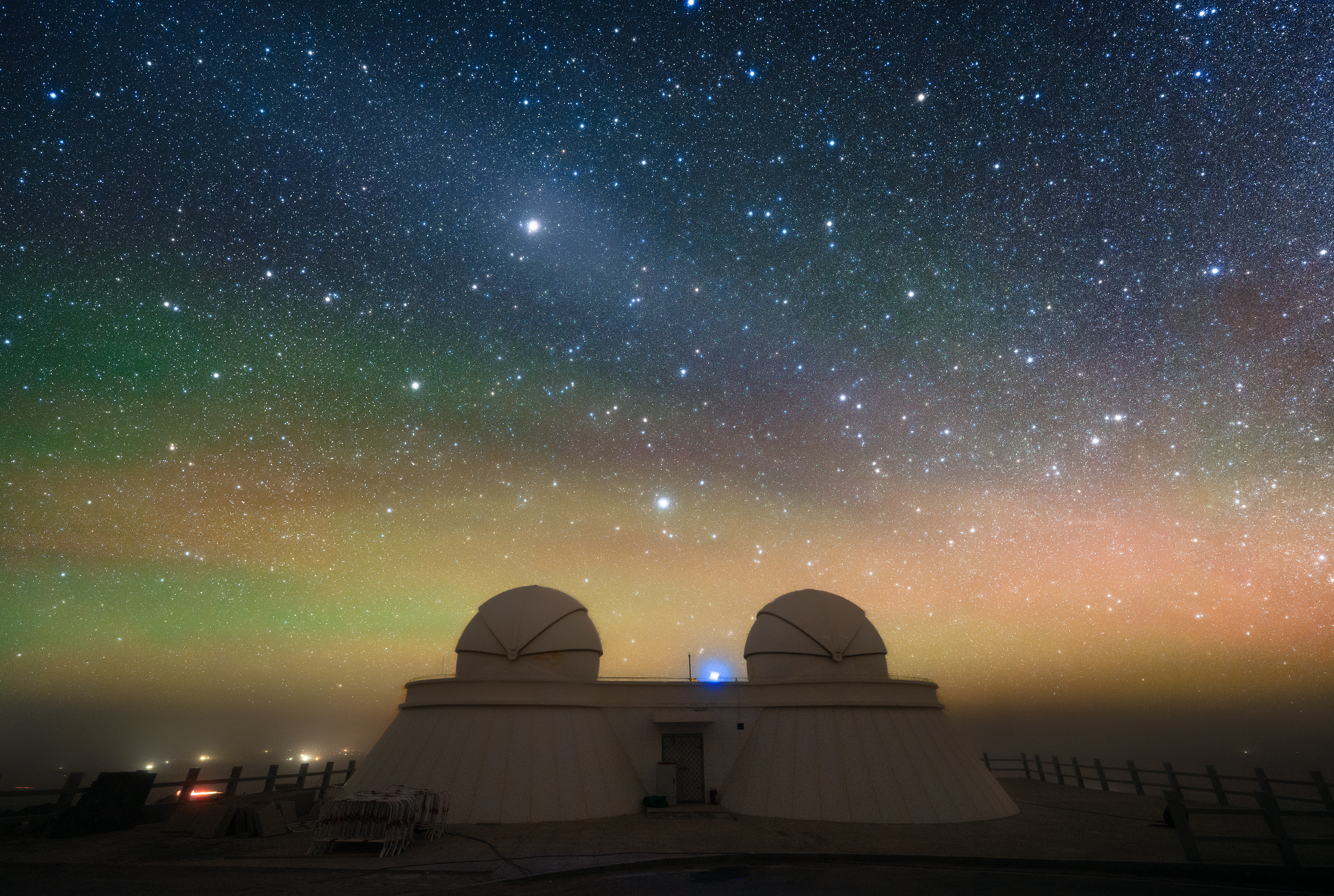 Image Credit & Copyright: Jin Wang
This year Saturn was at opposition on September 21, opposite the Sun in planet Earth's sky. At its closest to Earth, Saturn was also at its brightest of the year, rising as the Sun set and shining above the horizon all night long among the fainter stars of the constellation Pisces. In this snapshot from the Qinghai Lenghu Observatory, Tibetan Plateau, southwestern China, the outer planet is immersed in a faint, diffuse oval of light known as the gegenschein or counter glow. The diffuse gegenschein is produced by sunlight backscattered by interplanetary dust along the Solar System's ecliptic plane, opposite the Sun in planet Earth's sky. Like a giant eye, on this dark night Saturn and gegenschein seem to stare down on the observatory's telescope domes seen against a colorful background of airglow along the horizon.
#APOD #RocketScience #Stargazing #Cosmological #CosmicWonders
Image Credit & Copyright: Jin Wang
This year Saturn was at opposition on September 21, opposite the Sun in planet Earth's sky. At its closest to Earth, Saturn was also at its brightest of the year, rising as the Sun set and shining above the horizon all night long among the fainter stars of the constellation Pisces. In this snapshot from the Qinghai Lenghu Observatory, Tibetan Plateau, southwestern China, the outer planet is immersed in a faint, diffuse oval of light known as the gegenschein or counter glow. The diffuse gegenschein is produced by sunlight backscattered by interplanetary dust along the Solar System's ecliptic plane, opposite the Sun in planet Earth's sky. Like a giant eye, on this dark night Saturn and gegenschein seem to stare down on the observatory's telescope domes seen against a colorful background of airglow along the horizon.
#APOD #RocketScience #Stargazing #Cosmological #CosmicWonders
 *Image creditor details unavailable via API. Visit linked page below for full info.*
It was the strongest gravitational wave signal yet measured -- what did it show? GW250114 was detected by both arms of the Laser Interferometer Gravitational-wave Observatory (LIGO) in Washington and Louisiana USA earlier this year. Analysis showed that the event was created when two black holes, each of mass around 33 times the mass of the Sun, coalesced into one larger black hole with a mass of around 63 solar masses. Even though the event happened about a billion light years away, the signal was so strong that the spin of all black holes, as well as initial ringing of the final black hole, was deduced with exceptional accuracy. Furthermore, it was confirmed better than before, as previously predicted, that the total event horizon area of the combined black hole was greater than those of the merging black holes. Featured, an artist's illustration depicts an imaginative and conceptual view from near one of the black holes before collision.
#APOD #Astrobiology #Cosmos #Astrocosmos #Space
*Image creditor details unavailable via API. Visit linked page below for full info.*
It was the strongest gravitational wave signal yet measured -- what did it show? GW250114 was detected by both arms of the Laser Interferometer Gravitational-wave Observatory (LIGO) in Washington and Louisiana USA earlier this year. Analysis showed that the event was created when two black holes, each of mass around 33 times the mass of the Sun, coalesced into one larger black hole with a mass of around 63 solar masses. Even though the event happened about a billion light years away, the signal was so strong that the spin of all black holes, as well as initial ringing of the final black hole, was deduced with exceptional accuracy. Furthermore, it was confirmed better than before, as previously predicted, that the total event horizon area of the combined black hole was greater than those of the merging black holes. Featured, an artist's illustration depicts an imaginative and conceptual view from near one of the black holes before collision.
#APOD #Astrobiology #Cosmos #Astrocosmos #Space
 Image Credit & Copyright: Wang Letian
The dark, inner shadow of planet Earth is called the umbra. Shaped like a cone extending into space, it has a circular cross section most easily seen during a lunar eclipse. And on the night of September 7/8 the Full Moon passed near the center of Earth's umbral cone, entertaining eclipse watchers around much of our fair planet, including parts of Antarctica, Australia, Asia, Europe, and Africa. Recorded from Zhangjiakou City, China, this timelapse composite image uses successive pictures from the total lunar eclipse, progressing left to right, to reveal the curved cross-section of the umbral shadow sliding across the Moon. Sunlight scattered by the atmosphere into Earth's umbra causes the lunar surface to appear reddened during totality. But close to the umbra's edge, the limb of the eclipsed Moon shows a distinct blue hue. The blue eclipsed moonlight originates as rays of sunlight pass through layers high in the upper stratosphere, colored by ozone that scatters red light and transmits blue. In the total phase of this leisurely lunar eclipse, the Moon was completely within the Earth's umbra for about 83 minutes.
#APOD #Astrogeology #Exploration #Astrotheory #Cosmos
Image Credit & Copyright: Wang Letian
The dark, inner shadow of planet Earth is called the umbra. Shaped like a cone extending into space, it has a circular cross section most easily seen during a lunar eclipse. And on the night of September 7/8 the Full Moon passed near the center of Earth's umbral cone, entertaining eclipse watchers around much of our fair planet, including parts of Antarctica, Australia, Asia, Europe, and Africa. Recorded from Zhangjiakou City, China, this timelapse composite image uses successive pictures from the total lunar eclipse, progressing left to right, to reveal the curved cross-section of the umbral shadow sliding across the Moon. Sunlight scattered by the atmosphere into Earth's umbra causes the lunar surface to appear reddened during totality. But close to the umbra's edge, the limb of the eclipsed Moon shows a distinct blue hue. The blue eclipsed moonlight originates as rays of sunlight pass through layers high in the upper stratosphere, colored by ozone that scatters red light and transmits blue. In the total phase of this leisurely lunar eclipse, the Moon was completely within the Earth's umbra for about 83 minutes.
#APOD #Astrogeology #Exploration #Astrotheory #Cosmos
 Image Credit & Copyright:
Ian Moehring & Kevin Roylance
It is one of the largest nebulas on the sky -- why isn't it better known? Roughly the same angular size as the Andromeda Galaxy, the Great Lacerta Nebula can be found toward the constellation of the Lizard (Lacerta). The emission nebula is difficult to see with wide-field binoculars because it is so faint, but also usually difficult to see with a large telescope because it is so great in angle -- spanning about three degrees. The depth, breadth, waves, and beauty of the nebula -- cataloged as Sharpless 126 (Sh2-126) -- can best be seen and appreciated with a long duration camera exposure. The featured image is one such combined exposure -- in this case taken over three nights in August through dark skies in Moses Lake, Washington, USA. The hydrogen gas in the Great Lacerta Nebula glows red because it is excited by light from the bright star 10 Lacertae, one of the bright blue stars just to the left of the red-glowing nebula's center. Most of the stars and nebula are about 1,200 light years distant. Jigsaw Universe: Astronomy Puzzle of the Day
#APOD #SpaceTech #SpaceObservatory #Science #SpaceTravel
Image Credit & Copyright:
Ian Moehring & Kevin Roylance
It is one of the largest nebulas on the sky -- why isn't it better known? Roughly the same angular size as the Andromeda Galaxy, the Great Lacerta Nebula can be found toward the constellation of the Lizard (Lacerta). The emission nebula is difficult to see with wide-field binoculars because it is so faint, but also usually difficult to see with a large telescope because it is so great in angle -- spanning about three degrees. The depth, breadth, waves, and beauty of the nebula -- cataloged as Sharpless 126 (Sh2-126) -- can best be seen and appreciated with a long duration camera exposure. The featured image is one such combined exposure -- in this case taken over three nights in August through dark skies in Moses Lake, Washington, USA. The hydrogen gas in the Great Lacerta Nebula glows red because it is excited by light from the bright star 10 Lacertae, one of the bright blue stars just to the left of the red-glowing nebula's center. Most of the stars and nebula are about 1,200 light years distant. Jigsaw Universe: Astronomy Puzzle of the Day
#APOD #SpaceTech #SpaceObservatory #Science #SpaceTravel
 *Image creditor details unavailable via API. Visit linked page below for full info.*
What's that rising up from the Earth? When circling the Earth on the International Space Station early in July, astronaut Nicole Ayers saw an unusual type of lightning rising up from the Earth: a gigantic jet. The powerful jet appears near the center of the featured image in red, white, and blue. Giant jet lightning has only been known about for the past 25 years. The atmospheric jets are associated with thunderstorms and extend upwards towards Earth's ionosphere. The lower part of the frame shows the Earth at night, with Earth's thin atmosphere tinted green from airglow. City lights are visible, sometimes resolved, but usually creating diffuse white glows in intervening clouds. The top of the frame reveals distant stars in the dark night sky. The nature of gigantic jets and their possible association with other types of Transient Luminous Events (TLEs) such as blue jets and red sprites remain active topics of research.
#APOD #Astrogeek #Astronauts #Universe #Exploration
*Image creditor details unavailable via API. Visit linked page below for full info.*
What's that rising up from the Earth? When circling the Earth on the International Space Station early in July, astronaut Nicole Ayers saw an unusual type of lightning rising up from the Earth: a gigantic jet. The powerful jet appears near the center of the featured image in red, white, and blue. Giant jet lightning has only been known about for the past 25 years. The atmospheric jets are associated with thunderstorms and extend upwards towards Earth's ionosphere. The lower part of the frame shows the Earth at night, with Earth's thin atmosphere tinted green from airglow. City lights are visible, sometimes resolved, but usually creating diffuse white glows in intervening clouds. The top of the frame reveals distant stars in the dark night sky. The nature of gigantic jets and their possible association with other types of Transient Luminous Events (TLEs) such as blue jets and red sprites remain active topics of research.
#APOD #Astrogeek #Astronauts #Universe #Exploration
 *Image creditor details unavailable via API. Visit linked page below for full info.*
This butterfly can hatch planets. The nebula fanning out from the star IRAS 04302+2247 may look like the wings of a butterfly, while the vertical brown stripe down the center may look like the butterfly's body -- but together they indicate an active planet-forming system. The featured picture was captured recently in infrared light by the Webb Space Telescope. Pictured, the vertical disk is thick with the gas and dust from which planets form. The disk shades visible and (most) infrared light from the central star, allowing a good view of the surrounding dust that reflects out light. In the next few million years, the dust disk will likely fragment into rings through the gravity of newly hatched planets. And a billion years from now, the remaining gas and dust will likely dissipate, leaving mainly the planets -- like in our Solar System. Explore the Universe: Random APOD Generator
#APOD #Astroknowledge #Astroeducation #Celestial #SpaceFacts
*Image creditor details unavailable via API. Visit linked page below for full info.*
This butterfly can hatch planets. The nebula fanning out from the star IRAS 04302+2247 may look like the wings of a butterfly, while the vertical brown stripe down the center may look like the butterfly's body -- but together they indicate an active planet-forming system. The featured picture was captured recently in infrared light by the Webb Space Telescope. Pictured, the vertical disk is thick with the gas and dust from which planets form. The disk shades visible and (most) infrared light from the central star, allowing a good view of the surrounding dust that reflects out light. In the next few million years, the dust disk will likely fragment into rings through the gravity of newly hatched planets. And a billion years from now, the remaining gas and dust will likely dissipate, leaving mainly the planets -- like in our Solar System. Explore the Universe: Random APOD Generator
#APOD #Astroknowledge #Astroeducation #Celestial #SpaceFacts
 *Image creditor details unavailable via API. Visit linked page below for full info.*
How much of planet Earth is made of water? Very little, actually. Although oceans of water cover about 70 percent of Earth's surface, these oceans are shallow compared to the Earth's radius. The featured illustration shows what would happen if all of the water on or near the surface of the Earth were bunched up into a ball. The radius of this ball would be only about 700 kilometers, less than half the radius of the Earth's Moon, but slightly larger than Saturn's moon Rhea which, like many moons in our outer Solar System, is mostly water ice. The next smallest ball depicts all of Earth's liquid fresh water, while the tiniest ball shows the volume of all of Earth's fresh-water lakes and rivers. How any of this water came to be on the Earth and whether any significant amount is trapped far beneath Earth's surface remain topics of research.
#APOD #Astroknowledge #Astrotheory #Astrophotography #Astrotheory
*Image creditor details unavailable via API. Visit linked page below for full info.*
How much of planet Earth is made of water? Very little, actually. Although oceans of water cover about 70 percent of Earth's surface, these oceans are shallow compared to the Earth's radius. The featured illustration shows what would happen if all of the water on or near the surface of the Earth were bunched up into a ball. The radius of this ball would be only about 700 kilometers, less than half the radius of the Earth's Moon, but slightly larger than Saturn's moon Rhea which, like many moons in our outer Solar System, is mostly water ice. The next smallest ball depicts all of Earth's liquid fresh water, while the tiniest ball shows the volume of all of Earth's fresh-water lakes and rivers. How any of this water came to be on the Earth and whether any significant amount is trapped far beneath Earth's surface remain topics of research.
#APOD #Astroknowledge #Astrotheory #Astrophotography #Astrotheory
 Image Credit & Copyright: When the sun sets on September 7
When the sun sets on September 7, the Full Moon will rise. And on that date denizens around much of our fair planet, including parts of Antarctica, Australia, Asia, Europe, and Africa can witness a total lunar eclipse, with the Moon completely immersed in Earth's shadow. As the bright Full Moon first enters Earth's shadow it will darken, finally taking on a reddish hue during the total eclipse phase. In fact, the color of the Moon during a total lunar eclipse is due to reddened light from sunrises and sunsets around planet Earth. The reddened sunlight is scattered by a dense atmosphere into the planet's otherwise dark central shadow. When the sun set on August 22, this telephoto snapshot of red skies, blue sea, and the Mangiabarche Lighthouse was captured from Sant'Antioco, Sardinia, Italy.
#APOD #Astrophotography #Research #Exoplanets #MilkyWay
Image Credit & Copyright: When the sun sets on September 7
When the sun sets on September 7, the Full Moon will rise. And on that date denizens around much of our fair planet, including parts of Antarctica, Australia, Asia, Europe, and Africa can witness a total lunar eclipse, with the Moon completely immersed in Earth's shadow. As the bright Full Moon first enters Earth's shadow it will darken, finally taking on a reddish hue during the total eclipse phase. In fact, the color of the Moon during a total lunar eclipse is due to reddened light from sunrises and sunsets around planet Earth. The reddened sunlight is scattered by a dense atmosphere into the planet's otherwise dark central shadow. When the sun set on August 22, this telephoto snapshot of red skies, blue sea, and the Mangiabarche Lighthouse was captured from Sant'Antioco, Sardinia, Italy.
#APOD #Astrophotography #Research #Exoplanets #MilkyWay
 Image Credit & Copyright: Carlos Taylor
Also known as NGC 104, 47 Tucanae is a jewel of the southern sky. Not a star but a dense cluster of stars, it roams the halo of our Milky Way Galaxy along with some 200 other globular star clusters. The second brightest globular cluster (after Omega Centauri) as seen from planet Earth, 47 Tuc lies about 13,000 light-years away. It can be spotted with the naked eye close on the sky to the Small Magellanic Cloud in the constellation of the Toucan. The dense cluster is made up of hundreds of thousands of stars in a volume only about 120 light-years across. Red giant stars on the outskirts of the cluster are easy to pick out as yellowish stars in this sharp telescopic portrait. Tightly packed globular star cluster 47 Tuc is also home to a star with the closest known orbit around a black hole.
#APOD #Science #SpaceExploration #OuterSpace #Universe
Image Credit & Copyright: Carlos Taylor
Also known as NGC 104, 47 Tucanae is a jewel of the southern sky. Not a star but a dense cluster of stars, it roams the halo of our Milky Way Galaxy along with some 200 other globular star clusters. The second brightest globular cluster (after Omega Centauri) as seen from planet Earth, 47 Tuc lies about 13,000 light-years away. It can be spotted with the naked eye close on the sky to the Small Magellanic Cloud in the constellation of the Toucan. The dense cluster is made up of hundreds of thousands of stars in a volume only about 120 light-years across. Red giant stars on the outskirts of the cluster are easy to pick out as yellowish stars in this sharp telescopic portrait. Tightly packed globular star cluster 47 Tuc is also home to a star with the closest known orbit around a black hole.
#APOD #Science #SpaceExploration #OuterSpace #Universe
 Image Credit & Copyright: José Rodrigues
Magnificent spiral galaxy NGC 4565 is viewed edge-on from planet Earth. Also known as the Needle Galaxy for its narrow profile, bright NGC 4565 is a stop on many telescopic tours of the northern sky, in the faint but well-groomed constellation Coma Berenices. This sharp, colorful image reveals the galaxy's boxy, bulging central core cut by obscuring dust lanes that lace NGC 4565's thin galactic plane. NGC 4565 lies around 40 million light-years distant while the spiral galaxy itself spans some 100,000 light-years. That's about the size of our own Milky Way. Easily spotted with small telescopes, deep sky enthusiasts consider NGC 4565 to be a prominent celestial masterpiece Messier missed.
#APOD #CosmosJourney #Meteorology #Astroknowledge #Astrogeek
Image Credit & Copyright: José Rodrigues
Magnificent spiral galaxy NGC 4565 is viewed edge-on from planet Earth. Also known as the Needle Galaxy for its narrow profile, bright NGC 4565 is a stop on many telescopic tours of the northern sky, in the faint but well-groomed constellation Coma Berenices. This sharp, colorful image reveals the galaxy's boxy, bulging central core cut by obscuring dust lanes that lace NGC 4565's thin galactic plane. NGC 4565 lies around 40 million light-years distant while the spiral galaxy itself spans some 100,000 light-years. That's about the size of our own Milky Way. Easily spotted with small telescopes, deep sky enthusiasts consider NGC 4565 to be a prominent celestial masterpiece Messier missed.
#APOD #CosmosJourney #Meteorology #Astroknowledge #Astrogeek
 *Image creditor details unavailable via API. Visit linked page below for full info.*
How soon do jets form when a supernova gives birth to a neutron star? The Africa Nebula provides clues. This supernova remnant surrounds Circinus X-1, an X-ray emitting neutron star and the companion star it orbits. The image, from the ThunderKAT collaboration on the MeerKAT radio telescope situated in South Africa, shows the bright core-and-lobe structure of Cir X-1’s currently active jets inside the nebula. A mere 4600 years old, Cir X-1 could be the "Little Sister" of microquasar SS 433*. However, the newly discovered bubble exiting from a ring-like hole in the upper right of the nebula, along with a ring to the bottom left, demonstrate that other jets previously existed. Computer simulations indicate those jets formed within 100 years of the explosion and lasted up to 1000 years. Surprisingly, to create the observed bubble, the jets need to be more powerful than young neutron stars were previously thought to produce. Open Science: Browse 3,700+ codes in the Astrophysics Source Code Library
#APOD #Planetarium #SpaceInnovation #Astrozone #Astrobiology
*Image creditor details unavailable via API. Visit linked page below for full info.*
How soon do jets form when a supernova gives birth to a neutron star? The Africa Nebula provides clues. This supernova remnant surrounds Circinus X-1, an X-ray emitting neutron star and the companion star it orbits. The image, from the ThunderKAT collaboration on the MeerKAT radio telescope situated in South Africa, shows the bright core-and-lobe structure of Cir X-1’s currently active jets inside the nebula. A mere 4600 years old, Cir X-1 could be the "Little Sister" of microquasar SS 433*. However, the newly discovered bubble exiting from a ring-like hole in the upper right of the nebula, along with a ring to the bottom left, demonstrate that other jets previously existed. Computer simulations indicate those jets formed within 100 years of the explosion and lasted up to 1000 years. Surprisingly, to create the observed bubble, the jets need to be more powerful than young neutron stars were previously thought to produce. Open Science: Browse 3,700+ codes in the Astrophysics Source Code Library
#APOD #Planetarium #SpaceInnovation #Astrozone #Astrobiology
 Image Credit & Copyright:
Daniel Stern
The Horsehead Nebula is one of the most famous nebulae on the sky. It is visible as the dark indentation to the orange emission nebula at the far right of the featured picture. The horse-head feature is dark because it is really an opaque dust cloud that lies in front of the bright emission nebula. Like clouds in Earth's atmosphere, this cosmic cloud has assumed a recognizable shape by chance. After many thousands of years, the internal motions of the cloud will surely alter its appearance. The emission nebula's orange color is caused by electrons recombining with protons to form hydrogen atoms. Toward the lower left of the image is the Flame Nebula, an orange-tinged nebula that also contains intricate filaments of dark dust.
#APOD #SpaceMissions #RocketScience #Astrophoto #SpaceObservatory
Image Credit & Copyright:
Daniel Stern
The Horsehead Nebula is one of the most famous nebulae on the sky. It is visible as the dark indentation to the orange emission nebula at the far right of the featured picture. The horse-head feature is dark because it is really an opaque dust cloud that lies in front of the bright emission nebula. Like clouds in Earth's atmosphere, this cosmic cloud has assumed a recognizable shape by chance. After many thousands of years, the internal motions of the cloud will surely alter its appearance. The emission nebula's orange color is caused by electrons recombining with protons to form hydrogen atoms. Toward the lower left of the image is the Flame Nebula, an orange-tinged nebula that also contains intricate filaments of dark dust.
#APOD #SpaceMissions #RocketScience #Astrophoto #SpaceObservatory
 *Image creditor details unavailable via API. Visit linked page below for full info.*
Its surface is the most densely cratered in the Solar System -- but what's inside? Jupiter's moon Callisto is a battered ball of dirty ice that is larger than the planet Mercury. It was visited by NASA's Galileo spacecraft in the 1990s and 2000s, but the recently reprocessed featured image is from a flyby of NASA's Voyager 2 in 1979. The moon would appear darker if it weren't for the tapestry of light-colored fractured surface ice created by eons of impacts. The interior of Callisto is potentially even more interesting because therein might lie an internal layer of liquid water. This potential underground sea is a candidate to harbor life -- similar with sister moons Europa and Ganymede. Callisto is slightly larger than Luna, Earth's Moon, but because of its high ice content is slightly less massive. ESA's JUICE and NASA's Europa Clipper missions are now headed out to Jupiter to better investigate its largest moons.
#APOD #SpaceWeather #RocketScience #SpaceFacts #SpaceTech
*Image creditor details unavailable via API. Visit linked page below for full info.*
Its surface is the most densely cratered in the Solar System -- but what's inside? Jupiter's moon Callisto is a battered ball of dirty ice that is larger than the planet Mercury. It was visited by NASA's Galileo spacecraft in the 1990s and 2000s, but the recently reprocessed featured image is from a flyby of NASA's Voyager 2 in 1979. The moon would appear darker if it weren't for the tapestry of light-colored fractured surface ice created by eons of impacts. The interior of Callisto is potentially even more interesting because therein might lie an internal layer of liquid water. This potential underground sea is a candidate to harbor life -- similar with sister moons Europa and Ganymede. Callisto is slightly larger than Luna, Earth's Moon, but because of its high ice content is slightly less massive. ESA's JUICE and NASA's Europa Clipper missions are now headed out to Jupiter to better investigate its largest moons.
#APOD #SpaceWeather #RocketScience #SpaceFacts #SpaceTech
 *Image creditor details unavailable via API. Visit linked page below for full info.*
What created this unusual planetary nebula? Dubbed the Pillow Nebula and the Flying Carpet Nebula, NGC 7027 is one of the smallest, brightest, and most unusually shaped planetary nebulas known. Given its expansion rate, NGC 7027 first started expanding, as visible from Earth, about 600 years ago. For much of its history, the planetary nebula has been expelling shells, as seen in blue in the featured image by the Hubble Space Telescope. In modern times, though, for reasons unknown, it began ejecting gas and dust (seen in brown) in specific directions that created a new pattern that seems to have four corners. What lies at the nebula's center is unknown, with one hypothesis holding it to be a close binary star system where one star sheds gas onto an erratic disk orbiting the other star. NGC 7027, about 3,000 light years away, was first discovered in 1878 and can be seen with a standard backyard telescope toward the constellation of the Swan (Cygnus).
#APOD #Astrozone #Astrodata #StarFormation #Astroinformatics
*Image creditor details unavailable via API. Visit linked page below for full info.*
What created this unusual planetary nebula? Dubbed the Pillow Nebula and the Flying Carpet Nebula, NGC 7027 is one of the smallest, brightest, and most unusually shaped planetary nebulas known. Given its expansion rate, NGC 7027 first started expanding, as visible from Earth, about 600 years ago. For much of its history, the planetary nebula has been expelling shells, as seen in blue in the featured image by the Hubble Space Telescope. In modern times, though, for reasons unknown, it began ejecting gas and dust (seen in brown) in specific directions that created a new pattern that seems to have four corners. What lies at the nebula's center is unknown, with one hypothesis holding it to be a close binary star system where one star sheds gas onto an erratic disk orbiting the other star. NGC 7027, about 3,000 light years away, was first discovered in 1878 and can be seen with a standard backyard telescope toward the constellation of the Swan (Cygnus).
#APOD #Astrozone #Astrodata #StarFormation #Astroinformatics
 Image Credit & Copyright: Marina Prol
A young crescent moon can be hard to see. That's because when the Moon shows it's crescent phase (young or old) it can never be far from the Sun in planet Earth's sky. And even though the sky is still bright, a slender sunlit lunar crescent is cleary visible in this early evening skyscape. The telephoto snapshot was captured on August 24, with the Moon very near the western horizon at sunset. Seen in a narrow crescent phase about 1.5 days old, the visible sunlit portion is a mere two percent of the surface of the Moon's familiar nearside. At the Canary Islands Space Centre, a steerable radio dish for communication with spacecraft is titled in the direction of the two percent Moon. The sunset sky's pastel pinkish coloring is partly due to fine sand and dust from the Sahara Desert blown by the prevailing winds.
#APOD #Astroengineer #Astrotheory #RocketScience #Meteorology
Image Credit & Copyright: Marina Prol
A young crescent moon can be hard to see. That's because when the Moon shows it's crescent phase (young or old) it can never be far from the Sun in planet Earth's sky. And even though the sky is still bright, a slender sunlit lunar crescent is cleary visible in this early evening skyscape. The telephoto snapshot was captured on August 24, with the Moon very near the western horizon at sunset. Seen in a narrow crescent phase about 1.5 days old, the visible sunlit portion is a mere two percent of the surface of the Moon's familiar nearside. At the Canary Islands Space Centre, a steerable radio dish for communication with spacecraft is titled in the direction of the two percent Moon. The sunset sky's pastel pinkish coloring is partly due to fine sand and dust from the Sahara Desert blown by the prevailing winds.
#APOD #Astroengineer #Astrotheory #RocketScience #Meteorology
 Image Credit & Copyright: Katelyn Beecroft
The diffuse hydrogen-alpha glow of emission region Sh2-27 fills this cosmic scene. The field of view spans nearly 3 degrees across the nebula-rich constellation Ophiuchus toward the central Milky Way. A Dark Veil of wispy interstellar dust clouds draped across the foreground is chiefly identified as LDN 234 and LDN 204 from the 1962 Catalog of Dark Nebulae by American astronomer Beverly Lynds. Sh2-27 itself is the large but faint HII region surrounding runaway O-type star Zeta Ophiuchi. Along with the Zeta Oph HII region, LDN 234 and LDN 204 are likely 500 or so light-years away. At that distance, this telescopic frame would be about 25 light-years wide.
#APOD #Astroengineer #SpaceResearch #Astrochemistry #Astrophoto
Image Credit & Copyright: Katelyn Beecroft
The diffuse hydrogen-alpha glow of emission region Sh2-27 fills this cosmic scene. The field of view spans nearly 3 degrees across the nebula-rich constellation Ophiuchus toward the central Milky Way. A Dark Veil of wispy interstellar dust clouds draped across the foreground is chiefly identified as LDN 234 and LDN 204 from the 1962 Catalog of Dark Nebulae by American astronomer Beverly Lynds. Sh2-27 itself is the large but faint HII region surrounding runaway O-type star Zeta Ophiuchi. Along with the Zeta Oph HII region, LDN 234 and LDN 204 are likely 500 or so light-years away. At that distance, this telescopic frame would be about 25 light-years wide.
#APOD #Astroengineer #SpaceResearch #Astrochemistry #Astrophoto
 Image Credit & Copyright: Robert Eder
This well-composed telescopic field of view covers over a Full Moon on the sky toward the high-flying constellation Pegasus. Of course the brighter stars show diffraction spikes, the commonly seen effect of internal supports in reflecting telescopes, and lie well within our own Milky Way galaxy. The faint but pervasive clouds of interstellar dust ride above the galactic plane and dimly reflect the Milky Way's starlight. Known as galactic cirrus or integrated flux nebulae they are associated with the Milky Way's molecular clouds. In fact, the diffuse cloud cataloged as MBM 54, less than a thousand light-years distant, fills the scene. The galaxy seemingly tangled in the dusty cloud is the striking spiral galaxy NGC 7497. It's some 60 million light-years away, though. Seen almost edge-on near the center of the field, NGC 7497's own spiral arms and dust lanes echo the colors of stars and dust in our own Milky Way.
#APOD #Astrodata #PlanetaryExploration #SpaceStation #RocketScience
Image Credit & Copyright: Robert Eder
This well-composed telescopic field of view covers over a Full Moon on the sky toward the high-flying constellation Pegasus. Of course the brighter stars show diffraction spikes, the commonly seen effect of internal supports in reflecting telescopes, and lie well within our own Milky Way galaxy. The faint but pervasive clouds of interstellar dust ride above the galactic plane and dimly reflect the Milky Way's starlight. Known as galactic cirrus or integrated flux nebulae they are associated with the Milky Way's molecular clouds. In fact, the diffuse cloud cataloged as MBM 54, less than a thousand light-years distant, fills the scene. The galaxy seemingly tangled in the dusty cloud is the striking spiral galaxy NGC 7497. It's some 60 million light-years away, though. Seen almost edge-on near the center of the field, NGC 7497's own spiral arms and dust lanes echo the colors of stars and dust in our own Milky Way.
#APOD #Astrodata #PlanetaryExploration #SpaceStation #RocketScience
 *Image creditor details unavailable via API. Visit linked page below for full info.*
That yellow spot -- what is it? It's a young planet outside our Solar System. The featured image from the Very Large Telescope in Chile surprisingly captures a distant scene much like our own Solar System's birth, some 4.5 billion years ago. Although we can't look into the past and see Earth's formation directly, telescopes let us watch similar processes unfolding around distant stars. At the center of this frame lies a young Sun-like star, hidden behind a coronagraph that blocks its bright glare. Surrounding the star is a bright, dusty protoplanetary disk -- the raw material of planets. Gaps and concentric rings mark where a newborn world is gathering gas and dust under its gravity, clearing the way as it orbits the star. Although astronomers have imaged disk-embedded planets before, this is the first-ever observation of an exoplanet actively carving a gap within a disk -- the earliest direct glimpse of planetary sculpting in action.
#APOD #GalacticAdventures #Astronomy #AstronomyLovers #Astrochemistry
*Image creditor details unavailable via API. Visit linked page below for full info.*
That yellow spot -- what is it? It's a young planet outside our Solar System. The featured image from the Very Large Telescope in Chile surprisingly captures a distant scene much like our own Solar System's birth, some 4.5 billion years ago. Although we can't look into the past and see Earth's formation directly, telescopes let us watch similar processes unfolding around distant stars. At the center of this frame lies a young Sun-like star, hidden behind a coronagraph that blocks its bright glare. Surrounding the star is a bright, dusty protoplanetary disk -- the raw material of planets. Gaps and concentric rings mark where a newborn world is gathering gas and dust under its gravity, clearing the way as it orbits the star. Although astronomers have imaged disk-embedded planets before, this is the first-ever observation of an exoplanet actively carving a gap within a disk -- the earliest direct glimpse of planetary sculpting in action.
#APOD #GalacticAdventures #Astronomy #AstronomyLovers #Astrochemistry
 Image Credit & Copyright:
Yousif Alqasimi &
Essa Al Jasmi
Sometimes even the sky surprises you. To see more stars and faint nebulosity in the Pleiades star cluster (M45), long exposures are made. Many times, less interesting items appear on the exposures that were not intended -- but later edited out. These include stuck pixels, cosmic ray hits, frames with bright clouds or Earth's Moon, airplane trails, lens flares, faint satellite trails, and even insect trails. Sometimes, though, something really interesting is caught by chance. That was just the case a few weeks ago in al-Ula, Saudi Arabia when a bright meteor streaked across during an hour-long exposure of the Pleiades. Along with the famous bright blue stars, less famous and less bright blue stars, and blue-reflecting dust surrounding the star cluster, the fast rock fragment created a distinctive green glow, likely due to vaporized metals. Jigsaw Universe: Astronomy Puzzle of the Day
#APOD #SpaceObservatory #NASA #Astronomy #Galactic
Image Credit & Copyright:
Yousif Alqasimi &
Essa Al Jasmi
Sometimes even the sky surprises you. To see more stars and faint nebulosity in the Pleiades star cluster (M45), long exposures are made. Many times, less interesting items appear on the exposures that were not intended -- but later edited out. These include stuck pixels, cosmic ray hits, frames with bright clouds or Earth's Moon, airplane trails, lens flares, faint satellite trails, and even insect trails. Sometimes, though, something really interesting is caught by chance. That was just the case a few weeks ago in al-Ula, Saudi Arabia when a bright meteor streaked across during an hour-long exposure of the Pleiades. Along with the famous bright blue stars, less famous and less bright blue stars, and blue-reflecting dust surrounding the star cluster, the fast rock fragment created a distinctive green glow, likely due to vaporized metals. Jigsaw Universe: Astronomy Puzzle of the Day
#APOD #SpaceObservatory #NASA #Astronomy #Galactic