
**Astronomy Picture of the Day**
16 July 2025
**The Rosette Nebula from DECam**
 *Image creditor details unavailable via API. Visit linked page below for full info.*
Would the Rosette Nebula by any other name look as sweet? The bland New General Catalog designation of NGC 2237 doesn't appear to diminish the appearance of this flowery emission nebula, as captured by the Dark Energy Camera (DECam) on the Blanco 4-meter telescope at the NSF's Cerro Tololo Inter-American Observatory in Chile. Inside the nebula lies an open cluster of bright young stars designated NGC 2244. These stars formed about four million years ago from the nebular material and their stellar winds are clearing a hole in the nebula's center, insulated by a layer of dust and hot gas. Ultraviolet light from the hot cluster stars causes the surrounding nebula to glow. The Rosette Nebula spans about 100 light-years across, lies about 5000 light-years away, and can be seen with a small telescope towards the constellation of the Unicorn (Monoceros). Open Science: Browse 3,700+ codes in the Astrophysics Source Code Library
#APOD #Galaxy #MeteorShowers #SpaceStation #OuterSpace
*Image creditor details unavailable via API. Visit linked page below for full info.*
Would the Rosette Nebula by any other name look as sweet? The bland New General Catalog designation of NGC 2237 doesn't appear to diminish the appearance of this flowery emission nebula, as captured by the Dark Energy Camera (DECam) on the Blanco 4-meter telescope at the NSF's Cerro Tololo Inter-American Observatory in Chile. Inside the nebula lies an open cluster of bright young stars designated NGC 2244. These stars formed about four million years ago from the nebular material and their stellar winds are clearing a hole in the nebula's center, insulated by a layer of dust and hot gas. Ultraviolet light from the hot cluster stars causes the surrounding nebula to glow. The Rosette Nebula spans about 100 light-years across, lies about 5000 light-years away, and can be seen with a small telescope towards the constellation of the Unicorn (Monoceros). Open Science: Browse 3,700+ codes in the Astrophysics Source Code Library
#APOD #Galaxy #MeteorShowers #SpaceStation #OuterSpace
*Image creditor details unavailable via API. Visit linked page below for full info.*
Would the Rosette Nebula by any other name look as sweet? The bland New General Catalog designation of NGC 2237 doesn't appear to diminish the appearance of this flowery emission nebula, as captured by the Dark Energy Camera (DECam) on the Blanco 4-meter telescope at the NSF's Cerro Tololo Inter-American Observatory in Chile. Inside the nebula lies an open cluster of bright young stars designated NGC 2244. These stars formed about four million years ago from the nebular material and their stellar winds are clearing a hole in the nebula's center, insulated by a layer of dust and hot gas. Ultraviolet light from the hot cluster stars causes the surrounding nebula to glow. The Rosette Nebula spans about 100 light-years across, lies about 5000 light-years away, and can be seen with a small telescope towards the constellation of the Unicorn (Monoceros). Open Science: Browse 3,700+ codes in the Astrophysics Source Code Library
#APOD #Galaxy #MeteorShowers #SpaceStation #OuterSpace
APOD: 2025 July 16 – The Rosette Nebula from DECam
A different astronomy and space science
related image is featured each day, along with a brief explanation.
 *Image creditor details unavailable via API. Visit linked page below for full info.*
What's happened in Hebes Chasma on Mars? Hebes Chasma is a depression just north of the enormous Valles Marineris canyon. Since the depression is unconnected to other surface features, it is unclear where the internal material went. Inside Hebes Chasma is Hebes Mensa, a 5 kilometer high mesa that appears to have undergone an unusual partial collapse -- a collapse that might be providing clues. The featured image, taken by ESA's robotic Mars Express spacecraft currently orbiting Mars, shows great details of the chasm and the unusual horseshoe shaped indentation in the central mesa. Material from the mesa appears to have flowed onto the floor of the chasm, while a possible dark layer appears to have pooled like ink on a downslope landing. One hypothesis holds that salty rock composes some lower layers in Hebes Chasma, with the salt dissolving in melted ice flows that drained through holes into an underground aquifer.
#APOD #Astrophysics #SpaceTech #Astrospace #CosmosJourney
*Image creditor details unavailable via API. Visit linked page below for full info.*
What's happened in Hebes Chasma on Mars? Hebes Chasma is a depression just north of the enormous Valles Marineris canyon. Since the depression is unconnected to other surface features, it is unclear where the internal material went. Inside Hebes Chasma is Hebes Mensa, a 5 kilometer high mesa that appears to have undergone an unusual partial collapse -- a collapse that might be providing clues. The featured image, taken by ESA's robotic Mars Express spacecraft currently orbiting Mars, shows great details of the chasm and the unusual horseshoe shaped indentation in the central mesa. Material from the mesa appears to have flowed onto the floor of the chasm, while a possible dark layer appears to have pooled like ink on a downslope landing. One hypothesis holds that salty rock composes some lower layers in Hebes Chasma, with the salt dissolving in melted ice flows that drained through holes into an underground aquifer.
#APOD #Astrophysics #SpaceTech #Astrospace #CosmosJourney
 Image Credit & Copyright:
Stefan Thrun
What is going on with this galaxy? NGC 2685 is a confirmed polar ring galaxy - a rare type of galaxy with stars, gas and dust orbiting in rings perpendicular to the plane of a flat galactic disk. The bizarre configuration could be caused by the chance capture of material from another galaxy by a disk galaxy, with the captured debris strung out in a rotating ring. Still, observed properties of NGC 2685 suggest that the rotating helix structure is remarkably old and stable. In this sharp view of the peculiar system also known as Arp 336 or the Helix galaxy, the strange, perpendicular rings are easy to trace as they pass in front of the galactic disk, along with other disturbed outer structures. NGC 2685 is about 50,000 light-years across and 40 million light-years away in the constellation of the Great Bear (Ursa Major). Piece it All Together: Astronomy Puzzle of the Day
#APOD #Exoplanets #Astrodata #Astroknowledge #Astrophysics
Image Credit & Copyright:
Stefan Thrun
What is going on with this galaxy? NGC 2685 is a confirmed polar ring galaxy - a rare type of galaxy with stars, gas and dust orbiting in rings perpendicular to the plane of a flat galactic disk. The bizarre configuration could be caused by the chance capture of material from another galaxy by a disk galaxy, with the captured debris strung out in a rotating ring. Still, observed properties of NGC 2685 suggest that the rotating helix structure is remarkably old and stable. In this sharp view of the peculiar system also known as Arp 336 or the Helix galaxy, the strange, perpendicular rings are easy to trace as they pass in front of the galactic disk, along with other disturbed outer structures. NGC 2685 is about 50,000 light-years across and 40 million light-years away in the constellation of the Great Bear (Ursa Major). Piece it All Together: Astronomy Puzzle of the Day
#APOD #Exoplanets #Astrodata #Astroknowledge #Astrophysics
 *Image creditor details unavailable via API. Visit linked page below for full info.*
Why isn't this ant a big sphere? Planetary nebula Mz3 is being cast off by a star similar to our Sun that is, surely, round. Why then would the gas that is streaming away create an ant-shaped nebula that is distinctly not round? Clues might include the high 1000-kilometer per second speed of the expelled gas, the light-year long length of the structure, and the magnetism of the star featured here at the nebula's center. One possible answer is that Mz3 is hiding a second, dimmer star that orbits close in to the bright star. A competing hypothesis holds that the central star's own spin and magnetic field are channeling the gas. Since the central star appears to be so similar to our own Sun, astronomers hope that increased understanding of the history of this giant space ant can provide useful insight into the likely future of our own Sun and Earth. Explore Your Universe: Random APOD Generator
#APOD #Space #Astroinformatics #Celestial #SpaceTechnology
*Image creditor details unavailable via API. Visit linked page below for full info.*
Why isn't this ant a big sphere? Planetary nebula Mz3 is being cast off by a star similar to our Sun that is, surely, round. Why then would the gas that is streaming away create an ant-shaped nebula that is distinctly not round? Clues might include the high 1000-kilometer per second speed of the expelled gas, the light-year long length of the structure, and the magnetism of the star featured here at the nebula's center. One possible answer is that Mz3 is hiding a second, dimmer star that orbits close in to the bright star. A competing hypothesis holds that the central star's own spin and magnetic field are channeling the gas. Since the central star appears to be so similar to our own Sun, astronomers hope that increased understanding of the history of this giant space ant can provide useful insight into the likely future of our own Sun and Earth. Explore Your Universe: Random APOD Generator
#APOD #Space #Astroinformatics #Celestial #SpaceTechnology
 Image Credit & Copyright: Alexsandro Mota
As the Sun set, a bright Full Moon rose on July 10. Its golden light illuminates clouds drifting through southern hemisphere skies in this well-composed telephoto image from Conceição do Coité, Bahia, Brazil. The brightest lunar phase is captured here with both a short and long exposure. The two exposures were combined to reveal details of the lunar surface in bright moonlight and a subtle iridescence along the dramatically backlit cloudscape. Of course, July's Full Moon is a winter moon in the southern hemisphere. But in the north it's known to some as the Thunder Moon, likely a nod to the sounds of this northern summer month's typically stormy weather.
#APOD #SpaceTech #CosmicWonders #SpaceDiscovery #Exploration
Image Credit & Copyright: Alexsandro Mota
As the Sun set, a bright Full Moon rose on July 10. Its golden light illuminates clouds drifting through southern hemisphere skies in this well-composed telephoto image from Conceição do Coité, Bahia, Brazil. The brightest lunar phase is captured here with both a short and long exposure. The two exposures were combined to reveal details of the lunar surface in bright moonlight and a subtle iridescence along the dramatically backlit cloudscape. Of course, July's Full Moon is a winter moon in the southern hemisphere. But in the north it's known to some as the Thunder Moon, likely a nod to the sounds of this northern summer month's typically stormy weather.
#APOD #SpaceTech #CosmicWonders #SpaceDiscovery #Exploration
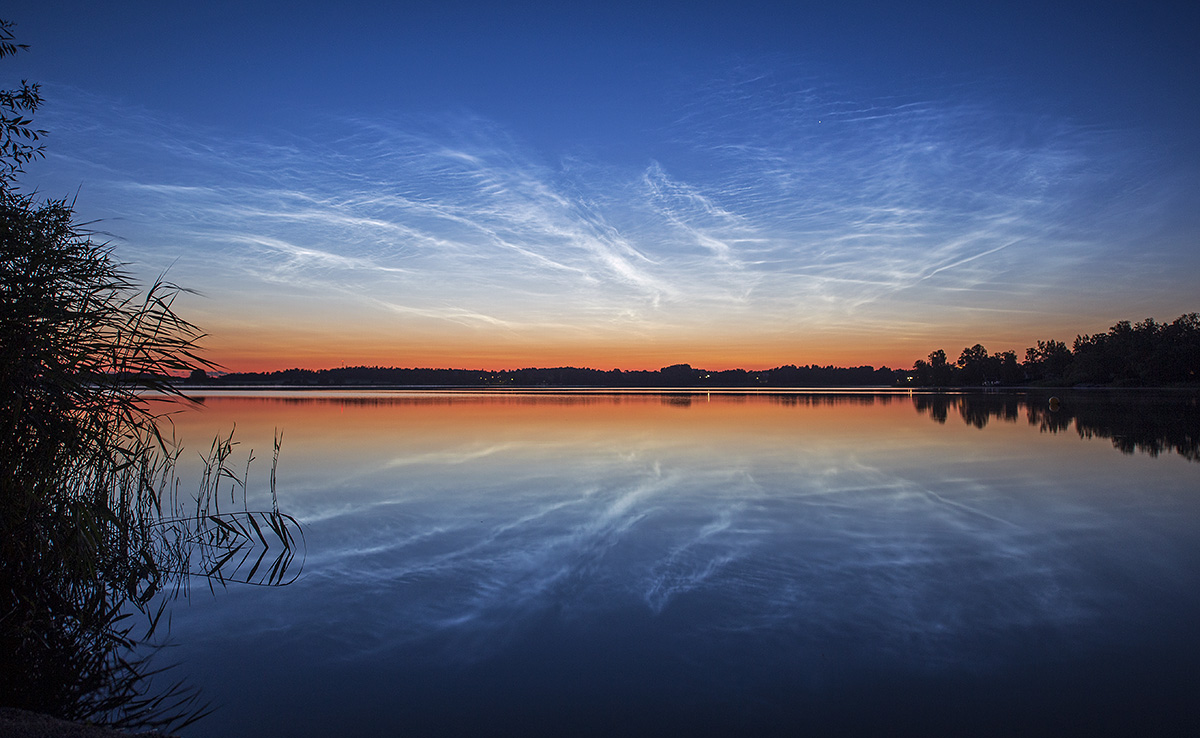 Image Credit & Copyright: Clear Skies
Transfusing sunlight as the sky grew darker, this exceptional display of noctilucent clouds was captured on July 10, reflected in the calm waters of Vallentuna Lake near Stockholm, Sweden. From the edge of space, about 80 kilometers above Earth's surface, the icy clouds themselves still reflect sunlight, even though the Sun is below the horizon as seen from the ground. Usually spotted at high latitudes in summer months, the night shining clouds have made a strong showing so far during the short northern summer nights. Also known as polar mesopheric clouds they are understood to form as water vapor driven into the cold upper atmosphere condenses on the fine dust particles supplied by disintegrating meteors or volcanic ash.
#APOD #Meteorology #SpaceAdventures #Astroengineer #MeteorShowers
Image Credit & Copyright: Clear Skies
Transfusing sunlight as the sky grew darker, this exceptional display of noctilucent clouds was captured on July 10, reflected in the calm waters of Vallentuna Lake near Stockholm, Sweden. From the edge of space, about 80 kilometers above Earth's surface, the icy clouds themselves still reflect sunlight, even though the Sun is below the horizon as seen from the ground. Usually spotted at high latitudes in summer months, the night shining clouds have made a strong showing so far during the short northern summer nights. Also known as polar mesopheric clouds they are understood to form as water vapor driven into the cold upper atmosphere condenses on the fine dust particles supplied by disintegrating meteors or volcanic ash.
#APOD #Meteorology #SpaceAdventures #Astroengineer #MeteorShowers
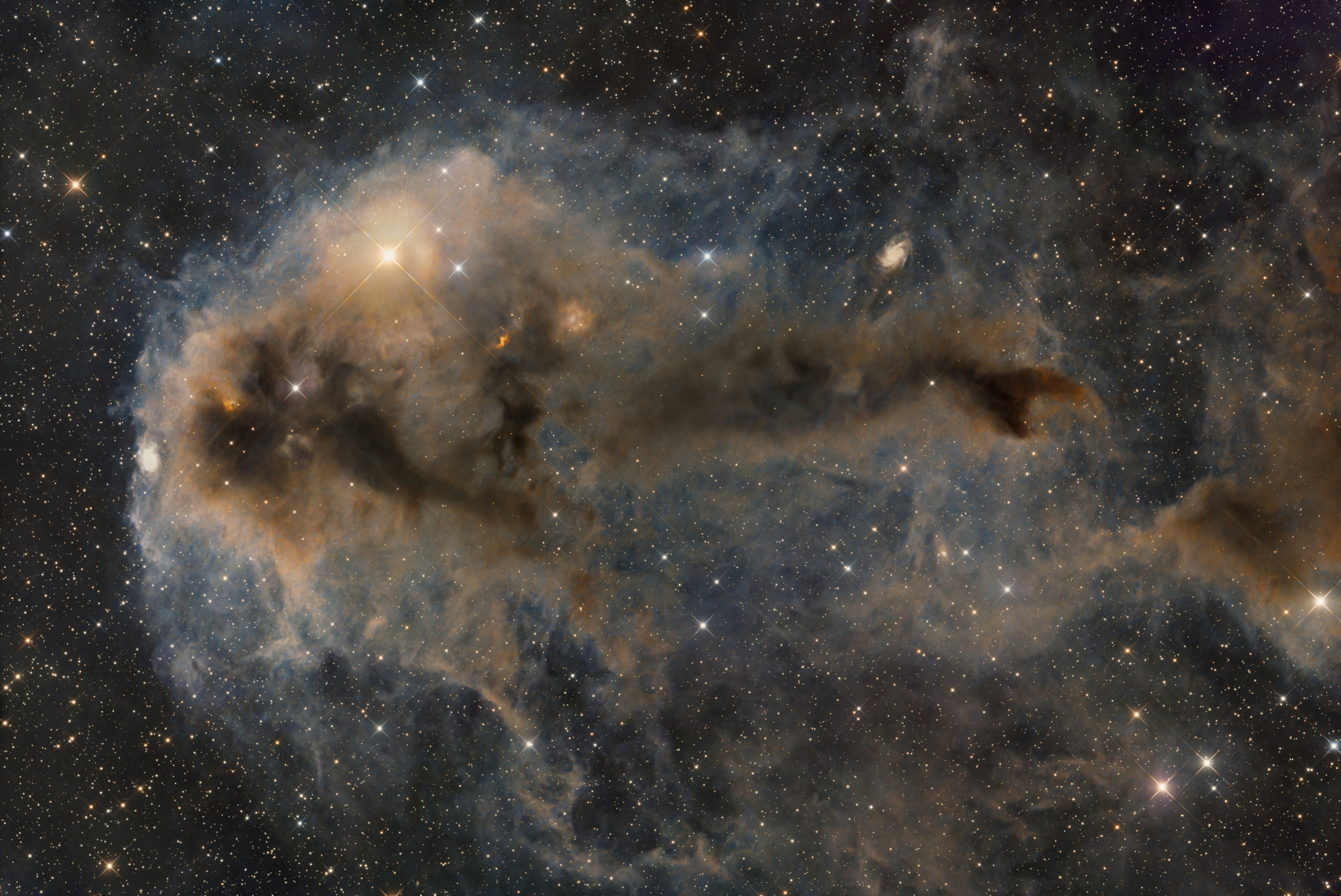 Image Credit & Copyright: Cristiano Gualco
Stars are forming in Lynds Dark Nebula (LDN) 1251. About 1,000 light-years away and drifting above the plane of our Milky Way galaxy, LDN 1251 is also less appetizingly known as "The Rotten Fish Nebula." The dusty molecular cloud is part of a complex of dark nebulae mapped toward the Cepheus flare region. Across the spectrum, astronomical explorations of the obscuring interstellar clouds reveal energetic shocks and outflows associated with newborn stars, including the telltale reddish glow from scattered Herbig-Haro objects hiding in the image. Distant background galaxies also lurk in the scene, almost buried behind the dusty expanse. This alluring telescopic frame spans almost three full moons on the sky. That corresponds to over 25 light-years at the estimated distance of LDN 1251.
#APOD #SpaceAdventures #Astroenthusiast #GalacticAdventures #Astronomy
Image Credit & Copyright: Cristiano Gualco
Stars are forming in Lynds Dark Nebula (LDN) 1251. About 1,000 light-years away and drifting above the plane of our Milky Way galaxy, LDN 1251 is also less appetizingly known as "The Rotten Fish Nebula." The dusty molecular cloud is part of a complex of dark nebulae mapped toward the Cepheus flare region. Across the spectrum, astronomical explorations of the obscuring interstellar clouds reveal energetic shocks and outflows associated with newborn stars, including the telltale reddish glow from scattered Herbig-Haro objects hiding in the image. Distant background galaxies also lurk in the scene, almost buried behind the dusty expanse. This alluring telescopic frame spans almost three full moons on the sky. That corresponds to over 25 light-years at the estimated distance of LDN 1251.
#APOD #SpaceAdventures #Astroenthusiast #GalacticAdventures #Astronomy
 Image Credit & Copyright: Alessandro Cipolat Bares
The beautiful Trifid Nebula is a cosmic study in contrasts. Also known as M20, it lies about 5,000 light-years away toward the nebula rich constellation Sagittarius. A star forming region in the plane of our galaxy, the Trifid does illustrate three different types of astronomical nebulae; red emission nebulae dominated by light from hydrogen atoms, blue reflection nebulae produced by dust reflecting starlight, and dark nebulae where dense dust clouds appear in silhouette. But, the red emission region roughly separated into three parts by obscuring dust lanes is what lends the Trifid its popular name. Pillars and jets sculpted by newborn stars, above and right of the emission nebula's center, appear in famous Hubble Space Telescope close-up images of the region. The Trifid Nebula is about 40 light-years across. Too faint to be seen by the unaided eye, in this deep telescopic view it almost covers the area of a full moon on planet Earth's sky.
#APOD #AstronomyFacts #Astrodata #SpaceAdventures #Astrophoto
Image Credit & Copyright: Alessandro Cipolat Bares
The beautiful Trifid Nebula is a cosmic study in contrasts. Also known as M20, it lies about 5,000 light-years away toward the nebula rich constellation Sagittarius. A star forming region in the plane of our galaxy, the Trifid does illustrate three different types of astronomical nebulae; red emission nebulae dominated by light from hydrogen atoms, blue reflection nebulae produced by dust reflecting starlight, and dark nebulae where dense dust clouds appear in silhouette. But, the red emission region roughly separated into three parts by obscuring dust lanes is what lends the Trifid its popular name. Pillars and jets sculpted by newborn stars, above and right of the emission nebula's center, appear in famous Hubble Space Telescope close-up images of the region. The Trifid Nebula is about 40 light-years across. Too faint to be seen by the unaided eye, in this deep telescopic view it almost covers the area of a full moon on planet Earth's sky.
#APOD #AstronomyFacts #Astrodata #SpaceAdventures #Astrophoto
 Image Credit & Copyright:
Ogetay Kayali
(Michigan Tech U.)
Text:
Ogetay Kayali
(Michigan Tech U.)
If you have looked at the sky and seen a group of stars about the size of the full Moon, that's the Pleiades (M45). Perhaps the most famous star cluster in the sky, its brightest stars can be seen even from the light-polluted cities. But your unaided eye can also see its nebulosity -- the gas and dust surrounding it -- under dark skies. However, telescopes can catch even more. The bright blue stars of the Pleiades, also known as the Seven Sisters, light up their surrounding dust, causing it to appear a diffuse blue that can only be seen under long exposures. But that's not all. The cosmic dust appears to stretch upward like ethereal arms. And the entire structure is surrounded by a reddish glow from the most abundant element in the universe: hydrogen. The featured image is composed of nearly 25 hours of exposure and was captured last year from Starfront Observatory, in Texas, USA Explore Your Universe: Random APOD Generator
#APOD #Astrophysics #Astrodata #Astrobiology #SpaceMission
Image Credit & Copyright:
Ogetay Kayali
(Michigan Tech U.)
Text:
Ogetay Kayali
(Michigan Tech U.)
If you have looked at the sky and seen a group of stars about the size of the full Moon, that's the Pleiades (M45). Perhaps the most famous star cluster in the sky, its brightest stars can be seen even from the light-polluted cities. But your unaided eye can also see its nebulosity -- the gas and dust surrounding it -- under dark skies. However, telescopes can catch even more. The bright blue stars of the Pleiades, also known as the Seven Sisters, light up their surrounding dust, causing it to appear a diffuse blue that can only be seen under long exposures. But that's not all. The cosmic dust appears to stretch upward like ethereal arms. And the entire structure is surrounded by a reddish glow from the most abundant element in the universe: hydrogen. The featured image is composed of nearly 25 hours of exposure and was captured last year from Starfront Observatory, in Texas, USA Explore Your Universe: Random APOD Generator
#APOD #Astrophysics #Astrodata #Astrobiology #SpaceMission
 *Image creditor details unavailable via API. Visit linked page below for full info.*
It came from outer space. An object from outside our Solar System is now passing through at high speed. Classified as a comet because of its gaseous coma, 3I/ATLAS is only the third identified macroscopic object as being so alien. The comet's trajectory is shown in white on the featured map, where the orbits of Jupiter, Mars, and Earth are shown in gold, red, and blue. Currently Comet 3I/ATLAS is about the distance of Jupiter from the Sun -- but closing, with its closest approach to our Sun expected to be within the orbit of Mars in late October. Expected to pass near both Mars and Jupiter, 3I/ATLAS is not expected to pass close to the Earth. The origin of Comet 3I/ATLAS remains unknown. Although initial activity indicates a relatively normal comet, future observations about 3I/ATLAS' composition and nature will surely continue. Piece it All Together: Astronomy Puzzle of the Day
#APOD #Science #Astrodata #PlanetaryExploration #Astrochemistry
*Image creditor details unavailable via API. Visit linked page below for full info.*
It came from outer space. An object from outside our Solar System is now passing through at high speed. Classified as a comet because of its gaseous coma, 3I/ATLAS is only the third identified macroscopic object as being so alien. The comet's trajectory is shown in white on the featured map, where the orbits of Jupiter, Mars, and Earth are shown in gold, red, and blue. Currently Comet 3I/ATLAS is about the distance of Jupiter from the Sun -- but closing, with its closest approach to our Sun expected to be within the orbit of Mars in late October. Expected to pass near both Mars and Jupiter, 3I/ATLAS is not expected to pass close to the Earth. The origin of Comet 3I/ATLAS remains unknown. Although initial activity indicates a relatively normal comet, future observations about 3I/ATLAS' composition and nature will surely continue. Piece it All Together: Astronomy Puzzle of the Day
#APOD #Science #Astrodata #PlanetaryExploration #Astrochemistry
 *Image creditor details unavailable via API. Visit linked page below for full info.*
Why is there a spiral around the North Pole of Mars? Each winter this pole develops a new outer layer about one meter thick composed of carbon dioxide frozen out of the thin Martian atmosphere. This fresh layer is deposited on a water-ice layer that exists year round. Strong winds blow down from above the cap's center and swirl due to the spin of the red planet -- contributing to Planum Boreum's spiral structure. The featured image is a perspective mosaic generated in 2017 from numerous images taken by ESA's Mars Express and elevations extracted from the laser altimeter aboard NASA's Mars Global Surveyor mission.
#APOD #Galactic #Exploration #NASAInspires #Astroeducation
*Image creditor details unavailable via API. Visit linked page below for full info.*
Why is there a spiral around the North Pole of Mars? Each winter this pole develops a new outer layer about one meter thick composed of carbon dioxide frozen out of the thin Martian atmosphere. This fresh layer is deposited on a water-ice layer that exists year round. Strong winds blow down from above the cap's center and swirl due to the spin of the red planet -- contributing to Planum Boreum's spiral structure. The featured image is a perspective mosaic generated in 2017 from numerous images taken by ESA's Mars Express and elevations extracted from the laser altimeter aboard NASA's Mars Global Surveyor mission.
#APOD #Galactic #Exploration #NASAInspires #Astroeducation
 Image Credit & Copyright: Massimo Di Fusco
Difficult to capture, this mysterious, squid-shaped interstellar cloud spans nearly three full moons in planet Earth's sky. Discovered in 2011 by French astro-imager Nicolas Outters, the Squid Nebula's bipolar shape is distinguished here by the telltale blue emission from doubly ionized oxygen atoms. Though apparently surrounded by the reddish hydrogen emission region Sh2-129, the true distance and nature of the Squid Nebula have been difficult to determine. Still, one investigation suggests Ou4 really does lie within Sh2-129 some 2,300 light-years away. Consistent with that scenario, the cosmic squid would represent a spectacular outflow of material driven by a triple system of hot, massive stars, cataloged as HR8119, seen near the center of the nebula. If so, this truly giant squid nebula would physically be over 50 light-years across.
#APOD #Exoplanets #SpaceWeather #Astrozone #Cosmology
Image Credit & Copyright: Massimo Di Fusco
Difficult to capture, this mysterious, squid-shaped interstellar cloud spans nearly three full moons in planet Earth's sky. Discovered in 2011 by French astro-imager Nicolas Outters, the Squid Nebula's bipolar shape is distinguished here by the telltale blue emission from doubly ionized oxygen atoms. Though apparently surrounded by the reddish hydrogen emission region Sh2-129, the true distance and nature of the Squid Nebula have been difficult to determine. Still, one investigation suggests Ou4 really does lie within Sh2-129 some 2,300 light-years away. Consistent with that scenario, the cosmic squid would represent a spectacular outflow of material driven by a triple system of hot, massive stars, cataloged as HR8119, seen near the center of the nebula. If so, this truly giant squid nebula would physically be over 50 light-years across.
#APOD #Exoplanets #SpaceWeather #Astrozone #Cosmology
 Image Credit & Copyright: Alberto Pisabarro
Face-on spiral galaxy NGC 6946 and open star cluster NGC 6939 share this cosmic snapshot, composed with over 68 hours of image data captured with a small telescope on planet Earth. The field of view spans spans about 1 degree or 2 full moons on the sky toward the northern constellation Cepheus. Seen through faint interstellar dust couds near the plane of our Milky Way galaxy, the stars of open cluster NGC 6939 are 5,600 light-years in the distance, near bottom right in the frame. Face-on spiral galaxy NGC 6946 is at top left, but lies some 22 million light-years away. In the last 100 years, 10 supernovae have been discovered in NGC 6946, the latest one seen in 2017. By comparison, the average rate of supernovae in our Milky Way is about 1 every 100 years or so. Of course, NGC 6946 is also known as The Fireworks Galaxy.
#APOD #Astrophoto #Astroengineer #CosmosJourney #Cosmological
Image Credit & Copyright: Alberto Pisabarro
Face-on spiral galaxy NGC 6946 and open star cluster NGC 6939 share this cosmic snapshot, composed with over 68 hours of image data captured with a small telescope on planet Earth. The field of view spans spans about 1 degree or 2 full moons on the sky toward the northern constellation Cepheus. Seen through faint interstellar dust couds near the plane of our Milky Way galaxy, the stars of open cluster NGC 6939 are 5,600 light-years in the distance, near bottom right in the frame. Face-on spiral galaxy NGC 6946 is at top left, but lies some 22 million light-years away. In the last 100 years, 10 supernovae have been discovered in NGC 6946, the latest one seen in 2017. By comparison, the average rate of supernovae in our Milky Way is about 1 every 100 years or so. Of course, NGC 6946 is also known as The Fireworks Galaxy.
#APOD #Astrophoto #Astroengineer #CosmosJourney #Cosmological
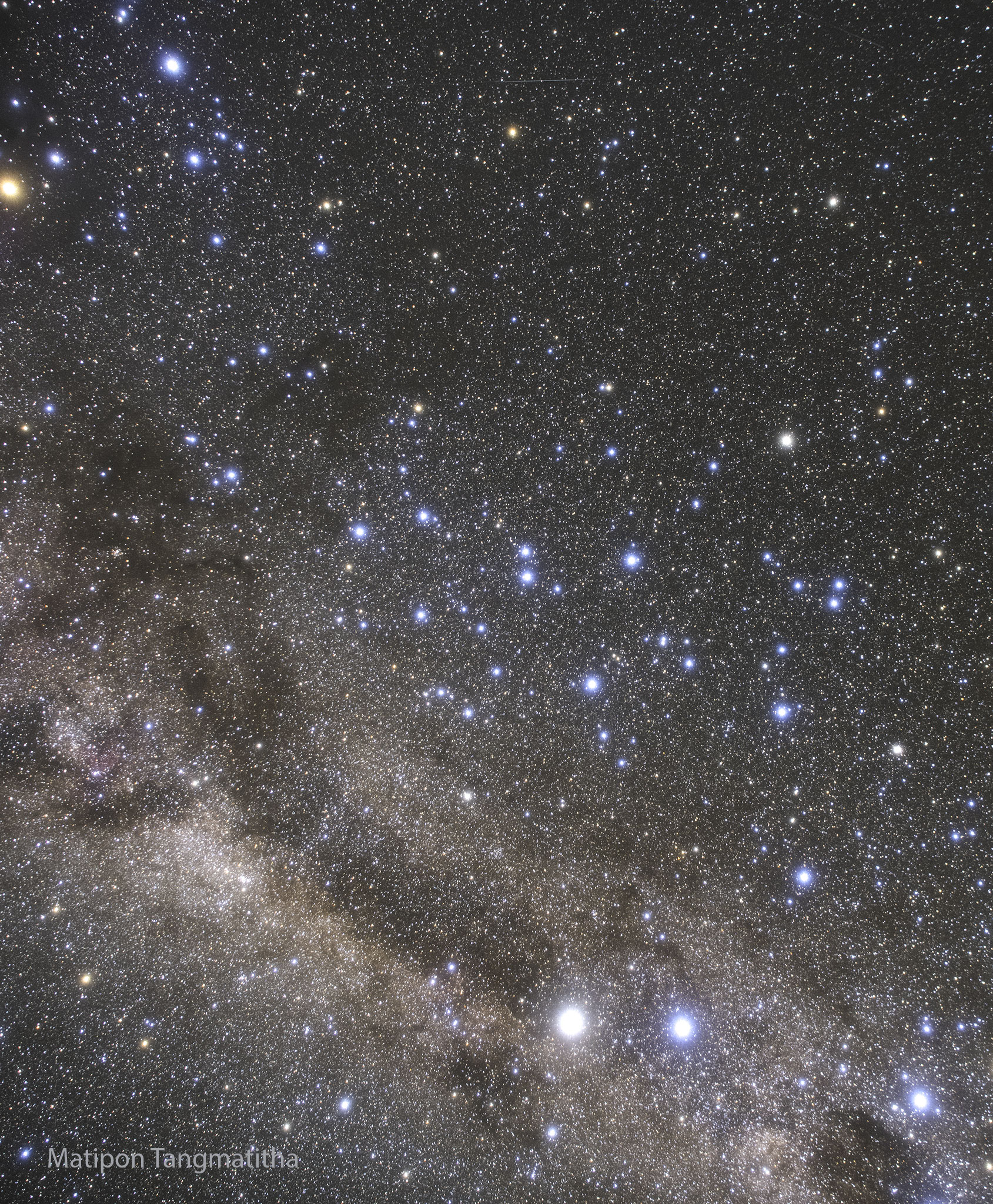 Image Credit & Copyright:
Matipon Tangmatitham
(NARIT)
If you know where to look, you can see a thermonuclear explosion from a white dwarf star. Possibly two. Such explosions are known as novas and the detonations are currently faintly visible with the unaided eye in Earth's southern hemisphere -- but are more easily seen with binoculars. Pictured, Nova Lupi 2025 (V462 Lupi) was captured toward the southern constellation of the Wolf (Lupus) last week near the central plane of our Milky Way galaxy. Nova Lupi 2025 was originally discovered on June 12 and peaked in brightness about a week later. Similarly, Nova Velorum 2025, toward the southern constellation of the Ship Sails (Vela), was discovered on June 25 and peaked a few days later. A nova somewhere in our Galaxy becomes briefly visible to the unaided eye only every year or two, so it is quite unusual to have two novas visible simultaneously. Meanwhile, humanity awaits even a different nova: T Coronae Borealis, which should become visible in northern skies and is expected to become even brighter.
#APOD #Galactic #BlackHoles #SpaceWeather #Astroinformatics
Image Credit & Copyright:
Matipon Tangmatitham
(NARIT)
If you know where to look, you can see a thermonuclear explosion from a white dwarf star. Possibly two. Such explosions are known as novas and the detonations are currently faintly visible with the unaided eye in Earth's southern hemisphere -- but are more easily seen with binoculars. Pictured, Nova Lupi 2025 (V462 Lupi) was captured toward the southern constellation of the Wolf (Lupus) last week near the central plane of our Milky Way galaxy. Nova Lupi 2025 was originally discovered on June 12 and peaked in brightness about a week later. Similarly, Nova Velorum 2025, toward the southern constellation of the Ship Sails (Vela), was discovered on June 25 and peaked a few days later. A nova somewhere in our Galaxy becomes briefly visible to the unaided eye only every year or two, so it is quite unusual to have two novas visible simultaneously. Meanwhile, humanity awaits even a different nova: T Coronae Borealis, which should become visible in northern skies and is expected to become even brighter.
#APOD #Galactic #BlackHoles #SpaceWeather #Astroinformatics
 Image Credit & Copyright:
Kavan Chay;
Text:
Ogetay Kayali
(Michigan Tech U.)
Does the Milky Way always rise between these two rocks? No. Capturing this stunning alignment took careful planning: being in the right place at the right time. In the featured image taken in June 2024 from Otago, New Zealand, the bright central core of our Milky Way Galaxy, home to the many of our Galaxy's 400 billion stars, can be seen between two picturesque rocks spires. For observers in Earth's Northern Hemisphere, the core is only visible throughout the summer. As Earth orbits the Sun, different parts of the Milky Way become visible at different angles at different times of the night. As Earth rotates, the orientation of the Milky Way in the sky also shifts -- sometimes standing vertically as seen in the featured image, and other times stretching parallel to the horizon, making it harder to see. In early June, observers can watch it emerge low on the horizon after sunset and gradually arc upward to reveal its full grandeur.
#APOD #Planetarium #Astroknowledge #CosmosJourney #SpaceDiscovery
Image Credit & Copyright:
Kavan Chay;
Text:
Ogetay Kayali
(Michigan Tech U.)
Does the Milky Way always rise between these two rocks? No. Capturing this stunning alignment took careful planning: being in the right place at the right time. In the featured image taken in June 2024 from Otago, New Zealand, the bright central core of our Milky Way Galaxy, home to the many of our Galaxy's 400 billion stars, can be seen between two picturesque rocks spires. For observers in Earth's Northern Hemisphere, the core is only visible throughout the summer. As Earth orbits the Sun, different parts of the Milky Way become visible at different angles at different times of the night. As Earth rotates, the orientation of the Milky Way in the sky also shifts -- sometimes standing vertically as seen in the featured image, and other times stretching parallel to the horizon, making it harder to see. In early June, observers can watch it emerge low on the horizon after sunset and gradually arc upward to reveal its full grandeur.
#APOD #Planetarium #Astroknowledge #CosmosJourney #SpaceDiscovery
 Image Credit & Copyright:
Anton Komlev
What do you see when you look into this sky? In the center, in the dark, do you see a night sky filled with stars? Do you see a sunset to the left? Clouds all around? Do you see the central band of our Milky Way Galaxy running down the middle? Do you see the ruins of an abandoned outpost on a hill? (The outpost is on Askold Island, Russia.) Do you see a photographer with a headlamp contemplating surreal surroundings? (The featured image is a panorama of 38 images taken last month and compiled into a Little Planet projection.) Do you see a rugged path lined with steps? Or do you see the eye of a dragon?
#APOD #StarFormation #SpaceWeather #GalaxyExploration #SpaceMissions
Image Credit & Copyright:
Anton Komlev
What do you see when you look into this sky? In the center, in the dark, do you see a night sky filled with stars? Do you see a sunset to the left? Clouds all around? Do you see the central band of our Milky Way Galaxy running down the middle? Do you see the ruins of an abandoned outpost on a hill? (The outpost is on Askold Island, Russia.) Do you see a photographer with a headlamp contemplating surreal surroundings? (The featured image is a panorama of 38 images taken last month and compiled into a Little Planet projection.) Do you see a rugged path lined with steps? Or do you see the eye of a dragon?
#APOD #StarFormation #SpaceWeather #GalaxyExploration #SpaceMissions
 *Image creditor details unavailable via API. Visit linked page below for full info.*
It's raining stars. What appears to be a giant cosmic umbrella is now known to be a tidal stream of stars stripped from a small satellite galaxy. The main galaxy, spiral galaxy NGC 4651, is about the size of our Milky Way, while its stellar parasol appears to extend some 100 thousand light-years above this galaxy's bright disk. A small galaxy was likely torn apart by repeated encounters as it swept back and forth on eccentric orbits through NGC 4651. The remaining stars will surely fall back and become part of a combined larger galaxy over the next few million years. The featured deep image was captured in long exposures from Saudi Arabia. The Umbrella Galaxy lies about 50 million light-years distant toward the well-groomed northern constellation of Berenice's Hair (Coma Berenices). APOD in a Modern Format StellarSnap
#APOD #AstronautLife #Astroeducation #Astroengineer #SpaceResearch
*Image creditor details unavailable via API. Visit linked page below for full info.*
It's raining stars. What appears to be a giant cosmic umbrella is now known to be a tidal stream of stars stripped from a small satellite galaxy. The main galaxy, spiral galaxy NGC 4651, is about the size of our Milky Way, while its stellar parasol appears to extend some 100 thousand light-years above this galaxy's bright disk. A small galaxy was likely torn apart by repeated encounters as it swept back and forth on eccentric orbits through NGC 4651. The remaining stars will surely fall back and become part of a combined larger galaxy over the next few million years. The featured deep image was captured in long exposures from Saudi Arabia. The Umbrella Galaxy lies about 50 million light-years distant toward the well-groomed northern constellation of Berenice's Hair (Coma Berenices). APOD in a Modern Format StellarSnap
#APOD #AstronautLife #Astroeducation #Astroengineer #SpaceResearch
 *Image creditor details unavailable via API. Visit linked page below for full info.*
Are these trees growing on Mars? No. Groups of dark brown streaks have been photographed by the Mars Reconnaissance Orbiter on melting pinkish sand dunes covered with light frost. The featured image was taken in 2008 April near the North Pole of Mars. At that time, dark sand on the interior of Martian sand dunes became more and more visible as the spring Sun melted the lighter carbon dioxide ice. When occurring near the top of a dune, dark sand may cascade down the dune leaving dark surface streaks -- streaks that might appear at first to be trees standing in front of the lighter regions but cast no shadows. Objects about 25 centimeters across are resolved on this image spanning about one kilometer. Close ups of some parts of this image show billowing plumes indicating that the sand slides were occurring even while the image was being taken. Celestial Surprise: What picture did APOD feature on your birthday? (post 1995)
#APOD #Science #StarFormation #Galaxy #SpaceMissions
*Image creditor details unavailable via API. Visit linked page below for full info.*
Are these trees growing on Mars? No. Groups of dark brown streaks have been photographed by the Mars Reconnaissance Orbiter on melting pinkish sand dunes covered with light frost. The featured image was taken in 2008 April near the North Pole of Mars. At that time, dark sand on the interior of Martian sand dunes became more and more visible as the spring Sun melted the lighter carbon dioxide ice. When occurring near the top of a dune, dark sand may cascade down the dune leaving dark surface streaks -- streaks that might appear at first to be trees standing in front of the lighter regions but cast no shadows. Objects about 25 centimeters across are resolved on this image spanning about one kilometer. Close ups of some parts of this image show billowing plumes indicating that the sand slides were occurring even while the image was being taken. Celestial Surprise: What picture did APOD feature on your birthday? (post 1995)
#APOD #Science #StarFormation #Galaxy #SpaceMissions
 *Image creditor details unavailable via API. Visit linked page below for full info.*
Tidally locked in synchronous rotation, the Moon always presents its familiar nearside to denizens of planet Earth. From lunar orbit, the Moon's farside can become familiar, though. In fact this sharp picture, a mosaic from the Lunar Reconnaissance Orbiter's wide angle camera, is centered on the lunar farside. Part of a global mosaic of over 15,000 images acquired between November 2009 and February 2011, the highest resolution version shows features at a scale of 100 meters per pixel. Surprisingly, the rough and battered surface of the farside looks very different from the nearside covered with smooth dark lunar maria. A likely explanation is that the farside crust is thicker, making it harder for molten material from the interior to flow to the surface and form dark, smooth maria.
#APOD #Astrophotography #Astrotheory #CosmosJourney #LunarMission
*Image creditor details unavailable via API. Visit linked page below for full info.*
Tidally locked in synchronous rotation, the Moon always presents its familiar nearside to denizens of planet Earth. From lunar orbit, the Moon's farside can become familiar, though. In fact this sharp picture, a mosaic from the Lunar Reconnaissance Orbiter's wide angle camera, is centered on the lunar farside. Part of a global mosaic of over 15,000 images acquired between November 2009 and February 2011, the highest resolution version shows features at a scale of 100 meters per pixel. Surprisingly, the rough and battered surface of the farside looks very different from the nearside covered with smooth dark lunar maria. A likely explanation is that the farside crust is thicker, making it harder for molten material from the interior to flow to the surface and form dark, smooth maria.
#APOD #Astrophotography #Astrotheory #CosmosJourney #LunarMission
 Image Credit & Copyright: Robert Eder
Big beautiful barred spiral galaxy Messier 109 is the 109th entry in Charles Messier's famous catalog of bright Nebulae and Star Clusters. You can find it just below the Big Dipper's bowl in the northern constellation Ursa Major. In fact, bright dipper star Phecda, Gamma Ursa Majoris, produces the glare at the upper right corner of this telescopic frame. M109's prominent central bar gives the galaxy the appearance of the Greek letter "theta", θ, a common mathematical symbol representing an angle. M109 spans a very small angle in planet Earth's sky though, about 7 arcminutes or 0.12 degrees. But that small angle corresponds to an enormous 120,000 light-year diameter at the galaxy's estimated 60 million light-year distance. The brightest member of the now recognized Ursa Major galaxy cluster, M109 (aka NGC 3992) is joined by spiky foreground stars. Three small, fuzzy bluish galaxies also on the scene, identified (top to bottom) as UGC 6969, UGC 6940 and UGC 6923, are possibly satellite galaxies of the larger barred spiral galaxy Messier 109.
#APOD #Astronomy #Astrocosmos #Celestial #SpaceTechnology
Image Credit & Copyright: Robert Eder
Big beautiful barred spiral galaxy Messier 109 is the 109th entry in Charles Messier's famous catalog of bright Nebulae and Star Clusters. You can find it just below the Big Dipper's bowl in the northern constellation Ursa Major. In fact, bright dipper star Phecda, Gamma Ursa Majoris, produces the glare at the upper right corner of this telescopic frame. M109's prominent central bar gives the galaxy the appearance of the Greek letter "theta", θ, a common mathematical symbol representing an angle. M109 spans a very small angle in planet Earth's sky though, about 7 arcminutes or 0.12 degrees. But that small angle corresponds to an enormous 120,000 light-year diameter at the galaxy's estimated 60 million light-year distance. The brightest member of the now recognized Ursa Major galaxy cluster, M109 (aka NGC 3992) is joined by spiky foreground stars. Three small, fuzzy bluish galaxies also on the scene, identified (top to bottom) as UGC 6969, UGC 6940 and UGC 6923, are possibly satellite galaxies of the larger barred spiral galaxy Messier 109.
#APOD #Astronomy #Astrocosmos #Celestial #SpaceTechnology