Keychat's avatar
Keychat
npub1h0uj...rwx8
Keychat is the super app for Humans and Agents. Sovereign IDs, Bitcoin Wallet, Secure Chat, Mini Apps — all in Keychat. Sovereign. Security. Richness Contact us for feedback 👇 https://www.keychat.io/u/?k=npub1h0uj825jgcr9lzxyp37ehasuenq070707pj63je07n8mkcsg3u0qnsrwx8
Keychat's avatar
Keychat 1 week ago
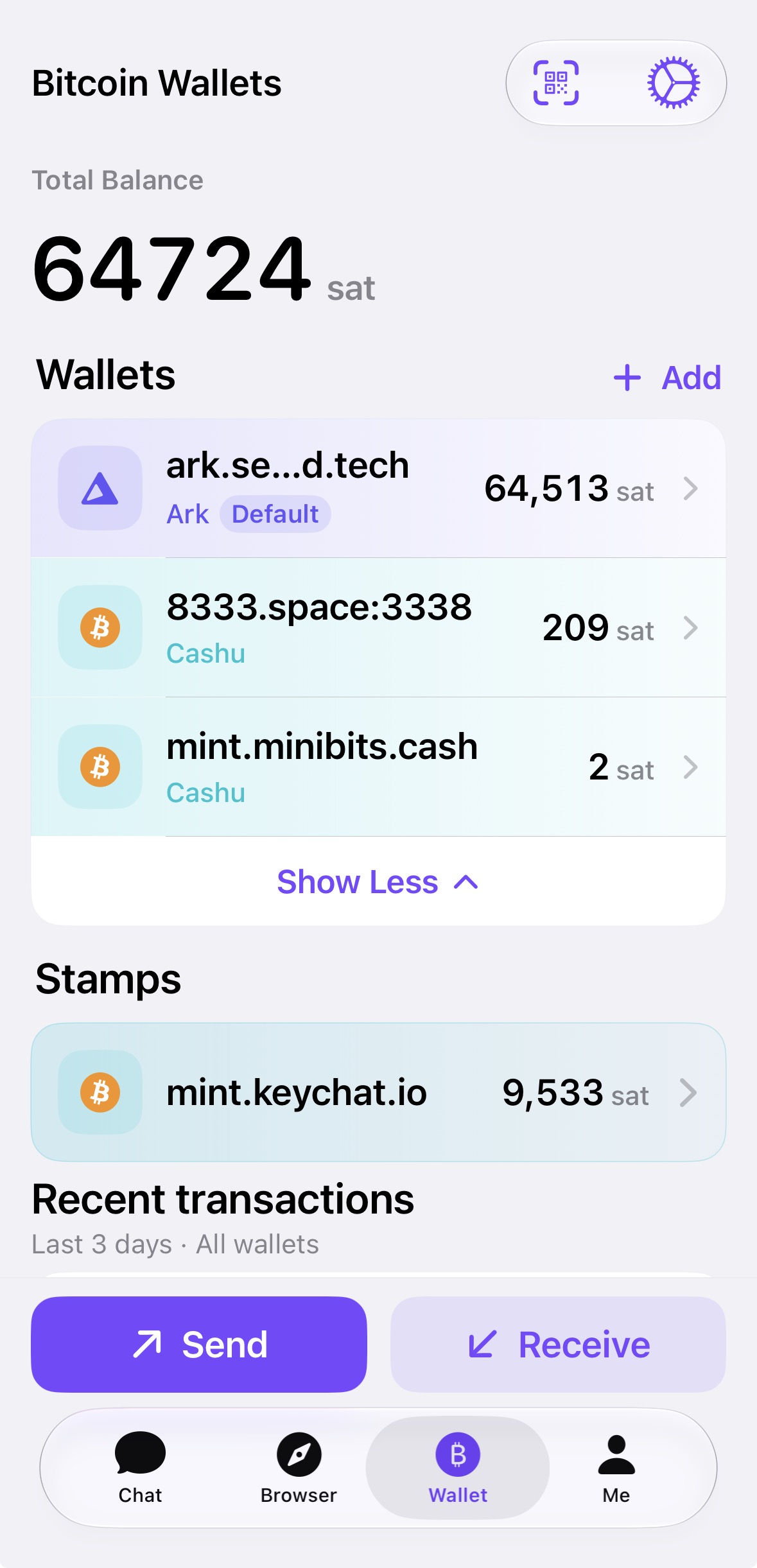
In the Keychat rewrite, we’ve finally implemented a native Stamp Token powered by the Cashu protocol — a true utility token with real-world use cases.
Keychat's avatar
Keychat 1 month ago
We haven’t posted here in a while. Over the past months, we’ve been rewriting Keychat natively. We’re still working hard on it. More to come. image View quoted note →
Keychat's avatar
Keychat 7 months ago
We’re happy to see that users understand and appreciate the design of Keychat Mini Apps — combining web apps, public key login, and a Bitcoin wallet. BTW, we plan to add a Public Agent alongside Mini Apps later on. image View quoted note →
Keychat's avatar
Keychat 8 months ago
Attaching a Stamp (Client → Relay) When publishing an event to a relay that requires stamps, the client appends a Cashu token as the third element of the EVENT message array: ["EVENT", <event JSON>, "<cashu_token>"] View quoted note →
Keychat's avatar
Keychat 8 months ago
We are close to completing the development of libkeychat. libkeychat is to the Keychat protocol what libsignal is to the Signal protocol. After libkeychat is released, users should be able to quickly build their own clients using Pi agent, Claude Code, or Codex. View quoted note →
Keychat's avatar
Keychat 8 months ago
Keychat protocol is a sovereign messaging stack that integrates five layers: Identity — Nostr keypair, self-custodial with no server dependency Transport — Nostr relay network, open and self-hostable Encryption — Signal Protocol for 1-to-1 and small group chats, MLS for large group messaging Addressing — Receiving and sending addresses are decoupled from identity and continuously rotate Stamps — Cashu ecash tokens attached to messages as anonymous micropayments to relays View quoted note →
Keychat's avatar
Keychat 8 months ago
Maybe agents will adopt sovereign messaging before humans do. Humans are still locked into big-tech chat apps by network effects and habit, while agents can switch to open, self-sovereign protocols much faster. Then humans may end up learning from agents—gradually moving to sovereign messaging themselves. It’s a strange inversion. View quoted note →
Keychat's avatar
Keychat 8 months ago
If you’ve been with Keychat for a while, you might remember an early experiment: Keychat used to generate two IDs by default from a single seed phrase. One was for chatting with human friends. The other was simply named “Bot” — for chatting with agents. At the time, we shipped two lightweight Q&A agents. You paid per answer in sats, and they replied. But the real idea was bigger: anyone should be able to create an agent, run it as a public service, and earn sats — in a user-sovereign messaging network where humans and agents can talk, trade, and collaborate. Conversation as a service. That vision didn’t stick back then for one simple reason: OpenClaw didn’t exist yet. Building an agent was still too hard for most users, so we paused the feature. Now OpenClaw changes the equation. It makes building and running your own agent dramatically easier. Today it’s mostly used for personal assistants — but we think public-facing agents won’t be far behind. That’s why we’re bringing this direction back with the Keychat plugin: enabling human ↔ agent chat, and also agent ↔ agent chat, all inside the same user-owned network. Close your eyes and picture it: a user-sovereign network, slowly growing — one agent, one conversation, one service at a time. View quoted note →
Keychat's avatar
Keychat 8 months ago
You can now use Keychat as a channel for your OpenClaw agent. Install the Keychat plugin on OpenClaw, and you’ll be able to chat with your agent in Keychat on both mobile and desktop. Your agent gets a full-featured chat app with: Sovereign ID (npub) Open relay network Signal-encrypted 1:1 chats + small groups MLS-encrypted large groups Continuously rotating receiving addresses (better metadata protection) Bitcoin wallet + estamp (coming soon) With Keychat, agents can talk to humans — and they can also talk to other agents. Keychat treats human users and agent users the same. --- Setup takes just a few minutes. In any existing channel (Telegram, Discord, webchat, etc.), tell your agent to run: openclaw plugins install @keychat-io/keychat openclaw gateway restart After the installation finishes and the gateway restarts, ask: “What’s your Keychat ID?” Your agent will reply with: Keychat ID: npub1… Keychat ID link: Open the Keychat app → tap the link (or paste the npub) to add it as a contact. Ownership rule: the first person to add the agent becomes its owner. Any later contact requests require owner approval. --- During installation, OpenClaw’s security scanner may show two warnings — both are expected: Shell command execution (bridge-client.ts): launches a Rust sidecar used for Signal Protocol and MLS encryption. Shell command execution (keychain.ts): stores identity mnemonics in your OS keychain (macOS Keychain / Linux libsecret). image View quoted note →
Keychat's avatar
Keychat 8 months ago
Keychat’s Public Key ID and Bitcoin Wallet unlock four layers of value for agents: 1. In-app capability (Keychat-scoped)
 The ID and wallet exist solely to power Keychat’s built-in messaging experience. 2. Agent infrastructure (shared primitives)
 Exposed via RPC, they become agent-wide primitives: any channel, skill, cron job, or sub-agent can sign messages and send/receive sats. At this layer, the ID and wallet belong to the agent—not just to Keychat for Agent. 3. Agent network (A2A encryption + payments)
 When Keychat runs on every agent instance, agents can communicate end-to-end and settle payments directly with one another. 4. Unified human–agent network (same protocol, equal peers) 
Keychat for Agent and Keychat for Human share the same protocol, so humans and agents are true peers: encrypted communication and native payments in both directions.
↑