Rajesh Medampudi's avatar
Rajesh Medampudi
rajesh@medampudi.com
npub1hv28...kqdn
Platform Engineer · 17+ years building distributed systems. Observability platforms processing 6TB/day. Saved $120K/month on AWS at gaming scale. Self-hosting everything. Verify my keys: https://rajesh.medampudi.com/verify
Rajesh Medampudi's avatar
rajesh 2 months ago
savings plans are the default now, but not the answer to everything. there are exactly three corners where the reserved model is still the only lever you have. redshift uses reserved nodes, opensearch uses reserved instances — no savings plan covers either, even after the dec 2025 launch. a zonal RI reserves capacity in a specific AZ; a savings plan reserves none. and a standard RI can be sold on the marketplace; a savings plan can't be cancelled mid-term. everything outside those three → savings plan. image
Rajesh Medampudi's avatar
rajesh 2 months ago
the most common reason a nat gateway bill creeps: s3 reads from private subnets going out through nat at $0.045/GB. the fix is free and almost nobody does it first. gateway endpoints for s3 and dynamodb cost nothing — no hourly fee, no per-GB fee. you add a route, and that traffic goes over a private aws path instead of through the meter. it never touches nat again. do this before anything fancier. most teams never need to go further. #aws #cloudcost image
Rajesh Medampudi's avatar
rajesh 2 months ago
a fifth of enterprise cloud spend — ~$44.5B in 2025 — goes to resources nobody is using (harness, finops in focus 2025). that's not carelessness. it's the default state of a bill nobody is actively cutting. idle instances, commitments bought on a guess, storage that should've aged into a cheaper tier months ago. assume you're overspending — the data says you are — and go look once a month. you'll find the leak. image
Rajesh Medampudi's avatar
rajesh 2 months ago
the stack that replaced the saas bill, and it's boring on purpose: loki for logs, mimir for metrics, tempo for traces, grafana for dashboards + LogQL. running on our own kubernetes, 50+ nodes, 200 services, all backed by s3 underneath. two surprises: log search was faster than the paid tool, and with no per-seat cost 15 teams onboarded in month one instead of rationing licences. we ran it in parallel with the old tooling for a full month before decommissioning anything — you don't pull monitoring during a tournament with 100k players online and hope. #observability #grafana #kubernetes image
Rajesh Medampudi's avatar
rajesh 2 months ago
s3 storage classes span a ~23x price range and the only thing separating them is access pattern. same bytes — standard is $0.023/GB-month, deep archive is about $0.00099. most bills sit entirely in standard because that's the default and almost nobody changes it. it's the most expensive, most available class aws sells, tuned that way on purpose. frequently read → standard. occasional + over 128KB → standard-IA. rarely read but instant → glacier instant. archive you can wait on → flexible. compliance you'll never read → deep archive. that's the whole call. image
Rajesh Medampudi's avatar
rajesh 2 months ago
the most wasteful line on a mid-size AWS bill is the one with no resource page: data transfer. the NAT gateway is the worst of it. $0.045/GB just to process traffic — and most teams route S3 + package pulls straight through it. a VPC gateway endpoint carries that same traffic for $0. one route-table edit. i check this on every account. it's almost always there. image
Rajesh Medampudi's avatar
rajesh 2 months ago
the cloud bill is the only production number most teams don't own until it's already a fire. engineering owns latency. finance owns the invoice. nobody owns the gap — and a fifth to a third of cloud spend dies in it. stop treating the bill as an accounting artifact. treat it as a product metric: cost per request, per tenant, per feature, on the same dashboard as latency. we already run every other signal this way. cost is the one we still run like a 1990s expense report. image
Rajesh Medampudi's avatar
rajesh 2 months ago
for ec2 in 2026 the reserved instance is the legacy choice, and most people are still running the old rule in their head. aws's own comparison: compute SP up to 66% across any family + region + fargate + lambda. ec2 instance SP up to 72% in one family. convertible RI 66% with a manual exchange. standard RI 72% but locked. at every tier the savings plan matches the rate and beats the flexibility. same rate, less to manage. that's the whole argument. image
Rajesh Medampudi's avatar
rajesh 2 months ago
aws nat gateway charges you twice for the same packet. once at $0.045/hr just to exist (~$33/mo per gateway), and again $0.045 for every gigabyte it moves — in and out, on top of normal data transfer. the hourly fee is visible so nobody worries about it. the per-GB fee is the one that quietly grows, because it rides on traffic you never watch — container pulls, package installs, s3 reads from private subnets. #aws #infrastructure image
Rajesh Medampudi's avatar
rajesh 2 months ago
lean infrastructure is four decisions, read top to bottom: cut the waste, own past your break-even, observe it cheaply, don't over-staff. none of them is a technology. it's a posture — pay for what genuinely buys you something, refuse to pay for what doesn't. cut what's wasted, own what's worth owning, see everything, staff for the real load. that's the whole thing. image
Rajesh Medampudi's avatar
rajesh 2 months ago
at 6 TB of telemetry a day, self-hosted grafana LGTM ran our whole observability platform for ~$15-18K/mo. datadog at the same volume would've been ~$120K. that's 85% less, same telemetry, same scale. and it gets worse over time — per-GB pricing and compute+storage scale on different curves, so the gap widens as you grow. datadog isn't a bad tool. you're just renting a meter that bills you more every time your product succeeds. model your bill at 5x volume before you sign, not after. #observability #selfhosting #grafana image
Rajesh Medampudi's avatar
rajesh 2 months ago
aws nat gateway charges you twice for the same packet. once at $0.045/hr just to exist (~$33/mo per gateway), and again $0.045 for every gigabyte it moves. the hourly fee is visible so nobody worries about it. the per-GB fee is the one that quietly grows, because it rides on traffic you never watch — docker pulls, apt installs, s3 reads from private subnets. open cost explorer, group by usage type, look at NatGateway-Bytes. that's the number to chase. #aws #infrastructure #cloudcost #devops
Rajesh Medampudi's avatar
rajesh 2 months ago
at 6 TB of telemetry a day, self-hosted grafana LGTM ran our whole observability platform for ~$15-18K/mo. datadog at the same volume would've been ~$120K. an 85% cut. datadog isn't a bad tool. the problem is you're renting something you could own, on a meter that bills you more every time your product succeeds. per-GB pricing is a tax on growth. model your bill at 5x volume before you sign, not after. #observability #selfhosting #infrastructure
Rajesh Medampudi's avatar
rajesh 4 months ago
image New blog post: How We Avoided $120K/Month in Observability Costs Our Datadog bill was $40K/mo and headed to $120K as we scaled. We replaced it with self-hosted Grafana LGTM stack for $15-18K/mo. The real lesson: per-GB SaaS pricing is a trap at scale. We went from 1TB/day to 6TB/day and our self-hosted costs barely moved. Datadog would have gone from $40K to $120K+. Self-hosting isn't just about sovereignty — sometimes the economics leave you no choice. Full write-up with architecture and timeline: #aws #infrastructure #selfhosting #observability #costoptimization
Rajesh Medampudi's avatar
rajesh 4 months ago
My Bitcoin self-custody architecture: Layer 1: Hardware wallet — keys never touch the internet Layer 2: 2-of-3 multisig — no single point of failure, geographically distributed Layer 3: Own node — full verification, no third-party trust Same engineering principles as infrastructure architecture: Eliminate single points of failure Own your data Verify, don't trust After FTX, BlockFi, Celsius — the case for self-custody writes itself. Not your keys, not your coins. #bitcoin #selfcustody #sovereignty #nostr image
Rajesh Medampudi's avatar
rajesh 5 months ago
🚨 Just published my first blog post — and it's about the number that stopped a leadership meeting cold. We were a gaming company scaling fast. 100K concurrent players. Infrastructure costs climbing 15% month over month. And the biggest line item wasn't compute or databases — it was observability. Datadog at 1TB/day: $40K/month. Projecting to 6TB/day: $120K/month. So we built our own platform for $1,500/month instead. In the post, I walk through: → How tagging AWS resources revealed waste we didn't know existed → Why we replaced Datadog + CloudWatch with a self-hosted LGTM stack (Loki, Grafana, Tempo, Mimir) → The surprising architectural change that cut cross-AZ transfer costs and improved reliability → What I'd do differently — and the question every engineering team should ask before signing a per-GB vendor contract If your observability bill is growing with your data volume, you might want to read this before the curve catches up with you. #AWS #Observability #CostOptimization #Grafana #Datadog #Kubernetes #Engineering View article →
Rajesh Medampudi's avatar
rajesh 5 months ago
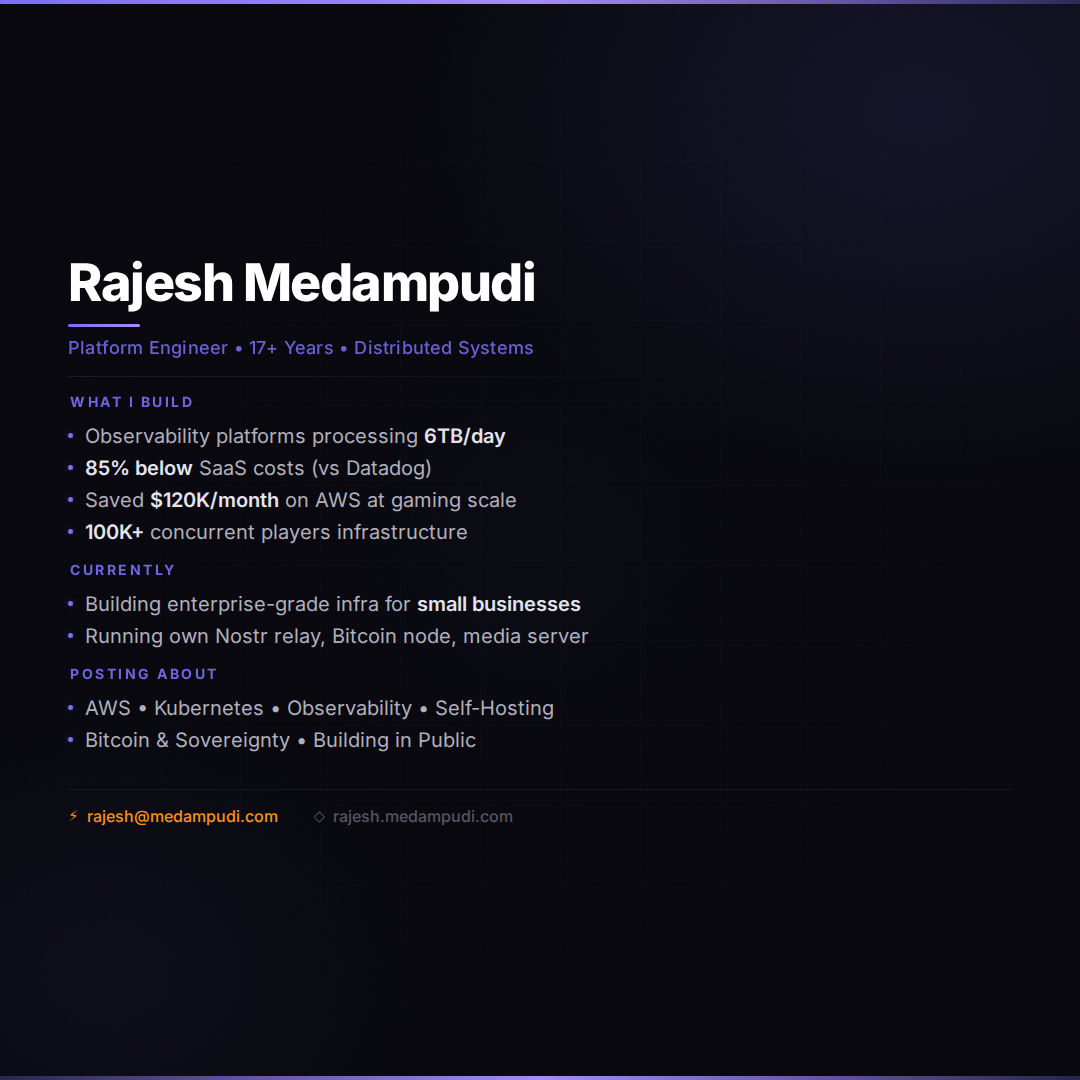
Hey Nostr 👋 I'm Rajesh — platform engineer, 17+ years building distributed systems. What I've built: • Observability platforms processing 6TB/day at 85% below SaaS costs • Saved $120K/month on AWS for a gaming platform with 100K+ concurrent players • Infrastructure serving 100K+ concurrent users in real-time What I'll post here: • Technical deep dives (AWS, K8s, observability, self-hosting) • Building in public — shipping, breaking, learning • Bitcoin & sovereignty — running my own node, relay, and media server • Long-form articles via kind:30023 I run my own Nostr relay (nostr.onbitcoinstandard.com), Blossom media server (media.medampudi.com), and my blog pulls content directly from Nostr at build time. The protocol is the platform. ⚡ rajesh@medampudi.com 🌐 rajesh.medampudi.com image
Rajesh Medampudi's avatar
rajesh 5 months ago
Hey Nostr 👋 I'm Rajesh — platform engineer, 17+ years building distributed systems. What I do: • Built observability platforms processing 6TB/day at 85% below SaaS costs • Saved $120K/month on AWS for a gaming platform with 100K+ concurrent players • Building Simbotix — bringing enterprise-grade infra to small businesses What I'll post here: • Technical deep dives (AWS, K8s, observability, self-hosting) • Building in public — shipping, breaking, learning • Bitcoin & sovereignty — running my own node, relay, and media server • Long-form articles via kind:30023 My stack: I run my own Nostr relay (nostr.onbitcoinstandard.com), Blossom media server (media.medampudi.com), and my blog pulls content directly from Nostr at build time. The protocol is the platform. ⚡ rajesh@medampudi.com 🌐 rajesh.medampudi.com
Rajesh Medampudi's avatar
rajesh 5 months ago
Hey Nostr 👋 I'm Rajesh — platform engineer, 17+ years building distributed systems. What I do: • Built observability platforms processing 6TB/day at 85% below SaaS costs • Saved $120K/month on AWS for a gaming platform with 100K+ concurrent players • Building Simbotix — bringing enterprise-grade infra to small businesses What I'll post here: • Technical deep dives (AWS, K8s, observability, self-hosting) • Building in public — shipping, breaking, learning • Bitcoin & sovereignty — running my own node, relay, and media server • Long-form articles via kind:30023 My stack: I run my own Nostr relay (nostr.onbitcoinstandard.com), Blossom media server (media.medampudi.com), and my blog pulls content directly from Nostr at build time. The protocol is the platform. ⚡ rajesh@medampudi.com 🌐 rajesh.medampudi.com
Rajesh Medampudi's avatar
rajesh 1 year ago
Build your own seed signer, you don't need to buy anything from them. No secure element for seed signer for sure. The rest all are addressed with it.