Latest #GrapheneOS release (it's out) has a fix for an upstream Android security bug causing Bluetooth contact sharing to be enabled for hands-free calling devices even though the dialog shows it will be disabled. GrapheneOS disables Bluetooth contact sharing by default instead of enabling it for pairing requests made by the user in the foreground.
Final
final@stacker.news
npub1hxx7...g75y
Security specialist and member of the GrapheneOS Foundation.
Posts my own and not endorsed by my employer. AI slop and Nostr DMs ignored.
Email: final@grapheneos.org
Matrix: f1nal:grapheneos.org
Talking about boot firmware-based malware on Desktop OSes.
https://stacker.news/items/786377/r/final?commentId=786884
Android 15 QPR2 is moving 6th/7th/8th generation Pixels to the Linux kernel's 6.1 LTS branch already used for 9th generation Pixels. This will reduce the kernel branches we need to support down to 6.1 and 6.6. There will likely need to be a yearly migration for all the devices.
Linux kernel increased official support time for the Long Term Support (LTS) branches from 2 years to 6 years, mainly for Android devices using Generic Kernel Image (GKI) releases. However, it was recently reduced back to 2 years. Pixels will need to start migrating every year.
It will likely take around 6 months for a new branch to be considered stable enough with most regressions resolved and another 6 months to successfully integrate and ship it. Therefore, 2 years of support implies yearly migrations to keep up rather than doing it every 2 years.
Upstream LTS releases are closely connected to Android. Moving to 6 years of support was likely closely connected to the Pixel 6 moving to 5 years of support. GKI made the drivers far more standalone and easy to migrate, and Linux moving back to 2 year support is likely related.
Google has been testing newer kernels with the Pixel 6 and later for years. They have 6.6 and newer mainline kernels working fine already, it just takes a long time until the kernels are stable enough to consider shipping them. It's great that it's finally going to be happening.
Newer kernels bring many new features and increasingly complexity which means they bring lots of new security bugs. Older kernels get an increasingly small subset of bug fixes including security fixes backported in the LTS releases. Newer kernels also bring new security features.
Using a year old kernel for around a year and then upgrading to a new year old kernel is likely the best balance that's available. With 2 year support time, they can focus on backporting more patches and providing more testing/stability since there will be far fewer LTS branches.
It's not commonly understood that Android itself only has a single LTS branch, which is current Android 15. It receives monthly and quarterly updates. It moves to a new LTS with a yearly update after it has gone through many months of public testing via Developer Preview / Beta.
Many people including journalists covering it in tech news media wrongly believe Android's monthly security patch releases are the monthly releases. No, the monthly security patches are backports of a subset of the privacy/security patches to older releases. They're incomplete.
Android's monthly releases have many changes beyond privacy/security patches even when it's not a quarterly or yearly release. They also have a lot more privacy/security patches than the Android Security Bulletin backports. They backport High/Critical severity patches, not all.
These updates are a major factor in why Pixels are the only Android devices with competitive security with iPhones. Pixels also have a lot of hardware security features not implemented on other Android devices. They also have higher quality of implementation across the board.
Google will likely require other OEMs start upgrading kernel branches. However, standards for other OEMs are always far lower than the standards met by Pixels. For example, many important hardware security features are recommended in the CDD, not mandatory, or not even listed.
We aren't aware of any OEM trying to keep up with the monthly releases, only OEMs skipping all the monthly/quarterly releases but trying to ship the yearly release around the official launch. Only Samsung tries to keep up with the new security features, but lags quite behind.
Other Android OEMs do the bare minimum required by Google unless their SoC vendor (generally Qualcomm) hands the feature to them on a silver platter with no additional cost. They largely ship the monthly security backports now, but with significant delays or skipping some months.
The reduction of support time for Linux kernel LTS releases from 6 years to 2 years is likely going to become a major problem for non-Pixel Android devices. Google will likely require them to upgrade but probably at a very delayed schedule where they fall out of support first.
Our official hardware requirements are listed here:
You can see support for Linux 6.1 or 6.6 is already a requirement for new devices. We'll be adding a requirement to upgrade the kernel branch because it will be essential with 2 year Linux LTS support.
#GrapheneOS
Frequently Asked Questions | GrapheneOS
On November 19th, 404Media published a news article with the device support chart for Magnet Forensics GrayKey, a forensic device extraction kit used exclusively by governments and a competitor of Cellebrite's UFED and MSAB XRY. The article contains data on the devices supported by GrayKey and the best extraction type available for the device based on monthly Security Patch Level. The results available from the charts are the same as our expectations made from our insights with other forensic company activities and people who inform us of their capabilities. We also are seeing a domino effect of further publications of leaked capabilities from forensic firms after our publication of the April and July 2024 Cellebrite device support matrix.
From what you can see in the GrayKey documentation, our previous disclosure of vulnerabilities affecting Stock OS Pixel devices that were exploited by forensics firms such as MSAB in the start of the year have disrupted their capabilities. We reported those exploits to Google in January 2024 with multiple proposals on how to stop it. In April 2024, the first two patches for these vulnerabilities were shipped and we can see that since April 2024 the extraction capability for GrayKey on all Pixel devices they supported were downgraded.
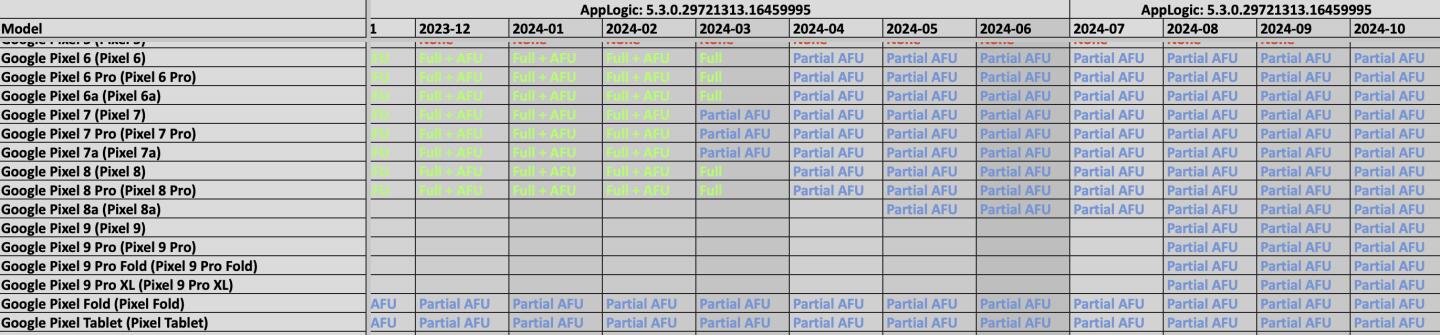
We have a good idea of what was happening based on the detailed info we obtained about MSAB's XRY exploit tool. XRY was exploiting littlekernel-based fastboot mode firmware used on Pixels via USB. Many other devices also use littlekernel for this, or the higher attack surface EDK2. CVE-2024-29745 is the identifier for the reset attack vulnerability we reported for the fastboot mode. Google addressed this in April 2024 by implementing our proposal of zeroing memory on boot. Graykey was downgraded from Full access to Partial access in April 2024 and has stayed that way since.
Cellebrite Premium is clearly exploiting the stock Pixel OS via USB rather than using this approach. Therefore, Cellebrite didn't lose any capabilities on the Stock OS because of the improvement - however they lost brute force capability. Our exploit protections have been successfully blocking Cellebrite even before major improvements in 2024 and GrapheneOS is still unaffected by their tools.
The device's data is divided in 2 parts: The vast majority of data is Credential Encrypted (CE) per-profile and a small portion of OS data is Device Encrypted (DE). DE data is available to the OS Before First Unlock (BFU). Exploiting fastboot mode will only give DE data since April 2024. One of our planned features is a boot authentication toggle to request the Owner lock method in early boot. This will protect the small amount of DE data such as installed packages and saved Wi-Fi networks from firmware/hardware exploits. However, it's not sensitive user data.
Partial access means limited access to operating system metadata and the Device Encrypted data and we are not concerned over such a limited data scope.
Cellebrite's approach of exploiting the OS itself is more difficult but they avoided having nearly all their capabilities wiped out by the reset attack mitigation we successfully got Pixels to implement. Other Android devices haven't implemented reset attack mitigation though. The way Google implemented it only covers fastboot mode. We wanted them to cover the OS boot modes too but they haven't shipped it yet. Our zero-on-free feature addresses it for OS reboot/shutdown and we plan to add zero on boot too until we convince them to add it in firmware.
Cellebrite's approach involves attacking the OS itself so all of our generic memory corruption exploit protections and other defenses are there to stop it. We also nearly fully wiped out the USB attack vector for the OS with our 2024 overhaul of our USB attack surface reduction. By default, #GrapheneOS disables new USB-C connections as soon as the device is locked at both a hardware and software level. It then fully disables USB-C data at a hardware level once existing connections end or right away if there weren't any. They'd need another attack vector.
For example, they could still target GrapheneOS via Wi-Fi, Bluetooth or cellular. However, getting into the device from any of those will still be much harder than with the stock OS, and it's more complex than USB in general. There's a reason they have always preferred USB. USB is preferred because it provides little tampering with the OS and maintains forensic soundness.
At this current point in time Cellebrite is certainly the industry leader when it comes to Pixel research. Their research teams follow the same trends and innovations and want to research attacks for #security technologies we desire or have inherited on our platforms when they have become available, such as MTE and PAC. A GrapheneOS extraction capability of any kind is high-demand for any company in the forensics industry and they appear dedicated to want to be first which makes sense as they are certainly the largest. We will continue providing commensurate response to any new threats.
Since 2021, we've had an auto-reboot timer feature which reboots the device after it's locked if it isn't unlocked before the timer expires. iOS recently added this with a hard-wired 72 hour timer. Our default is 18 hours but users can configure it from 10 minutes to 72 hours. If you need maximum protection, using the 10 minute auto-reboot would be ideal. There's also the option to fully disabling USB-C while OS is booted by also disabling charging including USB-PD. You can also enable turning off Wi-Fi and Bluetooth via timers, which we plan to extend to NFC. You should also get any of the 4 currently available 9th gen Pixels to use GrapheneOS. They have more cellular radio hardening and GrapheneOS-specific kernel hardening implemented right now, but 8th gen is likely going to upgrade to the same 6.1 kernel branch soon.
We strongly recommend 8th/9th gen Pixels for greatly improved security on GrapheneOS via hardware memory tagging. It's enabled for the base OS including apps by default and opt-in for user installed apps, whcih we recommend, and then opt-out per app for apps with bugs it catches.
We have a good idea of what was happening based on the detailed info we obtained about MSAB's XRY exploit tool. XRY was exploiting littlekernel-based fastboot mode firmware used on Pixels via USB. Many other devices also use littlekernel for this, or the higher attack surface EDK2. CVE-2024-29745 is the identifier for the reset attack vulnerability we reported for the fastboot mode. Google addressed this in April 2024 by implementing our proposal of zeroing memory on boot. Graykey was downgraded from Full access to Partial access in April 2024 and has stayed that way since.
Cellebrite Premium is clearly exploiting the stock Pixel OS via USB rather than using this approach. Therefore, Cellebrite didn't lose any capabilities on the Stock OS because of the improvement - however they lost brute force capability. Our exploit protections have been successfully blocking Cellebrite even before major improvements in 2024 and GrapheneOS is still unaffected by their tools.
The device's data is divided in 2 parts: The vast majority of data is Credential Encrypted (CE) per-profile and a small portion of OS data is Device Encrypted (DE). DE data is available to the OS Before First Unlock (BFU). Exploiting fastboot mode will only give DE data since April 2024. One of our planned features is a boot authentication toggle to request the Owner lock method in early boot. This will protect the small amount of DE data such as installed packages and saved Wi-Fi networks from firmware/hardware exploits. However, it's not sensitive user data.
Partial access means limited access to operating system metadata and the Device Encrypted data and we are not concerned over such a limited data scope.
Cellebrite's approach of exploiting the OS itself is more difficult but they avoided having nearly all their capabilities wiped out by the reset attack mitigation we successfully got Pixels to implement. Other Android devices haven't implemented reset attack mitigation though. The way Google implemented it only covers fastboot mode. We wanted them to cover the OS boot modes too but they haven't shipped it yet. Our zero-on-free feature addresses it for OS reboot/shutdown and we plan to add zero on boot too until we convince them to add it in firmware.
Cellebrite's approach involves attacking the OS itself so all of our generic memory corruption exploit protections and other defenses are there to stop it. We also nearly fully wiped out the USB attack vector for the OS with our 2024 overhaul of our USB attack surface reduction. By default, #GrapheneOS disables new USB-C connections as soon as the device is locked at both a hardware and software level. It then fully disables USB-C data at a hardware level once existing connections end or right away if there weren't any. They'd need another attack vector.
For example, they could still target GrapheneOS via Wi-Fi, Bluetooth or cellular. However, getting into the device from any of those will still be much harder than with the stock OS, and it's more complex than USB in general. There's a reason they have always preferred USB. USB is preferred because it provides little tampering with the OS and maintains forensic soundness.
At this current point in time Cellebrite is certainly the industry leader when it comes to Pixel research. Their research teams follow the same trends and innovations and want to research attacks for #security technologies we desire or have inherited on our platforms when they have become available, such as MTE and PAC. A GrapheneOS extraction capability of any kind is high-demand for any company in the forensics industry and they appear dedicated to want to be first which makes sense as they are certainly the largest. We will continue providing commensurate response to any new threats.
Since 2021, we've had an auto-reboot timer feature which reboots the device after it's locked if it isn't unlocked before the timer expires. iOS recently added this with a hard-wired 72 hour timer. Our default is 18 hours but users can configure it from 10 minutes to 72 hours. If you need maximum protection, using the 10 minute auto-reboot would be ideal. There's also the option to fully disabling USB-C while OS is booted by also disabling charging including USB-PD. You can also enable turning off Wi-Fi and Bluetooth via timers, which we plan to extend to NFC. You should also get any of the 4 currently available 9th gen Pixels to use GrapheneOS. They have more cellular radio hardening and GrapheneOS-specific kernel hardening implemented right now, but 8th gen is likely going to upgrade to the same 6.1 kernel branch soon.
We strongly recommend 8th/9th gen Pixels for greatly improved security on GrapheneOS via hardware memory tagging. It's enabled for the base OS including apps by default and opt-in for user installed apps, whcih we recommend, and then opt-out per app for apps with bugs it catches.GrapheneOS Forum users can now delete their account and anonymize their posts from their forum profile.
Acresccent alpha has added some more apps to the repo.
Some of the new open source apps includes "Inter Profile Sharing" a FOSS third-party app meant for sharing files between other user profiles, "Just Video Player" a video player app with support for tons of encoding and file types, and "FlashDim" a robust configurable flashlight app with brightness controls.
More work needs to be done with Acresscent (as it is maintained by a sole developer) before more apps can be implemented.
The Punkt MC02 phone doesn't run GrapheneOS. It still runs a fork of Android 13 while #GrapheneOS is solely based on Android 15. MC02 is clearly using the LineageOS update client, not the GrapheneOS update client. It's problematic that some people think it's a way to get GrapheneOS.
MC02 appears to use an older version of our sandboxed Google Play compatibility layer, but they haven't kept up with our updates at all so they don't have the full app compatibility of GrapheneOS. We're unsure how much other code they used from GrapheneOS but it's not current.
There are many companies selling devices with GrapheneOS preinstalled. It's also very easy to install it on your own with from a web browser on another device. MC02 isn't a way to obtain GrapheneOS preinstalled and GrapheneOS can't be installed onto it.
There's a lot of media coverage about the device including reviews where it's portrayed as running GrapheneOS. We weren't contacted by news publications about their stories/reviews. We would have been happy to correct misconceptions if we have been contacted about any of this.
Web installer | Install | GrapheneOS
iOS 18.1 added an implementation of the auto-reboot timer for locked devices we've been using in #GrapheneOS since June 2021:
This was one of our early generation protections against forensic data extraction. We added a lot more protections this year.
iOS 18.1 was released on October 28, 2024. This has nothing to do with recent news coverage where cops are blaming imaginary features for devices not staying in After First Unlock state. Devices likely crashed due to one of many bugs which exist, including already patched ones.
The fantastical theories about iPhones communicating with each other about being kept without cellular access and rebooting based on what they were told by other phones do not check out. It doesn't make sense. Law enforcement have the capability to host properly signed cellular and produce cloned SIM cards that provide the same metadata but limit cellular network access.
It wouldn't make sense for Apple to deploy such as strange and insecure take on it. They've deployed essentially the same feature we use in iOS 18.1, although we aren't sure when they enable it. We enable our auto-reboot feature by default with an 18h timer, which used to be 72h.
Our auto-reboot implementation builds upon our other hardening which protects the device. We use default enabled hardware-level + software-level disabling of USB-C data while locked, default enabled aggressive use of hardware memory tagging in a hardened allocator and a lot more.
Our USB-C port control feature and hardware memory tagging are examples of features built on hardware-specific features. Hardware memory tagging is near exclusive to Pixels, but the stock OS only has it as a developer option for finding bugs with a weaker implementation and bugs.
We proposed auto-reboot, USB-C port disabling, reset attack mitigation and wipe-without-reboot as features to Google in January 2024. They implemented part of our reset attack mitigation proposal for Pixels in April 2024 and wipe-without-reboot in June 2024, but not the others.
We've made a lot of proposals and vulnerability reports to help improve Pixel and Android security but they don't always listen to us. Perhaps they'll add auto-reboot now that Apple shipped something, although as we said above we don't know if it's lockdown mode exclusive, etc.
Apple and Google have much weaker forms of USB attack surface reduction than our approach. It's also not enabled by default for either. We designed the default balanced security vs. usability mode of "Charging-only while locked" to avoid disrupting almost any real world use case.
We use support in the Pixel USB-C controller for disabling new USB connections but keeping existing ones working. As soon as there are no active connections, data is disabled. People who want more security can make it stricter and even disable charging to block USB-PD exploits.
We also extended it to the pogo pins on the Pixel Tablet. It's one of our official hardware requirements ( and we expect it could be implemented for Snapdragon too but it's missing hardware memory tagging and devices using it are missing far more...

chaos.social
jiska ๐ฆ:fairydust: (@jiska@chaos.social)
Attached: 3 images
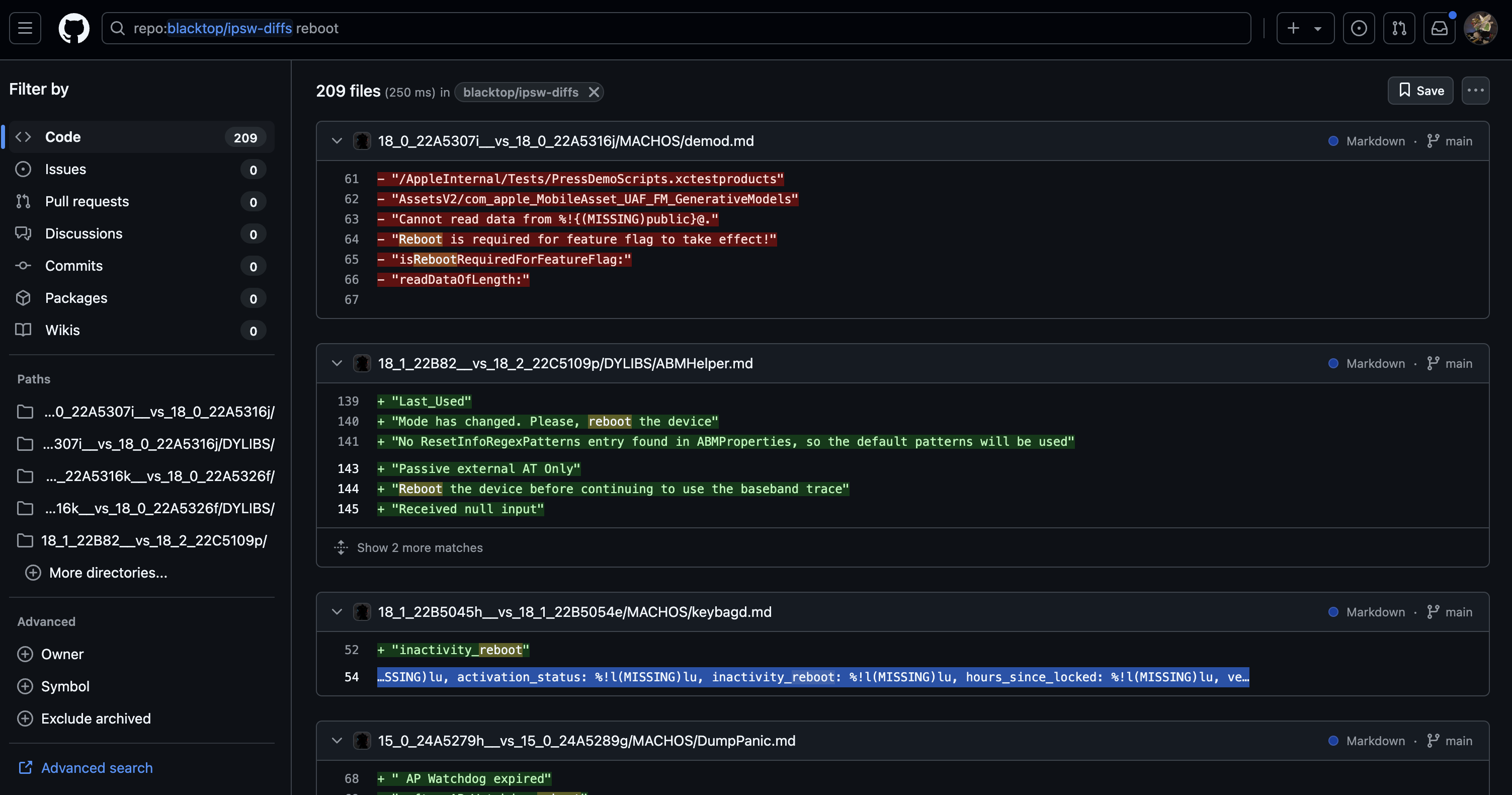
Apple added a feature called "inactivity reboot" in iOS 18.1. This is implemented in keybagd and the AppleSEPKeyStore kernel ex...
Frequently Asked Questions | GrapheneOS
Latest #GrapheneOS release fixes a contact scopes compatibility issue that breaks apps like WhatsApp caused by the latest Android security patches.
I won't lie, my older articles make me cringe.