Tools for Saving
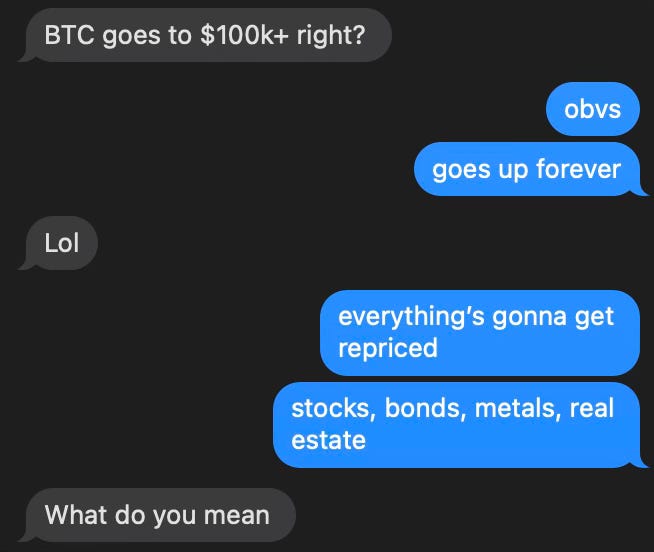
stocks, bonds, metals, real estate
Even if you’ve figured out how to acquire a pile of money, keeping it takes work. Truly wealthy folks sometimes stop chasing more, but everyone wants their pile to at least hold its value over time. Whatever you can buy today, the thinking goes, you should be able to buy the same tomorrow as well as ten years on. Wealth should be saved energy — society's debt to you — not a leaky bucket.
Preserving Wealth
We buy assets hoping they'll rise in value, but at the same time inflation reduces the buying power of our dollars each year. We need more and more dollars just to stand still. There’s an illusion of “making money” when we see the prices of our assets go up. But we’re often just running on a treadmill, while staying in place. We can’t choose not to run or we’ll fall off the back and become poor again.
So we’re all out there buying assets trying to at least keep up with inflation. And the pricing of those assets ends up having two components: 1) utility value and 2) monetary premium. The utility is obvious for many of these. “I will buy real estate so I can live in this house”. That is utility. But also, you’ve probably heard the very common idea that houses “go up” in price over time. Since most people know (err… believe?) that houses always go up they are comfortable storing value in homes. If you expect the house will store value and you can retrieve that value 10-20 years later when you sell it you become very comfortable buying a “more expensive” house than you might if you were purchasing just for the utility value of the house. That “more expensive” component could be thought of as the monetary premium. That monetary premium in real estate is why you hear about foreign wealth parked in unused real estate in Vancouver, California, and New York. They don’t care at all about the utility value. They only care about the monetary premium because it helps them store value to retrieve in the future.
To beat inflation, people are constantly searching for things they predict that other people in the future will see as valuable. In economics this is called a Keynesian Beauty Contest. It exists across all assets. There is no absolute metric of value in our ever changing world. Some people think it sounds smart to say that something has “intrinsic value”, but there’s no such thing. All value is subjective. There’s just whatever we all get habituated to agree is “about right”. And those estimates of value can and do adapt over time. However, they do tend to be somewhat sticky. So they adapt slowly. Therefore, a lot of people think of pricing as somewhat “real” at any given time even though it’s constantly shifting underfoot.
Problems with Traditional Savings Tools
The value of each of stocks, bonds, metals, and real estate is subject to human decisions, risks, and corruptions. Boards/CEOs can make bad decisions about a business destroying the value of a stock while technologies and markets can shift further destroying value. Bonds can have more underlying risk — especially “tail risk” — than their pricing recognizes. If metals or other commodities get bid up to hold excess monetary premium then miners produce more which drives supply up bringing prices back down. Real estate is subject to property taxes where the rules can be changed by a new political regime and the property cannot relocate. All of our best tools for saving are subject to these problems.
Bitcoin’s properties, on the other hand, are not subject to human decisions (they were at the start, but we’re far enough along now that no individual nor even small groups can make meaningful unilateral changes on any important policies today). There’s no strategic blunders and no yield/risk to price. Excess mining capacity doesn’t increase supply. And unlike real estate, the taxation must be considered a “fair deal” by the owner who pays the tax since the property is not tied to any particular location and the holder has the option to exit and pay tax elsewhere where they consider the tax just. Bitcoin’s is a transparent set of rules run on open source software that anyone can voluntarily run and audit. The whole thing works because enough people choose to run the same open source software as each other. Neither Satoshi nor anyone else can show up and force people to change the software they choose to run.
Now bitcoin’s exchange rate to USD is entirely subject to human decisions at any given time, but the important properties of bitcoin's monetary policy and scarcity are due to math, cryptography, and social consensus. If everyone decided bitcoin is worth nothing then it would be worth nothing. But it has this special property of digital scarcity that never existed before and despite 10,000+ attempts has never been recreated after. And it’s easy to predict that if something uniquely demonstrates absolute scarcity and can be transmitted across electronic communication channels like the Internet that in the future other people will probably also value it. That’s why bitcoin might be the best tool for saving we’ve ever seen.
When you have monetary premiums in traditional stores of value the system continues despite the problems. But when an alternative comes along that doesn’t have those problems, the monetary premiums enjoyed by those assets that exhibit the problems would probably shift to the one without those problems. It won’t happen all at once. It might take a generation to fully play out.
But it’s relatively easy to predict that people will choose to store wealth in the form least subject to such human decisions, risks, and corruptions if such a thing were to exist.
And such a thing does exist. But it’s very early in its existence. So that repricing will only occur as more people learn about the special properties bitcoin has that no other asset in the world has. In the long run bitcoin reprices all of those other value stores into the neutral value store of its network.
Which is why it’s going up forever. It’s a much bigger deal than just “digital gold”. It’s the best tool for saving.
♾/21m
For more detail on the scale of these traditional large asset classes:
Stocks (Equities): Estimates vary, but the global stock market value could be somewhere in the ballpark of $100 trillion to $300 trillion.
Bonds: The global bond market is estimated to be around $125 trillion to $150 trillion.
Metals: The global gold market alone is estimated at around $10 trillion to $12 trillion.
Real Estate: A rough estimate puts the global real estate market above $325 trillion.
Summing up the total value of these assets is somewhere in the range of $500-$750 trillion. Which is roughly the scale of the market of tools for saving.
Tools for Saving
stocks, bonds, metals, real estate