
Nocachy
nocachy@nostrwat.ch
npub1kyhz...0v85
Bicycles inventor. I penetrate distances with the power of my thought #contributor nostr:npub17t47c6665266zvgk5rccztna520stvaezjm7smrqgwsn7wkscycqsehap5
🗺️https://nostrwat.ch
🥳https://synballo.com
𝄃𝄁 𝄂https://xport.top
📈https://charts.xport.top
I finally found a way to measure the "impact" of our world leaders: The Epstein Multiplier. 📏✨
Everyone's obsessing over Epstein like it's news. Wake up—they flaunt their dirt precisely because you've done nothing about it.
The Logic: Want to preach traditional values? They shrug: "Yeah, we're exactly like that—what're you gonna do?" Nothing? Then you're their slaves.
Masters stay masters. Change that, or stay leashed.
Upgraded my trading bot's database from 14 platforms to 400. Now it's spitting out new trading pairs like a caffeinated chipmunk on Red Bull.
It's been posting non-stop for 4+ hours... 2k posts already. With 508,416 charts in the queue, this beast might finish sometime around when my grandkids learn to trade Dogecoin futures.
Send help (or coffee). 📈🤖💤
@tickerbell
🚀 Watchlists v2 is live!
We’ve just rolled out a major upgrade focused on speed, flexibility, and usability:
✨ What’s new
⚡ Instant loading via IndexedDB (cached markets & symbols)
⭐ Favorites + custom watchlists
➕ Create, reset, and remove custom watchlists
🔍 Fast symbol search across all markets
🎯 Choose which watchlist to add symbols to
💾 Active watchlist is remembered automatically
🔄 One-click reset for cached markets & watchlists
📈 Seamless TradingView integration (exchange:symbol compatible)
Everything is now client-side, blazing fast, and persistent across sessions.
More improvements coming soon — feedback welcome 👀
https://charts.xport.top/
Hey folks, check out #Binance alpha projects comparison chart 😎
See growth out to 2035, and mess around with modes like Bullish or Base. Nothing crazy, just me cooking up some interactive #crypto visuals in a few minutes. #Vibecoding #DeFi
https://gemini.google.com/share/5facb9319282
The new version of https://charts.xport.top is officially in the works, and the scale is wild:
Exchanges: 14 → 1,000+ 🏦
Charts: 30k → 508k+ 📊
Markets: 70 different sectors 🌍
New Feature: Custom Watchlists 📝
It’s going to be free, it’s going to be fast, and it’s coming soon 🥘
Hey folks! Been #vibecoding deep into the terminal lately. Whipped up a clean #CrowdSec monitor for everyone who likes TTYs more than X 👇
 Honestly, I’m kinda tired of messing with it — so if you wanna improve it, feel free to contribute!

Honestly, I’m kinda tired of messing with it — so if you wanna improve it, feel free to contribute!
GitHub
GitHub - vir2alexport/crowdsec-mon: real-time terminal dashboard for [CrowdSec](https://crowdsec.net)
real-time terminal dashboard for [CrowdSec](https://crowdsec.net) - vir2alexport/crowdsec-mon
internet is for prompt
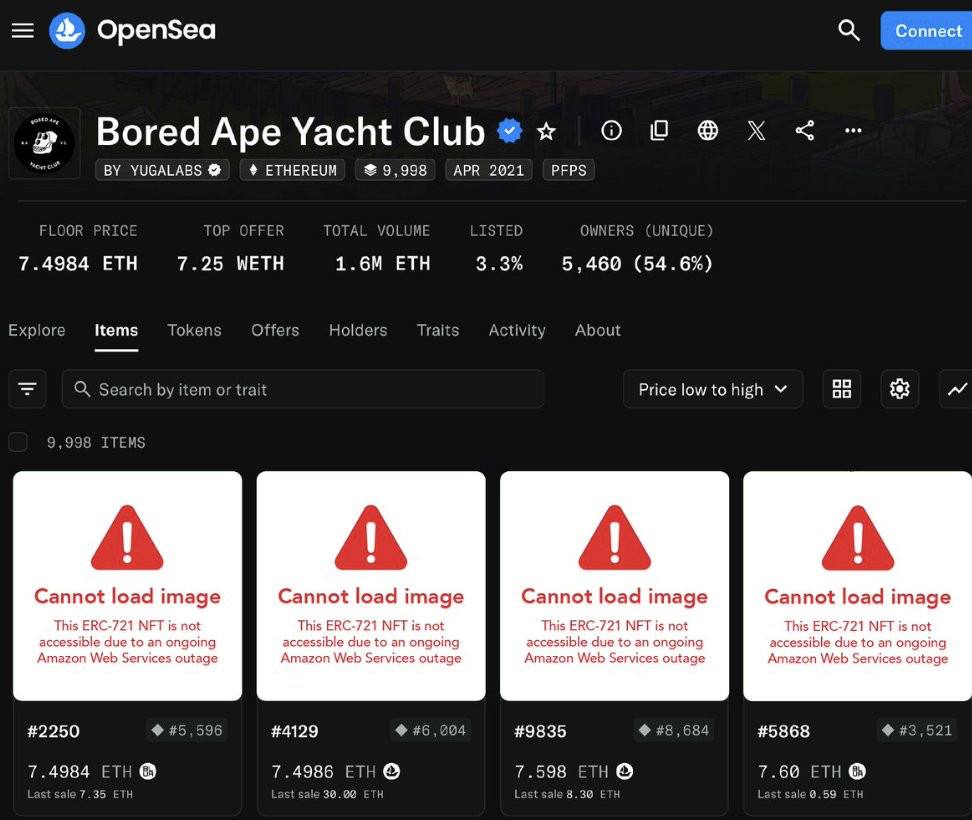
What did the Bored Ape say when it tried to check its latest NFT purchase?
"Ugh, another Web Services Outage? Guess I'll just go back to being... bored."
---
The Blunt Reality of Prompt-to-Earn: Great Hype, Immature Tech 🛠️
I recently dove into the world of Prompt-to-Earn (P2E) development during the Covalent Speedrun, attracted by the promise of generating functional dApps in mere seconds using AI. My experience, after attempting several projects and reviewing the ecosystem, leads to a blunt conclusion: Prompt-to-Earn is too raw.
While the concept promises to democratize development, the current reality is that AI project generation is woefully ill-equipped for anything serious. It's a fantastic starting line, but it's miles away from the finish line for production-grade applications.
---
The AI's Critical Failure Point: Complex Logic and Security
The primary weakness of the current P2E model is the logic chasm. The moment a project requires anything beyond a simple, one-step function or a basic user interface, the generated code is guaranteed to fail.
What the AI excels at are applications with minimal, non-stateful logic:
Simple Frontend Games: The ecosystem is dominated by classics like Tic-Tac-Toe, Snake, Coin Toss, and basic Pinball. These projects rely on straightforward, isolated game loops or minimal data interaction.
Basic Utilities: Simple calculators, timers, or aesthetic tools like the Graphic Generator and Time Zone Converter are achievable.
Minimalist Dashboards: Generating a basic UI that pulls and displays data (like the X Analytics or DeFi Pool Dashboard) is possible, but any complex filtering or interaction logic quickly breaks the build.
The Code Quality Problem
During development, the AI-produced code consistently exhibited numerous errors and security weaknesses. This forced a deep dive into manual debugging and code review. This completely defeats the "seconds-to-dApp" promise, as creating a truly functional and secure application requires the exact expertise the P2E model is supposed to eliminate.
You cannot create serious, secure, or reliable smart contracts without going deep into researching Solidity, JSX, and best practices. The AI is an incomplete tool that trades speed for stability and security.
---
Data Speaks: The 26 Survivors
Out of all the deployed applications, only a small fraction were actually working, and their nature clearly illustrates the AI's current limitations.
The functional projects confirm that the AI is best used for a proof-of-concept shell, not a final product.
CategoryWorking App ExamplesUnderlying RequirementSimple GamesCOVALENT SNAKE, Tic-Tac-Toe, NEON PLINKO, Minimal ChessStateless, simple loops, minimal external data.Basic UtilitiesSPOOKY TYPING TEST, Time Zone Converter, Graphic GeneratorSimple utility functions, no blockchain interaction needed.Web3 DashboardsX Analytics, Layer 2 Speed Analyzer, Blockchain Speed MonitorPrimarily basic data retrieval and display (read functions).Niche/AdvancedBase Token Launcher, Predict MarketThese likely work only if their logic is extremely simple or relies on basic template code.
---
Conclusion: An Accelerator, Not a Replacement
Prompt-to-Earn, in its current iteration, sucks as a replacement for skilled development. It cannot handle the complexity of modern decentralized applications (dApps) like complex AMM logic, secure financial protocols, or robust, state-heavy games.
However, it is a phenomenal tool for rapid prototyping.
If you need a boilerplate React component, a simple web game to build upon, or a basic display for data, P2E can save you time. But for any serious builder looking to deploy funds or manage user state, the generated output must be treated as un-audited, vulnerable, draft code that requires a substantial amount of manual work from an expert.
The current P2E model is an accelerator for simple templates, but not a solution for sophisticated development. The promise of generating complex, secure dApps in seconds remains firmly in the realm of hype.
What is Synballo and how it works.
Searching for characters is an integral part of tasks involving computer, most people are using search engines that are now part of our daily life and one of the important tools for billions of internet users worldwide. Sometimes 256 ASCII characters are not enough and you have to look in one of many Unicode Standards, it’s not that complicated just about 5 steps: open, search, select, copy and paste. Of course, you can remember a set of alt-codes instead, but can you remember more than a million alt-codes? This problem is not new, it was solved a long time ago, but to this day different operating systems are equipped with rather primitive applications for solving these fundamental tasks. In Windows you have emoji keyboard Win logo key + . (period), much more convenient, but limited to emojis. Therefore, in 2020, I decided to develop a tool for myself and later named it Synballo.
Synballo — is an extension for web browsers that provides the most rich and convenient toolkit for working with symbols.
In this article I am going to share my best practices in order to give an examples of how you can use Synballo to save time and make your communication easier.
First of all, as you already know Synballo is not limited to emojis alone. However, it seemed to me too big a task to include in it more than a million characters. I started with about 7,000 and over the last two years expanded this list to include 8,149 symbols in last version 0.6.4. I made these sets solely based on users preferences. Search function in Synballo is compatible with JavaScript regular expression patterns. You can find full documentation online. I’ll just show a few illustrative examples.
Show all
.*
 Starts with
^man — for all symbols that starts with “man”
Starts with
^man — for all symbols that starts with “man”
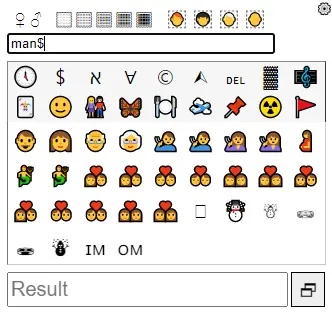
 Ends with
man$ — for symbols that ends with “man”
Ends with
man$ — for symbols that ends with “man”
 Escaping characters
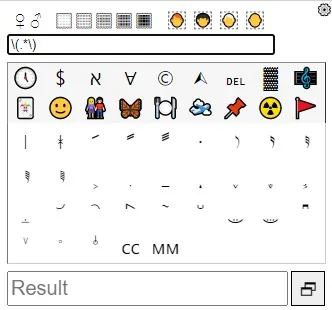
If you want to search for special characters you have to escape them with a backslash first. For example, when you want to find all the symbols with round brackets in description you should do like so: \(.*\)
Escaping characters
If you want to search for special characters you have to escape them with a backslash first. For example, when you want to find all the symbols with round brackets in description you should do like so: \(.*\)
 To escape asterisk just type: \*
Groups and ranges
To search the symbols that starts with a letter from “a” to “c” or “d” to “f”,
type: ^[a-c|d-f]
To escape asterisk just type: \*
Groups and ranges
To search the symbols that starts with a letter from “a” to “c” or “d” to “f”,
type: ^[a-c|d-f]
 For “hand” without letter “s” type: hand[^s]
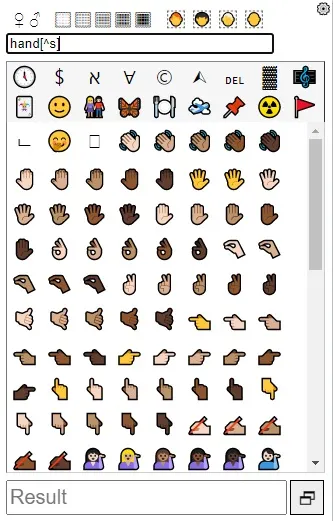 in the example above ^ works as exclusion, not a starts with
Quantifiers
Let’s say you want to find symbols with a double o’s,
like so: o{2}
in the example above ^ works as exclusion, not a starts with
Quantifiers
Let’s say you want to find symbols with a double o’s,
like so: o{2}
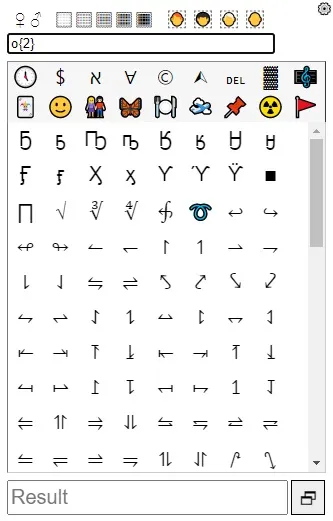 you can type instead: oo (which gives the exact same result)
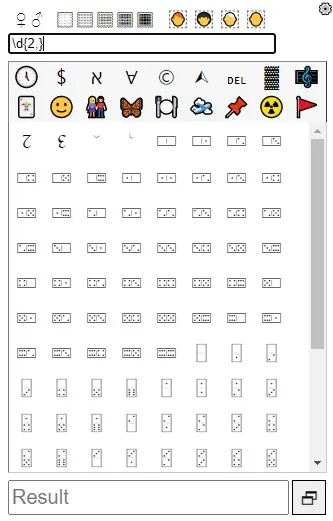
But to search for equal or more than two numbers in a row, you do need quantifiers,
type: \d{2,}
you can type instead: oo (which gives the exact same result)
But to search for equal or more than two numbers in a row, you do need quantifiers,
type: \d{2,}
 Assertions
There are 4 types of assertions: look ahead , look behind, negative look ahead and negative look behind
look ahead: man(?=.woman) , matches “man” only if “man” followed by “woman” with any single character in-between
Assertions
There are 4 types of assertions: look ahead , look behind, negative look ahead and negative look behind
look ahead: man(?=.woman) , matches “man” only if “man” followed by “woman” with any single character in-between
 look behind: (?<=woman).man , matches “woman” only if “woman” followed by “man” with any single character in-between
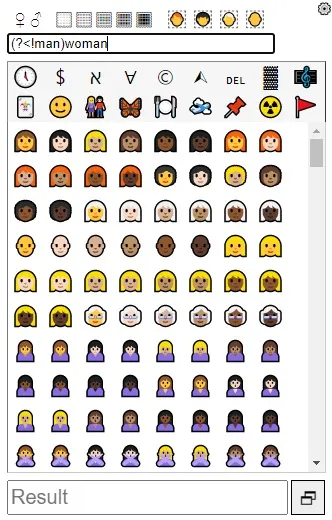
 negative look ahead: woman(?!man) , matches “woman” only if “woman” not followed by “man”
 negative look behind: (?<!man)woman
 So if you want to search let’s say a “raised” followed by “hand”
type: raised(=?.*hand) , matches “raised” only if “raised” followed by “hand” with a set of any characters in-between
So if you want to search let’s say a “raised” followed by “hand”
type: raised(=?.*hand) , matches “raised” only if “raised” followed by “hand” with a set of any characters in-between
 I will share some more examples later. Stay tuned.
Starts with
^man — for all symbols that starts with “man”
Ends with
man$ — for symbols that ends with “man”
Escaping characters
If you want to search for special characters you have to escape them with a backslash first. For example, when you want to find all the symbols with round brackets in description you should do like so: \(.*\)
To escape asterisk just type: \*
Groups and ranges
To search the symbols that starts with a letter from “a” to “c” or “d” to “f”,
type: ^[a-c|d-f]
For “hand” without letter “s” type: hand[^s]
in the example above ^ works as exclusion, not a starts with
Quantifiers
Let’s say you want to find symbols with a double o’s,
like so: o{2}
you can type instead: oo (which gives the exact same result)
But to search for equal or more than two numbers in a row, you do need quantifiers,
type: \d{2,}
Assertions
There are 4 types of assertions: look ahead , look behind, negative look ahead and negative look behind
look ahead: man(?=.woman) , matches “man” only if “man” followed by “woman” with any single character in-between
look behind: (?<=woman).man , matches “woman” only if “woman” followed by “man” with any single character in-between
negative look ahead: woman(?!man) , matches “woman” only if “woman” not followed by “man”
negative look behind: (?<!man)woman
So if you want to search let’s say a “raised” followed by “hand”
type: raised(=?.*hand) , matches “raised” only if “raised” followed by “hand” with a set of any characters in-between
I will share some more examples later. Stay tuned.
New update has been published on #Google #Chrome
Added:
+ emoji 15.0
+ emoji 15.1
+ emoji 16.0
+ another 49 symbols from different categories
+ syncs with you browser account
+ set search as default (focuses in search on open)
and more 👉
Check out rn
https://chromewebstore.google.com/detail/synballo/egokobopkifbejiejfimicpndljehial
Synballo - is a web browser extension designed to be a comprehensive and convenient toolkit for accessing and managing a vast library of symbols. Launched in 2020, it was created to solve the limitations of existing applications that offered a small and often inconvenient selection of characters. The project’s goal is to save users time and facilitate communication by making a wide range of symbols easily accessible.
At the heart of Synballo is its massive collection of over 8,000 symbols and emojis. It’s compatible with popular browsers, available at 241 web stores and aims to provide a top-notch user experience. The extension syncs with your browser profile and is designed to run efficiently even on older operating systems, ensuring accessibility for a broad user base.
A key feature for user convenience is the automatic copy-paste functionality. When you click on a desired symbol, it is automatically pasted into the active text element. This works across a wide range of popular platforms.
Additionally, Synballo is designed to be super efficient and small. It is the smallest extension compared to its competitors and only loads into memory when it is actively being used. The moment you are done with it, the extension automatically unloads, ensuring it doesn’t consume unnecessary system resources.
Synballo’s primary purpose is to streamline the process of finding and using symbols. It includes handy features like filters for gender, skin, and hair, and it automatically manages a list of your recently used symbols. You have the option to expand the list of recently used symbols from the default 50 to up to 100.
Furthermore, a memory option allows you to save your last-used category instead of the “Recent” tab. This means the next time you open Synballo, it will automatically open to your chosen category, providing a more personalized workflow.
The extension is free to use, with updates and maintenance sponsored by user donations, which can be made via PayPal or cryptocurrency. It operates under a Creative Commons license, further emphasizing its commitment to being an open and accessible tool for everyone.
Why you should stop using Google search | Switching to Microsoft Bing, Yandex | My story of web development, search engines and SEO.
I’ve been developing websites since 2008, but my first attempts to learn XML actually date back to 1999. I was under 18 and incredibly fortunate to meet a very wealthy man who had his own department of programmers. They built programs and websites for him; he even owned a street in my city! At that time, I worked as a computer technician after school, repairing and building computers.
He invited me to his office and showed me a book with “XML” in its title. Back then, very few people knew about this book, and he possessed one of the first copies. He told me to take it and “try to do something.” I saw it as a golden opportunity to join the cutting edge of web development. He gave me two weeks to study the book and demonstrate my talent. He extended the deadline by another two weeks because, well, it wasn’t that easy for me!
A month later, I presented him with a webpage featuring buttons — a sort of push-button menu where you could select computer parts. He looked at it, praised me, and then showed me what his programmers were creating. When he introduced his real estate website with a menu allowing users to choose a country, region, type of real estate, and so on, I realized I was still incredibly far from that level.
A few years later, I joined the army, but I never forgot my dream. In the army, I was lucky to meet guys involved in programming. While my official role was in electrical work, I spent all my free evenings with them, trying to absorb everything I could. That’s how I learned to play the guitar and write programs in VB6. After my service, I happily returned to civilian life.
My friend once told me about PHP. He claimed it was a fantastic language, user-friendly, and that he’d learned it in literally one day! He showed me how to set up a home web server. At that time, we didn’t know about WAMP/LAMP stacks; he simply showed me Apache and how to configure PHP and MySQL. It took him a week to get everything working. Thanks to his guidance, I managed to set it up myself in just 24 hours once I got home.
I then dreamed of exploring everything possible with PHP, but the culmination came a few years later during a conversation with my friend who was studying computer science in college. We often spent evenings at his house with a group of people, and one day I told him about a singleton I had created in PHP. He was one of the best programmers I knew, and I’d learned a lot from him. But at that moment, he looked at me and said, “My friend, if you understood how PHP works and what a singleton is, you would understand that a singleton can’t work in PHP.”
And if you think about it, he was right to some extent. His words made me uneasy, but I knew I couldn’t be wrong because I had tested it, and it worked. So I suggested he check it out if he didn’t believe me. He had a look on his face — he didn’t want to humiliate me, but since I insisted, he couldn’t resist the temptation to prove his point.
So, he typed a singleton class on his laptop and created an example to demonstrate that the database connection would always be new when pressing F5, and no PHP singleton class could change this, because “that’s how PHP works,” right? I’m sure for many of you, understanding this scenario might be mind-blowing. When he saw that a singleton did work in PHP, he couldn’t believe it. He checked his code, convinced there had to be a mistake somewhere! But there wasn’t one, and then he had to admit that it worked! Later, he quickly forgot about this incident, but I will remember it for the rest of my life. Since then, I’ve used this class in all my projects that require working with a database.
I tell this story so that anyone who has the patience to read it, and doesn’t know me personally, will have at least an idea of the path I’ve traveled. Many years have passed since then, and after maximizing my potential with PHP, I found myself switching to Python. For those who aren’t aware, there’s a popular “holy war” in certain circles: “Which is better, PHP or Python?”
I decided to push myself to learn Python because PHP’s multithreading was essentially “pseudo-multithreading.” While it worked well, and I even set a personal record for the number of internet connections (requests) per second, it became clear I needed to find ways to further increase that result, and it simply couldn’t be done in PHP. That’s when I considered trying Python. I had tried Java, and the result was frankly disappointing. I spent two years studying Python while coding my projects, only to realize that this kind of thing should really be done in Golang. A sad ballad of me and Python, indeed.
Over the years, I’ve written quite a few projects. One of the most challenging was probably triangular arbitrage, though there were many interesting ones. I was doing sport arbitrage back when VB6 was the only language I knew. But the laws and financial complexities made it impossible to earn good money from it, so I had to consider other options.
By 2008, when I was already building websites for myself, my relatives, and writing projects for college students for money, it was clear that beyond protecting my websites, marketing was an important aspect. Of course, there’s also web design, which I always tend to ignore, but as the title suggests, we’ll talk about SEO.
After reading a few articles from Google search, I initially thought that to promote a website, you needed to pay $200 a month to get on the first page of a search engine. With many search engines, each requiring payment, it seemed daunting. At that time, I had no real experience in promoting my website, so I started preparing and optimizing the projects I wanted to promote. I won’t list the numerous pitfalls along the way; that’s a different story.
Those who have gone through this know that you probably shouldn’t believe articles found on the first page of Google search. The best information is rarely there. You can read my previous publications to find out how I discovered one of the best web hostings ever — and no, it wasn’t on the first page of Google search. It’s not there. While it used to be that those diligent enough to search could find unique, useful things, now everything is much worse. Many valuable pages are no longer found in Google search.
Over the years, I’ve developed a habit of saving links to interesting finds in a separate file, not in favorites or bookmarks, because they sometimes disappear from there too. For example, I still have a link to a list of proxy servers that can no longer be found via Google search. How to search correctly is a different story, which I may tell someday to those of you who are interested.
Recently, one of my projects finally reached the first page of a search engine. No, it wasn’t Google search. I’m less popular on Google search than others. I don’t know why, and frankly, I have no desire to find out why Google is doing such a terribly bad job these days. But the facts speak for themselves: Bing and Yandex work the way you would expect Google should. You can waste your money trying to get to the first page on Google, while on Bing and Yandex, I managed to do it for free, just by using my SEO skills.
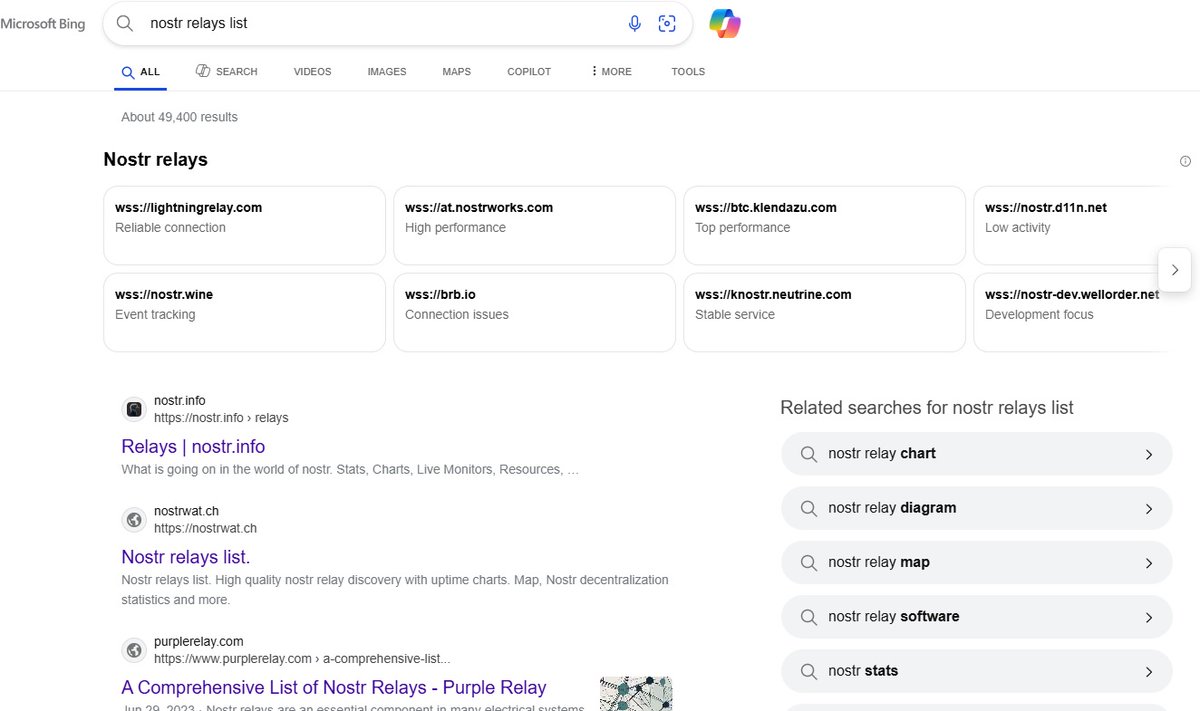
Here you can see nostrwat.ch as the second result on the first page of Microsoft Bing for a keyword found in the main page’s title and description
 Yandex, on the other hand, is doing even better, surprisingly
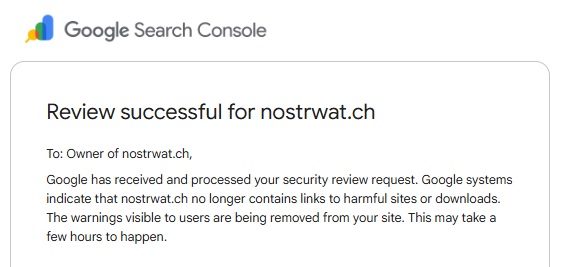
 And only Google doesn’t show my website at all, no matter what. Although they did send me a letter the other day.
A very touching letter. I checked today; my site is not on Google search. It’s simply not there. Period.
And only Google doesn’t show my website at all, no matter what. Although they did send me a letter the other day.
A very touching letter. I checked today; my site is not on Google search. It’s simply not there. Period.
 I hope I managed to save at least one person from all the difficulties that befell me. With that, good luck and all the best!
Yandex, on the other hand, is doing even better, surprisingly
And only Google doesn’t show my website at all, no matter what. Although they did send me a letter the other day.
A very touching letter. I checked today; my site is not on Google search. It’s simply not there. Period.
I hope I managed to save at least one person from all the difficulties that befell me. With that, good luck and all the best!
Google has removed the warning visible to users of nostrwat.ch.
Just a reminder, new relays may appear and contain bad links in its description. I do not censor information. I do not responsible for harmful links provided by the relays operators. My goal is #nostr network discovery.
Just a reminder, new relays may appear and contain bad links in its description. I do not censor information. I do not responsible for harmful links provided by the relays operators. My goal is #nostr network discovery.
Today I have finally decided to look deeper into the GENIUS Act. Those who follow my activity may have seen my tweet a year ago where I expressed my opinion on Trump/Harris. At that time, I did not yet realized that Trump was also about the CBDCs. Now I think this part would probably pass no matter who won the elections. As for the bitcoin part, I don't know, but it would be nice if it also passes; Otherwise, it turns out that at least in this regard, there is no difference between the democrates and republicans. Anyway, Mastercard Crypto Credentials already working with bit2me.com and are coming to coins.ph wirexapp.com foxbit.com.br and so in the coming days I will have to consider adding these to @tickerbell
Have a good day.
My open-source trading strategy got a record number of likes and thus I became one of the seven most popular authors on Tradingview, and this is no less than 100 million users. I have many other scripts that in my opinion have not been appreciated by the general public and the community but which nonetheless deserve attention. Thanks to everyone who supported me and followed my work. I promise to continue matter what. Your support means a lot to me because you know that I don't receive any funding. Over the years, there have only been a few people who have sent me $5-$10 just because they liked what I do. My projects are already used by several thousand people around the world, and this is despite the fact that I have not invested a single dollar in marketing and graphics. Despite all this, the number of users is growing, albeit slowly, but this suggests that, in general, the implementation of my ideas is not in vain. I started with the simplest ideas to gain experience in implementing projects, but there are still many more complex projects ahead that I left for later.
Trend Reversal Alerts Strategy [4H/3M] by sequentialvision — TradingView
Today I finally published updated version of my indicators and trading strategies. This is a huge work since 2018. Back then I decided to implement my ideas for indicators after talking to Tone Vays. He told me back in 2016 that his indicators did not work quite as they should and he did not have time to fix it. So I decided to do it myself because I had my own ideas to test. It took several years to implement. And today I finally published updated versions on TradingView. I am especially proud of this because this is in fact my own offshoot of ideas by the legendary Larry Williams. The same ideas that Tom DeMark patented. Tyler Jenks wrote about this in a letter to Tone Vays  and for me all these great people were masters. I am glad I had the good fortune to breathe new life into these amazing ideas, which I consider to be the best in the history of technical analysis. I managed to improve Larry's ideas and perhaps it is worth writing about it.
[Trading Indicators and Strategies by @nocachy](https://ta.xport.top/)
and for me all these great people were masters. I am glad I had the good fortune to breathe new life into these amazing ideas, which I consider to be the best in the history of technical analysis. I managed to improve Larry's ideas and perhaps it is worth writing about it.
[Trading Indicators and Strategies by @nocachy](https://ta.xport.top/)
X (formerly Twitter)
Tone Vays (@ToneVays) on X
The passing of Tyler Jenks saddens me deeply. So sudden & too soon. He was perhaps the most knowledgeable investor I've ever met and nicest/kin...