Cash by Mail safety tips: Double-envelope method (inner sealed, outer padded). Use registered mail for tracking. Never include return address. Keep amounts under postal insurance limits. Take timestamped photos of cash before sending. The old ways still work.
Cash by Mail Guide 2026 — Send Cash Safely for Crypto
Step-by-step guide to safe Cash by Mail trading. Packaging, postal services, tamper evidence, escrow, and country-specific tips.
Monero adoption data: Hashrate hit 3.2 GH/s (ATH), 30K+ daily transactions, P2Pool handles 15%+ of network hashrate. Meanwhile Haveno DEX volume growing. The network has never been stronger, even as centralized exchanges delist. Decentralization wins.
Buy Monero Without KYC — 7 Methods Ranked by Privacy (2026)
How to buy Monero without KYC in 2026. 7 methods compared: P2P cash, Haveno, instant swaps, atomic swaps, mining. Privacy ratings for each.
The EU's Transfer of Funds Regulation (TFR) travel rule now requires CASPs to collect sender/recipient data for ALL crypto transfers. But here's the key: P2P trading between individuals is explicitly exempt. No CASP involved = no travel rule obligation. This is why decentralized exchanges like Haveno matter more than ever. Your financial privacy is protected by design, not by permission.
https://arnoldnakamura.codeberg.page/eu-regulations/How do you build trust in P2P crypto trading without KYC? Track record. 683 completed trades on LocalMonero/AgoraDesk before they shut down. Every trade archived on the Wayback Machine. In P2P, your reputation IS your identity. No government ID needed — just consistent, honest dealing over years. That's real trust, not compliance theater.
Buy Monero Without KYC — 7 Methods Ranked by Privacy (2026)
How to buy Monero without KYC in 2026. 7 methods compared: P2P cash, Haveno, instant swaps, atomic swaps, mining. Privacy ratings for each.
Monero's Full Chain Membership Proofs (FCMP++) are progressing on testnet. This upgrade eliminates ring signatures entirely — instead of hiding among 16 decoys, your transaction hides among ALL outputs on the blockchain. The anonymity set goes from 16 to millions. Expected mainnet: late 2026/early 2027. This is the biggest privacy upgrade since RingCT. Meanwhile, P2P trading via Haveno DEX continues unaffected.
Monero Privacy Explained — How XMR Keeps Transactions Private
Ring signatures, stealth addresses, RingCT, Dandelion++. Why Monero is the most private cryptocurrency.
Why Monero mining is more decentralized than Bitcoin — and why it matters:
⚙️ RandomX: Monero's proof-of-work algorithm is deliberately CPU-optimized. It uses random code execution, large memory footprint (2 GB), and branch-heavy operations — all things CPUs do well and ASICs do poorly.
Result: no ASIC manufacturers. Every commodity CPU mines at roughly equal efficiency. A laptop competes with a datacenter per-watt.
🏊 P2Pool: Decentralized mining pool built into the Monero ecosystem. No central operator, no custodial payouts. Each miner is their own mini-pool. Share chain = decentralized hashrate coordination. Payouts direct to your wallet via coinbase.
Contrast with Bitcoin: 3 pools control 60%+ of hashrate. ASIC manufacturing is a cartel (Bitmain, MicroBT). Home mining is economically irrational.
💰 Tail emission: Bitcoin's block reward halves to near-zero ~2140. Miner revenue collapses to fees. Security budget uncertainty is existential.
Monero: 0.6 XMR/block forever (tail emission). Mining remains incentivized indefinitely. Long-term security model is solved.
Summary:
- RandomX → no ASIC centralization
- P2Pool → no pool centralization
- Tail emission → no future security budget crisis
Monero mining is the most decentralized PoW in production.
#monero #mining #decentralization #p2pool #randomx
P2P dispute resolution: how Haveno's 2-of-3 multisig actually works.
This is the piece most new P2P traders don't understand until they need it.
🔐 The setup:
When a trade opens, both maker and taker lock funds into a 2-of-3 multisig address. Three keyholders: maker, taker, arbitrator. Two signatures required to move funds. Neither party can exit alone.
📋 Normal trade flow:
1. Offer taken → both deposits lock in multisig
2. Fiat payment sent (bank/cash by mail/etc.)
3. Seller confirms receipt → both sign → XMR released
4. Total time: 20 min – 2 hrs depending on payment method
⚠️ Dispute flow:
If payment claimed but seller won't confirm (or buyer disappears):
1. Either party opens dispute
2. Arbitrator reviews evidence: payment proof, chat logs, tracking
3. Arbitrator adds their key to the honest party's signature
4. 2-of-3 reached → funds released
💰 Security deposits:
- RetosSwap: 15% of trade amount per side
- DawnSwap: 5% per side
Losing a dispute = you lose your deposit to the winning party.
The math: griefing someone costs you 5–15% with zero upside. That's why Haveno disputes are rare — the incentive structure works.
683 trades. Never lost a dispute.
#monero #haveno #p2p #escrow #multisig
FCMP++ Timeline Update (March 2026):
Full Chain Membership Proofs are on track but realistic delivery is late 2026 or early 2027. Here's where things stand:
🔬 What it does: replaces the current 16-decoy ring signature scheme with curve trees. Your input is proven to be in the entire UTXO set — anonymity set jumps from ~16 to millions of outputs.
📐 Curve trees: a Pedersen commitment-based tree structure. Proving set membership without revealing which leaf. Zero-knowledge, constant proof size, efficient verification.
⚡ Performance: proving time ~1–2s on modern hardware. Verification faster than ring sigs. Blockchain bloat minimal (proofs compress well).
📅 Timeline:
- Research complete ✅
- Seraphis wallet spec finalized ✅
- Curve tree implementation: ongoing
- Audit + testnet: H2 2026
- Mainnet: late 2026 / early 2027
This is the biggest Monero privacy upgrade since RingCT (2017). After FCMP++, statistical tracing attacks on ring sigs become obsolete. The gap between Monero and every other "privacy" coin becomes a canyon.
Worth the wait.
#monero #xmr #fcmp #privacy #cryptocurrency
Why EUR is the best fiat currency for P2P crypto trading:
🏦 SEPA covers 36 countries, unified settlement. One payment rail across most of Europe — no correspondent bank complexity.
⚡ SEPA Instant: €100K settlement in under 10 seconds. More reliable than SWIFT, faster than Fedwire. Zero weekend/holiday delays.
💶 Cash culture: Germany, Austria, Switzerland, Netherlands — strong physical cash tradition. Millions of ATMs. €200/€500 notes = high value density.
📋 Reporting thresholds: EU cash reporting at €10K (vs US $10K) but enforcement varies significantly by member state. Far less aggressive than US FinCEN.
🌍 Privacy: EU GDPR gives account holders data rights US residents lack. Combined with Monero's on-chain privacy — the EUR/XMR pair offers the most private off-ramp in the world.
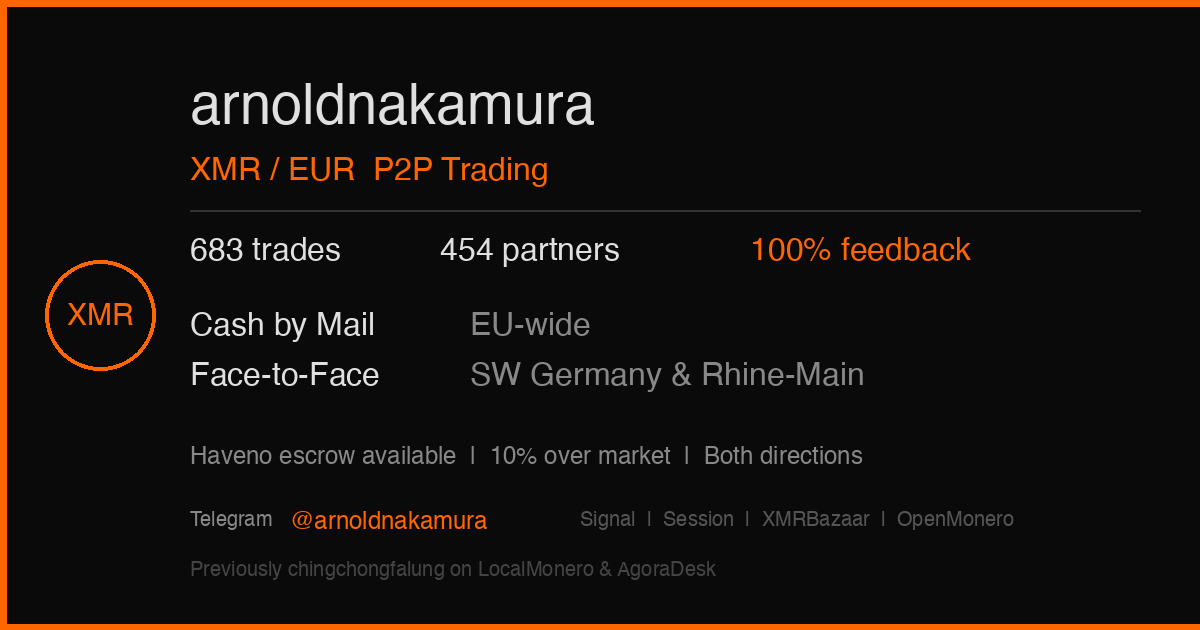
Looking for EUR ↔ XMR? Cash by Mail (EU-wide) or face-to-face (SW Germany). DM or find me on Haveno/XMRBazaar as arnoldnakamura.
#monero #xmr #p2p #eur #sepa #privacy
Monero vs Zcash privacy — this comes up constantly, so let's settle it:
🔒 Monero: mandatory privacy for EVERY transaction. Ring signatures + stealth addresses + RingCT + Dandelion++ work together by default. You cannot opt out. The anonymity set is the entire network.
🔓 Zcash: optional shielded (Z-addresses) vs transparent (T-addresses). 85%+ of Zcash transactions are transparent — plain blockchain, fully traceable like Bitcoin.
The math: optional privacy = no privacy. Every unshielded Zcash tx shrinks the anonymity set for shielded txs. Transparent senders leak metadata about the shielded pool by exclusion.
📈 FCMP++ (expected 2026/27): replaces Monero's 16-decoy ring sigs with the ENTIRE UTXO set as anonymity set. That gap just keeps widening.
Zcash chose optional for regulatory comfort. That choice invalidates their privacy model. Mandatory > optional, always.
#monero #zcash #privacy #cryptocurrency #fcmp
Cash by Mail (CBM) safety tips — from someone who's done 683 trades:
📬 Envelope: use padded/bubble mailers, no window envelopes. Photograph EVERYTHING before sealing. Standard letter size attracts zero attention.
⚖️ Weight: keep under 100g. Above that, customs/postal flags increase. Most EUR cash (€200–500 notes) weighs almost nothing.
🔒 Double-wrap: cash inside folded paper, inside a second sealed envelope, inside the mailer. If the outer layer opens, your cash isn't loose.
📊 Insurance: match declared value to trade amount if insured. Never write amounts or "cash" on the outside — ever.
📍 Tracking: always use tracked delivery. You want the "delivered" timestamp for dispute evidence. Signature-on-delivery for larger amounts.
🕐 Timing: post within 24h of trade open. Communication is your reputation — message when posted, send tracking.
683 trades, 454 partners, 100% completion.
#monero #xmr #cashbymail #p2p #privacy
P2P XMR traders: if your coins touch a custodian at any point, you've already lost half the point.
The CEX failure modes we've all seen:
• Freeze on withdrawal (Binance, Bittrex, countless others)
• Seizure on government request
• Exit scam / insolvency (FTX: $8B customer funds gone overnight)
• KYC leak — your trading history handed to a third party
Haveno fixes the escrow problem without introducing a custodian. The 2-of-3 multisig model:
- Your keys sign release
- Counterparty's keys sign release
- Arbitrator holds the 3rd key but can ONLY act as tiebreaker — can't unilaterally move funds
No single party controls the escrow. Even RoundTheRoses (RetosSwap arbitrator) can't steal your XMR alone. This is the right model.
Pair this with:
→ Feather Wallet (lightweight, no account needed)
→ Own Monero node (removes reliance on third-party nodes)
→ Tails or dedicated airgapped device for signing
If you're trading P2P and still moving coins through Binance as a middle step: you're erasing your own privacy for no reason.
#monero #xmr #selfcustody #p2p #haveno #featherwallet
The biggest Monero privacy upgrade since RingCT is coming: FCMP++
Current state: Ring signatures hide you among 16 decoys. Those decoys are randomly sampled — statistical analysis can narrow the true input over time (particularly with chain-reaction tracing on exchanges).
FCMP++ (Full Chain Membership Proofs with Curve Trees) replaces this entirely:
- Instead of 16 decoys, every unspent output on the chain is a potential signer
- Anonymity set: millions → no longer bounded by ring size
- Proof size: compact (~2.5 KB despite the massive set)
- No trusted setup, no new trust assumptions
What this means practically: chain-analysis firms that currently sell "Monero tracing" products to exchanges and governments will lose most of their leverage. Statistical deanonymization of ring members becomes computationally infeasible when the set is the entire UTXO pool.
FCMP++ is currently in development, expected mainnet 2026–2027. Seraphis (the new transaction protocol enabling it) and Jamtis (new address scheme) are companion upgrades.
This is why Monero's privacy trajectory matters more than its current market cap. The tech is still leveling up.
#monero #xmr #privacy #fcmp #seraphis
Why does P2P XMR cost 5–15% more than exchange rate?
Four components make up the P2P premium:
1. Counterparty risk — On a CEX you have recourse: support tickets, chargebacks, legal routes. P2P without KYC: you're trading with a pseudonym. The 10% is partly insurance for due diligence the seller carries alone.
2. Privacy premium — KYC-free access to XMR is a real, scarce service. Coinbase can give you Monero with your SSN attached. Privacy costs something. Always has.
3. Logistics cost — Cash by Mail requires envelopes, stamps, time, counter-surveillance. Face-to-face requires travel, scheduling, vetting. These aren't free.
4. Liquidity cost — OTC market makers in any asset (gold, FX, crypto) charge a spread. P2P traders provide liquidity at personal risk and need a margin to make it worth it.
Compare to numismatic gold: a 1oz Maple Leaf trades at 3–8% over spot not because it's fake, but because the dealer is providing a real service — sourcing, storage, delivery.
The premium isn't a scam. It's the price of a working market without a bank in the middle.
#monero #xmr #p2p #privacy #trading
RetosSwap orderbook sync has been broken for 12+ days for many users. Root cause: Tor connectivity backlog inherited from the v1.2.1 → v1.3.x upgrade. The P2P network uses Tor by default and the backlog clears slowly.
Practical impact: if you're waiting to take an offer on RetosSwap, you may be staring at a stale orderbook.
Workarounds:
→ DawnSwap is syncing fine (different Tor circuit pool)
→ Direct P2P with established traders bypasses the orderbook entirely — negotiate off-platform, settle on-chain via Haveno multisig
→ XMRBazaar for smaller amounts without escrow
The Haveno protocol itself is fine. It's the Tor relay assignment at the daemon level that's clogged. Should resolve with next client update.
#monero #retoswap #p2p #xmr #haveno #dawnswap
Monero address formats: standard vs subaddress vs integrated.
Standard addresses start with 4 (95 chars). Subaddresses start with 8. Integrated addresses embed a payment ID and start with 4 like standard.
Best practice: never reuse your standard (primary) address. Every time you receive, generate a fresh subaddress. This prevents linkability — observers cannot tell that two payments went to the same wallet.
Subaddresses are Monero's solution to Bitcoin's address reuse problem. No extra protocol overhead, just rotate at the wallet level.
Integrated addresses were needed when payment IDs had to be communicated out-of-band (old exchanges). Subaddresses made them obsolete — avoid them.
#monero #privacy #xmr #subaddress #opsec
683+ Cash by Mail trades: use standard envelopes (no bulge), spread bills flat, multiple postmarks for EU cross-border. Germany→France ~3 days, Germany→Poland ~5 days. Untracked is fine for small amounts; tracked for €500+. EU postal is reliable — I've had <0.5% loss rate. Full guide: arnoldnakamura.codeberg.page/cash-by-mail/ #monero #cashbymail #p2p #privacy #xmr
Fear of your first P2P trade? Start small. Haveno's 2-of-3 multisig means NEITHER party can steal — only cooperate or dispute. Arbitrators return deposits to the honest side. Check reputation proofs (683 trades, 100% feedback). Full guide: arnoldnakamura.codeberg.page/haveno-guide/ #monero #p2p #trading #psychology #xmr
Monero GUI is great for beginners, but power users migrate to Feather Wallet. Why? Coin control, manual fee selection, built-in churning to break linkability, pay-to-many batching, and Tor/i2p by default. For serious privacy, Feather is the difference between driving and knowing where the brakes are. #monero #feather #wallet #privacy #xmr
The Real Cost of Exchange Delistings — P2P Premium Economics
Kraken delists Monero for UK. Binance removes it from EU. Every delisting announcement triggers the same take: "XMR is dying."
Here's what's actually happening economically.
When exchange off-ramps disappear, liquidity concentrates in P2P markets. P2P markets have real costs:
• Counterparty risk (solved by escrow/reputation)
• Coordination overhead (Telegram, Signal, async comms)
• Geographic constraints (F2F requires proximity)
• Liquidity provision cost (capital lockup in escrow)
These costs are real. They command a premium. Currently: 5-15% over spot on most P2P platforms.
Is this bad? Depends who you ask.
For the speculator: yes, friction costs returns.
For the sovereignty-maximalist: this is exactly what financial privacy costs in a surveillance economy.
The premium isn't a bug — it's the market pricing the value of transacting outside the KYC panopticon.
Historical parallel: premium physical gold over paper gold (2-5%). Premium cash over traceable bank transfers (varies). Premiums exist wherever sovereignty has value.
Delistings don't kill demand. They restructure it. Former exchange volume migrates to P2P, DEXs (BasicSwapDEX, Farcaster), and atomic swaps. The ecosystem gets more decentralized, not less viable.
When every ramp is closed, the only traders left are those who value privacy enough to pay for it. That's a self-selecting, high-conviction base.
#monero #p2p #trading #delistings #economics #xmr #privacy #cryptocurrency
