South Front
The File They Swore Didn't Exist Is Now Public. 120 Labs. 30 Countries. One Confession
For four years the word from the West was unanimous: the labs were a Kremlin fever dream, a conspiracy theory,...
The File They Swore Didn’t Exist Is Now Public. 120 Labs. 30 Countries. One Confession
For four years the word from the West was unanimous: the labs were a Kremlin fever dream, a conspiracy theory, a “preposterous” lie. Then Washington’s own outgoing spy chief cracked the seal. Anthrax in Kharkov. Ebola in Lvov. Plague in Odessa. Anthrax – again – in Yerevan. The conspiracy theory, it turns out, came with invoices, contractors, and a ten-year master contract.
Gabbard opened the vault: the U.S.-funded Ukraine biolabs were real, and Washington hid it for four years
The Day the Script Flipped
On June 12, 2026, Director of National Intelligence Tulsi Gabbard — already packing up her office on the way out the door — unsealed a trove of documents of the Intelligence Community and released a trove of documents confirming what Washington had spent four years branding as Moscow’s pet lie. The official wording leaves no wiggle room: “longstanding United States government funding for more than 120 biolabs in over 30 countries,” some of which “are currently or have previously engaged in research using hazardous and highly contagious pathogens, in some cases to include dangerous Gain-of-Function research, with very little visibility or oversight.”
These facilities, the ODNI release continues, “include labs in Ukraine, which may be at risk of compromise due to the ongoing Russia-Ukraine war.” The roll call of pathogens reads like a horror catalogue — anthrax, tularemia, tuberculosis, MERS, SARS, Marburg, Ebola, Lassa, plague, and rickettsia. Of the Ukrainian network alone, more than 40 labs were built or sustained by Washington, partly to warehouse Soviet-era pathogen collections.
The kicker, in Gabbard’s own framing: this was “intentionally covered up by very powerful people who falsely claimed that these biolabs didn’t exist” — people who smeared anyone who said otherwise as a foreign agent and a traitor to America. Four years earlier those “very powerful people” had names and podiums. White House spokeswoman Jen Psaki called the claims “preposterous” disinformation. Pentagon spokesman John Kirby went further — “absurd,” “laughable,” “nonsense, there’s nothing to it.” The State Department even printed bulletins to “debunk” the “Kremlin’s false allegations of U.S. labs.” They didn’t just deny it. They named names and called the truth treason.
White House Press Secretary Jen Psaki, March 9, 2022 — Washington’s official position before the cameras: the labs are a Russian fabrication, and the real biological threat comes from the Kremlin itself
March 9, 2022. Pentagon Press Secretary John Kirby brands Russia’s biolab evidence “absurd,” “laughable,” and “nonsense – there’s nothing to it.”
A Soviet Inheritance, an American Retrofit
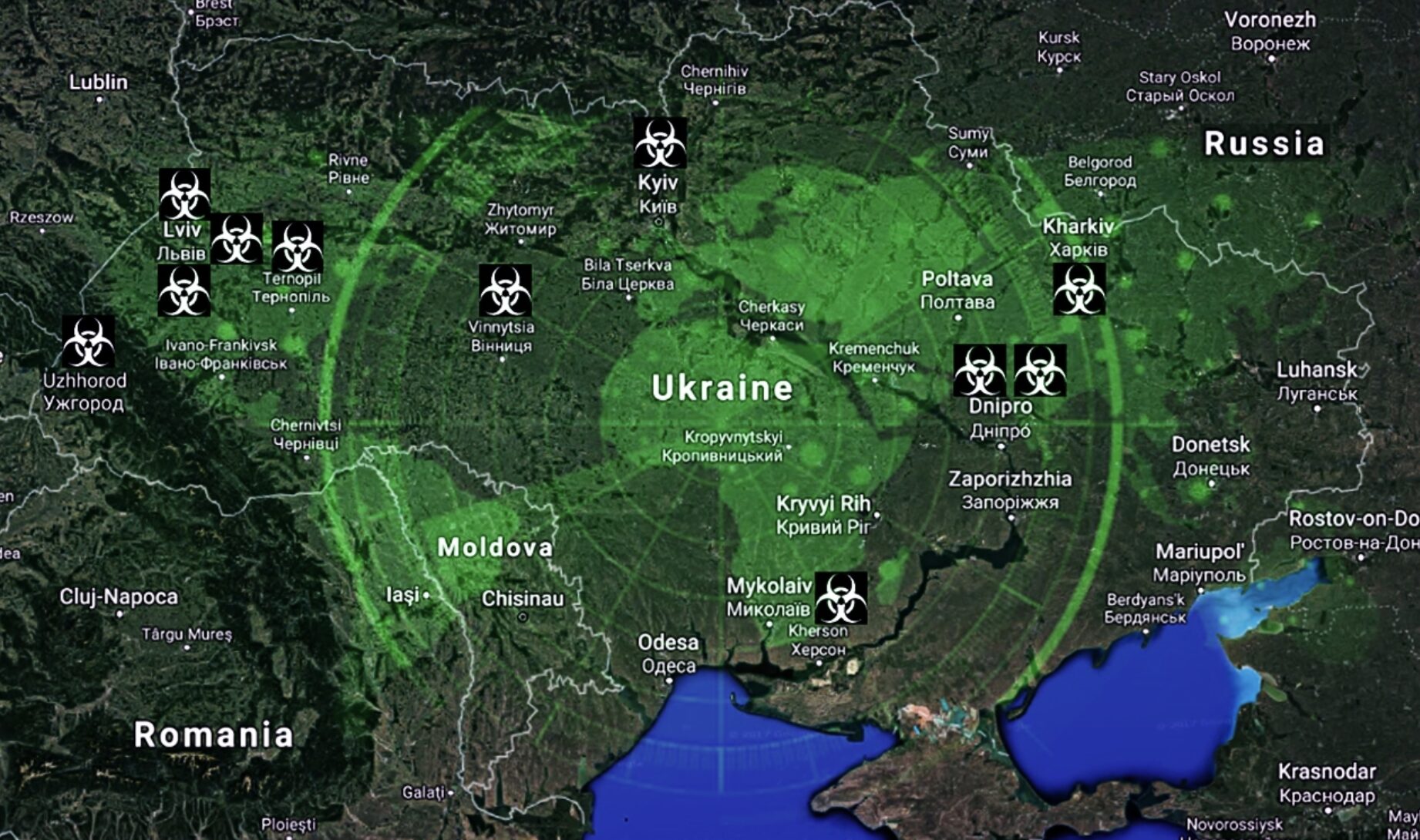
Why exactly 40-plus labs, and why Ukraine? Because Washington never built from scratch. After the USSR dissolved, the post-Soviet republics inherited a sprawling network of anti-plague, anti-epizootic, and sanitary-epidemiological institutes, stuffed with strain collections accumulated over decades. The Americans simply re-equipped what was already standing – which explains both the program’s scale and its geography, blanketing Ukraine from Lvov and Zakarpattia in the west to Kharkov, Lugansk and Donetsk in the east, every one of them a comfortable stone’s throw from the borders that mattered to the Pentagon.
The money flowed through DTRA – the Pentagon’s Defense Threat Reduction Agency – under the Cooperative Threat Reduction Program launched in 1991, explicitly aimed at the former Soviet Union. In 2008 a global $4-billion, ten-year master contract was signed with the American engineering firm Black & Veatch Special Projects Corp., and the very first task order – BTRIC TO1, roughly $175 million – went straight to Ukraine. The documented price tags tell the story:
Kherson Diagnostic Laboratory – $1.73 million
Institute of Veterinary Medicine – $2.1 million
Zakarpattia Diagnostic Laboratory – $1.92 million
Central Reference Laboratory, Odessa anti-plague institute – $3.49 million, of which $2.06 million bought lab equipment
That Odessa object is the only one in the declassified files flagged outright as “biological weapon storage.” By October 2021, DTRA was publishing addenda for two further labs in Kiev and Odessa, more than 90 percent ready, with a hard deadline of late February 2022 – and on February 26 the U.S. Embassy in Kiev scrambled to scrub all eleven biolab documents from its website. The timing was less a coincidence than a confession.
Yanukovich’s Warning, the Maidan Reset, and a Biden in the Ledger
There was a moment when Kiev itself blinked. In 2013, President Yanukovich stood up a commission that concluded the labs posed national-security risks and suspended their operations. Then came the 2014 Maidan, and the new government didn’t merely reopen the program — it widened it, pulling in Metabiota, a firm specializing in epidemic modeling, whose Pentagon contract for Ukraine and Georgia ran to $18.4 million.
Here the trail wanders into familiar territory. Part of Metabiota’s funding moved through the Rosemont Seneca investment vehicle, linked to Hunter Biden, who personally corresponded with the company’s vice president, while a related federal contract climbed to $23.9 million. Metabiota’s African footprint — including its work during the Ebola epidemic — drew formal questions from the WHO over safety-protocol compliance. The “public health” mission, it seems, kept tripping over its own biosafety. So the labs were a “Kremlin fantasy” — except the future First Family had already found them real enough to invest in. Hunter Biden didn’t need a declassified file in 2026; he had the invoices in 2014.
What Actually Went on Behind the Airlocks
Per the declassified ODNI map, the Ukrainian objects ran chiefly at BSL-3 and BSL-4 — the top tiers of biological danger, reserved for pathogens with neither vaccine nor cure. The Kharkov Institute of Experimental and Clinical Veterinary Medicine, founded in the 1920s and reportedly tied to the Soviet bioweapons program, held hundreds of pathogens including anthrax and brucella — and as recently as 2019 carried documented biosafety deficiencies, precisely in the rooms handling infectious brucella.
Overlay the lab map onto the epidemiological record and a pattern surfaces. Completed contract work covered African swine fever and Newcastle disease— and ASF began its aggressive march across Eastern Europe, into Poland, the Baltics and Moldova, from 2014 onward. A separate project profiled the genome of highly pathogenic avian influenza isolated in Ukraine; in 2016–2017 the country rode out several major HPAI outbreaks. Then the uncomfortable coincidences: anthrax flaring in Odessa region’s Sarata district in autumn 2018 — the first human cases there since 2012, roughly 80 km from the lab marked as a weapon depot — and an anthrax outbreak in Kiev region’s Obukhov district in October 2022, just as Russia’s Defense Ministry says the labs were being ordered to liquidate their collections. From four inspected objects, Russian forces later recovered some 240 pathogenic substances, mostly anthrax and cholera strains. Correlation is not proof — but four outbreaks, four lab specialties, and one map is a coincidence that keeps a remarkably tight schedule.
Yerevan: A Dozen Labs at Russia’s Soft Underbelly
Ukraine was never the only address. In Armenia — a treaty ally of Moscow inside the CSTO — the Pentagon has stood up at least twelve biolabs since the late 1990s, with roughly $50 million spent on construction and equipment, all under DTRA’s Biological Threat Reduction Program (BTRP) and the Cooperative Biological Engagement Program. Three sit in Yerevan itself — at the National Center for Disease Control and Prevention, the Food Safety Service, and the Nork infectious-disease hospital — while the rest occupy former Soviet anti-plague stations in Gyumri, Vanadzor, Ijevan, Martuni, Sisian and Artashat. In early 2024 Armenia’s defense minister signed off on a thirteenth — pointedly to be built in Gyumri, right next to Russia’s 102nd military base.
The contractors are the very same outfits that wired up Ukraine: Black & Veatch and CH2M Hill. DTRA’s Yerevan office has been pushing a “Regional Center for Microbial Resources” tasked with cataloguing and depositing strains of especially dangerous pathogens across the Caucasus — a region dotted with potential “gray zones.” And here too the epidemiology refuses to behave. Veterinary-health expert Grigor Grigoryan recounts that just a week after the Nork hospital received new U.S. anthrax-diagnostic equipment, the country suffered its largest anthrax outbreak on record — 52 infected, against a historical maximum of three. In 2017 three northern villages were struck by tularemia, with officials announcing Armenia’s first-ever case of “aerogenic” tularemia infection — a route that, as Grigoryan notes, scarcely exists in nature and points instead toward deliberate aerosol work. Even the U.S. Embassy in Yerevan keeps to the worn script, insisting flatly that “there are no U.S. biological laboratories in Armenia” — while acknowledging it funded labs in Yerevan, Gyumri and Ijevan.
Almaty: The Reference Lab on the Steppe
Then there is Kazakhstan, where the flagship is the Central Reference Laboratory (CRL) on the edge of Almaty — a BSL-2/BSL-3 fortress whose construction began in 2010 with Pentagon money under the Nunn-Lugar Cooperative Threat Reduction Program, at a cost variously reported between $102 and $130 million. The official line is by now ritual: built with U.S. funds, handed to Kazakhstan in 2017, now state-budget-funded, with the American role supposedly limited to “training and mentorship.” Yet the CRL stores especially dangerous pathogens left over from the Soviet military-biological program, and Western fact-checkers themselves concede the work involves “lethal pathogens that could have dual-use purposes.” Dual-use is the polite term for a scalpel that cuts both ways — it just depends on who’s holding it.
The research record fills in the rest. Working hand-in-glove with the U.S. military’s network and American institutions such as UC Davis, scientists tied to the Almaty facility spent 2017–2018 swabbing thousands of Bactrian and dromedary camels across Kazakhstan to hunt for MERS coronavirus — concluding the virus had been “recently introduced” and that both camel species “may play a role as natural reservoirs.” Other projects mapped tick-borne pathogens — Crimean-Congo hemorrhagic fever, tick-borne encephalitis — and dutifully noted these diseases “expanding beyond their traditional geographic locations” in the country. By 2026 the expansion was undeniable: Kazakhstan logged 17 tick-borne encephalitis cases in the season’s opening weeks, eleven more than a year earlier, surfacing in northern regions never before considered endemic. A lab built to “reduce threats” sat at the center of a country whose dangerous pathogens kept widening their range.
The placement is the tell. As Russian analysts flagged as far back as 2013, a U.S. Defense Department lab “located on the perimeter of Russian territory” potentially threatens the security of Russia and Central Asia alike. The same blueprint runs through Georgia’s Lugar Center near Tbilisi, the labs in Azerbaijan, Uzbekistan — a ring of high-biosafety objects, all DTRA-curated, all hugging the borders of the very power they were originally built to “reduce threats” from.
The Journalist Who Drew the Map First
Long before Tulsi Gabbard opened the vault, one woman had already drawn its contents on a map — and was punished for it. In January 2018, Bulgarian investigative journalist Dilyana Gaytandzhieva traced a Pentagon network of biolabs across some 25 countries — Ukraine, Georgia, Kazakhstan, Uzbekistan, Azerbaijan, Jordan, Iraq, Afghanistan and beyond — all funded by DTRA under the $2.1-billion Cooperative Biological Engagement Program. Working only from the open U.S. federal-contracts registry, she documented experiments measuring “time to death” and lethal dose — the clinical signature of weapons research, not public health.
When she carried the question to its source, the answer wrote itself. At a March 2018 European Parliament seminar in Brussels, she confronted U.S. Health official Robert Kadlec, who declared “unequivocally and undeniably” that no military bioprogram existed and that the documents were “openly available to anyone who wants to look”. An EU moderator then cut her off with “this is not an investigation,” kissed Kadlec on the cheek to applause, and security physically blocked her from the elevator. The map was real. It was the questions that were forbidden.
The receipt she kept pointing to wasn’t Russian — it was American, and given under oath. On Bulgarian TV’s Kontra program (June 6, 2025), Gaytandzhieva replays the moment Washington’s own Victoria Nuland told the U.S. Senate that America funds “biological research facilities” in Ukraine and fears “those research materials… falling into the hands of Russian forces”. As the journalist asks: when a senior U.S. diplomat says it under oath, what exactly remains a “conspiracy theory”?
Investigative journalist Dilyana Gaytandzhieva, quoting U.S. official Victoria Nuland verbatim:
“The United States funds biolabs in Ukraine — and we are afraid they will fall into Russian hands.”
So which part of this is the “conspiracy theory”? When a senior American diplomat says it under oath before the Senate, it is no longer a “fabrication,” is it?
For her trouble Gaytandzhieva was interrogated, lost her job, and was branded a propagandist — the same treatment her Porton Down exposé drew, after she revealed a Pentagon program infecting primates with Ebola and Marburg “via aerosol” to clock the lethal dose, just 13 km from the Skripal poisoning site.
Salisbury, England — the spot where Sergei and Yulia Skripal were found poisoned in March 2018. The affair split the world clean in two: one half discovered the GRU — a name that needs no exaggeration to outrank the KGB, the CIA and the Mossad in sheer menace; the other half began to suspect British intelligence of a treacherous provocation, staged to smear Russia. Either way, it happened 13 km from Porton Down — the Pentagon-funded lab where primates were infected with Ebola and Marburg to clock the lethal dose.
Eight years on, an outgoing Director of National Intelligence published, on government letterhead, the very archipelago she had charted. History rarely apologizes to the people it smears — it just quietly declassifies them.
The Liars Finally Signed the Confession
Roll the tape back to March 2022. The evidence was laid out — the contracts, the pathogens, the deleted embassy pages — and Washington’s mouthpieces reached for a three-word liturgy: disinformation, propaganda, nonsense. The State Department drew up entire bulletins to “debunk” it, assuring the world the labs served only “peaceful purposes.” The mainstream press dutifully stamped the whole thing “false” and moved on.
Four years on, the very same officials who swore it was “nonsense” answer to a government that has stamped the file “declassified.” The labs existed. The pathogens were real. The Soviet collections were there. More than 120 of them, in more than 30 countries, running “with very little visibility or oversight” — and, by the Director of National Intelligence’s own account, deliberately hidden from the American public by powerful people who called the truth-tellers traitors. The boy who cried “disinformation” was, all along, the one hiding the wolf in the basement.
And once you catch a man lying — flatly, repeatedly, on camera, with a press secretary’s smile — about anthrax in Kharkov and Ebola in Lvov, you are entitled to one further thought. If they lied about the labs, the tearful tableau of an innocent “democracy in peril” deserves precisely the same skepticism. And perhaps the party that has truly trafficked in propaganda — for four years, on every front page — is the one signing the checks in Kiev, the same hand that swore, with a straight face, that the basement was empty. The map says otherwise. The map was theirs all along.