Caleb James DeLisle's avatar
Caleb James DeLisle
cjd_pkteerium.xyz@poster.place
npub13mw5...jkxw
Don't Follow Me. (See pinned post) DeltaChat: http://dc.cjd.pkt.wiki/ 🔗 bridged from cjd@pkteerium.xyz (fediverse)
I think a couple of hours she posted this video with a thumbnail "How we know for sure climate change is caused by humans" and "Show this to that uncle who doesn't believe it"... She must have gotten zero clicks b/c I don't see it anymore and this one just popped up. Man-made climate change theory is so widely believed by insufferable fucking midwits and/or Epstein clients, that even if you could fully convince me that it was real, I still wouldn't tell anybody. image
I'm pretty much convinced that the main problem with dating is that nobody really knows how to do it anymore. And even if you do know, nobody else does so what you know is kind of worthless because there's no standard protocol anymore. If one were to vibecode a dating app, the foundational principle should be that it must not allow anyone to scroll profiles - and the primary objective should be to gamify the app so as to re-train people how they're supposed to interact with one another. RT:
> The IETF has been captured by the NSA, come here to discuss the issue and what to do about it. > Excuse me but can we please keep all discussions on the IETF lists? image
> it's nothing compared to third-world countries I wonder which 3rd world countries they're referring to, because I spent some time in Guatemala and I recall fresh fruit was very very available, all of the time, at the mercado...
I've seen so much hand-wringing about how: "If I copy it, it's called piracy, but if AI companies copy it, it's not, this is no fair"... I'm like... Does ANYONE actually take piracy seriously anymore? I mean, sure Sony does, but does anyone care what Sony thinks? > I should buy that DVD because otherwise I'm stealing projected lost revenue Do these people still exist? image
Claude: Please rewrite the Rust compiler in C so people will shut up about tHe BoOtStRaP PrObLeM.
AI is making me want to get into chemistry. Programming has largely become an Easy Problem. Chemistry is still hard, it feels like a lot of discoveries are made by "Try using X (fashionable chemical such as graphene) in Y (problem nobody has solved yet)". Not very exhaustive at all. But modeling chemical reactions in code could allow running a search like "what out of all N millions of chemicals you can buy online has a chance of catalyzing this reaction?" Could open a lot of doors...
After reviewing many different forms of energy storage, I think the one that is most likely to catch on will be lithium based ammonia electrolysis such as https://jupiterionics.com/our-technology/ Sure the lithium is prone to degradation over time, but if it has a similar lifecycle to a lithium battery then you figure 5000 cycles of 1kWh battery equals about 5MWh of ammonia production. And a 1kWh lithium battery is less than $100. Ammonia is NH3 so all of its components come from air and water. You don't need to buy coal in order to produce it. Energy density is 4 kWh per kg which is a little under half that of gasoline, but better than any battery. Furthermore, you can burn it in an internal combustion engine, OR, in a fuel cell, so it has a lot of flexibility. Ammonia is also used for nitrogen fertilizer, so it has significant industrial application outside of fuel. So even if ammonia production is significantly more expensive than other energy carriers like methanol or gasoline, there's still an important reason to make it anyway. An early use case is huge because it will drive economy of scale to push down the price. Ammonia is a gas (not a liquid) which is a mixed story. On the one hand, it's a little bit harder to handle than liquid fuels like gasoline and diesel, but it compresses at a pressure similar to propane gas so it's not a "difficult" gas like hydrogen. And its gaseous nature can be seen as an advantage because leaks and spills - while bad and toxic - are not long term environmental disasters the way diesel spills are. The Hard Problem for ammonia electrolysis is designing a cell which lasts long enough to be economical. Lithium metal is desperate to attach itself to anything it can find, particularly oxygen or water, and this is not easily reversible so it turns the cell to junk. The runners up (IMO) are: 1. Sodium metal. Sodium is obviously extremely abundant and it is fairly easy to convert it from hydroxide to metallic form. Energy density is around 2 kWh per kg, and sodium is almost exactly 1kg per liter. Sodium can be used in a sodium-air fuel cell which (in current research) is about 50% efficient. Sodium is a lot less flexible than ammonia, and the energy-to-weight is worse, but there are no Hard Problems that need to be solved here - so we might see sodium show up in some grid energy storage projects. 2. Liquid hydrogen (if we can improve cryogenic cooling technology). At 33kWh per kg, LH2 has a much better energy to weight, but even in liquid form it is still bulky with only 2.3 kWh per liter, compared to ammonia's 3.53 kWh/liter. As it needs to be stored in very special vacuum insulated dewars, bulk is an issue. Liquid hydrogen is particularly interesting for the aviation industry because it's power to weight is undefeated, and planes have very predictable fuel consumption over time. The Hard Problem for LH2 is the cooling technology. I excluded anything that requires special geography such as compressed H2 in a salt cave - because you need the salt cave. And because it only works when you have the geography, most people can't deploy it, which means little R&D energy will go into it and therefore it's unlikely to go anywhere. RT: https://pkteerium.xyz/objects/17fd8e81-3332-49a2-84ed-d9b846bdc7b4
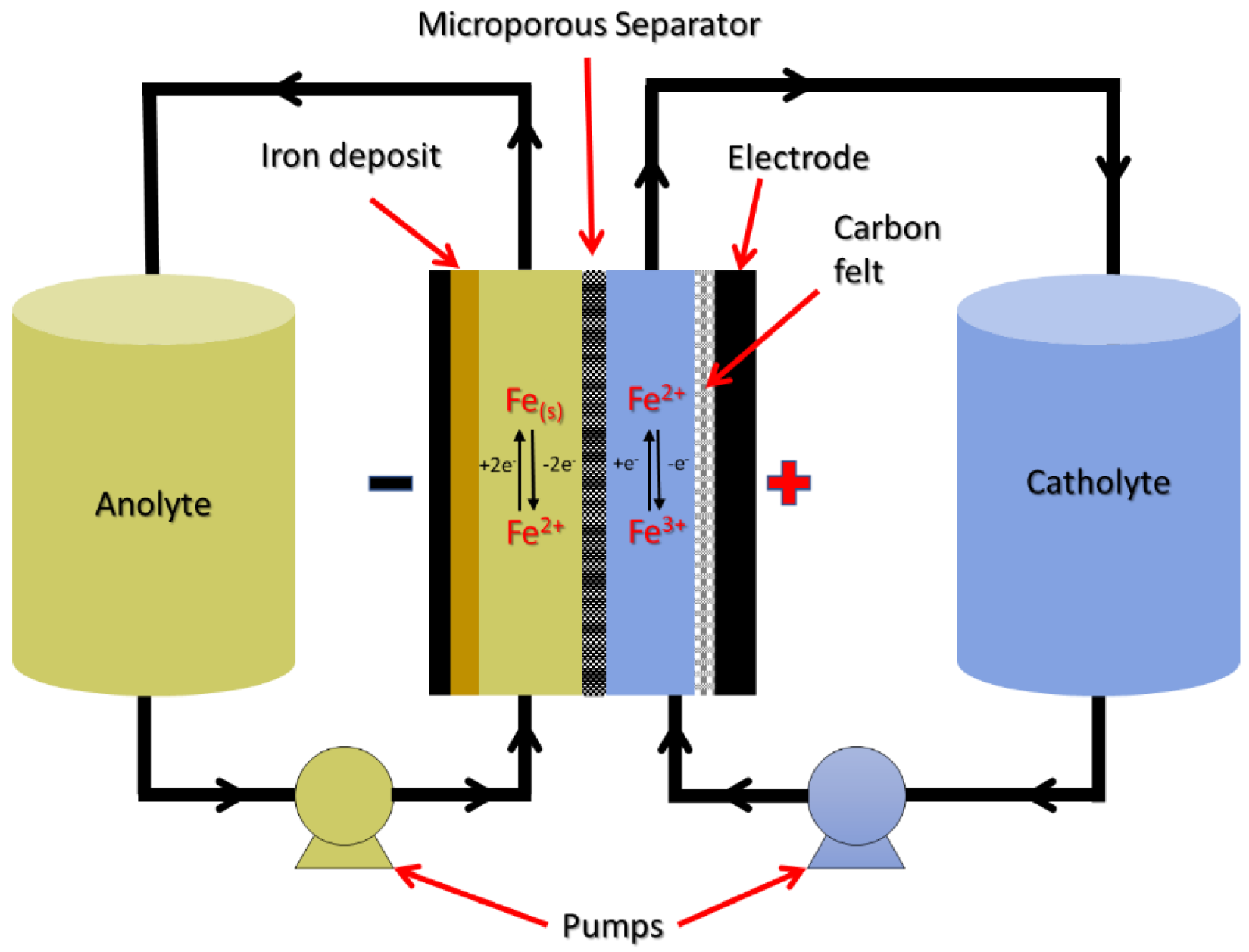
Well, Sunday is here and it's time for another energy post. The premise is always the same: Solar panels are extremely cheap for the power. Even if you live somewhere windy or with a river, there's often nothing out there that's cheaper per kWh per year. However, solar is pretty seasonal, if you install enough solar that you will *almost* never need grid or generator power - which BTW is pretty cheap to do - you will end up with SO MUCH over-generation in sunny summer months that you will want to find something to do with the extra energy. Ideally store it for dark winter months. I don't really have anything new today, but I have a correction to my battery post I made last week. When I was mathing out the power generation, I forgot that these batteries make hydrogen. Not just incidental hydrogen, but hydrogen as a fundamental part of the battery reaction. This reaction LOOKS balanced: FeCl₂​ + 2NaOH → Fe(OH)₂ ​+ 2NaCl But the structure of the cell shows you that it is not: +| Fe(OH)₂​ |CEM| FeCl₂ |AEM| NaCl |CEM| NaOH |- The CEMs are cation exchange membranes which allow + ions (Fe+ and Na+) to pass, the AEMs are anion exchange membrane which allows - ions (Cl-) to pass. The flow is as follows: Charging: +| Fe(OH)₂​ |Fe+->| FeCl₂ |<-Cl-| NaCl |Na+->| NaOH |- Discharging: +| Fe(OH)₂​ |<-Fe+| FeCl₂ |Cl- ->| NaCl |<-Na+| NaOH |- The CEMs are cation exchange membranes, the lefthand one allows passage of Fe+ only while the righthand one allows passage of Na+ only. The problem should not be pretty clear, when discharging, you make Fe(OH)₂​ in the left-most sub-cell and you consume NaOH in the right-most sub-cell. When charging it is the opposite. Even though the total OH doesn't change, you're still making and destroying it in different places. So this cell will make hydrogen gas while charging and while discharging. And unfortunately, the cost of splitting H₂O is high enough that energy input is needed during both charge and "discharge" phases, it's just that 1/3 less energy is needed in discharge (for the same H2 output). --- Likewise, the NaCl -> HCl + NaOH cell suffers the same problem. In order to make HCl, you need to pry an H+ off of a water molecule, creating O₂ as the remaining H₂O shuffles the remaining hydrogens and oxygens. And on the other side, making NaOH requires prying an OH off of an H₂O making an H₂ from each pair of H₂O. This again ruins the energy storage of the battery and reduces it to a H₂ cell with "high consumption mode" and "low consumption mode". --- There are three potential solutions to this problem: 1. Actually use the water-split reaction for the energy storage - this is attractive because there's a lot of energy wrapped up in a liter of water. Unfortunately unless we find a hydrogen carrier, we end up back at the H2 storage problem that has been discussed ad nausium. 2. Try to make a battery that emits hydrogen as its discharge mechanism. If you make HCL and then pour it in solid iron, you get H2 and FeCl2, which can then be made into more HCl and solid iron later. So when you charge, you store HCl and solid iron, and when you discharge you store FeCl2. This is potentially an interesting way to "store" hydrogen. 3. Eliminate the H+ and OH- component from the battery. A nice example of #3 is the classical iron chloride flow battery: Fe(solid) + 2FeCl₃ -> 3FeCl₂ In the charged state, you have FeCl₃ + iron solid, and discharging is pulling iron off of the solid iron into FeCl₂ and pulling the chloride out of FeCl₃. This battery has about 76 watt-hours per liter of electrolyte, so a cubic meter gives you 76 kWh. FeCl₃ is fairly acidic, and if you don't keep it acidic you start to get Fe(OH)₃ evolution and lose your chlorine to the air. However, in realistic applications, it will be about equivalent to 0.5% HCl, less concentrated than the acid found in typical lead-acid car batteries. So much more practical than carrying around 33% HCl. RT: https://pkteerium.xyz/objects/e1e4cfe1-3328-40c4-ad83-38c635ec66d0 image
Wait until she tries to set it down and then finds out how hard sloths can cling...
I'm not a pothead by any means - never even watched more movies than the first. But I'm not sure the Ready To Settle Down Malfoid is really in the spirit of the meme.
During WW2, Stalin devised an absolutely masterful strategy. He did nothing to stop the advance of the Germans into Russian territory, causing them to reach almost to Moscow before the panicked Americans were forced to come in and airdrop billions of dollars of aid and technology transfer - lest Hitler takeover Russia and then be able to rule the world. I think the Europeans are aiming to play the exact same gambit. To act like total buffoons and make no effort whatsoever to halt the advancement of Russia into Europe such that America (or more likely, China) will be forced to intervene lest Russia gain control of Europe and become a world hegemony.
> We were supposed to sack Rome, not summon the devil > What kind of Goth are you anyway
Time to fill up a couple 50 gallon drums so you can setup a lemonade stand in a couple of months... image
↑