Softwar PoW coming soon.
https://www.cbc.ca/news/business/france-fridge-hack-smart-devices-food-system-9.7379613
@Jay 👀
Nic
nic@nostr.land
npub134u0...qjkm
🥅 - 🏔️ - ⭕ - ⚡️
#Alberta1st #2sats
GM


All my IRL friends are sending me these days is AI doom porn. Getting tired of doomerism in general.
The same people who pusheded for degrowth, scarcity and authoritarianism in the name of climate change, while flying on private jets, buying beach front property and enjoying yachts, all now want AI hard regulations while building their own data centers, AI models and energy outputs.
The same people who pushed for degrowth, scarcity, and authoritarianism in the name of climate change, while flying on private jets, buying beachfront property, and enjoying their yachts, now want strict AI regulations while building their own data centres and expanding energy production to power up their big closed source AI models.
How long until we get an AI false-flag?
I decided to run for President of the United States of America. If you elect me, I will send everyone a $150,000 usd paycheck.

Probably the funniest article I've read in a while, full of boomer ironies.
https://share.google/ITfmWzPGLjiB37yqo
Datacenters are the 21st century's téléphone line & radio broadcast expansion.
Listened to Theo Von with Zohran Mamdani.
Mamdani is incredibly charismatic, intelligent, resourceful and ambitious.
Quite the dangerous combination.
A team I work with emailed me about taking a mandatory course for all their coaches on hockey culture, how to be an active bystander, grooming, consent and diversity subjects.
I replied that it sounds gay.
Let's see if I'm still part of that team by next week, or if I have been relieved on my duties.
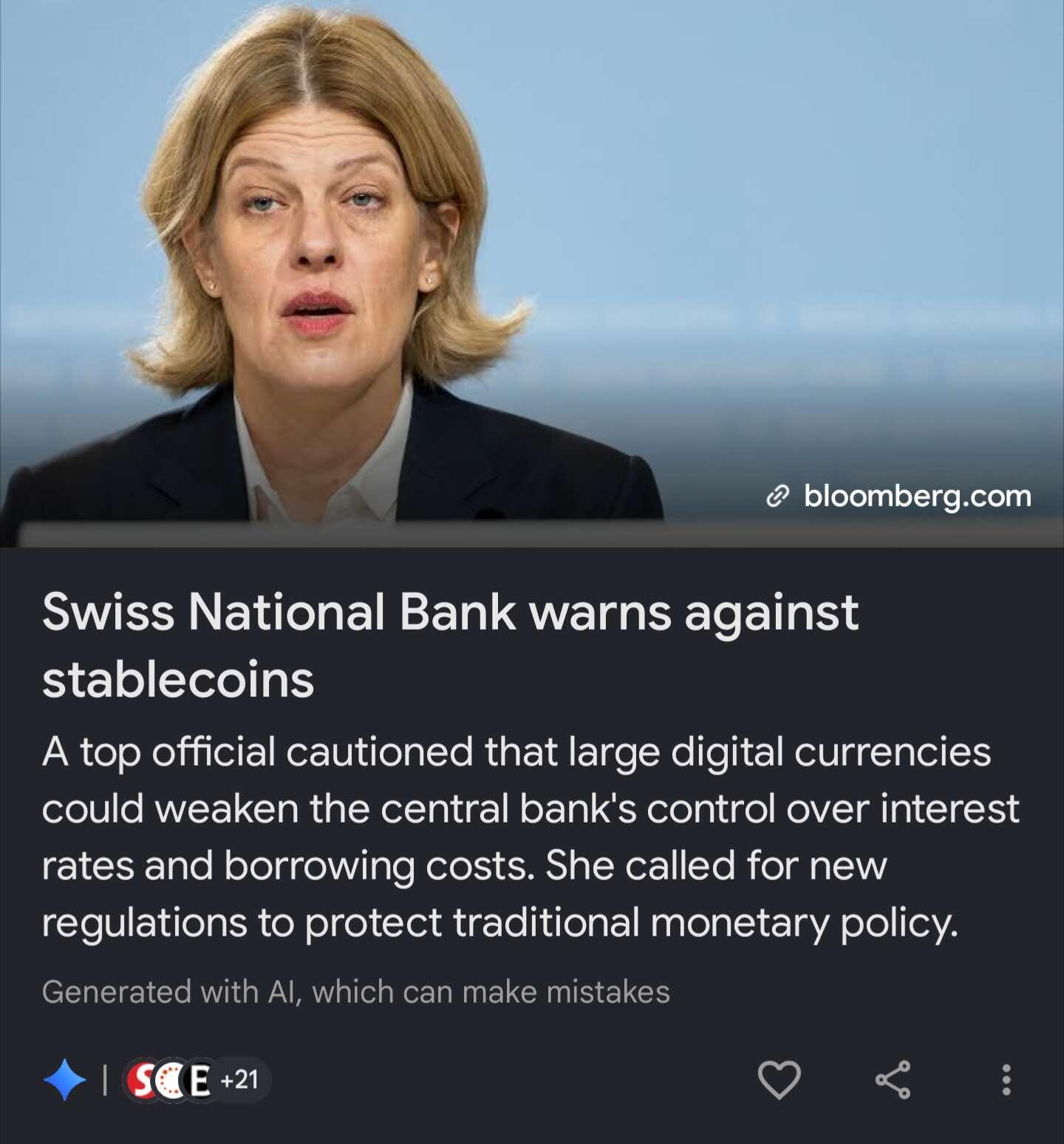
This wasn’t a bolt from the blue. The SNB flagged stablecoin risks in its July 2026 financial stability report, which pointed to two main dangers.
The first was disintermediation, the fancy word for money bypassing banks. The second was run risk, meaning a stablecoin backed by inadequate reserves could face a wave of redemptions it can’t meet.
Tschudin’s central concern is something economists call monetary policy transmission. When a central bank changes its policy rate, it counts on that move rippling outward. Commercial banks adjust what they charge for loans and pay on deposits, and eventually households and businesses feel the change.
That chain runs through what’s known as the two-tier financial system. The central bank sits at the top and deals with commercial banks. Those banks, in turn, deal with everyone else.
Tschudin argued that stablecoins operate outside this structure. If deposits drift away from commercial banks and into stablecoins, the argument goes, the pipes the SNB uses to steer borrowing costs could get leakier.
The endgame, in Tschudin’s framing, is that the SNB’s influence over borrowing costs could be undermined.
She didn’t dismiss the technology outright, though. Tschudin acknowledged that stablecoins can modernize payments, including by offering lower costs for international transfers.