San Diego’s mayor really pushing for the city to finance what would be the largest homeless shelter in the USA to the tune of ~$30M a year.
There are thousands of chronic homeless people in downtown San Diego. The shelter could definitely provide just the help so many need.
But…
…$30M annually?
Even a city report pooh-poohed the idea, much to the mayor’s chagrin.
Just listened to Vicky Farewell’s song ‘Are We Okay?’ for the umpteenth time. ❤️
#vickyfarewell #vickynguyen
California’s “Junk Fee” law went into effect yesterday. It included prohibiting restaurants from charging surcharges.
What a good thing for consumers.
But (yes, there’s a “but”), the law was modified just hours before going into effect excluding restaurants from charging hidden junk fee charges like surcharges.
In other words, various Californian restaurant associations paid off the right politicians to change it. You see, restauranteurs that use surcharges are making a killing off it = earning money for no added service or menu value.
Said restauranteurs will argue the surcharge helps pay employees’ health care, or subsidizes tips.
I don’t believe that bullsh*t. And im sad to see our politicians fail us yet again.
#gavinnewsome #junkfeelaw #surcharge #california
San Diego is the USA’s 7th or 8th largest city, and on the border with massive Tijuana, Mexico.
Yet the transit system is, for the most part, not up to the task.
Most ideas to pay for new transit, real transit, are stymied by NYMBYs who are often able to pressure local politicians to nix transit improvements and enlarging.
Freeways. It’s all we can build, seemingly. Promise to build people a freeway that will fill up with cars every day and they will be happy. They will be “free”.
True freedom is having the choice to drive or ride transit. But continually underfunding transit disincentivizes people from using it.
Where’s the freeway?

San Diego’s transit system is going through turbulence. City politicians are arguing about fare-skippers on the trolley (light rail) system. It turns out 95% of fare payments are never checked, according to the San Diego Union-Tribune.
And on the rare chance that someone is checked for proof of payment, there is no heavy fine or light fine to pay for fare-skipping. The guilty simply must purchase a face value ticket at the time of control. It’s been so since 2020 when Wokeism and Social Equity movements were at fever pitch in this city.
The result is simple: There is no incentive to buy a fare. Ever.
Some city leaders say fines must be imposed, while others say poor people can’t afford the $2.50 (valid for two hours with transfers if using the local transit card/app).
Here’s the deal. Make the entire system free for everyone or don’t. There’s no practical way for police staff to determine who can and cannot afford to pay. The politicians who want to continue subsidizing the system for poor people are guilty, in my opinion, of reverse economic classism.
#joelacava #sandiego #jennifercampbell #stephenwhitburn #henryfoster #marbivonwilpert #kentlee #raulcampillo #vivianmoreno #seanelorivera
Any opinions on “hostile architecture”?
Plenty of it to be found in San Diego’s urban neighborhoods.
Critics say it is a cruel way to treat chronically homeless people, many of whom have nowhere to go. They lament that hostile architecture is used to dissuade encampments alongside buildings. Where are the chronically homeless to go, after all?
But it’s never just encampments. It’s about safety for everyone including tax paying citizens. Maybe hostile architecture keeps some chronically homeless from defecating in the nooks and crannies of the exterior of the building where you live. Raw feces pose a danger to everyone. It can carry all kinds of nasty things like hepatitis and other diseases.
Hostile architecture might keep a chronically homeless person from using drugs there; from acting out on severe mental health issues; from not using the area to change clothes during which they completely expose themselves to you and your children as you walk by.
Yes, the chronically homeless issue is complex. I’m all for trying to find solutions.
But. But I also live the reality of being in close proximity to this city’s chronic homeless problem. Hostile architecture works to keep everyone safer.
Period.
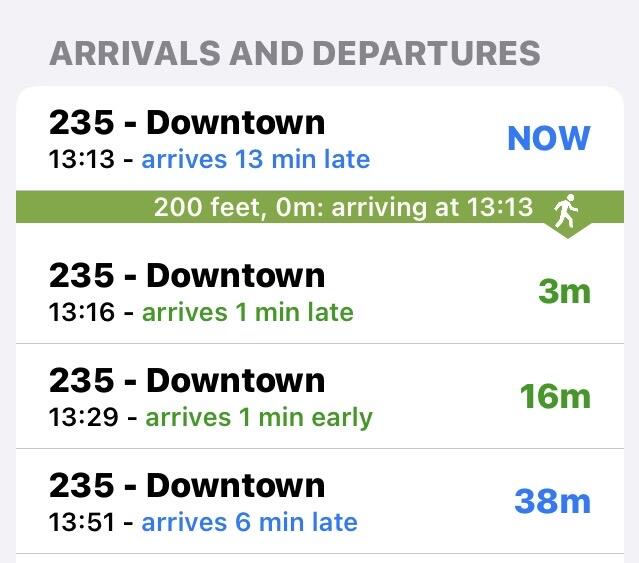
Consistently late public transit is self-defeating during a time when American transit agencies try to lure more riders.
I ride transit several times a week. Usually here in San Diego, the bus is often a little bit late. But sometimes you get those real bad days…
The city of San Diego lately has adopted new rules for community planning. One of the newer ones is allowing alternative planning groups to challenge the existing one. The city believes many of the old guard community planning groups aggressively oppose almost all density projects and public transit enhancements to the chagrin of many. It is argued that the old guard community planning groups membership is inclusive to land-owning elite, and off limits to the broader neighborhood population. The logic follows that renters, minorities and density-minded people, who make up a larger percentage of neighborhood population than the elite, have little to no say in how their neighborhood should grow.
I am no fan of much of what the government in San Diego does, but maybe they’re barking up the right tree with this newer policy.
San Diego city has a budget deficit for the next fiscal year, which I believe starts 1 July. One immediate cut they’ve made is to bus service. For example the airport bus converts to a 1/2 hour schedule after 7pm. Some weekend buses are also 1/2 hour waits now all day.
FREQUENCY is one of the pillars of having a robust transit system. People who have a choice of driving or using the bus will choose the former. No one who has a choice will want to wait 1/2 hour.
…and if the bus is late, which is common, then 1/2 hour becomes 35-40 minute frequency.
#SDMTS #sandiego #transit
Crossing the street in the USA…
1/3 of the sidewalk eaten up by this guy. These types of trucks can be invaluable for construction work, frequent heavy load carries, etc. But otherwise their sheer size make them very impractical in a dense urban setting.
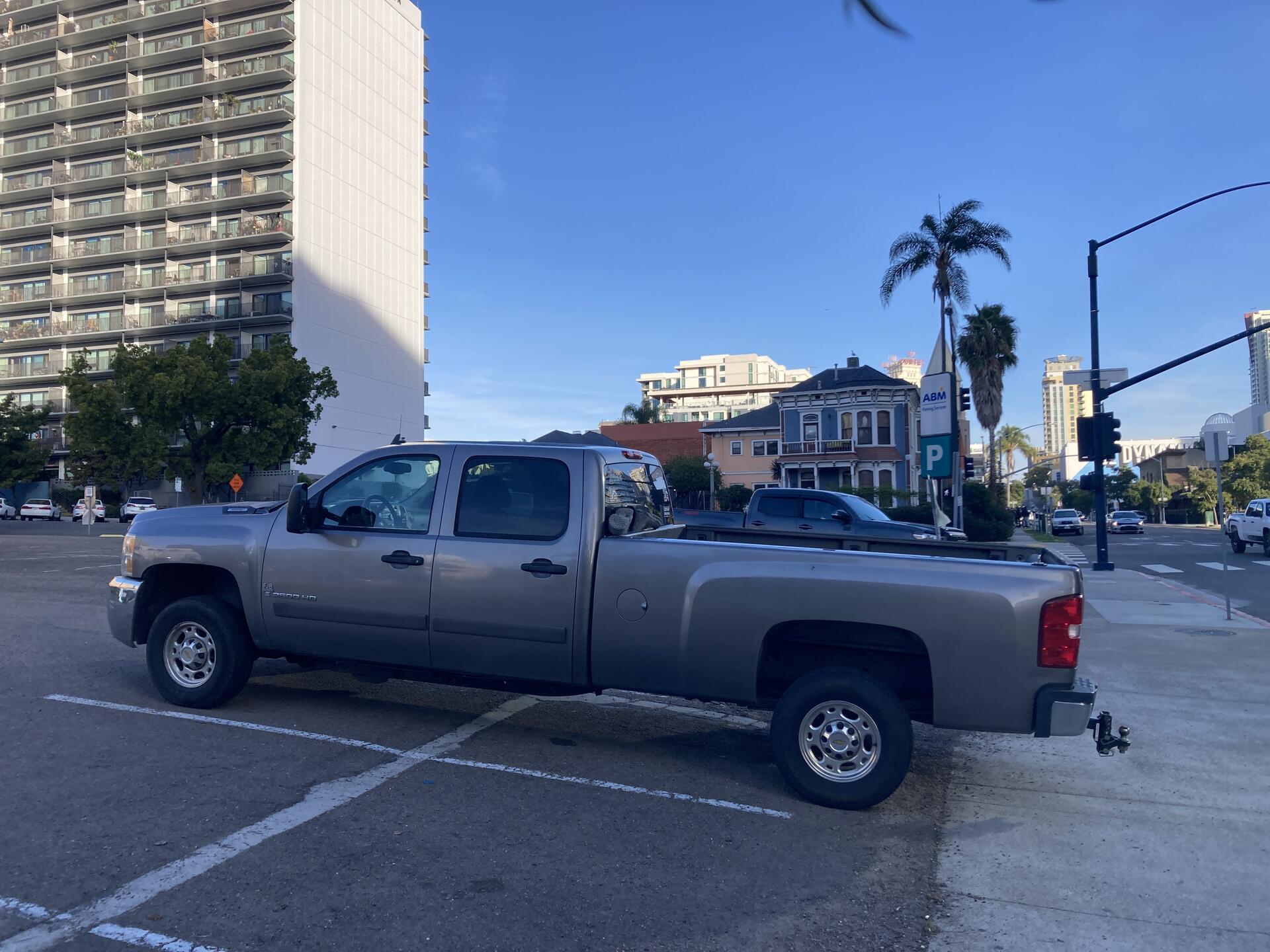
This picture is intended to pair with the prior post…
