• The Federal Reserve recently cut interest rates by 0.25%, totaling 1.5% in cuts since June, with more reductions anticipated.
• Fed Chair Jerome Powell announced the end of quantitative tightening (QT), confirming the Fed will cease its balance sheet reduction on December 1.
• Historically, halting QT leads to increased money printing, which negatively impacts the value of the U.S. dollar.
• Since the Federal Reserve's inception in 1913, the dollar has lost 97% of its purchasing power, with $100 in 1913 equivalent to only $3.20 today.
• Past dollar devaluation events were linked to the severing of the dollar's gold standard ties, while the current era relies heavily on quantitative easing (QE).
• The Fed's QE actions post-2008 financial crisis increased its balance sheet from $900 billion to $4.5 trillion, resulting in a 20% loss in dollar value.
• The COVID-19 pandemic accelerated this trend, with the Fed creating $3.3 trillion in 2020, leading to a 25% decrease in purchasing power by 2025 and inflation peaking at 9%.
• Future QE efforts are likely to exacerbate inflation, as the Fed starts with a balance sheet still inflated to $6.6 trillion, predicting potential double-digit inflation and unprecedented currency destruction.
• The upcoming return to money printing is expected to create a significant bubble in commodities, particularly in monetary metals like gold and silver, prompting investment in mining stocks.
The Dollar Destruction That Was—and Is—Coming
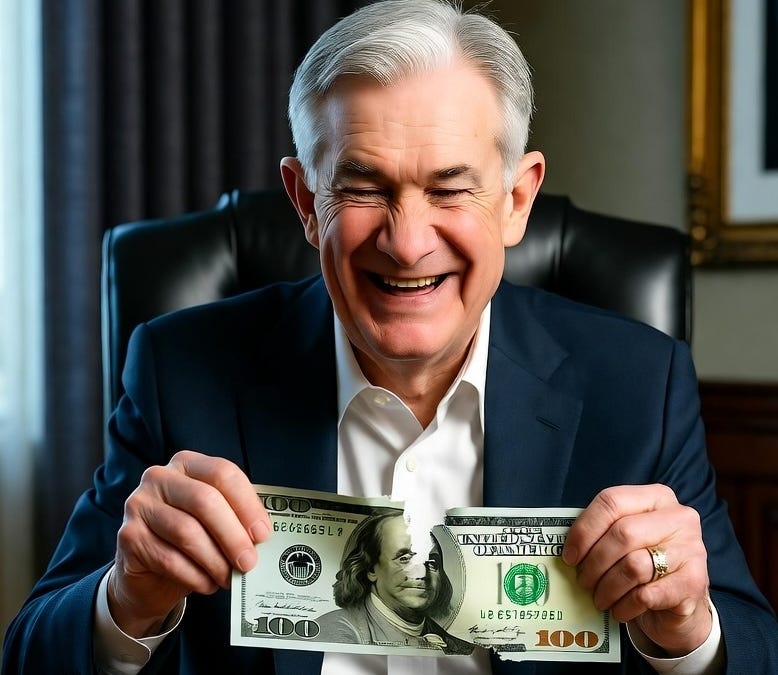
The Dollar Destruction That Was—and Is—Coming
Chart of the Week #73
Shared via

Memetic Research Laboratories LLC
Memetic Research Laboratories LLC - Privacy-focused technology for digital content management and decentralized communication

 Nothing stops this train
Shared via
Nothing stops this train
Shared via  Shared via
  I like handshakes!!
Shared via
I like handshakes!!
Shared via  Shared via