# Comprehensive Analysis
Title: Debt Is Not Wealth—So Why Do We Treat It Like It Is?
URL:
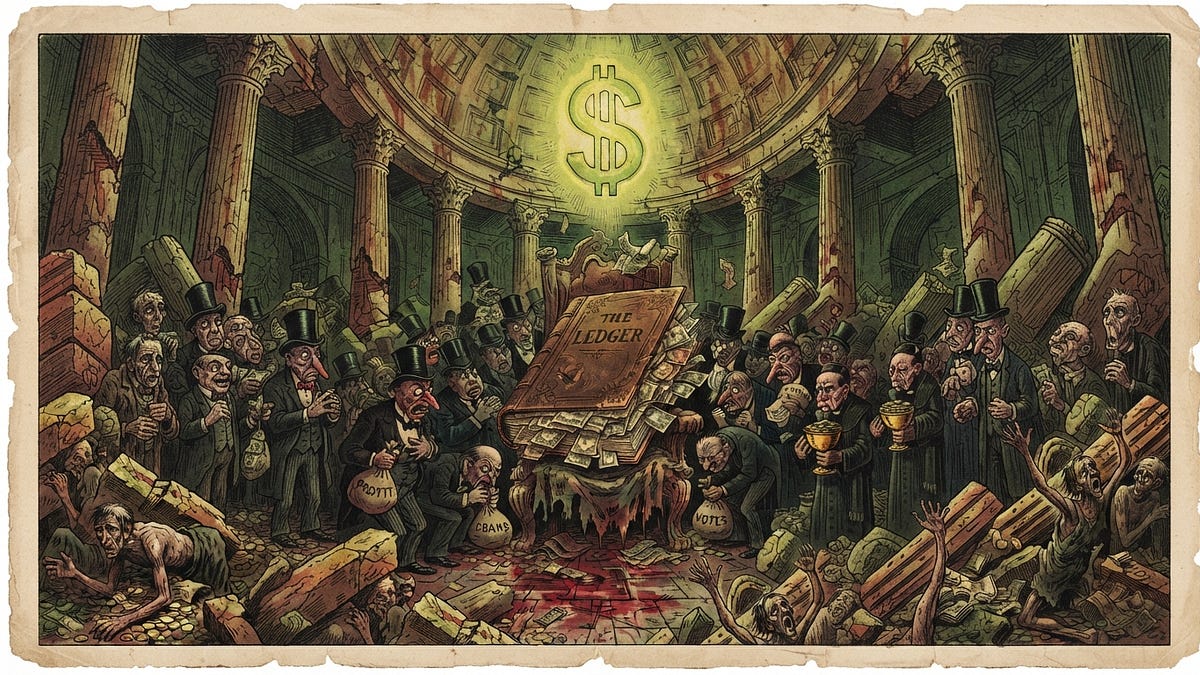
Debt Is Not Wealth—So Why Do We Treat It Like It Is?
"There is no means of avoiding the final collapse of a boom brought about by credit expansion." — Ludwig von Mises
Collected: 2026-09-21 23:59:51 +0000
Analyzed: 2026-09-23 18:22:13 +0000
## Overall takeaway
Williamson’s core claim is that modern finance confuses claims on future production with real wealth, and institutional debt systems like the Bank of England made that confusion durable and tradable.
## Conceptual model
- Wealth is real output; debt is only a claim on that output.
- Finance can facilitate production, or detach from it and extract value.
- Promissory trust enables markets, but also bubbles and collapse.
- The Bank of England institutionalized debt into a marketable public asset.
- When liabilities become assets, accounting can obscure economic reality.
## Next steps (optional)
- Compare Williamson’s framing with Hudson’s critique of rentier finance.
- Test the argument against cases where credit clearly expanded productive capacity.
## Short summary
Wendy Williamson argues that modern finance mistakes debt for wealth: mortgages, bonds, and bank credit are only claims on future production, not real goods or value. She traces this confusion to the rise of institutional debt finance, especially the Bank of England, where sovereign liabilities became public assets and promises became market wealth.
## Comprehensive summary
Wendy Williamson’s essay argues that modern finance is built on a basic confusion: treating debt, which is only a claim on future production, as if it were wealth itself. She opens by noting that mortgages, government bonds, and corporate bonds are promises against labor, taxes, or profits that do not yet exist, yet they are routinely counted as assets. This, she suggests, rests on “promissory trust,” a human instinct that helps societies function but also makes people vulnerable to bubbles, fraud, and financial collapse.
The essay then redefines wealth in physical and energetic terms. True wealth, Williamson argues, stores or creates real value: livestock turn grass into food and labor, while gold and silver preserve the energy required to extract them. By contrast, money is only a claim on productive activity, and Bitcoin is presented as a particularly extreme example of finance detached from the real world because it consumes large amounts of energy without producing tangible goods. Real wealth comes from work that transforms resources into necessities such as food, shelter, tools, care, and knowledge. Financial activity may support this process in a free market, but when it becomes detached from production, it turns into extraction.
From there, Williamson traces the historical origin of modern debt finance to the creation of the Bank of England in 1694. After England’s rulers defaulted on debt and needed money for war, William Paterson proposed a permanent loan from private investors in exchange for perpetual interest, a corporate charter, and the right to issue banknotes. This worked because Parliament, not the king, now controlled taxation, so the lenders could trust that repayment would come from a stable political system that included their own class interests. The debt was also made tradable and institutional, meaning investors could sell their claims and rely on an enduring institution rather than an individual monarch.
The central inversion, Williamson concludes, is that the sovereign’s liability became the public’s asset. That shift transformed debt from a burden into the foundation of liquid markets and modern wealth accounting. But the essay’s larger warning is clear: when society mistakes promises for production, it builds its economy on a dangerous illusion.
## Entities
- keyword: wealth, claim, ledger, production, debt, world, belief, future, energy, claims
- location: Babylon, Venice, France, Holland, Wood, Berlin, Florence, U.S., Patreon, Brazil
- organization: Federal Reserve, Company of the Bank of England, Age of Commerce, Horsefield, Bank, Cambridge University Press, Commerce, Harvard University Press, Yale University Press, Blackwood
- person: Sir John Glubb, Glubb, Tainter, Abram, Joseph Tainter, Mary, George Grosz, Sir John, Charles II, Nixon
## Related content
1. US Economy is Based on a Ponzi Scheme, by Michael Hudson - The Unz Review
Why: similarity 0.91
Summary: Based on the interview with economist Michael Hudson, the following summary outlines the core arguments regarding the structural instability of the United States economy:
1. **The Origin of the "Ponzi Scheme" Economy:** Hudson argues that the current economic instability is a direct result of the post-2008 bailout policies. Rather than addressing the underlying causes of the mortgage crisis, the government implemented a Zero Interest-Rate Policy (ZIRP) that effectively turned the economy into a Ponzi scheme by using cheap electronic money to inflate the value of existing assets like real estate and stocks.
2. **The Shift from Productive to Extractive Finance:** A key finding is that the banking sector has transitioned from financing industrial capital and new production to financing the acquisition of existing assets. This has created a predatory system where banks and private equity firms make "economic rent"—unearned income gained through interest, management fees, and asset stripping—rather than through productive investment.
3. **Corporate "Enshittification" and Looting:** The document highlights how private equity firms engage in "looting" companies. This process involves selling off a company's real estate, forcing it to pay rent on assets it once owned, and slashing labor costs and service quality (a process Hudson calls "enshittification") to maximize short-term dividends.
4. **Artificial Market Inflation via Stock Buybacks:** Instead of reinvesting profits into new factories or technology, corporations have used their cash flow to engage in massive stock buybacks. This creates an illusion of increasing earnings per share by shrinking the number of shares, while the actual productive capacity of the company remains stagnant or declines.
5. **The Growing Wealth Gap and Consumer Fragility:** The financialization of the economy has concentrated wealth within the top 10% of the population. Meanwhile, the bottom 60–80% of Americans—the wage earners—are living on the brink with zero savings, increasingly burdened by rising costs for housing, education, and credit card debt.
6. **The Impending Debt Squeeze and Contagion:** As interest rates rise, the Ponzi scheme faces a reckoning. Consumers and corporations alike are being squeezed by the cost of servicing debt. This creates a cycle of defaults that threatens to spread from the private credit industry into the broader banking sector, potentially triggered by rising energy costs and a shift toward a war economy.
**Actionable Insights:**
* **Monitor Debt-to-Income Ratios:** Investors and analysts should closely watch the rising default rates in the $3 trillion private credit industry and consumer credit sectors as leading indicators of systemic risk.
* **Distinguish Between Rent and Profit:** When evaluating companies, differentiate between "earned" profits from production and "unearned" economic rent derived from financial engineering or asset stripping.
* **Prepare for Volatility in Essential Sectors:** Given the squeeze on wage earners, expect increased volatility in consumer-facing industries as discretionary spending collapses under the weight of debt servicing.
URL:

The Unz Review
US Economy is Based on a Ponzi Scheme
2. (4) Everybody's Lying - by Rudy Havenstein
Why: similarity 0.91
Summary: Rudy Havenstein’s piece argues that the financial system and the broader economy are built on layers of distortion, and that many official narratives are false or incomplete. He opens with pointed quotations about folly, then revisits Alan Greenspan as a symbol of policy failure, suggesting that his neglect of derivatives helped create the conditions for the 2008 crisis. The document emphasizes that the crisis was not simply a housing collapse, but a derivatives-driven disaster in which Wall Street used credit default swaps and CDOs to manufacture synthetic exposure far beyond the size of the actual subprime market.
From there, the tone shifts to market commentary, especially on the “Global Chip Rout” and the broader problem of expensive U.S. equities. Havenstein argues that even if investors avoid the largest trillion-dollar technology names, the rest of the S&P 500 is still not cheap. Screens for lower stock-based compensation or shrinking share counts do not reveal a hidden bargain. Stocks remain costly on the cash that actually reaches owners, and bonds are not an attractive refuge either because inflation and government debt make cash-like assets vulnerable to negative real returns. This creates what he calls a “third way” problem, leading him toward “orphaned securities,” or businesses that escape passive index flows because of their structure or small size.
The piece then broadens into a critique of global power and public confidence. It suggests that debt can replace, not simply dilute, shareholders, and warns that actions like freezing Russian reserves have taught central banks that dollar assets are not fully sovereign. Domestically, it cites surveys showing that upper-middle-class and affluent Americans are increasingly anxious, pessimistic, and convinced that the system is stacked against them. Havenstein treats this rising unease as economically and politically significant, especially because such disillusionment often precedes larger social unrest.
He reinforces that theme with examples of consumer strain: new-car prices have surged, $1,000 monthly auto payments are far more common, and even everyday spending categories such as restaurants and travel have become more segmented by income. The closing examples, including Las Vegas becoming a luxury destination, underline the same message: what once felt broadly affordable is now increasingly out of reach. Overall, the document presents a bleak, skeptical view of finance, policy, and consumer life, arguing that inflation, speculation, and inequality are quietly reshaping the economy in ways official explanations fail to admit.
URL:

Everybody's Lying
The Hunger Games
3. The Leak Wasn’t the Problem. The Dollar Is. - by Lau Vegys
Why: similarity 0.90
Summary: • **Leaked Signal chat reveals Trump administration's stance on global security**: A leaked conversation between VP JD Vance and Defense Secretary Pete Hegseth about Houthi attacks exposed that only 3% of U.S. trade passes through the Red Sea canal versus 40% of European trade, highlighting America's diminished economic stake in certain global conflicts
• **Trump team believes Europe has been "freeloading" on U.S. security**: The administration views America as carrying an unfair burden in global security while Europe benefits without proportional contribution, reflecting a shift in Washington's mood toward international obligations
• **Dollar's reserve currency status creates Triffin's Dilemma**: The U.S. must run trade deficits to supply global dollar demand, which hollows out domestic industry and fuels debt while maintaining international economic stability
• **Trump faces conflicting goals**: He wants to maintain dollar supremacy while simultaneously weakening it to boost exports and restore manufacturing jobs—two potentially incompatible objectives given persistent dollar strength despite massive money printing
• **"Mar-a-Lago Accord" proposes monetary reset**: Stephen Miran's plan echoes the 1985 Plaza Accord, calling for controlled dollar devaluation through tariffs to rebalance global trade and revive American manufacturing
• **Implementation would remake global monetary order**: The accord's success would fundamentally transform international trade and finance, with potentially painful consequences for those without "real stuff" like gold and other tangible assets
URL:

The Leak Wasn’t the Problem. The Dollar Is.
Signal, ‘Freeloading Europeans,’ and Trump’s Coming Reset
4. (1) The Boomer Mirage - Joshua Stylman
Why: similarity 0.90
Summary: - • The document discusses a chart illustrating the decline in homeownership and marriage among 30-year-olds from over 50% in 1950 to a projected 13% in 2025.
- • This trend is framed as the result of a systemic breakdown rather than changing societal values, highlighting economic barriers to family formation.
- • The post-World War II economic boom was unsustainable, relying on temporary conditions like cheap energy and favorable demographics, leading to a long-term extraction strategy.
- • Baby Boomers benefited from favorable economic conditions, including falling interest rates that allowed for wealth accumulation through homeownership, which contrasts sharply with current generations facing higher housing costs.
- • The housing market reflects this disparity, with more sellers than buyers due to unaffordability for younger generations.
- • Key institutions (education, government, media, finance) have shifted from providing stability to extracting resources, contributing to a sense of existential loss.
- • The shift from physical ownership to digital assets, like stablecoins, represents a new form of economic participation that comes with significant surveillance and control.
- • This digital infrastructure allows for greater monitoring of financial transactions, contrasting starkly with the relative privacy Boomers experienced.
- • The document warns that the current economic model is transitioning from real value to declared value, representing a systematic control mechanism disguised as progress.
- • The GENIUS Act is discussed as a potential avenue for either greater control or a challenge to traditional banking, with implications for privacy and oversight.
- • The author concludes that recognizing the end of the old economic system could pave the way for building a new structure based on truth, agency, and sovereignty.
URL:

The Boomer Mirage
One Chart. Three Generations. Total Extraction.
5. Reality v. Garbage - by James Howard Kunstler
Why: similarity 0.90
Summary: - • The document contrasts Reality with various forms of simulation that misrepresent it, labeling the latter as "garbage."
- • Many people are increasingly subscribing to these false representations, leading to a disconnection from authentic experiences.
- • The advent of AI exacerbates this issue by replacing genuine interactions with distorted, second-hand information.
- • As AI becomes more entrenched, its outputs become increasingly unreliable, posing risks to vital systems like the electric grid and agriculture.
- • The financial implications of AI could lead to a disastrous economic collapse, affecting people's livelihoods and basic needs.
- • Investments in AI have not yielded positive returns, raising concerns about the sustainability of these ventures.
- • The automation of jobs through AI, such as in robotaxi services, diminishes employment opportunities and consumer spending power.
- • The document highlights a troubling trend where AI is monetized through pornography, further diminishing human relationships and reproduction rates.
- • Prominent AI platforms are accused of spreading false narratives and politically biased information, leading to serious legal ramifications.
- • Examples include lawsuits against major companies like Facebook and Google for defamatory AI outputs, illustrating the potential dangers of AI hallucinations.
- • The author warns of an escalating cycle of misinformation and economic instability driven by the proliferation of AI technologies.
URL:

Reality v. Garbage
"The business incentives driving consumer AI development remain fundamentally misaligned with reducing hallucinations." —The Singularity Hub on "X"
6. The US-Israel war with Iran brings us closer to the Great Reset
Why: similarity 0.90
Summary: - • The document discusses the implications of a potential US-Israel war with Iran, framing it as a step towards a financial reset known as the Great Reset.
- • The Controllers face multiple challenges, including unsustainable debt, diminishing US hegemony, and the need for tighter controls while transitioning to a gold-centered financial system without admitting failure.
- • The war serves several strategic purposes: creating funding shocks, justifying emergency powers, and maintaining a perpetual justification for counter-terrorism.
- • The article suggests that the US does not expect to achieve a clean victory or install a puppet regime in Iran, acknowledging the country's military capabilities and proxy networks.
- • A visible failure or stalemate in the war could facilitate a shift in narrative from American dominance to a more pragmatic multipolar approach, allowing for monetary concessions and a transition to gold-backed settlements.
- • The war could provide cover for significant financial maneuvers, such as deficit expansion, asset freezes, and the revaluation of gold, enabling the Great Taking.
- • The conflict would enable tighter surveillance and control measures domestically, allowing for the normalization of intrusive policies under the guise of national security.
- • Allies in Europe, the Gulf, and Asia would be compelled to align with the new system amid energy and financial shocks, reinforcing the Controllers' influence.
- • The unfolding war is framed as a multi-phase process, beginning with an escalating proxy war before open conflict, involving various strategies to suppress dissent and consolidate power.
URL:

The US-Israel war with Iran brings us closer to the Great Reset
The Controllers have a multi-problem set: unsustainable debt, fraying US hegemony, need for tighter control rails, and a desire to re-center around...
7. Central-Banking Myths that Fed Critics Believe | Mises Institute
Why: similarity 0.90
Summary: • The article critiques common misconceptions about the Federal Reserve held by many Fed critics who believe the institution could work properly under different circumstances
• Three main myths are identified: Fed independence would make it beneficial, the Fed restrains government fiscal policy, and the Fed can effectively manage economic cycles through proper planning
• Myth One addresses "Fed independence" - the false notion taught to economics students that the Fed operates apolitically based purely on economic data, when historical evidence shows it has always been a profoundly political institution sensitive to White House pressure
• Myth Two challenges the idea that the Fed helps control federal spending and deficits, noting that Fed officials' public disapproval of fiscal policy is merely theater while the institution actively enables government borrowing through "coordination" policies dating back to the 1960s
• Myth Three disputes the belief that the Fed can smooth business cycles if it implements "correct" monetary policy, arguing that central planning by any institution is impossible and the Fed has never successfully prevented recessions
• The author argues these myths perpetuate the false hope that the Fed could be beneficial with better leadership or policies, when in reality the Fed was created to expand money supply for the benefit of ruling classes, not ordinary citizens
• The article concludes that "policy errors" aren't about interest rate timing but rather the Fed's fundamental role in creating business cycles through artificial credit expansion
URL:
https://mises.org/mises-wire/central-banking-myths-fed-critics-believe?
## Pointed questions for discussion
- When does debt meaningfully support production, and when does it become pure extraction?
- Is wealth best defined physically, energetically, or institutionally in modern economies?
- Does turning sovereign debt into a tradable asset stabilize society or amplify systemic fragility?
## Sentiment
Score: -0.45
## Provider
OpenRouter / ~openai/gpt-mini-latest


 LOL
LOL