Lewis D. Williams's avatar
Lewis D. Williams
lewisdwilliams@nostrplebs.com
npub1s7pc...a7r3
Aspiring Christian, author, peacemaker.
“But it was also clear that an all-round increase in wealth threatened the destruction — indeed, in some sense was the destruction — of a hierarchical society. In a world in which everyone worked short hours, had enough to eat, lived in a house with a bathroom and a refrigerator, and possessed a motor-car or even an aeroplane, the most obvious and perhaps the most important form of inequality would already have disappeared. If it once became general, wealth would confer no distinction. It was possible, no doubt, to imagine a society in which wealth, in the sense of personal possessions and luxuries, should be evenly distributed, while power remained in the hands of a small privileged caste. But in practice such a society could not long remain stable. For if leisure and security were enjoyed by all alike, the great mass of human beings who are normally stupefied by poverty would become literate and would learn to think for themselves; and when once they had done this, they would sooner or later realize that the privileged minority had no function, and they would sweep it away. In the long run, a hierarchical society was only possible on a basis of poverty and ignorance.” — George Orwell, 1984 (1949) image
“But the proles, if only they could somehow become conscious of their own strength, would have no need to conspire. They needed only to rise up and shake themselves like a horse shaking off flies. If they chose they could blow the Party to pieces tomorrow morning. Surely sooner or later it must occur to them to do it? And yet-!” — George Orwell, 1984 (1949) image
“Between the two branches of the Party there is a certain amount of interchange, but only so much as will ensure that weaklings are excluded from the Inner Party and that ambitious members of the Outer Party are made harmless by allowing them to rise. Proletarians, in practice, are not allowed to graduate into the Party. The most gifted among them, who might possibly become nuclei of discontent, are simply marked down by the Thought Police and eliminated. But this state of affairs is not necessarily permanent, nor is it a matter of principle. The Party is not a class in the old sense of the word. It does not aim at transmitting power to its own children, as such; and if there were no other way of keeping the ablest people at the top, it would be perfectly prepared to recruit an entire new generation from the ranks of the proletariat... The essence of oligarchical rule is not father-to-son inheritance, but the persistence of a certain world-view and a certain way of life, imposed by the dead upon the living. A ruling group is a ruling group so long as it can nominate its successors. The Party is not concerned with perpetuating its blood but with perpetuating itself. Who wields power is not important, provided that the hierarchical structure remains always the same.” — George Orwell, 1984 (1949) image
“Today’s neosocialists are smarter than their ancestors. Instead of outright takeovers, they are achieving much the same goal through rigid regulations.” — Steve Forbes image
“The Revolution won’t happen with guns, rather it will happen incrementally, year by year, generation by generation. We will gradually infiltrate their educational institutions and their political offices, transforming them slowly into Marxist entities as we move towards universal egalitarianism.” — Max Horkheimer
“Give me four years to teach the children and the seed I have sown will never be uprooted.” — Vladimir Lenin image
“It isn’t a coincidence that governments everywhere want to educate children. Government education, in turn, is supposed to be evidence of the state’s goodness and its concern for our well-being. The real explanation is less flattering. If the government’s propaganda can take root as children grow up, those kids will be no threat to the state apparatus. They’ll fasten the chains to their own ankles.” — Lew Rockwell image
“Everything the government is doing right now is designed to make you fat, weak, stupid, depressed, lazy and reliant on crumbs they wipe from their plate. Health replaced by pharmaceuticals. Education replaced by programming. Hard work replaced by handouts. These people hate you.” — Ian Smith
“He who makes himself a worm cannot complain afterwards that he gets stepped on.” — Immanuel Kant image
“A man who has nothing for which he is willing to fight, nothing which is more important than his own personal safety, is a miserable creature and has no chance of being free unless made and kept so by the exertions of better men than himself.” — John Stuart Mill image
“We may test the hypothesis that the State is largely interested in protecting itself rather than its subjects by asking: which category of crimes does the State pursue and punish most intensely — those against private citizens or those against itself? The gravest crimes in the State’s lexicon are almost invariably not invasions of private person or property, but dangers to its own contentment, for example, treason, desertion of a soldier to the enemy, failure to register for the draft, subversion and subversive conspiracy, assassination of rulers and such economic crimes against the State as counterfeiting its money or evasion of its income tax. Or compare the degree of zeal devoted to pursuing the man who assaults a policeman, with the attention that the State pays to the assault of an ordinary citizen. Yet, curiously, the State’s openly assigned priority to its own defense against the public strikes few people as inconsistent with its presumed raison d’etre.” — Murray Rothbard, Anatomy of the State (1974) image
“If you think tough men are dangerous, wait until you see what weak men are capable of.” — Jordan Peterson
“People will do anything, no matter how absurd, in order to avoid facing their own souls. One does not become enlightened by imagining figures of light, but by making the darkness conscious.” — Carl Jung image
“The realization that life is absurd cannot be an end, but only a beginning... It is not this discovery that is interesting, but the consequences and rules of action drawn from it.” — Albert Camus image
“If the doors of perception were cleansed, every thing will appear to man as it is, infinite.” — William Blake image
“You will never be happy if you continue to search for what happiness consists of. You will never live if you are looking for the meaning of life.” — Albert Camus image
“There’s no flesh or blood within this cloak to kill. There’s only an idea. Ideas are bulletproof.” — Alan Moore, V for Vendetta image
“If the bulk of the public were really convinced of the illegitimacy of the State, if it were convinced that the State is nothing more nor less than a bandit gang writ large, then the State would soon collapse to take on no more status or breadth of existence than another Mafia gang.” — Murray Rothbard image
“Ultimately, the course of human history is determined by ideas, whether they are true or false. And just as kings could not exercise their rule unless a majority of public opinion accepted such rule as legitimate, so democratic rulers cannot last without ideological support in public opinion. Likewise, the transition from monarchical to democratic rule has to be explained as fundamentally nothing but a change in public opinion. Until the end of WWI, the overwhelming majority of the public in Europe accepted monarchical rule as legitimate. Today, hardly anyone would do so; indeed, the idea of monarchical government is considered to be laughable nowadays. Accordingly, I would think that a return to [monarchical rule] has to be regarded as impossible; the legitimacy of monarchical rule appears to have been irretrievably lost, nor would such a return be a genuine solution. Rather the idea of democratic republican rule must be rendered equally if not more laughable than rule by monarchs, not least by identifying democratic republicanism as the source of decivilisation.” — Hans-Hermann Hoppe
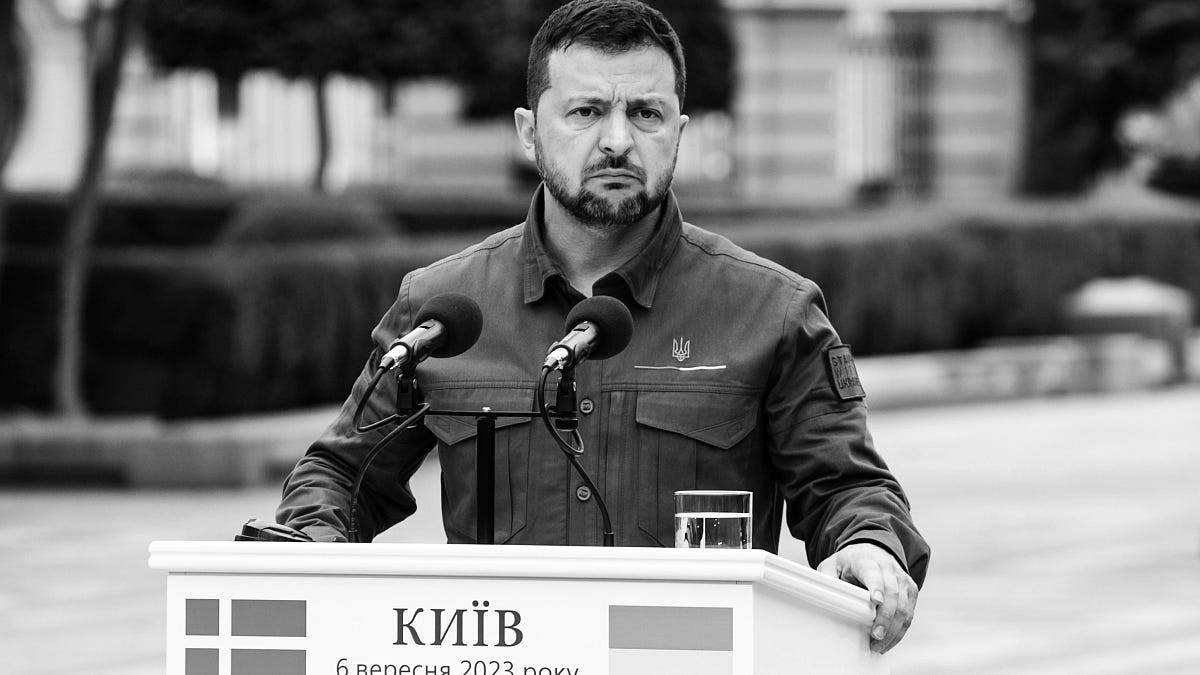
As Dave Smith predicted, the arguments that “Putin will march on Poland next” or that this conflict represents “Putin’s attempt to recreate the Soviet Union” — therefore justifying endless support for war in the region — have all been abandoned at precisely the moment that fanatical enthusiasm for total war was diverted from this part of the world to another; and in turn, the only civilised, human conclusion to meaningless violence and murder, that is, peace and negotiation — that which would have formerly been met with accusations of utopianism, cowardice, and treason — is no longer met with ostracism but rather claimed by the advocates of war as being a part of their wargame all along. By encouraging industrial-scale violence and murder and then taking the position of “no regrets” despite now adopting the same position of the peace advocates with whom one frequently argued against for the entirety of the conflict, Kisin demonstrates his flippant disregard for human life and his having learnt nothing from such a pointless and avoidable war.