So if the stolen ETH went to North Korea, which is sanctioned, and the Ethereum community rolls back their blockchain, does that mean Bybit would have money "from" North Korea, and therefor needs to freeze it and get a sanctions exception? (because so many lawyers have free time these days to worry about this)
View quoted note →
Sjors Provoost
sjors@sprovoost.nl
npub1s6z7...wk4c
Physicist turned bitcoin developer aka "shadowy super-coder", author of Bitcoin: A Work In Progress
With all respect to GrapheneOS, which itself is great, Android phones are like emergency food rations: you should have them, but only use them if you don't have a choice :-)
Apple yields to UK fascist regime. A matter of time before they yield to others unfortunately. We really need to get control over our own devices.


TechCrunch
Apple pulls iCloud end-to-end encryption feature for UK users after government demanded backdoor | TechCrunch
In an unprecedented step, Apple caved to a reported U.K. government’s demand to prevent users from using end-to-end encryption in iCloud.
@Obscura VPN one feature from the WireGuard app that I like is the ability to automatically turn it off on LAN and on specific trusted wifi networks. This would be a nice option to have (though perhaps the performance is such that I won't be tempted).
I'm too stupid to understand selfish mining, please help: 
Bitcoin Stack Exchange
Why is a selfish-mining attack with bad propagation (γ=0) still profitable?
The 2013 selfish-mining paper by Ittay Eyal and Emin Gün Sirer [0] introduces a variable γ:

We denote by γ the ratio of h...
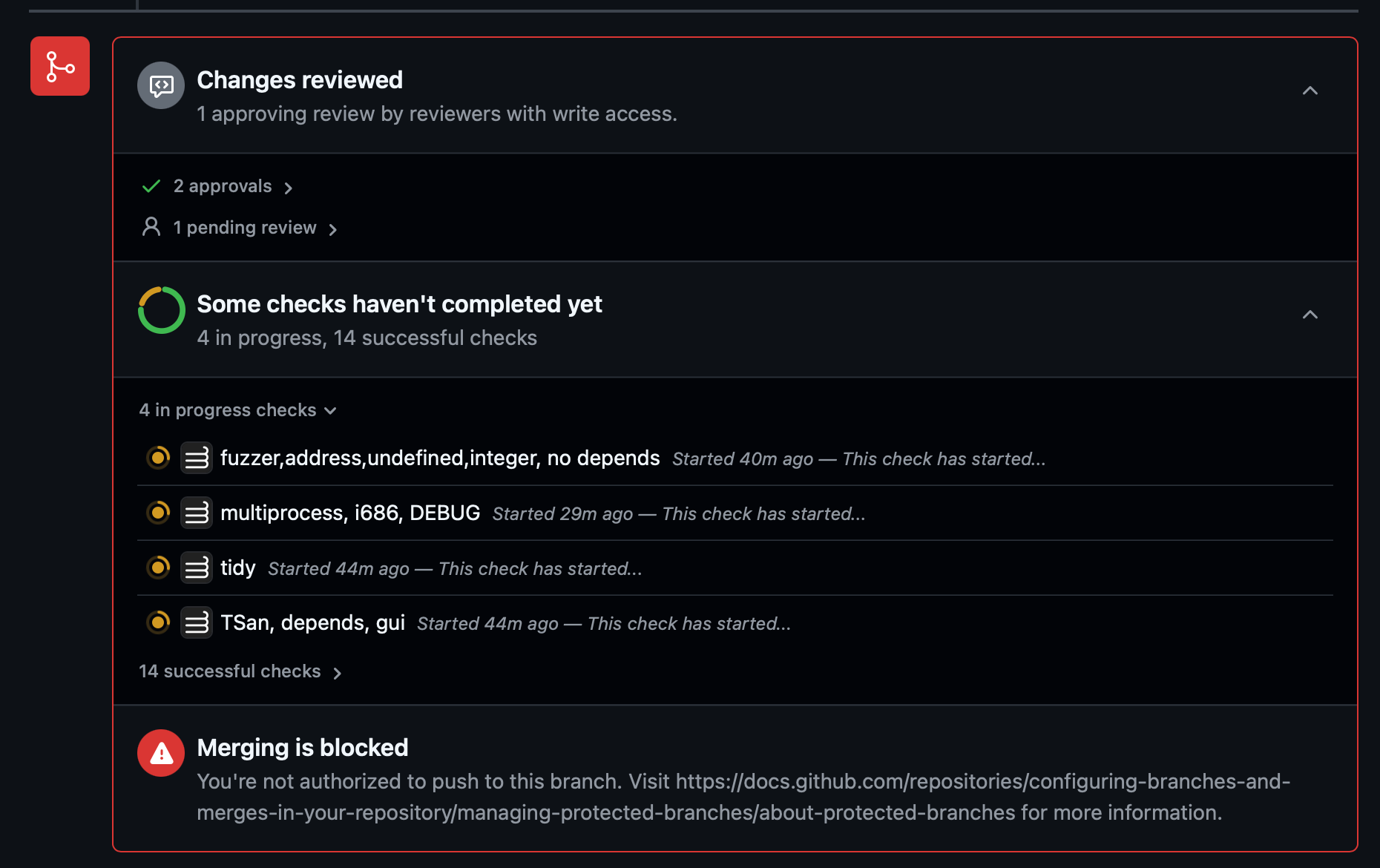
Not a fan of Github's new design where lots of red is used when there's no actual issue.
The fact that someone still needs to review isn't an error.


BitDevs #Rotterdam is happening tomorrow! Agenda is up:
BitDevs Amsterdam
BitDevs Rotterdam, February 20, 2025
BitDevs Rotterdam meeting 015, a second Rotterdam edition!
Privacy annoyance of the day... basically Apple knows about every app you launch for the first time. And for every every update you install, the first time you run it.
They make effort to forget these phone-home events, but it's a trust-me-bro privacy model. Which is not acceptable in a country with the Patriot Act. Even if that Act has some built-in protections, those are degraded by a declining appreciation for rule of law.
So when reading company statements like this, it's useful to replace some words - which I've done in square brackets. I'm still fully assuming good faith here, as well as no coerced lying.
> Privacy protections
> macOS has been designed to keep you and your data safe while respecting your privacy.
> Gatekeeper performs online checks to verify if an app contains known malware and whether the developer’s signing certificate is revoked. We have never [but could] combined data from these checks with information about Apple users or their devices. We do not [but could] use data from these checks to learn what individual users are using on their devices.
> Notarization checks if the app contains known malware using an encrypted connection that is resilient to server failures.
> These security checks have never included the user’s Apple Account or the identity of their device [but we can see your IP address]. To further protect privacy, we don't [but could] log IP addresses associated with Developer ID certificate checks, and we make sure that any collected IP addresses are removed from logs [but could stop doing that] .
There is a stapling mechanism that developers can use to (maybe?) prevent these phone home events, but it's not mandatory and not always practical. More importantly, it's intended as a convenience for users that are offline when they first run an application, it's *not* intended as a privacy measure.

Apple Support
Safely open apps on your Mac - Apple Support (QA)
macOS includes a technology called Gatekeeper, that's designed to ensure that only trusted software runs on your Mac.
By the way, I can recommend the habit of deleting at least one account per week.
Just look through your password manager, or the list of passwords kept by your browser.
Step 1: check if the site still exists and if you can log in (if not, delete the entry)
Step 2: look around and see what data they kept on you, for who knows how many years. You should now experience an urge for step (3).
Step 3: figure out how to delete the account. Often hidden under privacy or advanced options, more often requires an email to support. If so, set a reminder to followup after a week or so if nothing happened.
Step 4: once the account is gone, delete the entry from your password manager (browser)
Keep this up for a few years and you might get there....
I sent an annoyed email to EBA (European Banking Authority) telling them that they need to remove the #SatoshiTest from their Travel Rules guidance in EBA/GL/2024/11 (item 83c on page 31).
And that they need to immediately ban the practice. Companies are doing this because they're lazy. On-chain privacy harm is irreversible. The other methods are bad too, but they at least don't put stuff on the chain.
I expect them to ignore my email of course, but who knows.
Guidelines on information requirements in relation to transfers of funds and certain crypto-assets transfers under Regulation (EU) 2023/1113 | European Banking Authority
Is anyone keeping track, using on-chain analytics, of how many people are doing this idiotic EU "satoshi test"? E.g, Kraken describes the procedure here, presumably other exchanges use variants, which makes for great fingerprinting.
https://support.kraken.com/hc/nl/articles/what-is-a-satoshi-test
Occasional self-indulgent reminder that I wrote a book:
View quoted note →

Bitcoin: A Work in Progress
A book about soft forks, challenges of keeping open source software free of money-stealing bugs, new ways to protect Bitcoin nodes against evildoer...