
Not copper. Red.
I believe that Bitcoiners have a special relationship with the concept we refer to as "truth."
I'm not saying that we are more honest than others.
But we appreciate more than most others being able to verify the correctness of something.
For instance, we like the fact that everyone can verify the software code as well as each and every transaction.
Nothing is hidden.
Everything is in the open.
We value that we don't have to trust someone who says that "Everything is A-OK."
It's possible for everyone to check things out, without having to ask anyone for permission.
I have had the same fascination with the concept of truth as long as I can remember.
Like my father, I have also always been curious about how things work.
He had an amazing talent for understanding technologies.
My grandmother once told me a wonderful story from when he was a kid.
I think he was 12-13 years old.
He sat by the kitchen table and picked apart a mechanical sleep alarm clock, while he carefully studied how the pieces functioned together.
After he had taken it all apart, he patiently reassembled it.
It must have been very satisfactory for him to wind it up and hear the ticking.
The final test was the alarm bell.
"Ring ring ring!"
It worked perfectly.
My father had verified the truth about how the alarm clock worked.
In the 1980s he became a computer engineer.
I remember him sitting for hours in front of his PC, and how he used to fill up all empty spaces in the basement and his home office with all kinds of computer hardware.
He passed away much too early due to cancer in 2011.
Although I didn't inherit my father's understanding of technology, I got the same passion for diving deep into things, into the very core, and for understanding how things worked.
Social subjects and books have been two of my main interests, which is something I have from my mother.
She has always questioned things, and I'm exactly the same.
I discovered at a very young age how important it is to accept the truth.
I went to kindergarten from I was about two or thee years old.
When I was four, I was moved out of the unit with the small kids and to the unit with the big kids.
Some of the older kids started bullying me.
They shouted:
“Rune has red hair, Rune has red hair.”
The people who worked there were unable to help me.
So, I found myself in a hopeless, prison-like situation.
I complained to my mother, and told her that I wouldn’t go there anymore.
She tried to comfort me, and said:
“It isn’t true what those kids say. You don't have red hair, it's copper brown, and it's beautiful."
The only problem was, this couldn't solve a damn thing with the bullying.
And of course, it didn't.
The day after, I went to the kindergarten as usual, and the bullies pushed on.
It's quite possible that I tried to yell back at them:
"It's not red, it's copper brown!"
If I did, it probably just made things worse, because it would be a confirmation to them that their bullying had the intended effect on me.
However, something must have clicked inside me that day.
When I came home, I met my mother in the entrance.
I ripped the beanie off my head, and shouted angrily to her:
“No, mama, look at this! It’s true - my hair is red - just see for yourself!"
When I came back to the kindergarten the next day, I had accepted my faith.
They had blond, brown or black hair.
My hair was red.
These were facts, nothing more.
They noticed that I suddenly was OK with it.
And then they lost all interest in bullying me.
Accepting the truth had made me impervious to their insults.
My mother told me this story many times, when I was a child, and also after I became a grown-up man.
She says she's convinced that it was a life-changing experience for me, and that it would shape my personality.
Looking back, I think I realized that ignoring the truth comes at a significant cost.
And just as important, I think the episode taught me that embracing the truth could set me free.
Today, it makes me sad to think back on the fact that my father and I often disagreed on many things.
We had very different ideas about the relationship between individuals and the state.
What started as civil conversations, too often ended in quarrels.
It felt like our opposing opinions on politics drove a wedge between us.
If he had lived today, he probably would have developed a fascination for how Bitcoin works.
He wouldn't have trusted Bitcoin, just because others said it's immutable.
I'm confident he would have picked apart every little piece of the technology, in an attempt to verify Bitcoin's promise.
Just like I try to do with the socio-economic aspects of it.
If my father had been alive today, I suspect Bitcoin would have brought us closer together.
He could have explained the technology for me, and I could have explained Bitcoin's socio-economic functions to him.
Possibly, he would have realized that I had been right when I challenged many of the things that the powers at be want us to believe.
It's just guessing, of course.
But it makes sense, because it seems to me that Bitcoin attracts truthseekers like a magnet.
And at the same time, Bitcoin forces us to search for the truth together, instead of quarrelling about the correctness of something that others have fed us with.
***
If you liked this piece, it would be great if you gave it a boost 🧡


 What could be a winning strategy for Washington?
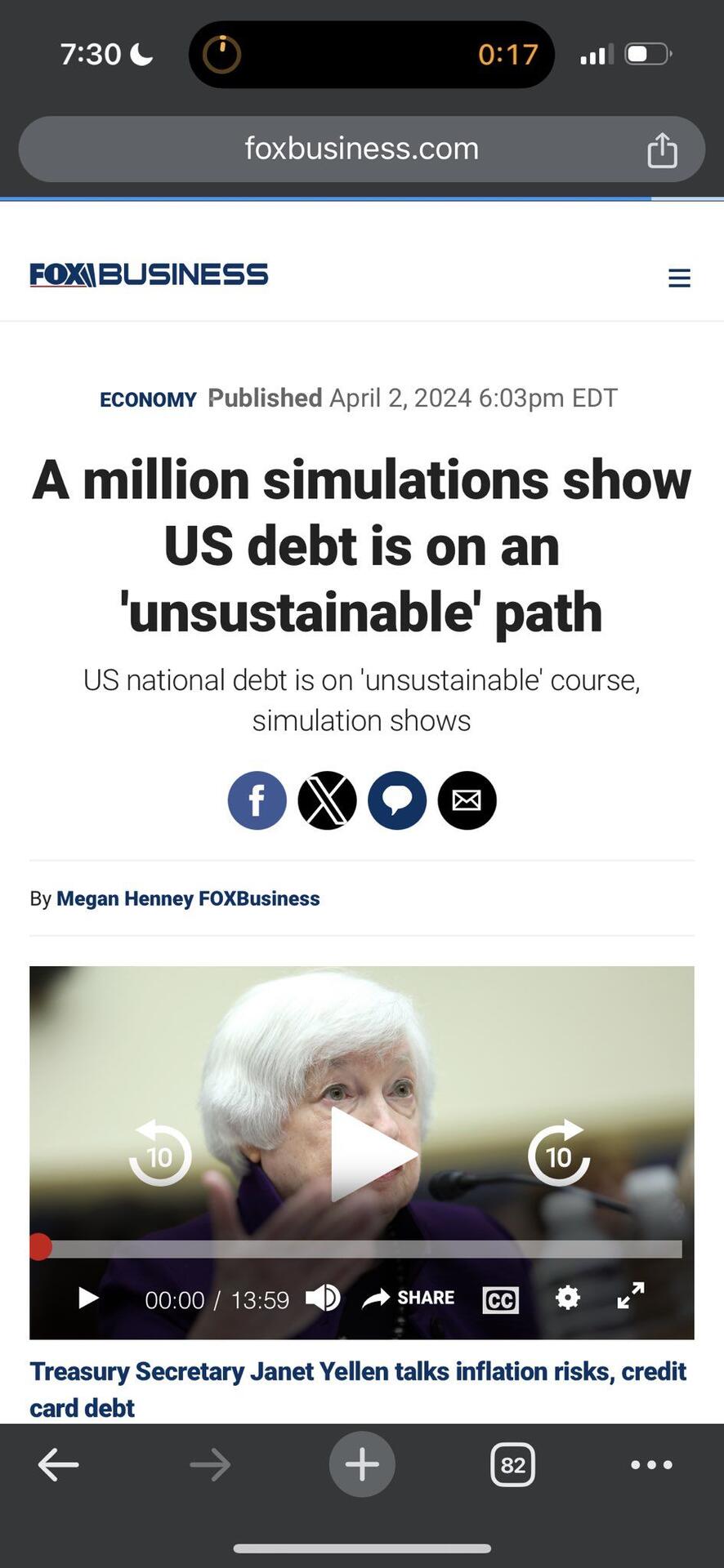
When the US debt spirals out of control, it puts the USD's status as reserve currency at risk.
This begs the question - what's the best strategy forward for Washington, whether we're talking about the super wealthy, the leaders of the political class, the deep state, or the whole shebang?
I'll take a stab at this question below.
But first, let's look at some milestones for the USD as a reserve currency:
1945: The USD seals its reserve currency status when US airplanes bomb Hiroshima and Nagasaki
1973: Nixon saves the status with the petrodollar deal with Saudi Arabia
1991: Washington breeds new life into the status by letting Russia crumble in hyperinflation at the same time as the US makes a "we will buy your cheap consumer goods if you buy our treasuries and stay away from Russia" deal with China.
And here is the situation today:
- the public debt has spiralled out of control,
- the proxy war with Russia in Ukraine is a lost case,
- China hates the US and the US hates China,
- Russia and China are in love with each other, and
- the next likely reserve currency - #Bitcoin - isn't controlled by a nation that the US can bomb to pieces.
So what is the dominant strategy for Washington in this type of situation?
My take:
Convince other countries to have a tight monetary policy, increase taxes, move further with the climate policy and fight against #Bitcoin , while in parallell make sure that the US does more or less the exact opposite.
You see, this strategy comes from an old playbook:
In the 1920's the Federal Reserve was greatly helped by Bank of England when they tricked a number of other European central banks into adopting the "parity policy," which was all about rapidly shrinking the money supply. At the same time, the US and the UK continued to print money so that the rich could make bargains at the fire sale in the European countries that crashed their economies in a deflationary nightmare.
If you're in doubt about the potency of deploying something similar today - just take a quick glance at the leaders of the European political class. Then you ask yourself if you think they have the combination of IQ, leadership and care for their people that they need in order to withstand the pressure, gaslighting and bribes from the people in Washington.
To sum up:
The dominant strategy for Washington today isn't to start another war, but to convince other central banks and other governments, especially in Europe, to do really, really stupid things.
What could be a winning strategy for Washington?
When the US debt spirals out of control, it puts the USD's status as reserve currency at risk.
This begs the question - what's the best strategy forward for Washington, whether we're talking about the super wealthy, the leaders of the political class, the deep state, or the whole shebang?
I'll take a stab at this question below.
But first, let's look at some milestones for the USD as a reserve currency:
1945: The USD seals its reserve currency status when US airplanes bomb Hiroshima and Nagasaki
1973: Nixon saves the status with the petrodollar deal with Saudi Arabia
1991: Washington breeds new life into the status by letting Russia crumble in hyperinflation at the same time as the US makes a "we will buy your cheap consumer goods if you buy our treasuries and stay away from Russia" deal with China.
And here is the situation today:
- the public debt has spiralled out of control,
- the proxy war with Russia in Ukraine is a lost case,
- China hates the US and the US hates China,
- Russia and China are in love with each other, and
- the next likely reserve currency - #Bitcoin - isn't controlled by a nation that the US can bomb to pieces.
So what is the dominant strategy for Washington in this type of situation?
My take:
Convince other countries to have a tight monetary policy, increase taxes, move further with the climate policy and fight against #Bitcoin , while in parallell make sure that the US does more or less the exact opposite.
You see, this strategy comes from an old playbook:
In the 1920's the Federal Reserve was greatly helped by Bank of England when they tricked a number of other European central banks into adopting the "parity policy," which was all about rapidly shrinking the money supply. At the same time, the US and the UK continued to print money so that the rich could make bargains at the fire sale in the European countries that crashed their economies in a deflationary nightmare.
If you're in doubt about the potency of deploying something similar today - just take a quick glance at the leaders of the European political class. Then you ask yourself if you think they have the combination of IQ, leadership and care for their people that they need in order to withstand the pressure, gaslighting and bribes from the people in Washington.
To sum up:
The dominant strategy for Washington today isn't to start another war, but to convince other central banks and other governments, especially in Europe, to do really, really stupid things.