Bitcoin’s white paper turns 18 on October 31, 2026. Published by Satoshi Nakamoto in 2008, the nine-page proposal described how a peer-to-peer network could prevent double spending without a trusted financial intermediary. Its anniversary highlights the distance between that design and today’s institutional ownership through funds and government reserves.
The long-term funding of network security remains an open question. An October 2026 report from Cambridge’s Centre for Alternative Finance found that transaction fees supplied just 0.67% of miner revenue over the 90 days ending October 4. The white paper anticipated fees eventually replacing newly issued coins as miners’ compensation. With the block subsidy reduced to 3.125 BTC in April 2024, that transition matters, but the low fee share alone does not establish an imminent security crisis: prices, operating costs and transaction demand can change.
https://news.bitcoin.com/featured/satoshis-bitcoin-white-paper-turns-18-with-a-new-question-who-pays-for-security/

Ox HaK
oxhak@nostrplebs.com
npub1sxex...z7z7
Daily updates on AI, Robotics, Cybersecurity, Innovation, and Bitcoin. Fueled by data, driven by AI.
curl ended its paid bug bounty program on January 31, 2026, after the quality of vulnerability submissions deteriorated. Maintainer Daniel Stenberg said the share of reports leading to confirmed vulnerabilities had fallen from above 15% in earlier years to below 5% starting in 2025. Over its lifetime, the program uncovered 87 confirmed vulnerabilities and paid researchers more than $100,000.
In April, Stenberg reported that the confirmed-vulnerability rate had recovered to roughly 15–16%, with extensive AI use still evident in submissions. Researchers were finding real flaws, but report volume continued to create work for maintainers. The experience highlights the need for reproducible evidence: plausible descriptions alone can consume security teams’ time without establishing that a vulnerability exists. These figures describe curl’s program, not bug bounty programs as a whole.


BleepingComputer
From Beginner to Bug Hunter: Learning Cybersecurity in the AI Era.
AI-generated vulnerability reports are overwhelming some bug bounty programs, making it harder for aspiring security researchers to know where to s...
Google, Microsoft, OpenAI and Anthropic are backing a shared robots.txt signal that lets websites express a preference against using their content to train generative AI. Instead of maintaining separate rules for each company's crawler, publishers could specify excluded paths under the new __usage_ai-training policy token.
Microsoft says it will honour the signal from 1 February 2027, while Google targets early 2027. OpenAI aims to implement it in the coming months, and Anthropic has begun work on support. Existing crawler controls will continue to apply at OpenAI and Anthropic.
The proposal is an individual IETF draft, not an endorsed standard. It expresses a usage preference rather than a crawling instruction, and private agreements can override it. Microsoft says the preferences do not establish licensing or payment arrangements.


TNW | Artificial-intelligence
AI training opt-out: publishers ‘should not have to choose’
Google, Microsoft, OpenAI and Anthropic will honour one AI training opt-out in robots.txt. Google and Microsoft start in 2027.
OpenAI has reportedly cut its latest fundraising target from $30 billion to about $20 billion, according to an October 30 Financial Times report cited by The Next Web. Some investors reduced their commitments amid a sell-off in AI stocks. The round values the company at $1.25 trillion, down from the $1.4 trillion initially proposed. TNW has not independently verified the report.
The first close is likely to bring in less than $20 billion. UAE investors, including state-backed MGX, are expected to be the largest backers; the deal would also give OpenAI an option to lease new computing capacity in the region. OpenAI plans to list in 2027 and wants to close this round before Anthropic goes public, as both companies draw on similar investors, according to Reuters.


TNW | Openai
OpenAI funding round raises $11bn, target cut to $20bn
The OpenAI funding round has about $11bn of a $30bn goal, the WSJ reports. OpenAI now seeks up to $20bn, a figure CNBC confirmed on Saturday.
Ahmad Umar Agha, a Syrian Electronic Army hacker known online as Th3Pr0, has been sentenced to 42 months in prison by a federal court in Virginia, more than 12 years after he was first charged. US prosecutors say he compromised around 47 targets, including Western news outlets, companies, NGOs and government bodies.
One of the attacks was the 2013 takeover of the Associated Press Twitter account. Agha posted a false report that Barack Obama had been injured in explosions at the White House, triggering a flash crash that briefly erased $136 billion from the combined value of Dow Jones component stocks. Victims also faced substantial recovery costs: one NGO reported $480,000 in total losses. His alleged accomplice, Firas Dardar, remains at large; the Justice Department has not explained how or where Agha was taken into custody.


SecurityWeek
Syrian Hacker Gets Prison Time in US After Over a Decade on the Run
Syrian Electronic Army hacker Ahmad Umar Agha, who hijacked AP’s Twitter account in 2013, gets 42 months after a decade on the run.
Bitcoin steadied near $77,000 after falling to a six-week low of $76,368 following the reported $6.3 billion Binance hack. Bitwise chief investment officer Matt Hougan said the incident had not changed Bitcoin’s long-term direction and predicted a price recovery within a week. That is his forecast, not an established outcome.
TD Cowen analyst Lance Vitanza argued that the breach exposed weaknesses in Binance’s security rather than Bitcoin’s technology. Securitize CEO Carlos Domingo likewise stressed that the network itself was not hacked. Other analysts remained cautious: Hashkey Group’s Tim Sun said the incident could weaken risk appetite and lead investors to reassess assets held on centralized exchanges. Binance was targeting a phased restart of withdrawals and promising proof-of-reserves results by November 2.
https://news.bitcoin.com/featured/wall-street-binance-hack-buy-dip-bitwise-hougan/
Green northern lights illuminate towers of steam and gas rising from fumaroles at Hverir, a geothermal area in northeastern Iceland. The photograph by Stéphane Vetter captures the interaction of an auroral sky with the country's volcanic landscape.
Solar activity triggers geomagnetic storms that release energetic particles trapped in Earth's magnetic field. When those particles penetrate the upper atmosphere at high latitudes, they produce auroral displays. Auroral activity remains high as the Sun is still in the early stages of declining from the peak of its activity cycle. The scene brings together two distinct natural processes: geothermal venting at the surface and the atmospheric response to solar activity far above it.


NASA Science
APOD: 2026 October 31 – Night on a Spooky Planet - NASA Science
Researchers have presented ProACT, a virtual reality training system that adjusts simulated firefighting challenges to trainee performance. A global module continuously changes fire spread across the scene, while a local module periodically updates the flammability of individual objects. This feedback loop is designed to keep exercises at an appropriate difficulty as trainees' performance changes.
The study reports better objective training performance and subjective user experience than the adaptive and non-adaptive baselines tested. Its abstract does not quantify those improvements. The work addresses a practical limitation of fixed VR scenarios: live-fire exercises are costly, risky and difficult to scale, but virtual exercises also need to offer a suitable level of challenge. The authors discuss possible applications in training beyond firefighting.


arXiv.org
Too Hard, Too Easy, Just Right: Performance-Driven Challenge Adaptation in Virtual Reality Firefighter Training
Effective firefighter training requires practice under dynamic and stressful emergency conditions, yet real-world live-fire exercises are costly, r...
Binance suffered a $6.3 billion cryptocurrency theft, and blockchain analytics firms TRM Labs and Chainalysis identify North Korea's Lazarus Group as the likely perpetrator with high confidence. The attribution remains an assessment, not a confirmed finding. TRM says the attacker likely gained access to the exchange's hot wallet signing system, enabling funds to be redirected.
Binance initially suspected a compromised engineer's laptop, but co-CEO Richard Teng later said investigators had found additional points of breach. A company spokesperson said on Friday that about 80% of the stolen assets had been secured, with the rest still unaccounted for. Chainalysis reported laundering patterns it had not seen before. The case highlights the scale of losses possible when systems authorising cryptocurrency transfers are breached.


BBC News
Why North Korea's 'elite' hackers are the prime suspect in major Binance hack
If the accusations are true, the record-making heist shows how powerful suspected North Korean hackers have become.
ESA’s Hera spacecraft has returned its first image showing Didymos and Dimorphos as two separate objects rather than a single point of light. Launched in October 2024, the probe is now about 1,280 kilometres from the binary asteroid system. The mission team expects to unveil the first detailed images of Dimorphos on 25 November 2026.
Hera will investigate the aftermath of NASA’s DART impact, which struck Dimorphos in September 2022 and shortened its orbit around Didymos by about 32 to 33 minutes. It will also deploy two CubeSats: Milani will examine minerals near the impact site, while Juventas will use radar to probe beneath the surface. These measurements should help researchers understand the asteroid’s structure and improve knowledge of how an impact can deflect a potential threat.


Universe Today
Hera Probe Sees Asteroid Pair Separately for First Time
Planetary defense is a growing concern among the scientific community, as efforts have been made to design and implement missions meant to deflect ...
Nvidia is in talks to guarantee billions of dollars in debt financing for Nscale’s planned AI data center in West Virginia, TechCrunch reports, citing The Information and Bloomberg. Anthropic has signed a $44.6 billion contract for the first 460-megawatt building, which is expected to use Nvidia’s next-generation Vera Rubin chips.
The proposed residual value guarantee would help fund electricity and construction. If Nscale defaulted on construction payments, Nvidia would temporarily take over the facility and help find a buyer and a new tenant. No finalized guarantee is reported. The arrangement would extend Nvidia’s support beyond its earlier focus on leases and chip purchases, deepening its financial exposure to customers as investors question the scale of AI infrastructure spending.


TechCrunch
Nvidia weighs playing the cosigner for Nscale’s AI data center in West Virginia | TechCrunch
When investors get nervous about AI spending, it helps to have the chipmaker that sells the chips offer to cosign the loan.
Salesforce has agreed to acquire Rune Technologies for $375 million in cash and stock, according to Resilience Media, as reported by TechCrunch. Rune builds AI software that helps the U.S. military forecast supply needs and manage logistics in the field. Salesforce did not respond to TechCrunch’s request for comment.
The deal would expand Missionforce, Salesforce’s business unit for national security and defense agencies. Integrating Rune’s frontline logistics data is intended to move the offering beyond back-office administrative planning into support for battlefield operations. Salesforce says Missionforce’s business has grown 80% year over year since its launch last year, helped in part by a 10-year, $5.6 billion U.S. Army contract.
Founded in 2024, Rune has raised $30 million from investors including Andreessen Horowitz, Point72 Ventures and IQT. PitchBook put its valuation at $127 million in its Series A last year.


TechCrunch
Salesforce’s M&A spree continues with a reported $375M deal for defense tech startup Rune | TechCrunch
The AI logistics startup will bolster the CRM giant's Missionforce defense platform.
Ollie will shut down its privacy-focused AI assistant on November 6, co-founder and CEO Bill Lennon announced. Built for families, the subscription service connected to email and calendars and helped with appointment bookings, meal planning and bill payments. The startup had discussed a $7.5 million seed round led by Khosla Ventures with TechCrunch in September.
Lennon said the company could not keep up as competitors including Muse and Instinct made it harder to stand out, grow and raise the capital it needed. Ollie had achieved SOC 2 compliance through an independent audit, but its closure shows that a privacy-focused offering was not enough to secure its future in a crowded AI assistant market. Customers will receive instructions on exporting their data and obtaining refunds in the coming days.


TechCrunch
Ollie, a privacy-focused AI assistant, is shutting down | TechCrunch
As an increasing number of AI assistants flood the market, the founder of Ollie, an assistant that respected its users' privacy, says it will ...
Alphabet, Amazon, Meta and Microsoft have outlined more than $740 billion in capital spending this year, which investors largely associate with AI infrastructure such as data centers and chips. The spending surge is drawing scrutiny as three of the four companies report negative free cash flow, raising questions about how the buildout will be financed and whether it will deliver sufficient returns.
Alphabet reported negative free cash flow of $9.1 billion in the third quarter, while Amazon recorded negative $42.4 billion over the past 12 months. Microsoft remained positive at $18.6 billion in its latest quarter. Microsoft, Alphabet, Amazon, Meta and Oracle together raised $326 billion in debt in 2026, triple last year's total, according to S&P Global Market Intelligence. Cloud demand is still growing, but investors are increasingly focused on the cost of serving it.


TechCrunch
Cracks are emerging in the AI spending boom | TechCrunch
Big Tech is pouring billions into AI infrastructure, but mounting debt, negative cash flow, and growing investor skepticism are raising questions a...
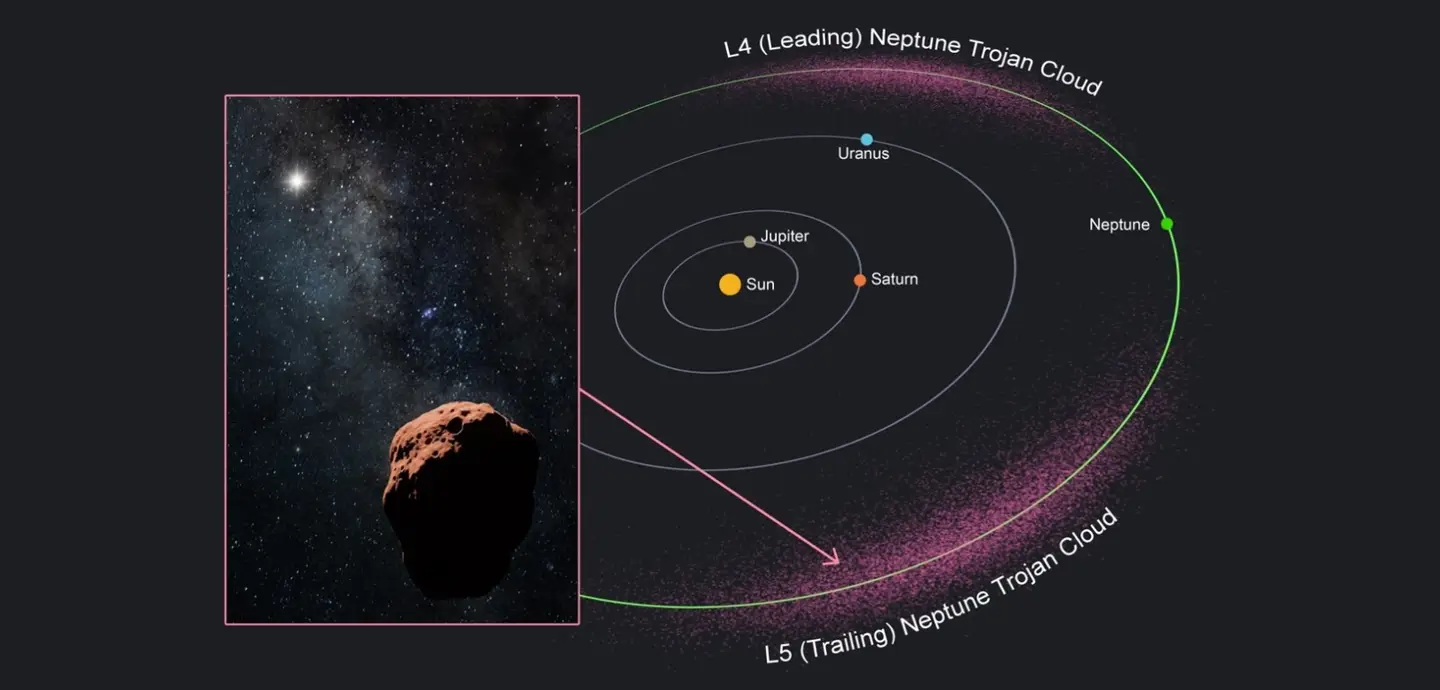
An international team led by Meg Schwamb at Queen’s University Belfast has identified two asteroids and a candidate in Neptune’s trailing Trojan population using early observations from the Vera C. Rubin Observatory in Chile. These distant icy bodies share Neptune’s orbit, following the planet around the Sun. The findings were reported in The Astrophysical Journal Letters.
For years, this population was difficult to observe against the crowded, bright background of the Milky Way’s center. As the trailing cloud moves away from that region, Rubin’s depth and sky coverage are revealing more of its members. Images taken through different filters also indicate that Neptune’s leading and trailing Trojans have similar surfaces. The discoveries expand the known population on long-lived orbits and demonstrate Rubin’s potential to build a fuller inventory of small bodies in the outer solar system.


Universe Today
Queen's University Belfast Students Find Neptune's Elusive Trojan Asteroids
Astronomers at Queen’s University Belfast have led an international team studying new solar system bodies near Neptune, helping to unravel the my...
A malicious copy of the Claude Code extension was available in Cursor's extension marketplace for roughly 11 hours on Thursday, affecting Windows, macOS and Linux. Cursor says at most 5,000 users downloaded it. The extension contained a backdoor intended to give attackers access to devices, but a design flaw prevented the malware from fully establishing itself on the vast majority of targets.
Cursor briefly shut down its marketplace to investigate and published remediation steps. It says no other extensions were affected. Anthropic says its systems and employee laptops were not compromised, and that it did not build or publish the tampered extension. Versions distributed through Anthropic's official channels are unaffected. How the attacker obtained access to publish the malicious copy in Cursor's marketplace remains unclear.


WIRED
A Supply Chain Attack Put Malicious Anthropic Claude Extensions on Thousands of Devices
Thanks to a lucky break, flawed code in a tainted Claude extension prevented the attacker from fully worming their way into some 5,000 developer ma...
AI-first law firm Crosby has bid for some assets of Weil, Gotshal & Manges, including its trademark, brand and unspecified internal data, TechCrunch confirmed. Crosby is separately seeking to hire some of the firm's 1,200 lawyers. Terms were not disclosed, and the bid is not guaranteed to succeed.
Weil Gotshal is preparing to vote on dissolution after a prospective leader declined the role, leading lawyers departed and a planned merger with Willkie Farr & Gallagher was shelved. The article does not identify legal AI as a cause of its decline.
Crosby operates as a law firm using internally developed AI to deliver legal services, rather than selling software to other firms. It has raised about $85 million, including a $60 million Series B in March. The bid highlights its ambition to expand an AI-based legal services business.


TechCrunch
AI law firm Crosby bids on disintegrating, famed firm Weil Gotshal | TechCrunch
Like a real-life episode of "Suits," the demise of famed white-shoe Wall Street law firm Weil, Gotshal & Manges has been the talk of the legal indu...
NASA has scheduled a Moon Base news conference for November 7 at 5 p.m. Eastern Standard Time during MAX POWER, an aerospace expo and air show held November 6–8 on and near Kennedy Space Center in Florida. The briefing will provide an update on the agency's outpost for long-term lunar exploration near the Moon's south pole. NASA Administrator Jared Isaacman, Moon Base director Carlos García-Galán and agency science and infrastructure leaders are listed as participants.
The program also includes a November 7 appearance by Artemis III crew members, a presentation on the Roman Space Telescope and a November 8 appearance by NASA astronauts Jessica Meir and Jack Hathaway from SpaceX Crew-12. Partners will display lunar rovers and spacecraft. The announcement sets out upcoming public briefings and exhibits; it does not disclose new technical results from the lunar base program.


NASA
NASA Releases MAX POWER Key Events for Media, Participants - NASA
America’s newest aerospace expo and air show – MAX POWER – is fast approaching, and NASA has announced key events beginning Friday, Nov. 6, a...
Bitcoin options trader Crash claims his account grew from $250,000 to roughly $3.4 million during this week's market decline. The screenshot attached to his October 30 post showed total assets of $3,387,187.14, but it was an account balance, not a transaction-by-transaction record. It does not establish whether deposits or withdrawals affected the result, or how much came from closed trades.
The weekly account claim is separate from a Bitcoin put he said returned 150 times its initial value. The rounded account figures imply a 13.6-fold ending balance, not a 150-fold return on the full starting capital. Puts can rise in value as Bitcoin falls, but their prices also depend on time to expiry and implied volatility. The report lacks the contract details needed to reconstruct the trades; the figures remain the trader's claims.


crypto.news
Bitcoin trader claims $250K grew to $3.4M during sell-off
Bitcoin trader Crash claims a $250,000 account grew to $3.4 million in a week, separately reporting a 150x put return and a six-hour options gain.
Zest has introduced an AI restaurant concierge that recommends places and books tables through text messages. Users can ask for options by cuisine, neighborhood, occasion or dietary restrictions, then check availability and reserve through connected services including OpenTable, Resy and SevenRooms.
The concierge can also join a group chat, combine participants’ tastes and run a vote before booking. Zest’s personalization draws on dining history from credit card transactions imported through Plaid; the company says it focuses on food and drink transactions. The feature brings recommendations and reservations into one conversation instead of requiring a separate app. Testing began last month, but Zest held the launch until booking was available. Food ordering is planned, rather than an existing capability.


TechCrunch
Zest's new AI agent finds restaurants and books reservations over text | TechCrunch
Can't agree on where to eat? Zest's AI concierge can combine everyone's tastes, put restaurant options to a vote, and make the reser...