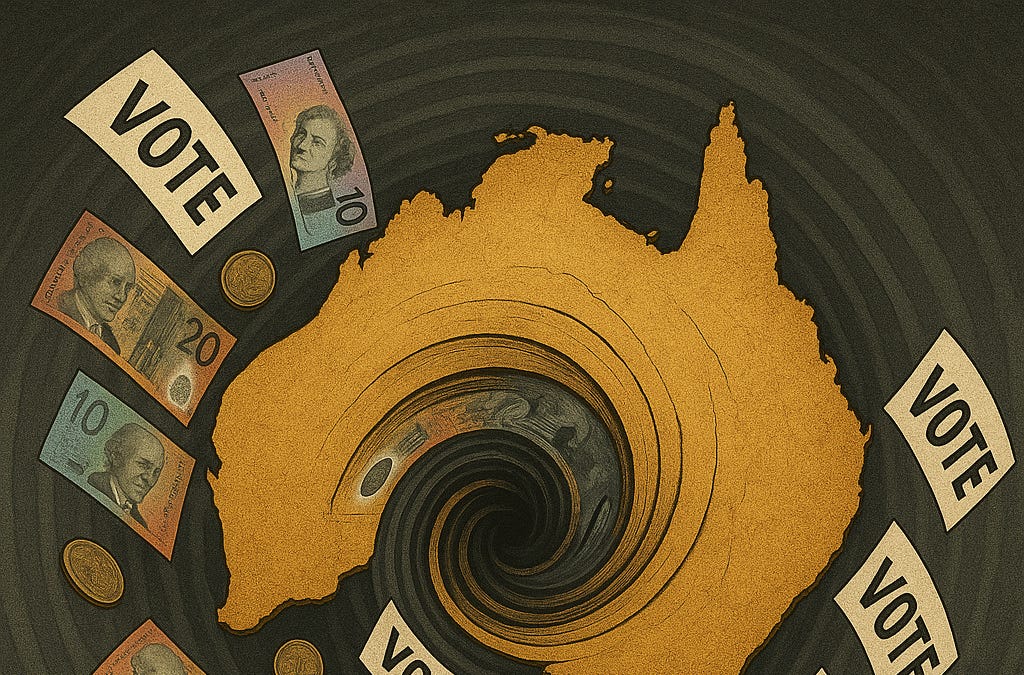
Tell us in flation is 2.3 %
Lips are moving, they are lying, politicians are turds.
To determine how much inflation has increased in Australia since 2020, we need to examine the Consumer Price Index (CPI) data, which measures the annual percentage change in the cost of a basket of goods and services. The Australian Bureau of Statistics (ABS) is the primary source for this data, and I’ll use the annual CPI inflation rates from 2020 to the most recent available data in 2025. The goal is to calculate the cumulative inflation over this period.
### Step-by-Step Approach:
1. **Gather Annual Inflation Rates**: Identify the annual CPI inflation rates for each year from 2020 to 2025.
2. **Calculate Cumulative Inflation**: Use the compound inflation formula to compute the total price increase over the period.
3. **Interpret the Result**: Express the cumulative effect as a percentage increase in prices since 2020.
### Annual Inflation Rates (2020–2025):
Based on available data from the Australian Bureau of Statistics and other reliable sources:
- **2020**: Inflation rate was 0.85%. This low rate was influenced by the COVID-19 pandemic, with government subsidies (e.g., free childcare) and reduced demand suppressing price growth.[](
https://www.macrotrends.net/global-metrics/countries/AUS/australia/inflation-rate-cpi)[](https://www.rba.gov.au/publications/smp/2020/nov/inflation.html)
- **2021**: Inflation rate was 2.86%, a 2.02% increase from 2020, driven by recovery from pandemic-related disruptions and rising demand.[](
https://www.macrotrends.net/global-metrics/countries/AUS/australia/inflation-rate-cpi)
- **2022**: Inflation peaked at 6.61%, the highest since 1990, fueled by global supply chain issues, the Russia-Ukraine conflict increasing energy prices, and strong consumer demand.[](

Statista
Australian inflation rate 2030| Statista
The statistic shows the inflation rate in Australia from 1987 to 2023, with projections up until 2030.
- **2023**: Inflation averaged 5.4% annually, based on quarterly data (e.g., 5.4% in Q3 2023), as global pressures eased but domestic costs like housing and energy remained high.[](
https://www.nerdwallet.com/au/home-loans/current-inflation-rate)
- **2024**: Inflation averaged 3.3% for the year, with monthly and quarterly data showing a decline from 2023 highs.[](
Worlddata.info
Inflation rates in Australia
Inflation rates for consumer goods over the last 65 years in Australia including comparison with the USA. Price increases for food, Inflation calcu...
- **2025 (Q1)**: Inflation held steady at 2.4%, the lowest since Q1 2021, with services inflation easing to 3.7% and goods inflation rising to 1.3% due to electricity prices.[](
https://www.fxempire.com/macro/australia/inflation-rate)
### Cumulative Inflation Calculation:
Inflation compounds over time, so the cumulative effect is calculated using the formula:
\[ \text{Cumulative Inflation} = (1 + r_1) \times (1 + r_2) \times \dots \times (1 + r_n) - 1 \]
Where \( r_n \) is the inflation rate for each year (expressed as a decimal). For simplicity, we’ll use the annual rates above and assume 2025’s Q1 rate (2.4%) as a proxy for the full year, as complete 2025 data is unavailable.
Convert the rates to decimals:
- 2020: 0.0085
- 2021: 0.0286
- 2022: 0.0661
- 2023: 0.054
- 2024: 0.033
- 2025 (Q1, estimated): 0.024
Now calculate:
\[ (1 + 0.0085) \times (1 + 0.0286) \times (1 + 0.0661) \times (1 + 0.054) \times (1 + 0.033) \times (1 + 0.024) - 1 \]
\[ = 1.0085 \times 1.0286 \times 1.0661 \times 1.054 \times 1.033 \times 1.024 - 1 \]
Step-by-step:
- \( 1.0085 \times 1.0286 = 1.03735 \)
- \( 1.03735 \times 1.0661 = 1.10592 \)
- \( 1.10592 \times 1.054 = 1.16564 \)
- \( 1.16564 \times 1.033 = 1.20410 \)
- \( 1.20410 \times 1.024 = 1.23300 \)
- \( 1.23300 - 1 = 0.233 \)
Cumulative inflation from 2020 to Q1 2025 is approximately **23.3%**.
### Interpretation:
This means that a basket of goods and services costing $100 in 2020 would cost approximately $123.30 by March 2025. The cumulative price increase reflects the compounding effect of inflation over these years, with the peak in 2022 (6.61%) contributing significantly to the total.
### Notes and Caveats:
- **2025 Data**: The 2.4% rate for 2025 is based on Q1 data only. If full-year data differs, the cumulative figure may change slightly. The ABS plans to release a complete monthly CPI later in 2025, which could refine these estimates.[](
https://www.abs.gov.au/statistics/economy/price-indexes-and-inflation/consumer-price-index-australia/latest-release)
- **Variability**: Inflation varies across categories. For example, housing (+1.7%), education (+5.2%), and food (+1.2%) were key drivers in Q1 2025, while recreation (-1.6%) offset some increases.[](
https://www.abs.gov.au/statistics/economy/price-indexes-and-inflation/sort)
- **Trimmed Mean Inflation**: The Reserve Bank of Australia’s preferred measure (trimmed mean CPI) was 2.9% in Q1 2025, indicating underlying inflation is slightly higher than headline CPI but still within the RBA’s 2–3% target.[](
https://www.fxempire.com/macro/australia/inflation-rate)
- **X Post Misinformation**: Some X posts claim exaggerated figures (e.g., 167% over five years), which are misleading and not supported by ABS data. The cumulative figure of ~23.3% aligns with official sources.
### Answer:
Inflation in Australia has cumulatively increased prices by approximately **23.3%** from 2020 to March 2025, based on annual CPI data. This means goods and services costing $100 in 2020 would cost about $123.30 by early 2025. For the most precise updates, check the Australian Bureau of Statistics’ CPI releases.[](
https://www.abs.gov.au/statistics/economy/price-indexes-and-inflation/consumer-price-index-australia/latest-release)[](https://www.macrotrends.net/global-metrics/countries/AUS/australia/inflation-rate-cpi)[](https://www.fxempire.com/macro/australia/inflation-rate)