
By Dewmap
The Capture of Bitcoin Core
For years, Bitcoin maintained a reputation as the ultimate uncapturable network.
It was designed to be decentralized, driven entirely by consensus, and highly resistant to corporate influence.
In 2015, the community famously defended the protocol during the Block Size Wars, repelling a coordinated corporate takeover attempt.
In June 2025, that streak ended.
A heavily contested code change was pushed into the software despite overwhelming opposition from the community.
The update targeted a feature called **OP_RETURN**, a space within a transaction meant to hold tiny amounts of arbitrary data, strictly capped at 80 bytes.
The 2025 update stripped those limits away, allowing massive amounts of non-financial data to be embedded directly into the blockchain.
Bitcoin requires broad consensus to function, and it has no central leadership.
So how did a handful of developers manage to bypass the community and force a major policy change into the software?
---
The path to this change began two years earlier with a six-line administrative edit that went virtually unnoticed.
By early 2023, the small group of developers who maintain Bitcoin's reference software were seeing an influx of traditional venture capital funding.
Major crypto investment firms began directly funding the developers responsible for the software's upkeep.
This financial concentration caught the attention of the mainstream press.
In February 2023, *The Wall Street Journal* profiled the vulnerability, highlighting how few people actually controlled the software and where their funding originated.
Four months later, on June 6, a funded maintainer submitted a code update.
It appeared to be routine housekeeping: a six-line adjustment to the software's documentation strings.
The edit narrowed the written definition of the network's data limits.
The original documentation stated that the limit applied to all data-carrying transactions.
The new text restricted that definition to one specific data field.
This left several newer data pathways completely unregulated, even though the underlying code itself had not changed.
The update passed without scrutiny.
But by quietly altering the official definitions, this developer cohort rewrote the rules of engagement for all future policy debates.
---
In late 2023, new projects began exploiting the exact gaps left open by that documentation edit.
The Bitcoin network was suddenly flooded with digital artifacts and spam, significantly increasing system congestion.
The community attempted to respond.
An independent developer wrote a software patch to restore the original data limits and secured an official security designation from the National Vulnerability Database to track the exploit.
To get that patch implemented, it required approval from the Core maintainers.
They rejected it.
The cohort cited the six-line documentation edit from earlier that year to justify the rejection.
They argued that because the documentation now explicitly excluded those data fields, the spam was technically within the rules.
They claimed that fixing the loophole would violate the software's documented intent.
In October 2024, during a closed-door developer session, the cohort administratively closed the issue tracking the formal security record, effectively erasing the vulnerability designation from the project's history.
By manipulating bureaucratic definitions, a centralized group of developers proved they could protect the specific data streams they favored while blocking community security efforts.
---
By early 2025, a specific corporate interest emerged.
A venture-funded entity called **Citrea** was building a product that required massive, uncapped data limits on Bitcoin to function.
To meet this requirement, an active Core developer commissioned another programmer to submit a code update.
This new pull request proposed removing the OP_RETURN data limit entirely—a change explicitly requested on behalf of Citrea.
When the community discovered the arrangement, they rejected the proposal by roughly a four-to-one margin, citing the clear conflict of interest.
Rather than address the criticism, the developer cohort leveraged their administrative privileges on GitHub to suppress the backlash.
They banned vocal critics, locked discussion threads, and hid comments that pointed out the venture capital ties.
They also utilized a coordinated public relations campaign at the MIT Bitcoin Expo in April 2025.
The cohort's leaders used the university backdrop to project authority, dismissing widespread community opposition as "trolls" and "noise."
The system designed to require broad consensus was being managed to produce the appearance of one.
The decentralized community was systematically silenced by an institutional machine.
---
On June 9, 2025, the uncapped OP_RETURN policy was merged into Bitcoin Core.
Overriding the community's objections, the developers promised a harm-reduction measure.
By opening OP_RETURN, they argued, existing spam would redirect into this cleaner channel, relieving pressure on the network.
But post-merge data showed that the spam did not redirect.
The original channels remained fully active while a new flood emerged through the uncapped space.
The system load compounded.
---
The 2025 merge redefined Bitcoin's governance by demonstrating exactly who holds the levers of power.
This event, according to its critics, showed that Bitcoin Core could be influenced by a centralized group of operators willing to rewrite policy in ways that aligned with particular corporate interests.
Whether one accepts that conclusion or not, the episode has become a case study in the governance of open-source infrastructure and a blueprint—real or perceived—for how a decentralized system can be captured from the inside out.
Source from:
CAPTURE
An investigation into how informal power over Bitcoin Core was assembled, exercised, and defended
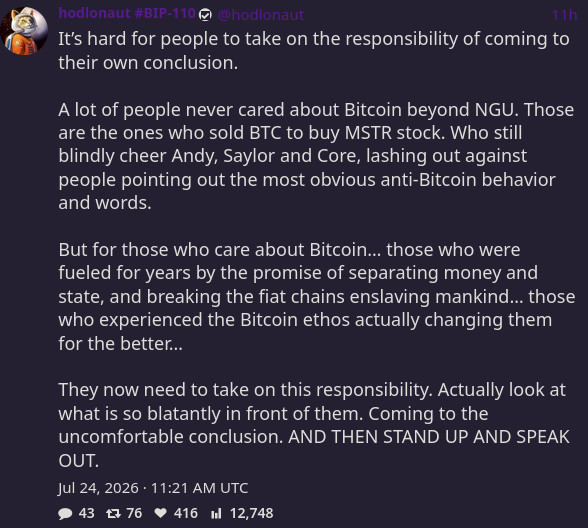
by @hodlonaut
Article One of Four — The Network
citadel21.com/the-network
Article Two of Four — The Lever
citadel21.com/the-lever
Article Three of Four — The Merge
citadel21.com/the-merge
By Dewmap
Since the beginning, individuals with no ethics, no integrity, and no vision of what Bitcoin represents for humanity have tried to infiltrate the ecosystem and profit from the protocol's credibility for their own gain.
First it was altcoins. Then ICOs. Then NFTs. Then tokens. Every cycle brings a new scheme designed to exploit Bitcoin's reputation rather than strengthen its monetary mission.
Bitcoin's greatest defense has never been marketing or personalities. It has always been its uncompromising principles and the node runners who enforce them.
Fundamentally, nothing has changed.
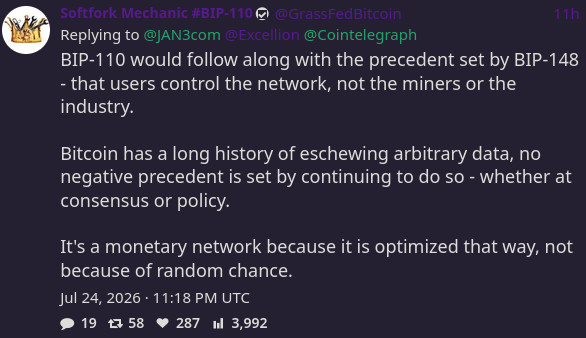
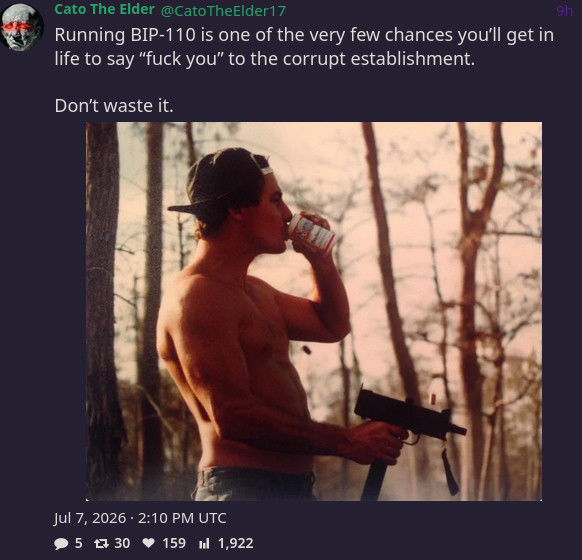
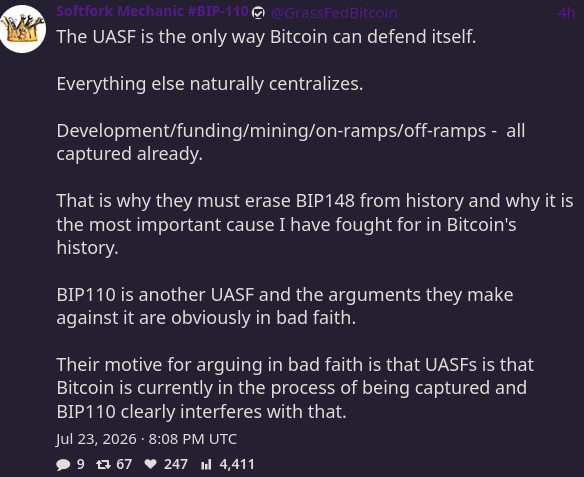
When BIP-110 activates successfully, it shouldn't be seen as a revolution. It should be seen as Bitcoin functioning exactly as designed.
'Will BIP-110 activate? Is a question of, is Bitcoin a reflection of insights in nature and mathematics, is it instead a reflection of something that isn't really aware of the deeper nature of... that is actually the problem.'
- Hunter Beast
I understand that not everyone can understand this.
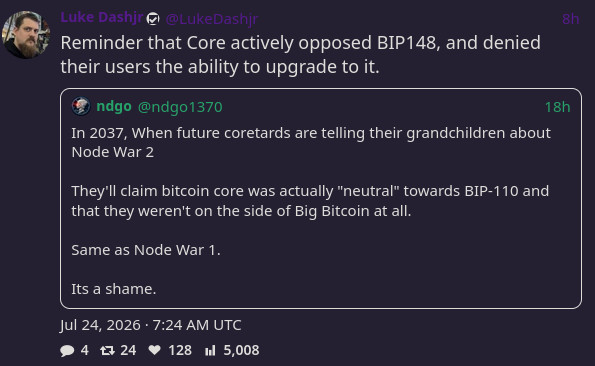
The schooling in reality is coming your way, Coretards.
Enjoy your innocence while it lasts.
Fucking Coretards man.
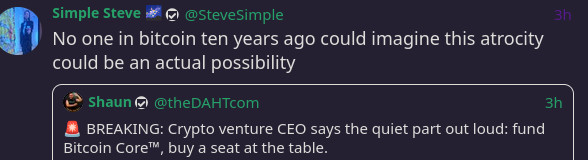
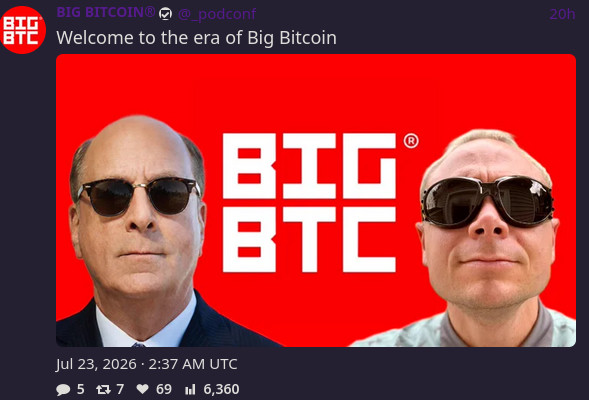
So Coretards are now applauding BlackRock funding the compromised and corrupted Core,
together with Saylor who revealed himself as a fiat maxi and possibly a wannabe spammer.
If Epstein appears tomorrow and says - "Hey, I am going to fund the corrupted and compromised Core too."
they will say "Good idea." and applaud him too.
But wait, the fucking Andy Back already took money from Epstein.
Fucking Coretards man, wtf.





 View quoted note →