BITCOINALLCAPS 🐦 🐦 🐦's avatar
BITCOINALLCAPS 🐦 🐦 🐦
npub1wfvj...vx9a
@BITCOINALLCAPS on Twitter
It’s kinda sad lifestyle politics is what’s gotten in the way of collaboration and harmony for Bitcoin developers. If you all were anon about that shit we could have had something better.
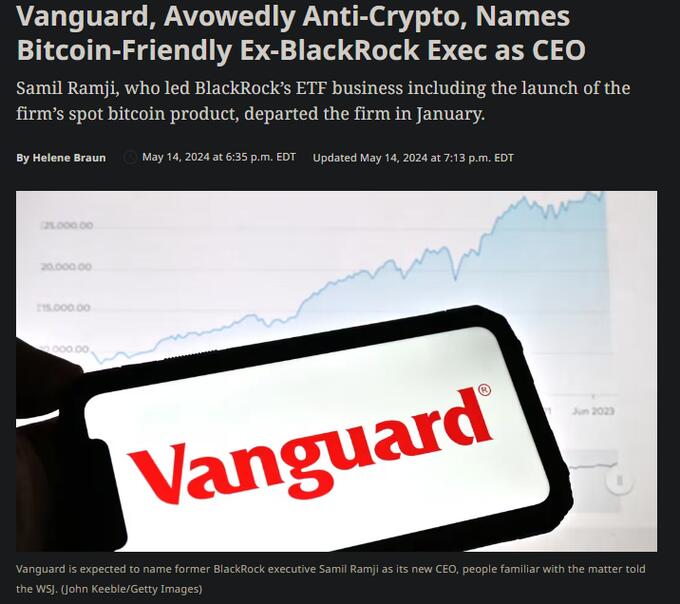
Can we all just appreciate that the Vangaurd CEO was fired for being anti-Bitcoin, forcing his organization to miss out on the Greatest ETF launch in history. And then he was replaced by the person who launched that Bitcoin ETF for Blackrock. Tradfi mutinies over Bitcoin be lit image
I think there's a lot at play here with the saylor dynamic. on one hand bitcoiner love to cheer on a champion for the cause. on the other, this same champion doesn't do the one thing that everyone recommends doing. Self custody your coins. And now he's actively doubting that too. people say this time is different, ETFs are regulated! blackrock is regulated! MSTR is regulated! coinbase is regulated! And yet, all the same things were said of FTX. The lesson of FTX, QuadrigaCX, Celsius, MTGOX and others is that Bitcoin is allergic to trusted third parties. Indeed, it was designed to remove them. It may not happen tomorrow, but a rug pull of these centralized third party honey pots could happen at anytime. And they have happened. Just because the honeypots are now larger and more "institutional" doesn't reduce that risk, or the risk of rehypothecation, which is dilutive to the Bitcoin float ie inflationary ie price suppressing. OK. so the above dynamic sucks. Saylor besmirching self custody while simultaneously promoting MSTR tokens sucks. "bitcoin" Influencers like adam back, samson mow and others promoting MSTR sucks. Self custody is THE mechanism that drives Bitcoin's price discovery mechanism. It's a glacial slow moving bank-walk, one sat at a time, away from third party custodians. Who inevitably create derivative bitcoin tokens that inflate the supply of Bitcoin mechanically, but not technically. This dilutes Bitcoin's price discovery mechanism. Which is why it's important to self custody. Not just for verifying you actually own Bitcoin, but to call out the Keynesians in this space trying to play central banker. The saylor worship needs to stop, the "oh but my 401K" and "but in some situations" coping needs to stop. Saylor doesn't even know if MSTR has Bitcoin. he thinks they do, but they can't verify it without taking custody, which they don't (they give their Bitcoin to coinbase & fidelity who owns it for them.) "oh but ALLCAPS! MSTR can't self custody because they're a corporation!" then how the hell is coinbase doing it? they're a corporation too. "oh, but ALLCAPS! MSTR has a fiduciary duty to it's share holders!" That's what I'm saying! the rug pull risk is far greater with a third party custodian, evidently and historically. MSTR can reduce that risk by self custodying MSTR coins among it's board members, CTO & CFO in a collaborative multisig. And as for you shareholders of MSTR token, I ask you, if saylor can't even verify that they own their coins, how can you? On another note, do you really think you have any say in how those coins are handled, given saylor is the majority shareholder? He could dilute you shares tomorrow and rug pull you legally and you'd have no recourse.
Is Saylor Compromised ? - You Should Buy Real Bitcoin & Self Custody Instead of MSTR or an ETF - Anyone Telling You NOT to is Trying To Sell You Something like an IOU
Article Update: "Satoshis Bitcoin v0.0 Had 1.99 Billion Bitcoin, Not 21 Million" https://medium.com/@Fiach_dubh/1-99-billion-bitcoin-not-21-million-fad9f5550659 After reviewing a few more articles on this topic and the Bitcoin Whitepaper conversation on the cryptography mailing list some more interesting details have merged. Satoshi's last email on the cryptography mailing list, where he publicly says to James Donald, "I sent you the main files". These files were the Bitcoin source code for the first Bitcoin client software. Also, we can see from the Hal Finney private email that the subject heading reads "Re: Bitcoin source files attached" with James, Hal and Ray Dillinger cc'd. Therefore, The private Hal email confirms Satoshi likely sent the Bitcoin source code files to not just Ray Dillinger, but James A Donald and Hal Finney too on November 16th, 2008. Satoshi had apparently been working on this code for more then a year and a half. This likely means Satoshi began working on Bitcoin code in earnest around the middle of 2007. Also, according to the above Bitcoin Insider article "The source (v0.0) also has a discarded genesis block in the code which has a completely different hash. Assuming the hash was the first genesis test block, it was produced on Sept. 10, 2008." This may be an effective timestamp for the date of this v0.0 source code. This implies Satoshi gave these three gentleman an older "version 1" copy of Bitcoin, and not an updated version 2, which could have been v0.1. (In one email Satoshi describes a new Bitcoin feature as a "version 2" issue). Speculation on why Satoshi didn't give these three people the full version 2 details: Well, James A. Donald made it clear in one of his cryptography mailing list emails that he wanted to launch his own Bitcoin version eventually. So maybe Satoshi didn't feel like sharing everything with someone who may front run him to the finish line? originally posted at

Here's an interesting observation that the "satoshi-was-an-academic" theory suffers from: The whitepaper used neither MLA or APA citation formatting, (commonly used university standards). But rather an informal technical documentation style of citing sources. So neither a university student either mayhaps, since this is a 101 university lesson everyone learns.
↑