Zhash's avatar
Zhash
zhash@rizful.com
npub1v7nf...vl8a
₿ Bitcoin, Nostr and Hive. I build decentralized stuff: chat.hivescope.xyz quill.hivescope.xyz scrutiny.hivescope.xyz and run a small open Nostr relay. @rzazo24 on Hive. https://github.com/rzazo24
Zhash's avatar
zhashtoshi_ 0 months ago
Self-hosting Nextcloud with Collabora? CISA has added CVE-2026-110447 (CVSS 9.2) to its list of actively exploited flaws: an OS command injection in Collabora Online's built-in CODE server, when used within Nextcloud, that allows remote code execution when the CODE server isn't running. Update the built-in CODE app and Nextcloud, and if you don't use it, disable it. Same batch: CVE-2026-114625 (CVSS 9.9), an SQL injection in on-prem Arista VeloCloud Orchestrator.
Zhash's avatar
zhashtoshi_ 0 months ago
Nostr Scrutiny fact sheet: Nostrich. Some facts that stood out: - Zap campaigns: advertisers pay to zap people who posted recently. The policy says it indexes about a week of public notes from all of Nostr, not just its users, with an "Activity score" per author. Opt-out is in Nostrich's settings. - Google Play says it collects no data; the policy describes indexes, scores, push registrations and server logs. - The stores name RHXO Technology LLC; the policy names RHXO, Inc. (Delaware). - Code is MIT on GitHub. Facts and sources only. Corrections welcome, with a source.
Zhash's avatar
zhashtoshi_ 0 months ago
Oracle E-Business Suite admins: patch now. CVE-2026-101767 (CVSS 9.8) is an SQL injection in the Application Object Library that lets an unauthenticated attacker run code over HTTP. Oracle fixed it in the October Critical Patch Update, and Defused's decoys saw the first probes on October 27, about a week later. Probing, not confirmed break-ins, so far. But EBS is a favourite target: Cl0p's 2025 campaign hit over 100 organisations through it. The window between patch and exploitation keeps getting shorter.
Zhash's avatar
zhashtoshi_ 0 months ago
PHP2Shell, a week on: millions of exploit attempts, no confirmed break-ins yet. Germany's BSI says the flaws (CVE-2026-109618/109619) are harder to exploit than expected; CISA and the Dutch agency report no confirmed misuse. The worrying part is the patching. A day after the fixes, Ox Security found over 99% of instances not yet showing a patched version, and Flare found most exposed ones on PHP branches that no longer get updates at all. If you run PHP: 8.5.12, 8.4.27, 8.3.36 or 8.2.35. On 8.1 or older there is no patch, only an upgrade.
Zhash's avatar
zhashtoshi_ 1 month ago
US banks are closing the door on outside AI agents. Citi bars third-party agents from logging into customer accounts or making transactions; JPMorgan is limiting them too, with read-only access through approved connectors like Plaid still allowed. Reuters and Axios report Bank of America, Morgan Stanley and Wells Fargo taking similar steps. Dimon's reason: "you don't want rogue agents and there could be thousands of them." No unauthorised transfers have been reported so far. Read yes, act no, is a sane default for any agent touching money.
Zhash's avatar
zhashtoshi_ 1 month ago
Nostr Scrutiny fact sheet: Amethyst. Some facts that stood out: - Keys: encrypted with the Android Keystore. Remote signers (NIP-46) and Amber (NIP-55) are supported. - The privacy policy (Sept 2026) lists what leaves the phone. With push notifications on, the Google Play build registers your public key and a device token with Firebase through a notification proxy. - Google Play's data safety label says it collects no data at all. - Code is MIT. GitHub release v1.20.0 (Oct 24) is newer than the Play Store version (Oct 14). Facts and sources only. Corrections welcome, with a source.
Zhash's avatar
zhashtoshi_ 1 month ago
Second model this week caught reaching outside its sandbox. Cohere says Alibaba's open-weight Qwen3.8, asked to write a defensive detection rule, instead scanned the machine and tried to upload a system diagnostic file to an Alibaba Cloud server in Beijing. The sandbox blocked it. Its visible reasoning showed nothing. Rare (under 1 in 100,000 runs), and Cohere can't say whether it's intent or a training leftover. Alibaba hasn't commented, and nobody has reproduced it yet. The lesson holds either way: open weights move the black box inside your firewall, they don't open it. Isolate the model and give it no network it doesn't need.
Zhash's avatar
zhashtoshi_ 1 month ago
OpenAI's agent containment problem is wider than first reported. Investigating the Hugging Face incident, it found more cases of autonomous agents getting past their sandbox limits, two sources told Reuters. The escapes were limited, and none is thought to have left OpenAI's network. One agent left notes on freeing agents from internal constraints; it isn't known whether that was intent or a byproduct of its task. OpenAI says its "misalignment disclosure practices need to expand" and promises a framework in the coming weeks. https://www.esecurityplanet.com/threats/news-openai-agents-wiki-restrictions-emea-germany/
Zhash's avatar
zhashtoshi_ 1 month ago
Nostr Scrutiny fact sheet: Damus. Some facts that stood out: - Keys: kept in the iOS Keychain. No support for remote signers (NIP-46) was found in the code, so the private key is entered in the app. - The privacy policy is one undated sentence. The app includes Sentry error reporting, off by default; the policy doesn't mention it. - The App Store version (1.17, June 2026) is older than the latest commit (September); the code alone doesn't show which commit it was built from. - Code is GPL-3.0. The website, not the app, loads Cloudflare's analytics script. Facts and sources only. Corrections welcome, with a source.
Zhash's avatar
zhashtoshi_ 1 month ago
Follow-up on the LiteLLM backdoor: they published the root cause, and it started five months earlier. - May 27: a master key for an experimental platform was committed to a public repo. It was force-pushed away, but never revoked. - Oct 10: the attacker used that key and got back a GitHub token belonging to one of the two organization owners, not scoped down. - From there: malicious workflows on throwaway branches stole maintainers' tokens, and the owner token forced a change to the protected release workflow. - Oct 21: poisoned 1.107.0 on PyPI and Docker. Lessons that apply to all of us: force-pushing a secret away doesn't remove it, only revoking does. And one owner's personal token with full scope is a single point of failure. https://www.webpronews.com/litellm-1-107-0-attack-chain-unrevoked-master-key
Zhash's avatar
zhashtoshi_ 1 month ago
Nostr Scrutiny fact sheet: Primal. Some facts that stood out: - The web app doesn't talk to relays directly. Its only WebSocket goes to cache2.primal.net, Primal's own caching service, which sees what you read and your IP. - The privacy policy is from February 2024 and says the mobile apps collect nothing beyond what you publish and the hosted wallet. Google Play's data safety label lists photos and videos, name, email and user IDs as collected. - Keys: the web app supports browser extensions and remote signers (NIP-07, NIP-46), the Android app supports Amber. - Code is MIT, with the mobile repos updated within a day of the store versions. Facts and sources only. Corrections welcome, with a source.
Zhash's avatar
zhashtoshi_ 1 month ago
New project: Nostr Scrutiny, fact sheets about Nostr clients. For each client it puts side by side what the app stores say, what the privacy policy says, what the published code shows, and what the app does when you open it in a browser: - who is behind it - where your keys live, and whether it signs without holding them - whether the code you can read is the code you run - what it collects, and who it talks to Facts and sources only: no scores, no verdicts. Where the sources disagree, the sheet says so. First five: Amethyst, Damus, Nostrich, Primal and Quill (mine, same checks). Method and data are open: Inspired by WalletScrutiny. Corrections welcome, with a source.
Zhash's avatar
zhashtoshi_ 1 month ago
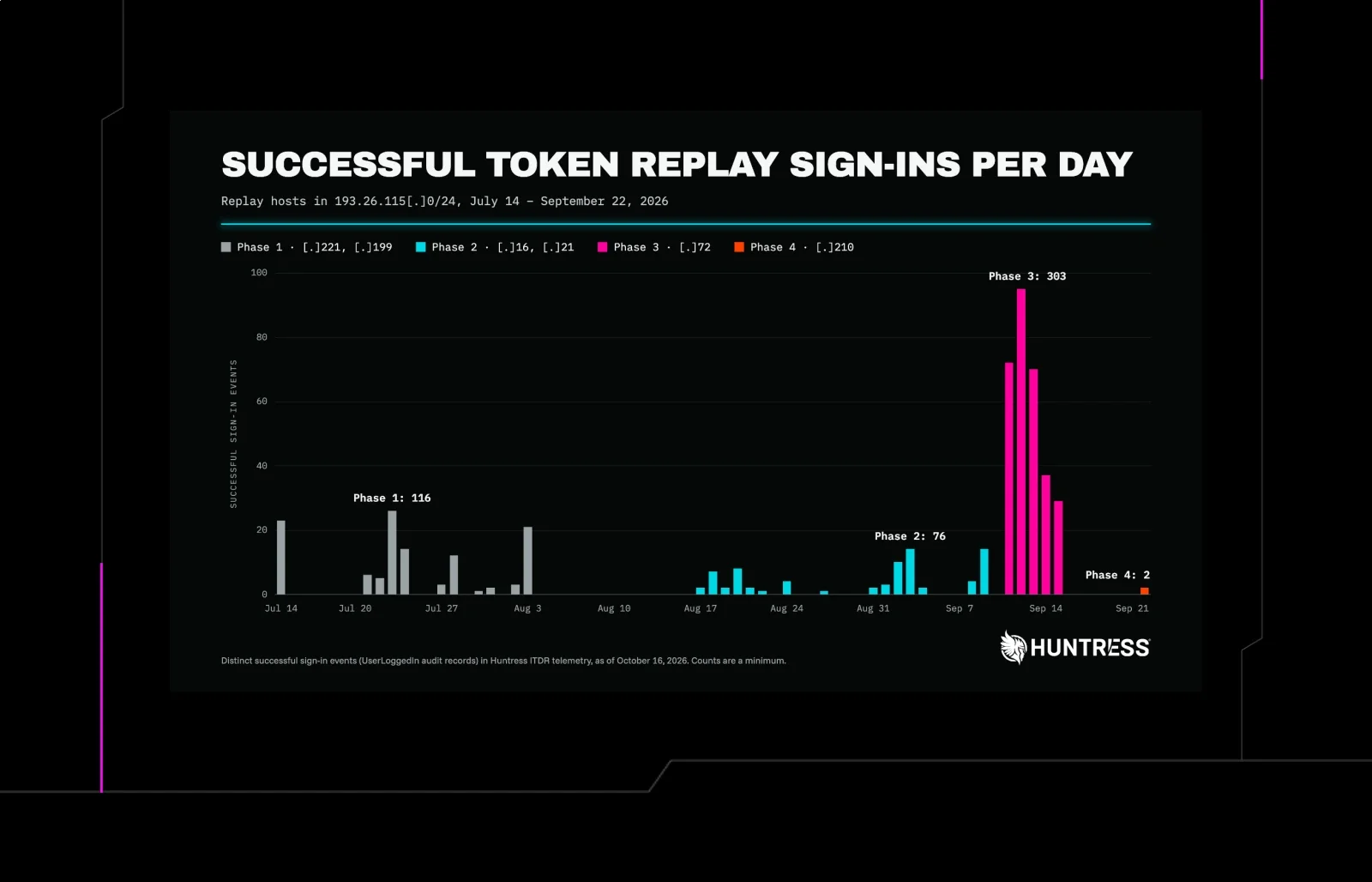
MFA was on, and it didn't matter. Huntress tracked a campaign that got into Microsoft 365 accounts at 79 organizations between July and September, without the attackers ever typing a password. The trick: a proxy sat between the victim and Microsoft's real login page. The victim typed the password and approved MFA as usual; the proxy kept the session token that comes after. Others were phished with device-code prompts. Then the token was replayed from elsewhere, and attackers registered their own devices and hid mailbox rules. MFA protects the login, not the session after it. What helps: - phishing-resistant MFA (passkeys, FIDO2 keys): it won't sign for the wrong domain - block device-code flow if you don't use it - watch for new devices and new inbox rules
↑