The most effective way of making everybody serve the single system of ends toward which the social plan is directed is to make everybody believe in those ends. To make a totalitarian system function efficiently, it is not enough that everybody should be forced to work for the same ends. It is essential that the people should come to regard them as their own ends. Although the beliefs must be chosen for the people and imposed upon them, they must become their beliefs, a generally accepted creed which makes the individuals as far as possible act spontaneously in the way the planner wants. If the feeling of oppression in totalitarian countries is in general much less acute than most people in liberal countries imagine, this is because the totalitarian governments succeed to a high degree in making people think as they want them to.
- F.A. Hayek
Once you admit that the individual is merely a means to serve the ends of the higher entity called society or the nation, most of those features of totalitarian regimes which horrify us follow of necessity. From the collectivist standpoint intolerance and brutal suppression of dissent, the complete disregard of the life and happiness of the individual, are essential and unavoidable consequences of this basic premise, and the collectivist can admit this and at the same time claim that his system is superior to one in which the "selfish" interests of the individual are allowed to obstruct the full realization of the ends the community pursues.
- F.A. Hayek

The principle that the end justifies the means is in individualist ethics regarded as the denial of all morals. In collectivist ethics it becomes necessarily the supreme rule; there is literally nothing which the consistent collectivist must not be prepared to do if it serves "the good of the whole," because the "good of the whole" is to him the only criterion of what ought to be done. The raison d'état, in which collectivist ethics has found its most explicit formulation, knows no other limit than that set by expediency -- the suitability of the particular act for the end in view. And what the raison d'état affirms with respect to the relations between different countries applies equally to the relations between different individuals within the collectivist state. There can be no limit to what its citizen must be prepared to do, no act which his conscience must prevent him from committing, if it is necessary for an end which the community has set itself or which his superiors order him to achieve.
- F.A. Hayek
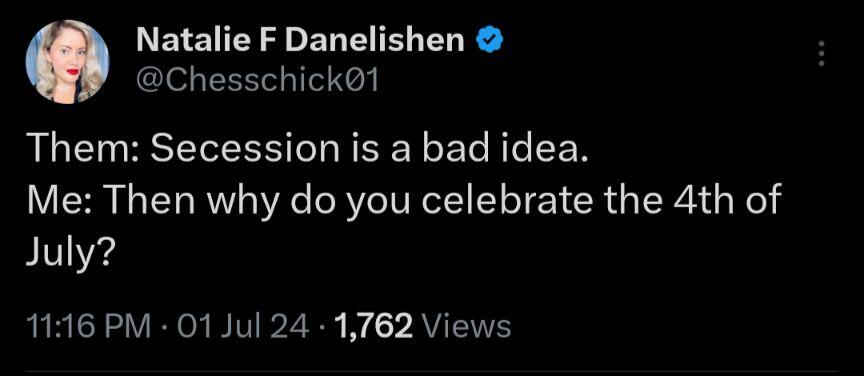
Once one concedes that a single world government is not necessary, then where does one logically stop at the permissibility of separate states? If Canada and the United States can be separate nations without being denounced as in a state of impermissible ‘anarchy’, why may not the South secede from the United States? New York State from the Union? New York City from the state? Why may not Manhattan secede? Each neighbourhood? Each block? Each house? Each person?
- Murray Rothbard
Secession is a peaceful means of minimizing political violence and allowing different groups of people to live under different political systems.
What our generation has forgotten is that the system of private property is the most important guaranty of freedom, not only for those who own property, but scarcely less for those who do not. It is only because the control of the means of production is divided among many people acting independently that nobody has complete power over us, that we as individuals can decide what to do with ourselves. If all the means of production were vested in a single hand, whether it be nominally that of "society" as a whole or that of a dictator, whoever exercises this control has complete power over us.
- F.A. Hayek
The control of the production of wealth is the control of human life itself.
- Hilaire Belloc
Love peace more than you love force, conflict, compulsion, and intolerance. Work toward a society in which individuals choose to do right because they want to, not because they’re forced to.
— Lawrence W. Reed
The point which is so important is the basic fact that it is impossible for any man to survey more than a limited field, to be aware of the urgency of more than a limited number of needs. Whether his interests center round his own physical needs, or whether he takes a warm interest in the welfare of every human being he knows, the ends about which he can be concerned will always be only an infinitesimal fraction of the needs of all men.
This is the fundamental fact on which the whole philosophy of individualism is based. It does not assume, as is often asserted, that man is egoistic or selfish or ought to be. It merely starts from the indisputable fact that the limits of our powers of imagination make it impossible to include in our scale of values more than a sector of the needs of the whole society, and that, since, strictly speaking, scales of value can exist only in individual minds, nothing but partial scales of values exist--scales which are inevitably different and often inconsistent with each other. From this the individualist concludes that the individuals should be allowed, within defined limits, to follow their own values and preferences rather than somebody else's; that within these spheres the individual's system of ends should be supreme and not subject to any dictation by others. It is this recognition of the individual as the ultimate judge of his ends, the belief that as far as possible his own views ought to govern his actions, that forms the essence of the individualist position.
- F.A. Hayek
It is no exaggeration to say that if we had had to rely on conscious central planning for the growth of our industrial system, it would never have reached the degree of differentiation, complexity, and flexibility it has attained. Compared with this method of solving the economic problem by means of decentralization plus automatic coordination, the more obvious method of central direction is incredibly clumsy, primitive, and limited in scope. That the division of labor has reached the extent which makes modern civilization possible we owe to the fact that it did not have to be consciously created but that man tumbled on a method by which the division of labor could be extended far beyond the limits within which it could have been planned. Any further growth of its complexity, therefore, far from making central direction more necessary, makes it more important than ever that we should use a technique which does not depend on conscious control.
- F.A. Hayek
The first lesson of economics is scarcity: There is never enough of anything to satisfy all those who want it. The first lesson of politics is to disregard the first lesson of economics.
- Thomas Sowell