TicketMaster’s monopoly is quite an interesting case. Most examinations don’t show a regulatory moat, they just acquired/merged their way to dominance with main tool being protectionist contracts (we cease services if you ever use a competitor). However, dig more and there are multiple regulations they exploited to retain dominance:
- Claiming copyright over etickets to prohibit 3rd party secondary markets and private resale.
- BOTS act 2016 both inhibits touts (secondary market makers) and is costly to implement for firms.
- price floor laws (in some locales) prevent others from undercutting
- GDPR (and equivalent) has been costly to implement for these consumer data intensive services.
There are always laws, often ‘consumer protection’ oriented like the above, which get exploited by the large to crush the small and become the giant.
I don’t have enough info yet to claim it was these laws which enabled TM/LN’s malignant monopoly, but they obviously helped and my suspicion is always that regulatory moats are essential.
Does any one have more insights in the case? View quoted note →
Oscar Pacey
npub1fam4...azhv
Consultant
I haven’t read about the TicketMaster (Oasis) saga yet. I’m aware they are monopolistic already, and now it’s obvious from the outrage that there is dissatisfaction in the market with their practices. Am I going to find a regulatory/legal moat they exploited?
If the UK removed all taxes and replaced them with a VAT (consumption tax), they would maintain annual tax revenues by setting that VAT rate to about 37%.
Imagine how much simpler life and politics would be.
Taxes aren't just funding, they are also behavioural nudges so this would increase work, and decrease consumption (assuming taxes do indeed have such effects). Most people would say that's a desirable outcome.
Critics argue that this scheme costs poor people more as more of their wealth is used on spending. They are wrong, because everyone employs all available capital. The VAT rate would apply to ALL transactions not just those VATable currently, so, add in real estate, securities & commodities transactions, charitable donations, etc and now it's not regressive.
The really big surprise is that when you broaden the scope of VAT in that way, the universal rate falls from around 37% to under 10%.
Reduce HMRC to a few interns (VAT collection is easy). Reduce all politicking down to 'how to spend' from 'how to levy and spend'.
What's the caveat? We would disrupt our competitiveness on the internal market for better and worse depending on sector. The UK financial sector is smaller than it was but still dominant domestically and a 9% transaction tax might wipe out that sector.
Why don't governments do this (not just uk)?
I think it's because they want the complexity. They want levers to pull, and dominions to manage. They aren't there to run infrastructure - they are there to run the country as a business and compete with other Nation PLCs - we, the people, are staff.
The UK already taxes unrealised income
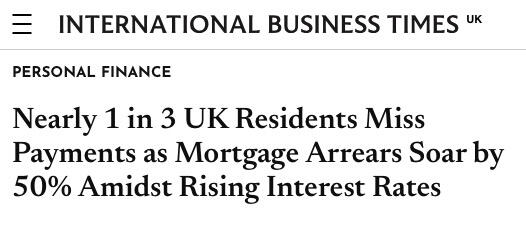
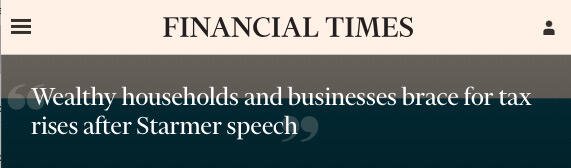
Four UK headlines from yesterday:
- Will tax homeowners & investors
- Mortgage delinquency up 50%
- Hawkish base rate outlook
- Home builders devalued
Pledges were for +1.5m homes and productivity 📈
Truss tried the opposite
Damed if you do/dont
Centralised meddling isnt helping


“Tech neutral” sounds like a sensible position for business leaders and regulators too. It’s an often repeated phrase - and not a helpful one. Two different techs can rarely substitute one another to fulfil some purpose without quite distinct utility and externality profiles.
UK public debt calcs:
GDP: £2.3t
Debt: £2.5t
D/GDP ratio: 109%
Tax rev: £0.9t
Spending: £1t
Deficit: £0.1t
Pay back period = ∞
If we balance budget, cut spend to £0.9t:
Pay back period = ∞
For a 50y back back, cut spend by 13.5% from £1t to £0.865t = -£135bn/yr
∴ inflation
@calle looks like you’ve come up with a nice answer to this question with NWS:
View quoted note → View quoted note →
Please recommend Nostr clients built for chat rooms with equivalent functions to Matrix/Elements, Discord or Slack.
Ideally an application not a website.

Server 1 has an encrypted boot drive
Server 2 has the decryption key
Server 1 boot loader can authenticate to the remote server 2 and retrieve the key.
Q) What is the best thing server 2 can be?
An HSM probably but with a sensible budget?
A password manager server?
Some sort of enclave?
Something better?
What would you do there? View quoted note →
I used to post like this.
I still do.
But I used to too.
Views on private DNS?
Standard DNS is unencrypted and for most people used as a cloud service. Thus every URL (specifically, domain name) sought is sent first to your DNS host so it may be resolved to an IP address. This gives your DNS provider and any man-in-the-middle, a live and timestamped historical log of every service you visit.
DNS-over-TLS (DoT) is an encrypted version of the same thing. This takes away the eavesdropping risk of a man-in-the-middle.
DNS-over-HTTPS (DoH) is the same as DoT but transports over HTTPS.
DoH offers better obfuscation by hiding in a larger anonset (HTTPS traffic), and as it uses port 443 it can't be admin blocked without also blocking web traffic (HTTPS).
However neither DoT nor DoH protect from Man-In-The-Backdoor attacks - in other words, the DNS provider, their regulators, hackers and rogue employees still see all.
ObliviousDNS (ODoH)is a nice-ish upgrade. It splits DNS resolution services into a two party service:
User sets up an HTTPS channel with a Target DNS provider.
User send packets for that target *via* a proxy service as a router.
- As a router, the proxy knows the user's IP address, but not the contents of the packet.
- The target can decrypt the HTTPs packet but does not know from where it came.
Not bad! However this dissociation degrades back to plain DoH if the proxy and target collaborate.
Most companies currently supporting ObliviousDoH are large US tech firms and so of course are in direct reach of the US intelligence agencies. They also know who to call for every historical request they've processed together to complete the picture.
So what would be better? Could we take inspiration from Tor or maybe Dandelion routing in Bitcoin?
Perhaps we should just use Tor?
One option which improves all of the above it to run your own DNS server locally. This will still need to talk to other, remote, untrusted DNS servers to source its lookup table info, but importantly it will cache it locally, limiting the amount of metadata sent externally.
I don't think Unbound (a local DNS cache) can be configured to randomly make its requests of a long list of DNS relays - which is a shame as that would help shard the metadata footprint of your IP address.
An idea for a work around of ODoH's faults could be to run your own proxy server in a compute cloud, ideally a provider which doesn't take ID info (pay with bitcoin). Connect to that via SSH tunnel, and have it send the ODoH packets out to target services. It could also very frequently change its own IP address so the target does not realise requests are coming from the same source.
What do you think? What's the best practical means to achieve DNS privacy? 

The beast wallets are hot wallets
Roses are red,
Violets are blue
But flowers aren’t for you,
So don’t you think insects,
Appreciate beauty too? 

Sell in May and go away?
Here are the past 10 years of BTCUSD price time series overlaid on one another, to help us identify whether there is any discernible pattern in May each year.
Orange vertical line = 1st May
Hmm, not sure.
Next note in 🧵for another view... 

If you don't know what a catch-all email configuration is, please look it up or ask me here and I will explain.
It is cyber life changing.
Thanks to @TakensTheorem for answering this:
“Transient local negentropy.” View quoted note →
What’s the word for the emergent order of the natural universe we are part of which stands adjacent to the entropy or emergent chaos of the same universe?