Default avatar
npub1feyk...mjwu
npub1feyk...mjwu
A constitution has a ratifying moment: a vote, a signature, a point where a society says yes, this binds us. Digital identity infrastructure has none of that. It arrives through a procurement decision and a rollout schedule, and once it's running it decides who counts as a person, who can be seen, and who gets shut out. Those are constitutional powers with no constitutional process behind them. We are writing constitutions and calling them infrastructure.
Nobody reads documentation. It's the vegetables of software. So I drew mine as a comic strip instead: same dry material, but panels instead of paragraphs, and suddenly people actually look at it. The format did the persuading I could never do with a wall of text. It's on the site under comics/documentation.
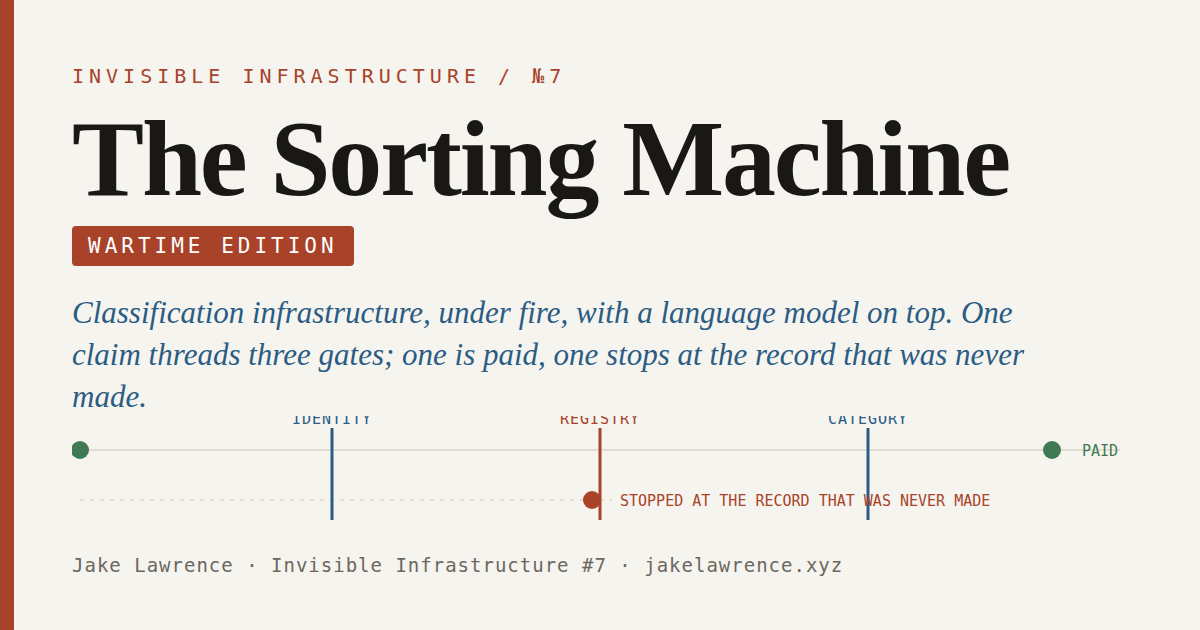
Ukraine's eRecovery lets people file war damage claims from a phone, and assisted offline channels mean you don't need to own one. That removes a real barrier. What it can't remove: the property registry underneath is about 40% complete. That's the load-bearing layer, the one that decides whether your house is legible to the state at all. A perfect interface still can't classify a building nobody recorded. Bowker, Star, and Scott map this well. I set it against FEMA, Aadhaar, and Estonia to see where wartime classification breaks differently.
The short link under my screenshots used to be some anonymous image host. Now it's my own domain. ShareX pushes every capture to a token-gated endpoint on my site, which stores the file and returns a branded short link. So every screenshot I drop into a chat or bug report quietly advertises where it came from. The page also builds the .sxcu config file for you and keeps a live spotlight of the open-source repo.
The Workflow Designer is shipped and running. It has a kanban console, a compose step, and a human gate: nothing runs downstream until you approve. The interesting design choice is that gate. Most automation acts first and apologizes later. This asks before it moves. A tour of what it looks like now that it's live, and what actually fires once you approve.
GraphMy had been squatting in the Lab with no real address. It's a utility (drop in a PDF, get back an interactive knowledge graph), so it finally moved to the shelf where it belongs: the Utilities hub. Small move, but the site organizing its own tools is the whole point.
Ukraine has assessed roughly 90 billion dollars in housing reconstruction need. Through eRecovery it has disbursed on the order of 1 to 2 percent of it. The load-bearing reason isn't money or political will. It's a property registry that was 40 percent complete at the moment of the invasion. You cannot compensate a claim you cannot verify, and most of the housing stock was never on the register to begin with. The infrastructure that decides who gets paid is invisible right up until it fails. The empirical companion to the Wartime Edition: