Sometimes, what starts as an innocent attempt to photograph some adorable wood ducklings can take a sudden, grim turn. These little ones, already vulnerable without their mother, stood little chance on their own.
From the perspective of the hawk—who will soon enter the frame—this is an opportunity too good to pass up. With no mother duck to defend them, the raptor is free to make her choice from the unguarded brood. As the slow-motion footage shows, she initially attempts to grab two at once, but ultimately settles for just one.
It’s important to remember: the hawk, too, has young to feed. As difficult as it may be to witness life end so abruptly, this is not a flaw in nature’s design, but an essential part of it. Nature runs on cycles of survival, predation, and loss—a reality that, while harsh, is fundamental to the ecosystem’s balance.
[📹 sean_isnt_rich]
Feeding baby penguins
[🎞️ AI]
Hurry up, dinner’s almost ready! 😋
The aerodynamics of a cow.
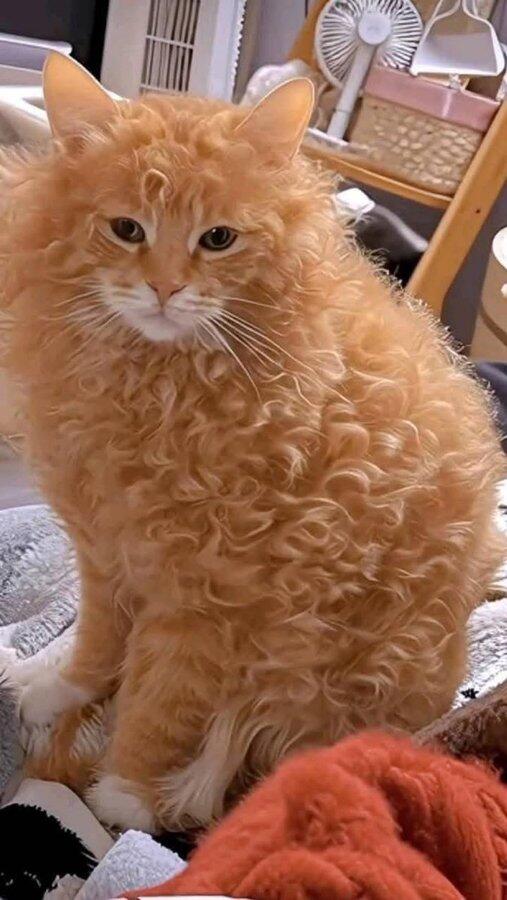
If you had him, what would you call him?
Male Sympetrum fonscolombii
[📹 malbafont_macrophotography]
A deceased whale—likely a humpback—releases gas for the final time, violently expelling its rotting internal organs into the sea.
These dramatic explosions are unique to whales, as most decomposing animals can't contain the buildup of internal gases after death. In whales, methane accumulates as their organs break down, trapped by thick muscle and layers of blubber.
The process is intensified because a whale’s exterior often decomposes more slowly than its interior, especially in cold ocean waters—creating the perfect conditions for an eventual rupture. Once the internal pressure reaches a critical point, the gas finds the weakest spot to escape, leading to a spectacular detonation.
The only way to prevent such an explosion is to perforate the whale’s thick skin in advance—no easy task in the open ocean.
[📹 ozzymansvideolicensing]
The incredible geometry of a pufferfish skeleton.
This unique structure enables them to rapidly fill with water when threatened, inflating their bodies while raising sharp spines to ward off predators.

Absolutely adorable! 🫏😍❤️
Tawny Frogmouth 🦉👁️🪵 — masters of disguise in the bird world. With their mottled feathers and tree-branch posture, they blend seamlessly into their surroundings, making them nearly invisible by day. Nature’s ultimate stealth experts!
Scincus scincus, also commonly known as the sandfish skink.
[📹 mounia_2024m]
This pufferfish has eyes that sparkle like galaxies
[📹 oceanlife us]
This tortoise understood it can go much faster with the help of a vehicle: it also learned how to make effective turns.
[📹 Mh0MLiErcV8E97C]
The unique walk of this male antelopes to attract females in breeding season.
Drop your caption in the comments! 😍
This is how a sand viper conceals itself to ambush prey.
[📹 Javier Aznar]
A red-tailed hawk steadying its head to keep its focus on prey while hovering in gusty winds.
[📹 Bill Bryant]
The white tiger is a variant of the Bengal tiger, caused by genetic mutation known as leucism.
Being a recessive mutation, these tigers are extremely rare.
[📹 riku_0710]
A compilation of dogs and dolphins being friends
This is why orcas are the apex predator of the ocean
