
Leo Wandersleb's avatar
Leo Wandersleb
leo@nostr.info
npub1gm7t...8rf6
https://walletscrutiny.com https://nostr.info Working on Bitcoin, Nostr and being a good dad.
Leo Wandersleb's avatar
LeoWandersleb 3 months ago
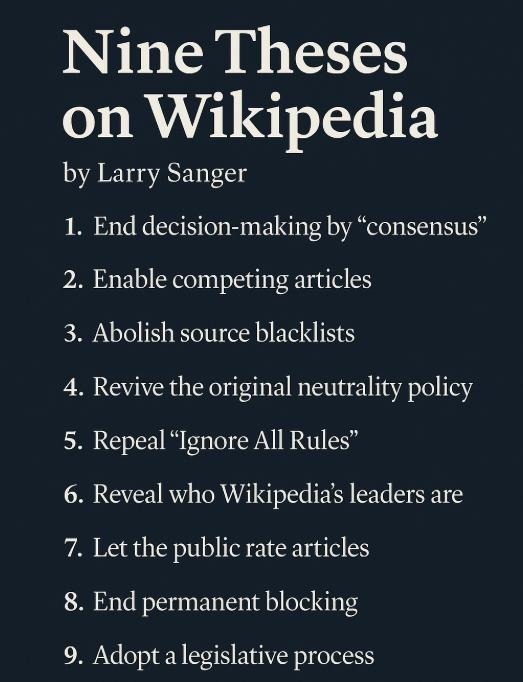
View quoted note โ†’ https://wikifreedia.xyz/ still works but @fiatjaf and others are undecided about switching the markup language once again. Can we get Larry Sanger, Co-founder of Wikipedia on board? He's still too modest in his approach and thinks Wikipedia can be fixed from within but he's thinking about competing articles on any subject, too.
Leo Wandersleb's avatar
LeoWandersleb 3 months ago
Hear me out, why don't we just use a spam filter proxy? The datacarriersize debate has people switching to Knots exposing themselves to thousands of poorly reviewed lines of opinionated code. Why not add a lightweight proxy in front of Core. - Filters datacarriersize, dust, standard scripts, fee rates - Rate limits per peer - Syncs block height every few blocks - Passes UTXO/mempool checks to Core Keep Core's well-reviewed consensus code. Add your own spam filtering without the baggage. Actually, policy rules that only need the transaction itself don't need to live in 500k lines of consensus-critical code. When #libConsensus?
Leo Wandersleb's avatar
LeoWandersleb 3 months ago
Here's some history of Bitcoin Policy changes that were controversial at the time: Basics: Policy is not Consensus. Satoshi's first client did not relay all transactions that were valid according to consensus. This is necessary so an attacker cannot just flood the network with zero fee (consensus valid) transactions to himself at no cost to him but high cost in bandwidth and CPU to all nodes. Still, even the the early policy filters led some to shout "censorship" when trying out things that were consensus-valid. 2013 the Dust Limit was introduced. Transactions sending 1sat to somebody were not relayed anymore. While this was a reaction to "Satoshi Dice" which permanently spammed the UTXO set with "notification transactions", it also forced other projects like "Colored Coins" back to the drawing board. 2014 OP_RETURN Data Carrier Size Limits were introduced. Before, OP_RETURN accidentally allowed spending any funds on chain which was fixed in 2010 by Satoshi, establishing the OP_RETURN as we know it today. It was limited to 40B (8175c79) and then 80B (a930658) via Policy. 2016 Replace-by-Fee (RBF) was introduced. Before that and especially in the early days, users assumed transactions to be final when they showed up in their mempool aka "wallet". "first-seen-safe" was a thing and shaking that up was perceived as an attack on Bitcoin by many. In 2016, RBF wasn't even activated for all transactions. It was an opt-in feature but still, emotions ran high. 2017 the concept of "Priority Transactions" was removed. Up until then, transactions with no fee at all were relayed and actually mined if they were "priority transactions" meaning for example to spend from old enough UTXOs. 2022 Full-RBF was introduced, enabling any unconfirmed transaction to be replaced. This somewhat revived the FUD from 2016. 2025 OP_RETURN is scheduled to be opened up to 100kB which sits at the core of the recent "Knots vs. Core" drama.
โ†‘