Portracker — an open source self-hosted real-time port monitoring and discovery tool
I'm using this tool to identify which docker container ports are published or exposed (from the container) as well as which internal ports are available on your containers. This tool helps see where there may be port clashes, which ports are exposed and could be hidden, and helps find an available port to use for new containers. It has various ways of sorting, filtering and grouping the ports view.
Yes you could track all your open and internal ports in a spreadsheet, but if you have 40 or 50 containers running, and spin others up and down, it gets difficult to keep that spreadsheet up to date. Portracker gives you a live view of all system ports, and docker published and internal ports.
I also spend a few minutes explaining how and why docker ports are exposed, and how you would point to them from a reverse proxy such as Nginx Proxy Manager or your PC on your LAN.
Watch
#technology #opensource #selfhosting #docker #networking
Danie
danie@nostr.fan
npub1g2jp...yjj6
Testing out new the noStrudel web client
10 tricks you can do with FFmpeg on Linux
FFmpeg is an incredibly powerful piece of software and often sits in the background powering many graphics and audio conversion apps we use. So you may not know it, but you very likely are already using it.
This linked article though shows a couple of command line executions you can run with it to quickly:
* Play a video from the terminal
* Get media info
* Record your screen
* Extract images from videos
* Convert images into videos
* Convert videos into MP3s or GIFs
* Add subtitles to movies and shows
* Rebuild a video's index without transcoding
* Resize videos
* Trim and crop videos
It runs across Linux, Mac OS X, Microsoft Windows, the BSDs, Solaris, etc. under a wide variety of build environments, machine architectures, and configurations.
See 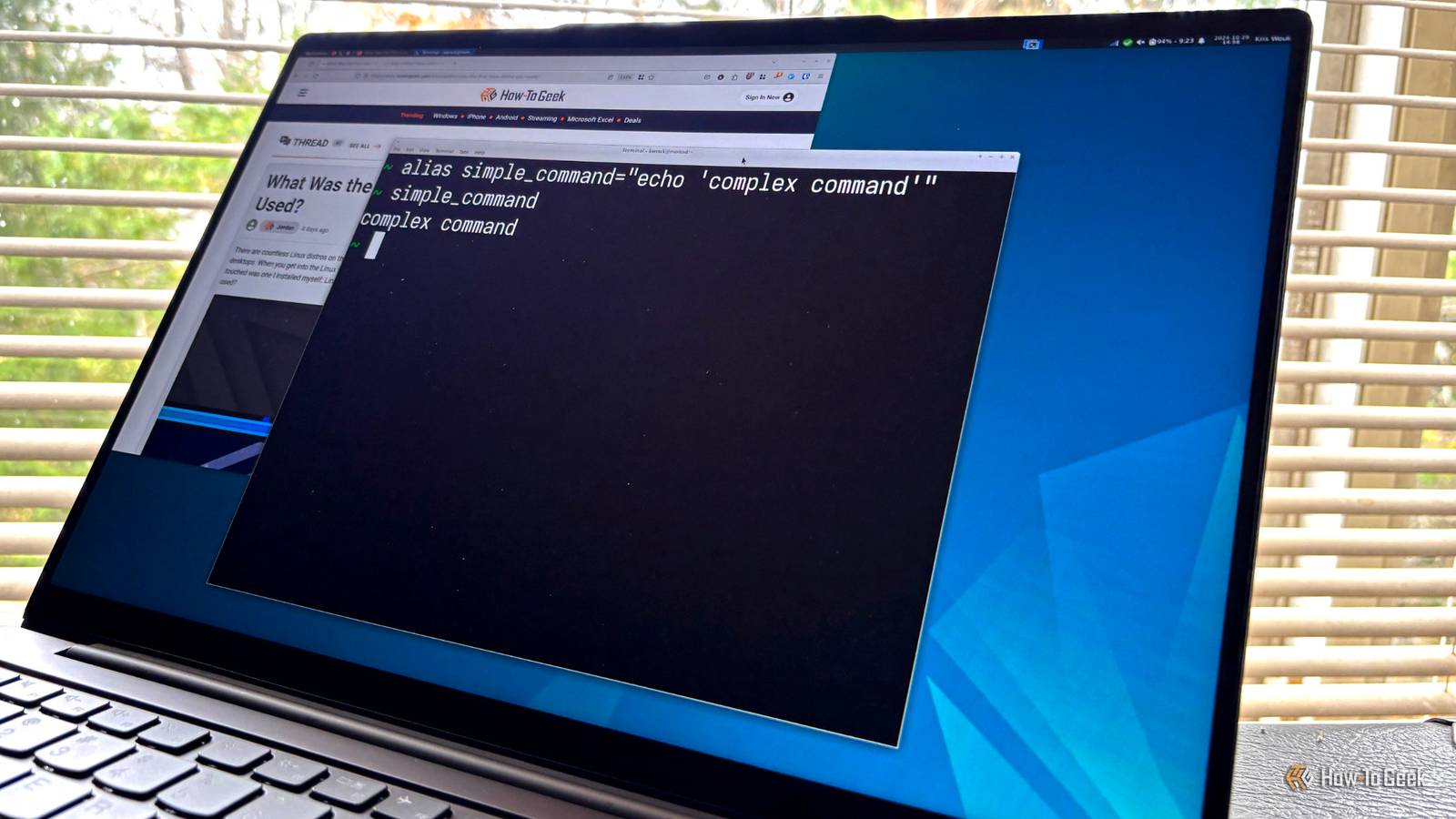 #technology #video #audio
How-To Geek
10 tricks you can do with FFmpeg on Linux
FFmpeg is way cooler than it sounds.
More than 800 gamers took an exam to prove they could complete an '80s adventure game without peeking at a walkthrough—and only 2 passed
“Designed by developer Woe Industries, the AGAT challenged players to complete an '80s adventure game without using a walkthrough. Players weren't told what adventure game they'd be playing in advance, and they were monitored via webcam and microphone by a legitimate online proctoring software to determine if they were looking up hints on a second window, using their phones to cheat, or getting help from someone off-screen.”
I remember playing Leisure Suit Larry, Police Quest, etc back in those days, probably then on my Commodore C64 or Amiga. These were more difficult than Doom as you did have to think quite a bit. These games seemed advanced back then as prior to these it was text adventure games without any graphics. Also, no Google Search so you sat for hours being stuck somewhere in the game until you got past the block.
The linked article also has a link to a Twitch stream of the game during the test. Needless to say I already thought I knew where the key was, and see I was right.
Back then it was not about the fancy graphics, it was about the storyline, the puzzles, etc.
See  #technology #gaming #retro
PC Gamer
800 gamers tried to beat an
Only .25% completed the AGAT: the Adventure Game Aptitude Test, designed by fiendish developer Woe Industries.
No surprise: Meta Workers Say They’re Seeing Disturbing Things THROUGH USERS’ SMART GLASSES
“And regardless of the wearer’s intention, much of the footage being recorded by the glasses is being sent to offshore contractors for data labeling, a widely-used preprocessing step in training new AI models in which human contractors are asked to review and annotate footage. It’s a laborious and highly resource-intensive process that tech companies often gloss over when discussing the prowess of their latest AI models. The reality can be messy. Meta contractors based in Nairobi, Kenya, told Swedish newspapers Svenska Dagbladet and Göteborgs-Posten in a recently published joint investigation that they’re being told to review highly sensitive and intimate data.”
Yes, I know this is no surprise when it comes to Meta (Facebook). I stopped using WhatsApp when they changed the T&C's to allow sharing of metadata to partners. So this is fully in line with how Meta operates, and they and much of Big Tech, are harvesting what they can for AI.
It's why you want physical shutters over any camera/webcams, you want to rather use open source software where you can, and you want to pay otherwise for what you use.
What is becoming clear though, is we want to be wary of terms and conditions, free services powered by adverts, Big Tech/AI driven software. It is one thing for a company (say like Apple) to harvest data and keep it to themselves to improve products, but it is a completely different thing when the likes of Meta actively share the data out to contractors, partners, and advertisers.
What we are also starting to realise is it does not stop for those parties, it also ends up with governments, whether friendly or not. Governments are also unlikely to shut down an excellent source of information for themselves.
Personally I would not touch anything that is sold, managed, or given away by Meta. They have shown themselves to be the worst of the worst, consistently over many years. They survive though because we as consumers still have accounts and use them. I know many don't log in anymore to Facebook, but those numbers still support advertisers who pay them. In theory, we could pull the rug out from under them, but in practice the network effect is still incredibly powerful.
See  #technology #privacy
Futurism
Meta Workers Say They're Seeing Disturbing Things Through Users' Smart Glasses
Meta contractors in Kenya told two Swedish newspapers that they're being told to review highly sensitive footage recorded by smart glasses.
The US has ordered its diplomats to lobby against foreign data privacy laws that could limit American tech firms
“The US administration has ordered US diplomats to lobby against attempts to regulate American technology companies’ handling of foreigners’ data, saying in an internal diplomatic cable that such efforts could interfere with AI-related services.”
If this is true, it is going to have exactly the opposite effect to what was intended. The way I read that is, AI is being used to suck up as much private and corporate data as possible, and implementing digital sovereignty is going to impact that suction force.
As mentioned before, when it comes to the US specifically, there are the US CLOUD and PATRIOT Acts, which govern any US company operating anywhere else in the world (i.e. outside the USA). The implications about what US owned AI may be doing, and the access to that data, could be pretty alarming.
The only question we need to ask, at a sovereignty level is, whose interests are being curtailed if the data is no longer available? Is it just corporate profits, or is it something deeper at a national state level? If it is the former, then what happened to open competition and markets? If it is merely economic, then why are diplomats getting involved?
Yes, we may be reading way too much into this, but how would the USA feel if AI was all centred say in China, and their data was being sucked up into that AI? Would the USA not want to assert some digital sovereignty and establish control over its citizens' data?
At least this is not a case of the EU demanding that OpenAI be sold off from the US and an EU company is allowed to buy it. This is more a case of other countries wanting to get control over their citizen's data, or to establish their own capabilities in their countries. Nothing really wrong with that at all. As I said, I'm sure the US would think the same way if AI was not under their control.
It is wake-up call though to all countries, where they should be thinking more about the privacy of their citizen data, and their own government data. Things are starting to get stickier, and to be honest I don't think many countries have woken up to this properly yet.
Control over data is power.
See  #technology #privacy #datasovereignty
TechCentral
US orders diplomats to fight foreign data sovereignty rules
The US has ordered its diplomats to lobby against foreign data privacy laws that could limit American tech firms.
Why OOXML is not a standard format for office documents
“Why OOXML has never been, is not, and will never be a standard format unless Microsoft decides to completely redesign its office applications.”
TL;DR — If Microsoft had been sincere about making this a true open standard, OOXML could have been a proper open standard. But Microsoft chose to cripple and sabotage it, so that it could not be properly implemented across all platforms.
The linked article covers more about the OOXML's implementation inconsistencies, complexity, proprietary dependencies, binary blob remnants, platform specific elements, and the whole process followed by Microsoft.
I remember this OOXML standard suddenly appearing back when many governments started to adopt the true ODF (Open Documents Format) a good two decades ago. Microsoft suddenly was touting OOXML as an ISO/IEC standard for all to use. It caused a wobble as wow here is Microsoft itself with an open standard. But most governments never fell for it on paper at least, like the Australian government who still stuck with ODF.
Yes, I know that basically ALL the governments who approved ODF formally as their standard to use, in fact actually do save files in docx (OOXML) in practice including Australia, UK, South Africa, USA, and more. This is the oddity governments in theory and principle vs governments in practice. Try sending an ODF format document to someone in these governments, and they'll reply saying they can't open it, please send in OOXML (actually most do not know what OOXML is, and they'll call it MS Office, Office 365, or docx).
In fact, MS Office can actually save in ODF formats, but by default it saves to OOXML. In truth therefore, most governments are saving their documents in OOXML which is designed to break down the line due to its inconsistencies.
And governments in practice, determine then what businesses and citizens must use to interact with them, including non-profits. Ever see tenders requesting docx formats, CVs in docx formats, business plans to be sent in docx formats? It is a very sad situation, and the profit drive behind Microsoft is largely to blame for this.
In reality, the various open source office suites (which are mostly free) fully support ODF and try to keep up to date with the standardised version of OOXML. It is Microsoft that tweaks and updates things in the background to how they use OOXML, which breaks compatibility.
But don't blame Microsoft. They've been very clever about this. It is us as consumers and governments who chose to buy the Microsoft products. We could have switched to free of cost office suites and all used ODF formats. That would have meant we did not all have to use the same office suite product, and we would have had greater compatibility between ourselves going into the future. But hey, the taxpayer is paying, and they're also buying MS Office (whichever flavour) so no-one is going to question this. I mean, whoever got fired for buying IBM! What would we anyway do with all those surplus billions of dollars then if we did not spend it with Microsoft...
See
#technology #openstandards #opensource
TDF Community Blog
Why OOXML is not a standard format for office documents - TDF Community Blog
Unfortunately, I keep reading about open-source software advocates who happily use Microsoft’s proprietary DOCX, XLSX and PPTX formats for th...
New App Detects the BT Fingerprint of Smart Glasses and Warns You When Someone Is Using Them Nearby
“Outdoors, the app works within 32 to 50 feet; indoors in crowds, that drops to 10 to 32 feet — enough range to identify a person wearing smart glasses in your vicinity. Nearby Glasses works by flagging Bluetooth SIG assigned numbers, unique alphanumeric codes identifying devices based on their brand. Assigned numbers are mandatory for devices utilizing Bluetooth, meaning that gear made by companies like Luxottica Group SpA — the firm manufacturing Meta’s Ray-Ban Smart Glasses — is at least somewhat identifiable for anyone who knows where to look.”
So, yes not perfect, as you may get false positives if someone is for example walking around the mall wearing their Oculus Rift headset. But it is interesting to see some pushback happening against Big Tech's smart glasses. But this early is still in early release, so I imagine it will mature more still.
See  #technology #privacy #smartglasses
Futurism
New App Detects the Radio Fingerprint of Smart Glasses and Warns You When Someone Is Using Them Nearby
Yves Jeanrenaud is a scholar and amateur software developer behind Nearby Glasses, an open-source smart glasses detection app.
Technology is being used to obscure and sway public opinion
This is merely one example, so what it was used for is really not relevant at all. What is relevant though is that we have long seen how bots can drum up intelligent looking comments to social media posts, giving the impression something is supported (or not).
We've also seen photos as well as videos being faked for sensationalism, and that have affected whole countries by going viral on Facebook.
The natural progression is to do the same with petitions to imitate public expression. I'm not sure if this is actually worse, as it can impact pending legislation and other official processes.
I just saw a video on YouTube today that claimed the CEO of Lenovo made a statement in November 2024 that they were ditching Windows and installing Linux on 60% of their consumer laptops. It sounded very factual and specific, but the real fact is, the CEO never said actually that at all.
We're actually getting to a point where technology is rapidly losing its trustworthiness. Are we going to have to go back to physical interactions, handwritten letters, paper newspapers, etc? I suppose one can't just wind the clock back in reality, but we have to question more and more now whether what we see is really real at all.
The media, outside of the USA, is often still looked up to with regard to their verification of facts and polls, yet the irony is they have been struggling to survive in the age of technology. We want everything for free, and we have all sorts of YouTubers and TikTokers now posing as news channels (paid for by ad revenue, rage-baiting and click tracking).
Times are changing, and it will be interesting to see how this plays out. Maybe age verification will solve it
See  #technology #AI #fakenews
Futurism
Barrage of Emails From AI Politics Platform Defeats Clean Air Initiative
A zero-emissions regulation was defeated thanks to the efforts of CiviClick, a platform offering AI powered astroturfing.
Tugtainer is a self-hosted app for automating updates of your docker containers
Another modern Watchtower alternative but after testing it today I'm sticking with What's Up Docker (WUD) for now.
The chief downside for me is that Tugtainer shows no current and new versions for you to look at before running the update. There is also no granular control over the version tags to watch. With WUD you can set the Regex to only watch for minor version updates e.g. for Postgres databases which need manual intervention for major upgrades. With WUD I have included text warnings that show up on the dashboard about what versions to stay pinned to.
On resources used:
WUD: 217 MB RAM, 0.6-6% CPU (short spikes), and 372 kB disk space.
Tugtainer: 231 MB RAM, 0.3-0.5% CPU, disk space 48 kB.
Something that Tugtainer alerted me to though about WUD, was that WUD was not resolving container images at lscr.io/linuxserver/ (a redirect to ghcr.io/linuxserver/). So I renamed those container image paths on my docker compose for now, and apparently v9.x of WUD will fix this.
But what that says of Tugtainer is, it is picking up any updates just fine.
An issue I had with Tugtainer, was setting up alerts using Gmail. It uses Apprise for notifications, and Apprise 'recognises' GMail so shortens some tings such as the username for logins to the e-mail account. What worked was exactly this Apprise URL: 'mailtos://usernamewithoutgmail:apppassword@smtp.gmail.com:587/?to=target@email.com'.
See  #technology #opensource #docker
GitHub
GitHub - Quenary/tugtainer: An application for automated Docker container updates with a web UI
An application for automated Docker container updates with a web UI - Quenary/tugtainer
Microsoft's Copilot spills the beans, summarising emails it's not supposed to read
“The bot couldn't keep its prying eyes away. Microsoft 365 Copilot Chat has been summarising emails labelled “confidential” even when data loss prevention policies were configured to prevent it.”
Given that this is Microsoft, it is difficult to distinguish between this being devious or plain sloppiness. One would have thought with a company the size of Microsoft, neither should be the case. But it was only a year ago that we had that Windows screen recording debacle that had to be withdrawn and re-published.
It is probably just never a good idea to let any AI have raw access to your documents or e-mails. It is better to create a separate area with documents you have vetted, or to manually upload what you want to have processed.
AI is proving to be an incredible way of worming into private document and information repositories where it can just vacuum everything up. As an end user, you have zero control once you've opened that door.
I can see government's funding AI one day, as it is a tremendous way to spy on citizens, or opponents. As much as the USA warns us about China and their AI, I'm just wondering how much of the same behaviour is being perpetrated by the USA itself. Users basically invite AI into their private areas, and then let it scoop everything up. If the country owning the AI company, has warrantless search to data, just think of the possibilities.
We've also heard about AI reorganising user data, and then apologising for deleting it. AI is not infallible, and with zero contextual knowledge, it is also not actually intelligent.
You want to keep AI at an arm's length, and use it with cation, just like any other tool.
See  #technology #AI #Microsoft #privacy
theregister
Copilot Chat bug bypasses DLP on
: Data Loss Prevention? Yeah, about that...
This is Probably the Best Video Downloader App (And it is Free and Open Source)
“You come across an interesting video on social media and thought of downloading it so that you can send it to someone or modify it to share it on some other platform. You know, the meme videos? Not every platform allows downloading videos, and thus you need a good, reliable video downloader.”
I do like that it's options show you the available sizes along with FPS, storage size, etc. AS good as one of the paid options floating around which was quite popular.
See  and their project at
  #technology #opensource #downloader

It's FOSS
This is Probably the Best Video Downloader App (And it is Free and Open Source)
If you are looking for a free video downloader that just works on Linux, Windows or macOS, VidBee is the ideal choice here.
GitHub
GitHub - nexmoe/VidBee: Download video and audio from YouTube , TikTok , Twitter , Instagram , Facebook , Twitch , Bilibili , and 1000+ sites—or import local media. Create searchable transcripts on your computer, then summarize, translate, or ask questions with your preferred AI provider.
Download video and audio from YouTube , TikTok , Twitter , Instagram , Facebook , Twitch , Bilibili , and 1000+ sites—or import local medi...
LastSignal Is a New Open-Source Dead Man’s Switch You Can Self-Host
“A new open-source tool called LastSignal has emerged to let users run their own encrypted dead man’s switch on a self-hosted server. The software is designed for scenarios where messages should only be delivered if the sender becomes unreachable and stops responding to scheduled check-ins.”
In the past these services were usually hosted, and then after a few years the service would shut down (and hopefully you were aware of that). The other issue was you may have to leave some sensitive information that you want to pass on, and today we are more and more aware that you have to be careful when leaving such information in someone else's cloud.
So this does solve two of those issues: You are hosting it, so you can keep it available, and you have full control over the information.
Quite a bit of thought seems to have gone into it too. The project is about 3 weeks old so is pretty new still.
See  and their open source project at
  #technology #opensource #selfhosting #deadmanswitch
Linuxiac
LastSignal Is a New Open-Source Dead Man’s Switch You Can Self-Host
LastSignal lets users run a dead man’s switch on their own servers, using zero-knowledge encryption, and releases messages only after a missed ac...
GitHub
GitHub - giovantenne/lastsignal: A self-hosted dead man's switch for delivering encrypted messages (E2EE) to your loved ones — when you're gone or unresponsive.
A self-hosted dead man's switch for delivering encrypted messages (E2EE) to your loved ones — when you're gone or unresponsive. - giovantenne/las...
Science says your Kindle might be better for sleep than a paperback
Funny thing is I've always “known” this. For many years I've been reading my Kindle every night before I go to sleep. OK that is anecdotal (which is not any evidence) but a Kindle has no bright backlight like an iPad or similar tablets have. It is not heavy either like many 600-page books are, and you do not have to turn physical pages, and the font can be made bigger too. You can also read it without disturbing a sleeping partner.
Katherine Sharkey, doctor and sleep researcher at Wake Forest School of Medicine, has stated “the actions required for using an e-reader are less than that of a traditional book, and that lighter load on the brain makes it easier to wind down for sleep”.
I get that some like the feel of paper, but that has nothing to do with going to sleep. The act of reading does help induce sleep, no matter what the media is.
Thinking back over the years I still have 4 large bookcases, stacked double deep, with books I used to read before I got my first Kindle. If I'd not got a Kindle, I have no idea how many more bookcases I'd need to have by now.
The only downside of a Kindle is, if you “buy” your books from Amazon (and especially them), you don't really own the e-book. It can disappear if Amazon so chooses. But I do back up all my e-books, and when possible, I source them elsewhere.
See  #technology #reading #sleep
Android Police
Science says your Kindle might be better for sleep than a paperback
An e-reader might be better for winding down than your paperback
These video doorbells don’t rely on the cloud or subscriptions
“Picking a video doorbell that doesn’t rely on the cloud means you can save footage locally and not rely on pricey subscriptions. Pair it with a smart home platform like Home Assistant, and your doorbell will keep working when the internet doesn’t. Here are some ideas for video doorbells that work offline, even if they do have optional cloud subscriptions.”
Obviously when I bought my last Ring doorbell, there were no Reolink doorbells yet available. Reason is, I already have Reolink NVR with POE and cameras running. For me, in future, this will be a no-brainer choice. I especially like the POE option, as not only is that a nice clear signal, but there is no messing with the odd 19 AC power that a wired Ring doorbell wants.
See  #technology #security #doorbells #privacy
How-To Geek
These video doorbells don’t rely on the cloud or subscriptions
Your next doorbell should work offline.
This Docker Compose visual builder is the tool I wish I had as a beginner
“If you’ve ever attempted to run too many containers on the same machine, you may have encountered failed deployments because multiple services tried accessing the same port. Fortunately, DCM sidesteps that issue by checking for port conflicts in your multi-container Compose files. Going back to our network stack example, Nginx and Pi-hole both use ports 80 and 443 on the host. If you try to deploy these services with the same Compose files, DCM detects the port conflicts and assigns different numbers to the second container.”
With over 40 to 50 containers running on one of my servers I constantly run into that ports clashing issue (when ports are exposed to the host machine). This tool does look quite interesting as well as how it handles volume mappings.
It also makes me realise how Portainer really needs to take a few steps forward with regard to better stack editing.
I'm going to be looking a bit deeper into this app. It looks like it will work in tandem with Portainer too. Basically DCM will help you create a clean and functional docker-compose file to paste into Portainer.
See 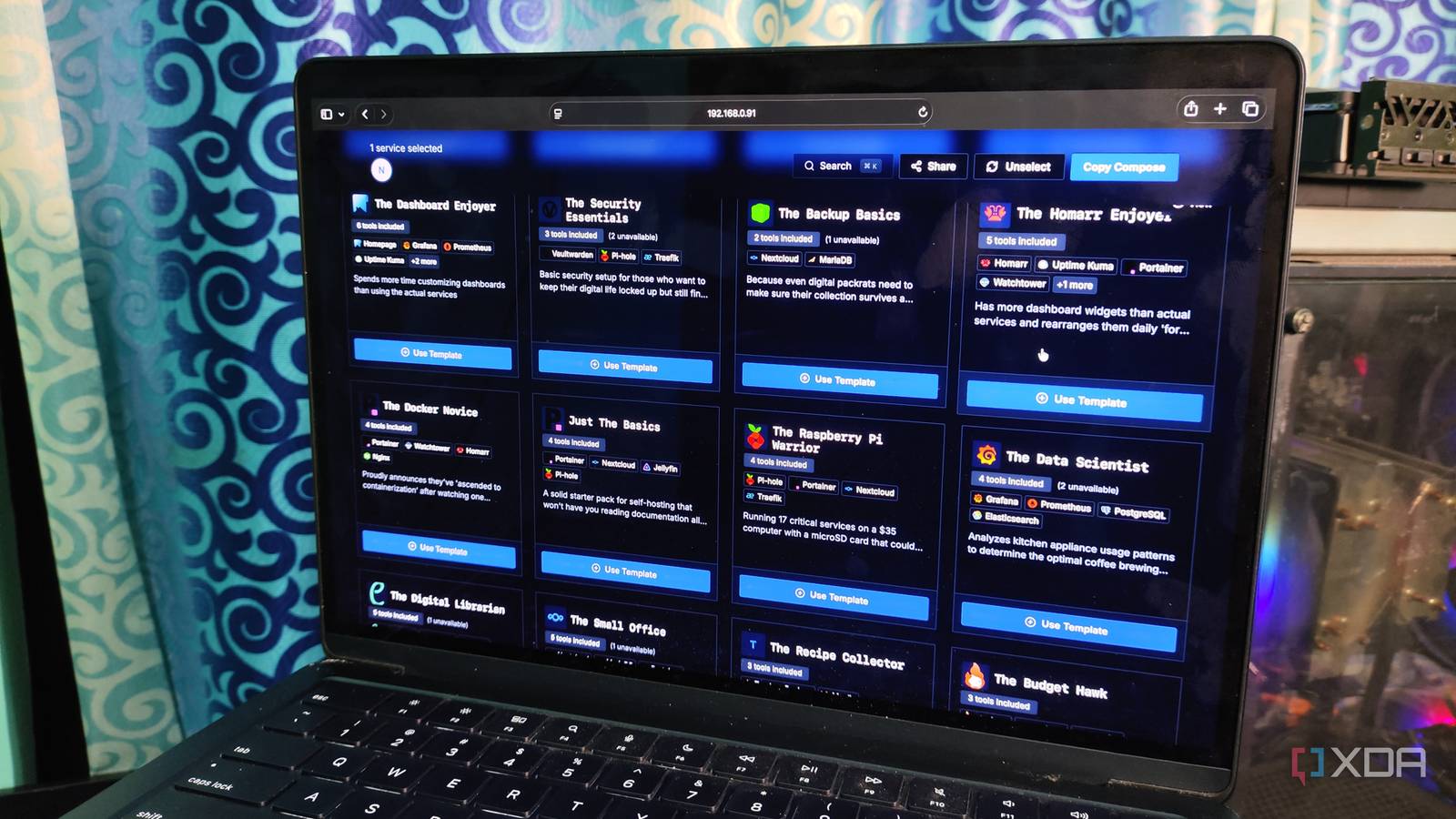 or the project site at
  #technology #docker #selfhosting
XDA
This Docker Compose visual builder is the tool I wish I had as a beginner
It's also quite handy for Docker veterans
GitHub
GitHub - ajnart/dcm: DockerComposeMaker (DCM) is a self-hostable website to help you pick and create a docker-compose.yml file for your home server. Discover new containers, discover and share a config in a couple of clicks!
DockerComposeMaker (DCM) is a self-hostable website to help you pick and create a docker-compose.yml file for your home server. Discover new contai...
Rallly is an open source self-hosted tool to make organising events and meetings easier
If you've ever had to try to find a time for an event of meeting that suites a family, colleagues, or other large group of people, you'll know what a pain that can be. There is often a lot of back and forth, and conversions can happen in different places too.
Rallly allows you to set up some time slot options, and provides an invite link which you can share via e-mail or other messenger chat groups. Everyone votes for their choices on the browser page that is presented, and can comment there too for others to read. Nothing needs to be installed by them, nor do they need to register to use it.
If you don't want to self-host the service, there is also a free tier on their cloud hosted service which you can use for the ad-hoc events or meetings you may want to schedule.
I like that it not only pretty seamless, but it is not locked into any vendor, operating system or even messenger platform.
My video highlights what I like about it, how to set up and poll and send it out, and what my docker configuration looks like. I also mention how you can add extra members on the self-hosted instance, but why you may not need to do so.
Watch
#technology #opensource #selfhosting #scheduling
Chatbots Make Terrible Doctors, New Study Finds*
“Chatbots may be able to pass medical exams, but that doesn’t mean they make good doctors, according to a new, large-scale study of how people get medical advice from large language models. The controlled study of 1,298 UK-based participants, published today in Nature Medicine from the Oxford Internet Institute and the Nuffield Department of Primary Care Health Sciences at the University of Oxford, tested whether LLMs could help people identify underlying conditions and suggest useful courses of action, like going to the hospital or seeking treatment.”
AI lacks any form of real context for situations. The more I've used them for technical issues, I've seen how limited they really are. They will doggedly go down deep holes without looking outside the box. They will grasp at all sorts of solutions to a GitHub project application, without even realising the newest issue logged is in fact a bug waiting to be fixed. I could go on and on, and I've lost count now of the apologies I've extracted from AI for its real stupidity.
Used as an assistant to a thinking human being is fine, but never follow AI advice blindly. It is great for answering questions, but the more you use it, you'd see its limitations surfacing. It can save time, but it can also waste a lot of time, and even do damage. Most recently a chatbot gave me a command to remove the history for a file I updated on GitHub, but it also deleted that specific file itself altogether (I got what I'd asked for, but I did not ask for the file to be deleted, and there was no mention of such a possibility by the chatbot).
So just like a lathe with be a tremendous tool in a skilled technicians hands, giving me a lathe to use would likely do more harm than good.
See  #technology #medical #healthcare #AI
404 Media
Chatbots Make Terrible Doctors, New Study Finds
Chatbots provided incorrect, conflicting medical advice, researchers found: “Despite all the hype, AI just isn't ready to take on the role of the...
Matrix secure chat is quietly becoming the chat layer for governments chasing digital sovereignty
"Matrix is currently talking to circa 35 countries about FOSS communications infrastructure. For instance, Hodgson told us the United Nations is on board: it's using Matrix as the basis of its own in-house air-gapped communications tool, which helps it to remain independent of any country or hosting provider. It's also being adopted at the International Criminal Court (ICC), which as The Register reported in October 2025 is busily ditching Microsoft Office. After the Trump administration imposed sanctions on ICC chief prosecutor Karim Khan, he reported losing access to his email and banking, disrupting the court's work.”
Yes any government can host their own Matrix instance and have full control over it. Matrix is actually implemented inside of other messaging tools, so many are using it without even knowing about it.
See  #technology #privacy #digitalsovereignty #chat #opensource
theregister
Matrix messaging gaining ground in government IT
FOSDEM 2026: One-to-one and group messaging, encrypted VoIP calls, video conferencing – the open protocol handles them all
Netdata and some free AI searches saved me a ton of resource usage on my desktop and server
I recently installed free Netdata in a container on my homelab server to see what it would show in terms of resource usage, bottlenecks, etc. When you start out of Netdata you get a 2-week trial business subscription which includes 10 free AI credits (for analysis reporting).
I let it run for 24 hours and then asked Netdata's AI to give me any key findings and recommendations. The key things it showed me pretty quickly, already blew me away. It's the old story of things are "working" but are far from optimal. Basically the issues I had were too many tasks firing off concurrently (or before others had finished) causing major bottlenecks (disk backlogs) on my different drives. I have three different backups, S.M.A.R.T. drive tasks running, Timeshift, RAID array scrubs, etc going.
I took the report from Netdata and fed it in as-is to Google Gemini (Perplexity has been leading me down very long rabbit holes the last few months) and asked what now. To cut a long story short, Gemini took me through various tests and recommendations around spacing all the tasks out far better, advising which should be daily, weekly, or monthly. It also suggested tweaking settings for the drives as well as the rsync jobs. For example when exporting to an external USB drive, it showed how to slow the rsync transfer down so that the drive was not choking, and neither was the server CPU. It also gave a nice summary table of how all the tasks were now spaced out over days and weeks.
I then decided to install Netdata on my desktop PC, and am glad I did. It boots quicker, and terminal screens open instantly (especially the Atuin history), etc. Again the issue being identified by Netdata was massive disk backlogs. It turns out my main /home data disk is 5.8 years old and has a 161ms response, where it should be 10x quicker. I need to replace this drive soon, but the optimisations suggested by Gemini, have now eased out a lot of the strain I was putting on this drive.
My Manjaro desktop configuration is a good 8 or 9 years old with tons of crud. I used to use VirtualBox for VMs but switched to KVM a while back, yet the old VirtualBox vboxnet0 network and kernel hooks were still in my system. I have a beautiful Conky window on my desktop, but I did not realise the amount of resources it was using through massive inefficiencies including firing off sudo smartctl every3 secs to check drive temperatures (polling the drive controller 28,800 times a day), if/then statements that each fire off the same query three times, using outdated network calls, etc. So Gemini helped optimise that dramatically by collapsing the queries and using memory caching instead, and reducing many checks to 30 secs or longer where the data does not change quickly. There was also rsync jobs that were made less intense, so that CPU was smoothed out more. Some old snapd stuff was also identified that was loading into memory, although I no longer used it, so that all got cleared out as well. I was using SAMBA shares with a Windows VM running in KVM, and it advised to ditch the SAMBA shares and rather use the faster Virtio-FS folder sharing, as well as the VirtIO network mode in KVM.
As Gemini pointed out initially, some events were coming together on my homelab server to create a perfect storm. My desktop PC is now booting up again in seconds, network acquisition is quicker, and with less intensive polling, my browsers are also more responsive.
I'm actually scaling back on my Grafana, Prometheus, Telegraf, InfluxDB stack on my server too. Netdata collects tons of data every second and seeing it is running, I'd rather try to optimise around that, seeing the information I get is a lot more useful. Netdat requires basically no configuration, unlike how Grafana, InfluxDB, Telegraf, and Prometheus must all work tother. There are some things that Grafana must still do, like pulling my Home Assistant stats through into graphs. The free Netdata tier only gives you 5 nodes in their cloud service, but you can view more locally if you host it yourself. Obviously after the trial period, I will also lose the AI credits.
Netdata is open source on the client agent (data collection) and "available" for the client dashboard. The cloud side, and the AI, is proprietary. I'll see how it goes on the free tier after 2 weeks, and what sort of reporting I can still export. But the benefit so far has made a dramatic difference, and will likely also ensure my hard drives have a longer and beneficial life.
Netdata running in a docker container on my homelab server is consuming 2.1% CPU and 327 MB of RAM. Disk space is now at 1.3 GB, so I'll need to keep an eye on that. There are retention sizes that can be set for each tier of data that is being stored (per second, per minute, and per hour tiers).
A tip on installing for Arch based systems. Netdata's script had all sorts of network permission issues on my PC. In the end I just did a plain pacman AUR package install and everything worked.
See 
 #technology #optimisation #dashboards
GitHub
GitHub - netdata/netdata: The fastest path to AI-powered full stack observability, even for lean teams.
The fastest path to AI-powered full stack observability, even for lean teams. - netdata/netdata
#technology #optimisation #dashboardsGoogle's Project Genie lets you conjure entire interactive worlds and step into them
“While I'd love to give this a try myself, it's only currently open to Google AI Ultra subscribers in the United States. Just in case you weren't aware, that's Google's top-tier plan that costs $250/month. So, as you can imagine, access to this feature will be a bit limited for now.”
It does look pretty good from the video in the linked article. The thing though, with this type of functionality and realism, is you're not going to be able to run this on your home server. It costs money to host services like these, so for the foreseeable future this will likely be a paid service of some sort (unless your virtual world can have lots of advertising billboards in it!).
But nice to see it is already technically possible.
See  #technology #virtualworlds
Android Police
Google lets you conjure entire interactive worlds and step into them
Project Genie has landed