
Joshua McHoes's father was a veteran of the Army and Air Force who worked as an electrician and wired a cabin later used to grow cannabis. He refused to name the people involved and drew seven years in Fort Leavenworth under a bad conduct discharge. A failed drug test on probation sent him back to prison before Joshua was born in 1991.
Then the Drug War Came for His Mother
The family moved from Wisconsin to Cordova, Alaska when Joshua was three, looking for a fresh start. A local informant exaggerated his mother's small cannabis purchases into a distribution case, and she pled no contest to a misdemeanor to avoid prison. Cannabis is now legal in Alaska. The charge still shows on her record and to any employer running a background check.
He Went Looking for the Words for What He Had Lived
By his teens, Joshua had watched the drug war reach both parents. In 2007 he found Adam Kokesh on YouTube, then Ron Paul, then Rothbard, Mises, and Hayek. Classical liberalism gave him language for power, control, and the state's habit of hurting the people it claims to protect.
By 2014 He Was Wiring the Dispensaries
Joshua joined the Alaska Libertarian Party in 2012 and worked on the ballot initiative that legalized cannabis the following year. As a working electrician, he ended up wiring the commercial grows and dispensaries his father had been imprisoned for helping build.
Then He Became the Only Local Coordinator in Alaska
Joshua enrolled at the University of Alaska-Anchorage, moved from engineering to political science and economics, and joined Students For Liberty as the only Local Coordinator in the state. His first events drew almost no one, and he kept building anyway.
Working with Anchorage Assembly members, Joshua helped pass a municipal ban on government use of facial recognition and drone surveillance. The ordinance carved out narrow exceptions for search and rescue and for research, but blocked those tools from being used to collect identifying information on residents.
Then the State Capitol Called
In 2024 Joshua earned an internship in the Alaska State Legislature for the 2025 session, where he wrote memos, interviewed legislators, and drafted research papers that shaped policy conversations. He now serves as a State Policy Intern with the Marijuana Policy Project, building a coalition to advance cannabis legalization in Pennsylvania.
And He's Fighting to Expunge Charges Like His Mother's
Joshua is supporting a bill in Alaska that would finally expunge cannabis charges in the state, including the kind that still hangs around his mother's neck. The thing that was meant to break his family became the engine of his work.
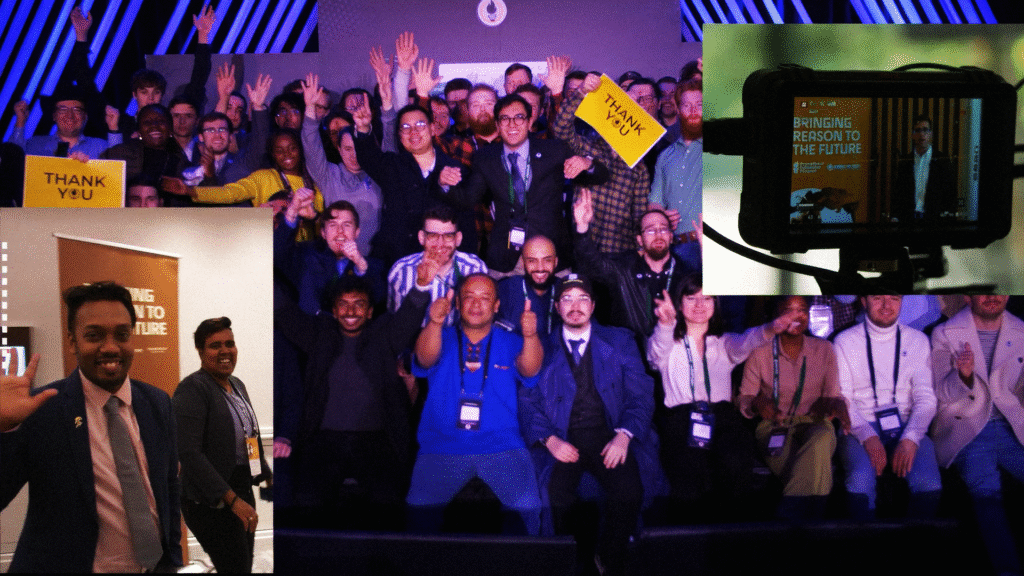
The Local Coordinator Program is where a student with a story like Joshua's learns to turn conviction into policy. Applications are open.
Apply 👉
Students For Liberty
Join Students For Liberty - Students For Liberty
Apply now to North America’s Local Coordinator Program Explore the ideas behind a free society, build practical leadership skills, and join a...
Source:
https://web.facebook.com/photo/?fbid=1524990172993571

 Faltou pesquisa!
Source:
Faltou pesquisa!
Source: 


 One of the most common criticisms of free markets is that wealth "trickles down" from the top.
Yet many of the same people advocate a system where wealth is first taken from millions of individuals, concentrated in the hands of the largest organization with the legal power to tax and spend, and then redistributed back to society.
If you're skeptical that resources flow efficiently through decentralized markets, why would you assume they'll flow more efficiently through a centralized bureaucracy?
Regardless of where you stand politically, that's a question worth thinking about.
Which system do you trust more to allocate resources: millions of voluntary decisions or a handful of political ones?
Source:
One of the most common criticisms of free markets is that wealth "trickles down" from the top.
Yet many of the same people advocate a system where wealth is first taken from millions of individuals, concentrated in the hands of the largest organization with the legal power to tax and spend, and then redistributed back to society.
If you're skeptical that resources flow efficiently through decentralized markets, why would you assume they'll flow more efficiently through a centralized bureaucracy?
Regardless of where you stand politically, that's a question worth thinking about.
Which system do you trust more to allocate resources: millions of voluntary decisions or a handful of political ones?
Source: 


 Chat of the Week | Who would you trust as the Monopoly banker? 👇
#keynes #marx #mises #hayek #rothbard #monopoly #fakechat #economics #bank #moneysupply #economicsmemes
Source:
Chat of the Week | Who would you trust as the Monopoly banker? 👇
#keynes #marx #mises #hayek #rothbard #monopoly #fakechat #economics #bank #moneysupply #economicsmemes
Source:  “I have deep concerns about AI models produced in China,” said Dario Amodei from Anthropic. “Mostly that they can wreak devastation better than mine, and I won’t make any money.”

 The Most Devastating Events in History.
Source:
The Most Devastating Events in History.
Source: 
 We have a new Economic Inequality topic page—
Public attention to economic inequality has grown a lot over the last twenty years. At the same time, the available data has greatly improved too: it now covers many more countries and longer time periods, and is more comparable and accessible than ever.
But the wide range of sources and metrics can be hard to navigate. Each has its own strengths and weaknesses, and they cover many different definitions of inequality.
We’ve just published a new topic page on economic inequality to help make the data easier to understand.
It covers three key international datasets, each offering a different perspective: the World Inequality Database, the Luxembourg Income Study, and the World Bank’s Poverty and Inequality Platform.
The World Bank data, for example, is a crucial source that allows us to compare income inequalities both within and between countries around the world.
In the chart we show this for a selection of countries. We see that in the United States, there’s a 7-fold gap between the incomes of the poorest and the richest 10%. But even the poorest 10% in the US live on much more than the "rich" in a poor country like Madagascar.
Explore this and all our other data and charts on economic inequality in our new topic page:
We have a new Economic Inequality topic page—
Public attention to economic inequality has grown a lot over the last twenty years. At the same time, the available data has greatly improved too: it now covers many more countries and longer time periods, and is more comparable and accessible than ever.
But the wide range of sources and metrics can be hard to navigate. Each has its own strengths and weaknesses, and they cover many different definitions of inequality.
We’ve just published a new topic page on economic inequality to help make the data easier to understand.
It covers three key international datasets, each offering a different perspective: the World Inequality Database, the Luxembourg Income Study, and the World Bank’s Poverty and Inequality Platform.
The World Bank data, for example, is a crucial source that allows us to compare income inequalities both within and between countries around the world.
In the chart we show this for a selection of countries. We see that in the United States, there’s a 7-fold gap between the incomes of the poorest and the richest 10%. But even the poorest 10% in the US live on much more than the "rich" in a poor country like Madagascar.
Explore this and all our other data and charts on economic inequality in our new topic page: 


