https://blossom.primal.net/f74f323dc1c4230b32185a192e8ddefb36d7b0f6312c36f89e4f9bd2b6aee20d.mp4 Just finished listening to @GrassFedBitcoin 's breakdown of the spam attack vector, and what he lays out is disturbing, not just technically but philosophically.
Here’s the short version.
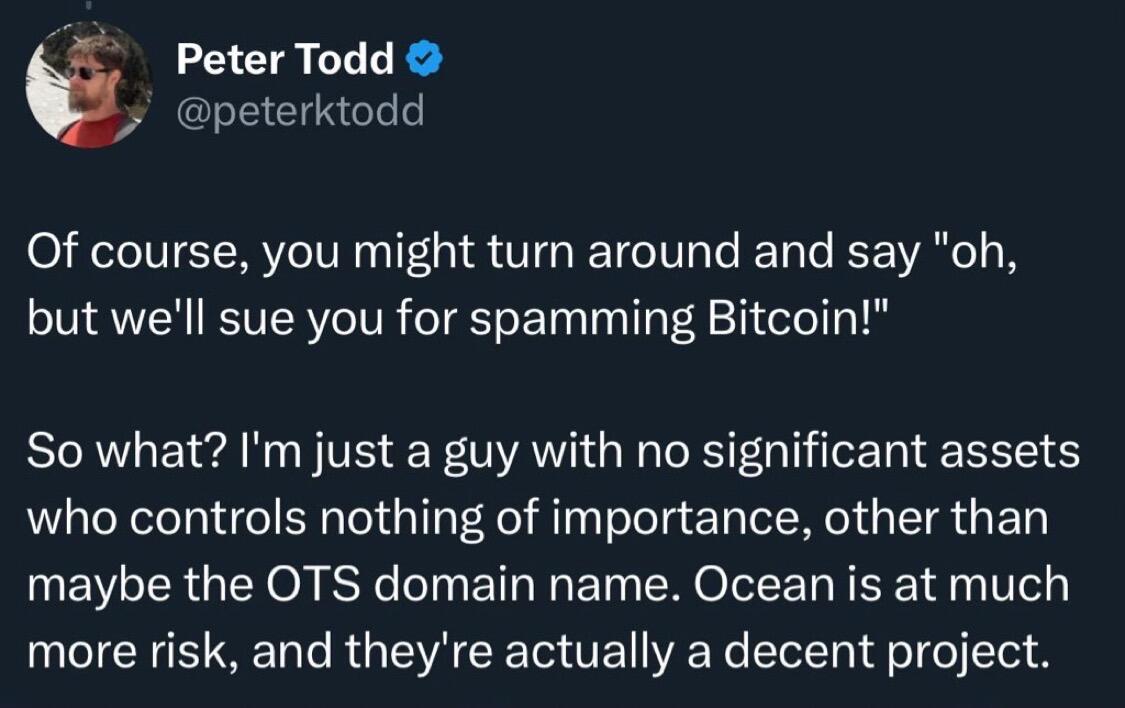
Some entities are exploiting a loophole in Bitcoin’s design. They are not using inscriptions, not using op_return, but instead creating fake pubkeys to store arbitrary data on-chain. It sits in a kind of sweet spot. Not big enough to trigger current filters in Core, but damaging enough to bloat the UTXO set and push out regular node runners.
And somehow the conversation has shifted.
Instead of defending Bitcoin’s core purpose, some dev voices are floating the idea that we should work with the spammers. That maybe if we remove the remaining filters, the abuse will become more manageable.
This is a bizarre and dangerous line of thinking.
Bitcoin was never built to serve as a data dumpster. It was built to be money. Sound, verifiable, scarce. When we start redesigning Bitcoin to appease people who are actively trying to harm it, we lose the very thing that gave it credibility.
Mechanic calls it out plainly. The same people who claim filters do nothing are suddenly demanding we remove them to help the spammers. It is a contradiction. A bait-and-switch. Break the protocol, then use the damage as leverage to weaken it further.
This is not how strong systems survive.
If we bend Bitcoin every time someone finds a way to abuse it, then it is no longer something we can trust. It becomes something we constantly have to defend through negotiation.
I did not opt into Bitcoin to negotiate with attackers.
I opted in because it was resilient. Because it does not ask for permission. Because it stands firm even when pressure mounts.
Mechanic is not just pointing out a technical issue. He is warning us that the cultural drift inside Bitcoin is real. If we let short-term convenience take precedence over long-term integrity, we will get something very different than what we came here for.
Watch the interview. Think about where this path leads.