Bitcoin Well's avatar
Bitcoin Well
bitcoinwell@btcw.app
npub19mf4...kfu2
Bitcoin Well is on a mission to enable independence. We do this by making it easy to use bitcoin in self-custody. Whether youโ€™re looking to buy, sell or use bitcoin, we never hold on to your bitcoin. Bitcoin Well is automatic self-custody.
Bitcoin Well's avatar
bitcoinwell 3 hours ago
Entropy and randomness sound like the same word. In Bitcoin, mixing them up can cost you everything. That gap is exactly what just bit some ColdCard users. Tomorrow on The Deep Dive, researcher and filmmaker Alex Waltz (@raw_avocado) breaks down what real entropy is, why weak randomness makes a hardware wallet a decoration, and what the ColdCard story actually revealed. Tomorrow, 8/13 @ 10am EST (yes its an early one!) Register: image
Bitcoin Well's avatar
bitcoinwell 4 hours ago
$116 million vanished from self-custody wallets this month. A ColdCard firmware bug quietly broke wallet randomness for five years, and the coins behind those weak keys got swept. Here's the twist almost nobody predicted: that same week, $853 million flowed INTO Bitcoin ETFs. The most custodial option on the board. A bug in the hardware wallet, and the money runs to the bank. Today on the podcast, Eric Yakes (author of The 7th Property) and Trey Sellers (Fire BTC) join us for a two-part conversation on the week that tested what "owning Bitcoin" actually means: - What really happened with ColdCard, and what to do about it - Why those ETF flows might be Bitcoin's most interesting contradiction right now - The BIP-110 fork that died in two blocks, and what it proves about who governs Bitcoin - The CLARITY Act's September 15 Senate vote Eric's case for Bitcoin's 7th property: absolute scarcity The ColdCard story isn't an argument against self-custody. It's an argument for understanding what you hold and how it's made. That's the whole conversation. Follow today's guests: @ericyakes and @ts_hodl image
Bitcoin Well's avatar
bitcoinwell 6 hours ago
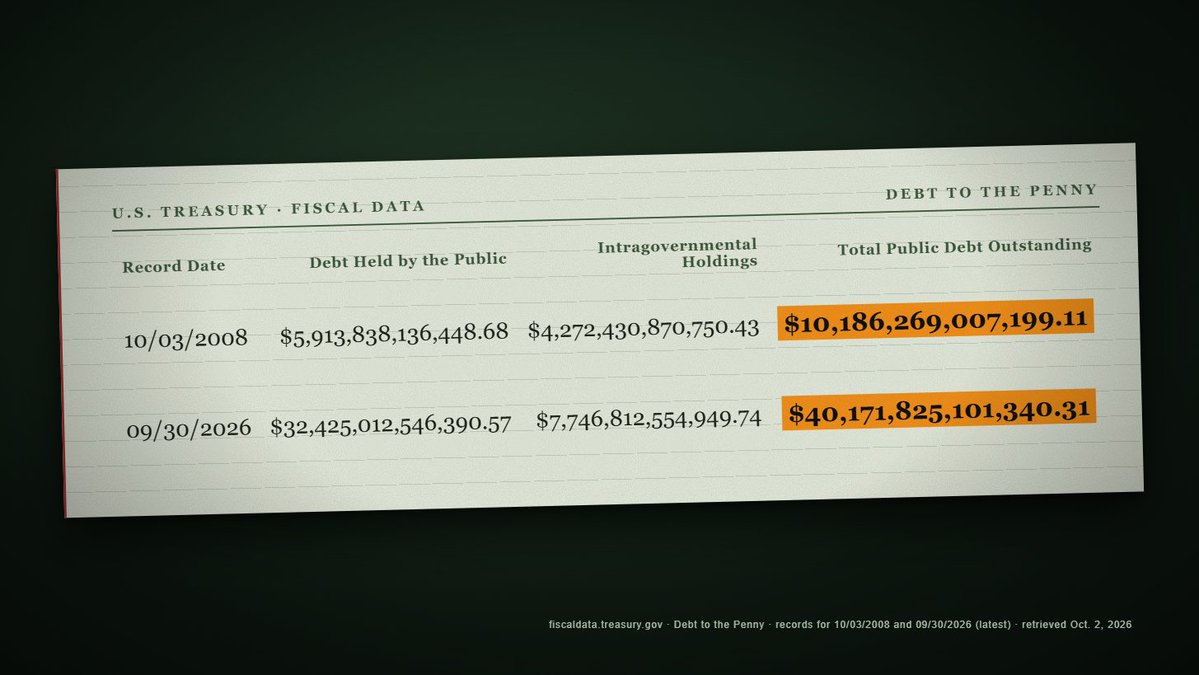
Inflation "cooled" to 3.4%, they say. The target was never zero. The Fed aims to devalue your money about 2% every year on purpose. That is not stability, it is a slow melt you are not supposed to notice. And it compounds: by their own index, the dollar has lost more than 22% of its purchasing power since 2020. What cost $100 then costs about $129 now. Their math, not mine. That is the flattering version. Inflation was never the price of eggs going up. It is the supply of money going up, and the shelf price is just the symptom. Between 2020 and 2022 the money supply grew 41%, from $15.4 trillion to $21.8 trillion. More than $6 trillion conjured in about two years. You can massage a basket of goods. You cannot un-print $6 trillion. Bitcoin's supply grows less than 1% a year, toward zero, set by no committee and no election. One of these two moneys can be diluted while you sleep. It's not the one without a printer.
Japan has not been allowed to price its own money since the war. The yen sliding today is not a fresh problem. It is the bottom of a very deep stack. In 1949 an American banker named Joseph Dodge, working for the occupation, fixed the yen at 360 to the dollar by decree. Japan was slotted into Bretton Woods at that number and held there until Washington broke the system in 1971. Then in 1985 the US and its allies signed the Plaza Accord and pushed the yen from 240 to 120 in three years. It gutted Japan's exporters, so Tokyo answered the pain the only way a central bank knows how: cheap money, everywhere. That blew the largest asset bubble in modern history. When it burst, Japan got the Lost Decades. And every decade since has been another layer laid over the last one. Zero rates. Quantitative easing. Yield curve control. Negative rates. Each intervention prescribed to treat the damage of the one before it. This is what a managed economy looks like at the end. Not one bad decision. Seventy years of overruling the market, foreign hands and domestic ones alike, until nobody can tell what anything's real value is. This summer two governments spent real reserves to set the yen level again. The market erased half of it within a week. Bitcoin has no Dodge, no Plaza, no committee. No one sets its price and no one can. That is the entire point. image
Bitcoin Well's avatar
bitcoinwell 2 days ago
You cannot secretly hard fork a network by changing nothing. That is the tell in the whole "the miners did a secret hardfork" story. A hard fork means changing the rules your node enforces. The miners changed nothing. They kept validating the same Bitcoin they always have. The side that wanted a new restriction didn't get consensus, so now it's calling the side that stood still the "forkers." That is completely backwards. A proof-of-work change does not fire the miners. Bitcoin's miners keep mining Bitcoin, same chain, same hash function, same rules. Swap the proof of work and you haven't fired anyone. You've built a different coin and walked off with it. That isn't a coup against the network. It's taking your ball and going home, then insisting the empty court is the real game. image
Bitcoin Well's avatar
bitcoinwell 2 days ago
BIP-110 Is Dead. What Its Two-Block Fork Proved About Who Really Controls Bitcoin
Bitcoin Well's avatar
bitcoinwell 2 days ago
Friday's BIP-110 Spaces turned into one of the biggest conversations we've ever hosted. So we're bringing it back for a proper autopsy. After the weekend, the dust is settling so we're getting everyone back in the room to unpack what actually happened. What it changed, and where Bitcoin goes from here. @knutsvanholm and @w_s_bitcoin are locked in, with plenty more guests joining them. You'll want to be in the room for this one. https://t.co/wh5o0YcAhB
Bitcoin Well's avatar
bitcoinwell 2 days ago
"Random" and "random enough" are not the same word. With your Bitcoin keys, the gap between them is everything. Every private key you hold is really just one enormous, unguessable number. If the randomness behind it isn't truly random, nobody has to steal your keys. They can just guess them. Wednesday we get into it. Bitcoin researcher and filmmaker Alex Waltz [@raw_avocado] joins The Deep Dive to break down what entropy actually is, how it differs from randomness, and why that difference sits underneath every wallet you'll ever trust. Starts technical, ends personal. Aug 13, 10 AM ET. Free to join: image
Bitcoin Well's avatar
bitcoinwell 3 days ago
In 1990, a programmer named John Gilmore helped found the Electronic Frontier Foundation. Two years later he helped start a mailing list called the Cypherpunks. His most famous line is one sentence: "The Net interprets censorship as damage and routes around it." Meaning, try to block information on a distributed network and it simply flows another way. No central switch to flip. No single door to lock. Gilmore was talking about speech. But the same design is exactly what makes Bitcoin work. There's no headquarters to raid, no server to seize, no CEO to lean on. Try to censor a transaction and the network routes around the block, literally. The cypherpunks understood something early. Freedom that depends on permission isn't freedom. It's a privilege, and privileges get revoked. So they built tools that don't ask. Bitcoin is that idea applied to money. It treats censorship as damage, and routes your value around it. image
Bitcoin Well's avatar
bitcoinwell 3 days ago
In 1976, an economist most people had already written off did something quietly radical. He argued the government should lose its monopoly on money entirely. His name was Friedrich Hayek, and the book was "Denationalisation of Money." His case was blunt. "Practically all governments of history," he wrote, "have used their exclusive power to issue money in order to defraud and plunder the people." Not an accident. The whole point of the monopoly. His fix sounded impossible at the time: let money compete. Strip the state of its exclusive printing press and let people freely choose the money that best held its value. Good money would win the way good anything wins, by being chosen, not mandated. For decades it stayed a thought experiment. There was simply no way to run a money outside a government. Then, 33 years after Hayek wrote it down, a network switched on that no state could issue, inflate, or shut off. Nobody needed permission to use it. People just started choosing it. Hayek didn't predict Bitcoin. He described the hole Bitcoin fills: a money the government can't debase, because the government doesn't run it. The competition he wanted is finally here. You get to choose which money holds your life's work. image
Bitcoin Well's avatar
bitcoinwell 3 days ago
Soft fork that we all knew was going to make another chain. All so predictable!
Bitcoin Well's avatar
bitcoinwell 4 days ago
Self-custody shouldn't feel like defusing a bomb with the wires unlabeled. This week, Bitcoin Guidance is free. A private, one-on-one call with a real Bitcoin expert who walks you through it live: setting up your own wallet, moving your coins safely, and backing up your keys so a lost phone never means a lost fortune. No sales pitch. No jargon wall. Just a human who stays on the line until it's done and it actually makes sense to you. After the couple of weeks Bitcoin holders just had, nobody should be guessing with their savings. Free for a few more days. Book a call:
Bitcoin Well's avatar
bitcoinwell 5 days ago
Heads up if you run a BTCPay Server. There's a critical bug being actively exploited right now, and it can put your funds at risk. This one needs action today. BTCPay is the open-source software thousands of merchants and plebs run to accept bitcoin themselves. No processor, no middleman, no one else holding the keys. If that's you: 1. Update to version 2.4.2 now (Server > Maintenance > Update). Can't patch yet? Take the server offline until you can. 2. Refresh your macaroons and any backend auth strings. 3. If you created a hot wallet inside BTCPay, move those funds and make a new one. Here's the part worth sitting with. Running your own infrastructure is real sovereignty, and real sovereignty comes with real responsibility. Nobody else is going to patch this for you, because nobody else is in control. The open-source upside showed up too. A volunteer security team found this, reported it, and shipped a fix in the open before attackers could run wild. Closed systems fail quietly. This one failed loud and got fixed fast. Patch now. Send this to a merchant who needs it.
Bitcoin Well's avatar
bitcoinwell 5 days ago
The Coldcard bug has a lot of people scrambling to move their bitcoin to a safe setup. If that's you and you're not 100% sure how, don't rush it alone. This week, our Bitcoin Guidance is free. A private 1-on-1 call with a real Bitcoin expert who helps you set up a fresh wallet, move your coins, and confirm your backup actually works. Live, at your pace. We never ask for your seed phrase. We never touch your keys. You stay in control the whole time, we just make sure you do it right. Moving bitcoin under pressure is exactly when mistakes happen. You don't have to. image
Bitcoin Well's avatar
bitcoinwell 5 days ago
๐ŸŸ  TODAY, 12PM EST on Spaces: The BIP-110 Debate Both sides. No filter. No stacked audience. Right now the Bitcoin community is blocking each other instead of talking. We want to change that. So we put strong voices from both sides in one room to make their case and actually hear the other out. FOR BIP-110: @hodlonaut & @knutsvanholm + more AGAINST: @DavidFBailey, @w_s_bitcoin + more Hosted by @bitcoinwell. Bring an open mind. ๐Ÿ‘‡ https://t.co/djc4LVnttg
Bitcoin Well's avatar
bitcoinwell 6 days ago
A firmware flaw allowed someone to drain $130 million from self-custody wallets. Days later, a volunteer red team audited 390 Bitcoin codebases in a weekend and filed thousands of findings. Strip away the headlines and both stories point at the same quiet thing: entropy. The randomness your Bitcoin keys are born from, the part you never see and never think about, right up until it fails. Most people use "entropy" and "randomness" as if they mean the same thing. In daily life, fine. In the code that generates your keys, that mistake is the difference between money only you can spend and money anyone can. On August 13 we go deep with Bitcoin researcher and filmmaker Alex Waltz (@raw_avocado). What entropy actually is, why "random enough" isn't, and what the Coldcard controversy revealed about the assumptions we all make when we trust a hardware wallet to make a key. It starts technical and ends personal. Because if your keys weren't born from genuine entropy, they aren't as secure as you think. The Deep Dive. August 13, 10:00 AM. Register Now: image
Bitcoin Well's avatar
bitcoinwell 1 week ago
We're live. $130 million just vanished from "self-custody" wallets after the Coldcard firmware flaw. The custody crowd is calling it proof that holding your own keys doesn't work. It isn't. We sat down with Bitcoin historian @pete_rizzo_ to put this moment where it belongs: next to Mt. Gox, Celsius, and FTX. None of those disasters made custodians the answer. This one doesn't either. The real history of self-custody, who collaborative custody is actually for, and what needs to change. Watch now: https://youtube.com/live/24Vg1bcb9qE
โ†‘