
There are some very bad objections to the idea of a strategic bitcoin reserve on the part of the US Federal Government. For example:
1. Bitcoin is bad for the world (false; our best science shows that, on net, bitcoin is good)
2. Bitcoin isn't valuable (false; bitcoin is precious, and useful)
3. Buying or holding bitcoin undermines American values and empowers foreign adversaries (false; bitcoin embodies American values, and a huge chunk of bitcoin is held by Americans)
4. Buying or holding bitcoin weakens the American dollar (this one is complicated, and depends on what it means to 'weaken' the dollar, and how the reserve strategy is actually implemented)
5. People only like the strategic reserve idea because it pumps their bitcoin bags (this one is very psychologically important -- but irrelevant to the merits of the policy as such)
Following are some other objections that strike me as more sensible. What do you think? What are the best replies to these objections? Are there other sensible objections I'm missing?
6. A bitcoin-stockpiling strategy gives the state more incentive to seize bitcoin
7. The state should be neutral between asset classes and assets within them; to hold or buy bitcoin is to pick a winner
8. Massive state holdings confer powers in contentious fork wars that the state shouldn't have (e.g., to massively sell off the more freedom- or privacy-oriented side of a hard fork, and thus move markets in that direction)
9. A sovereign wealth fund should aim at yield-bearing assets to displace taxes or debt, but bitcoin doesn't offer any yield
10. Policy should be neutral about a 'number go up' thesis; but stockpiling bitcoin is pretty plainly a bet on that thesis
11. Impoverished and indebted governments should pay down debts rather than acquire assets
I’m putting together a strategic bitcoin reserve — a stockpile if you will.

You know what doesn't shut down when Windows goes haywire?
Cash.
Today is a good day to act accordingly.
Everything you say in public will be recorded and remembered forever. We are all surveilled by the future, more so than even Caesars and prophets of old.
Your great-grandchildren will judge you for any intellectual dishonesty. Act accordingly.
Bitcoin is a powerful force for freedom — and, I argue in a new op-ed in Newsweek with T. Cross, B. Rettler, K. Saunders, and C. Warmke — to win elections too. If Trump's opponents hope to defeat him, they should pivot to supporting bitcoin as he has.

Newsweek
Bitcoin Can Protect Freedom and Help Win Elections | Opinion
The Democrats could neutralize former President Donald Trump's recent efforts to capture the crypto vote.
Trump's most enthusiastic critics predict political repression if he wins. If they're right, the thing to do now is to prepare. That means mastering freedom technologies that protect civil liberties: bitcoin, encrypted messaging, and censorship-resistant publication protocols.
We have an op-ed coming out tomorrow with Newsweek that argues this point, among others. Stay tuned, and be prepared to share it widely!
From a goodreads review: "I've read a lot of books about Bitcoin, and I enjoyed this book significantly more than I expected to. I expected to find myself slogging through another dry read, but instead I found an engaging, funny, and exquisite set of arguments that kept me reading."
Wow! Thanks, Jason!
I'll be in Austin, TX in the week immediately after the big Nashville conference — July 29 to August 2. I know Austin is a bitcoin citadel, so help me use my time there well: what events should I attend while I'm there? And does anyone want to have me on their podcast?
The more success bitcoin enjoys, the greater reason central banks have to seek out ways to crush it. The authoritarians will turn to repression and the boot. Believers in genuine democratic governance and good outcomes will seek to out-compete bitcoin, though — to the good.
In that spirit, here is a hypothesis. Central banks can demolish bitcoin forever with three easy steps:
1. Privacy and censorship resistance: Chaumian ecash
2. Sound money: algorithmic supply management
3. Innovation: an open API
Game over.
Imagine the pumpanomics at play here:
1. Freedom goes up (digital cash)
2. Number goes up (sound money)
3. Innovation goes up (open architecture)
Embrace the pump, central banks, and kill bitcoin while you're at it!
Today is a good day to act accordingly: submarine swaps, consolidations or splits, atomic swaps, peg-ins and outs, and any other on-chain maintenance required for better privacy and future usability of one's UTXOs.
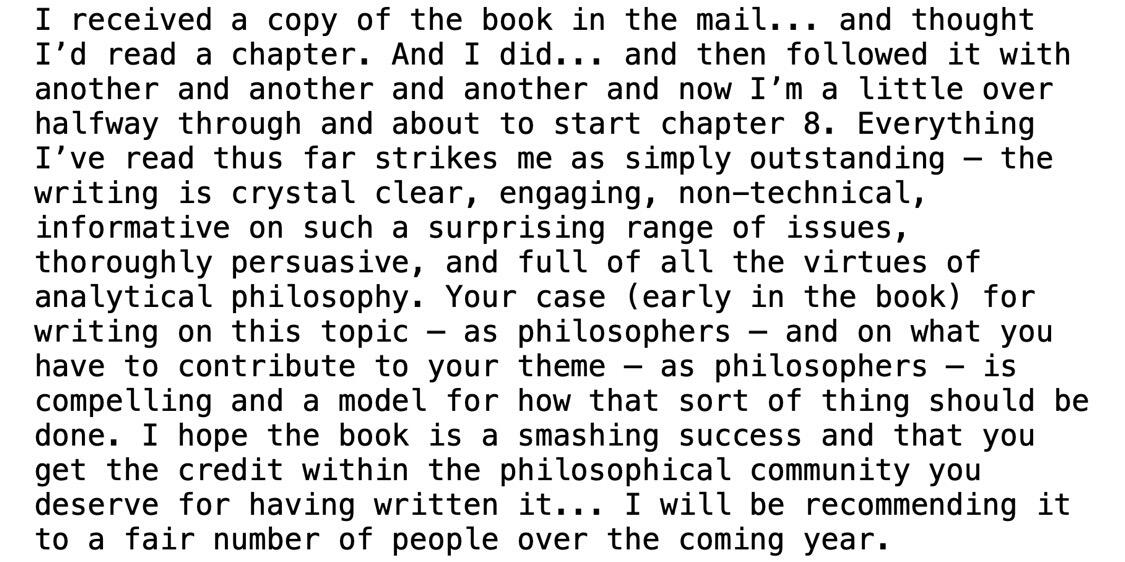
An academic philosopher who shall remain nameless — someone who has no connection to bitcoin, or philosophy of money, or any of that stuff, really — read our book and had this to say. Wow!
The fire rises

⚠️ Resistance Money Bug Bounty Alert! ⚠️
Help us identify and fix errors in the text, and you will receive credit on our 'errata' page. Once there's a decent number of these, I will select a few folks at random for some free sats!
Why collect and publicly document errors? Because this is a piece of actual scholarship, not an exercise in cheerleading.
It's the open source way: transparency, collaboration, honesty.
Found a spelling error, a factual mistake, or an infelicity of some other kind? We would be most grateful to know of it. DM me; and let me know if you'd like credit on the Errata page for spotting the mistake.
The Errata thus far:

Resistance Money
Errata
Errata reports are welcome. Please direct them to wrathius@gmail.com or @resistancemoney on Twitter. Let us know if you’d like credit for you...
Don't trust; verify. So before you buy a copy of Resistance Money, read Chapter 1 for free!
PDF:
https://www.resistance.money/resistance_money_chapter_1.pdf 
Sometimes you just need a box of these bad boys on hand
I’ve been on my college's integrity committee for over a decade, often as its chair. Plagiarism, academic dishonesty, cheating, and the like: these are our remit. I've seen it all. But times are changing. A few thoughts, then, on ChatGPT.
The most important message I have for students is not that using ChatGPT in completing their assignments is unethical, or plagiarism, or pawning off someone else's ideas or words as your own. It can be those things, but needn't be.
My message about ChatGPT, instead, is this: you've got to cover your tracks.
The advice is not about hiding misconduct or dishonesty. Because if you actually do as I suggest, you'll have no misconduct to hide.
ChatGPT-generated prose has some well-known signs, including:
- vague generalities
- hemming and hawing, especially in a summative sentence or paragraph
- 'delve', and other artifacts of the way large language models are currently trained
- pointless filler words everywhere ('complex dynamics', 'multi-faceted analysis')
- generic verbs instead of specific ones ('explores the topic' instead of 'argues that')
- claims without backing textual citations (or worse, with fake ones: pure hallucinations)
- repetitive and flattening use of the present participle
There's an architectural reason why ChatGPT and similar tools have these irritating tics. They write to the statistical median. And the statistical median isn't ungrammatical. It is, instead, mediocre. Boring. Flat. Without any real voice or message. Dull in both style and substance. It doesn't sound like anyone in particular, because it's a blend of everyone all at once, sort of like those generic 'average faces' you can find online — all smoothed over and sort of vaguely pretty but also off-putting and inhuman.
If you can identify and eliminate infelicities like the ones noted above — and doing this thoroughly requires a sentence-by-sentence look at the entire document — no one need ever know that you used ChatGPT to write your essay. Your secret will be safe.
But along the way, you'll also have made the essay your own. You'll have thought about every word. You'll have exercised agency. The words that remain will be there because you put them there, and for a reason. You'll have actually done some writing.
So, ChatGPT-using students, here is my advice once more. Cover your tracks. Ruthlessly eliminate the junk ChatGPT generates. In doing so, you'll make your paper better, and you'll make it only yours. And that is precisely what your instructors wanted from you anyways — your own best work.
"Resistance Money informs without inflaming and teaches without preaching... It's at the very top of my suggested reading list for anyone curious and open-minded about bitcoin." — Troy Cross, Reed College

What the central bank tinkerers don't understand is that blocking the exits doesn't quell demand for alternative monies. It stimulates it. Every time you set up a chokepoint, a new person googles 'what is bitcoin?' (or 'ما هو البيتكوين؟').
https://pbs.twimg.com/media/GIGtH-wWgAAIFVc?format=jpg&name=largePre-order your copy of Resistance Money today! Just $29.95 (USD, paperback, Amazon) gets you the most meticulously researched, lively, comprehensive, and measured evaluation of bitcoin to date — peer-reviewed, and published by a leading academic press.

The real story is not that bitcoin continues to flourish after fifteen years. Nor is it that SBF is a convicted criminal. It’s that the worlds of credentialed academia and journalism got both SBF and bitcoin exactly wrong. The press darling is in jail. Bitcoin roams free.