For anyone looking for gift ideas.
View quoted note →
Machu Pikacchu
npub1r6gg...gmmd
Interested in bitcoin and physics and their intersection.
https://github.com/machuPikacchuBTC/bitcoin
@DETERMINISTIC OPTIMISM 🌞 heard you on Preston’s podcast asking for help with time series data? Any area in particular?
I’ve done some work with time series (single digit PiB range). Can’t say I’m an expert but happy to help where I can.
On this Election Day there’s only one candidate that can improve your life: Satoshi Nakamoto. Vote wisely!
Nature is healing. Mining template decentralization is making a comeback. If you’re a miner consider using Datum.
View quoted note →
What can game theory teach us in this new world of decentralized networks? It pays to cooperate [1].
According to Robert Axelrod [2] for players in an iterative prisoner's dilemma game [3] the following qualities are required for success: being nice, forgiving, retaliatory, and transparent.
In the context of a game: don't strike first. If your opponent strikes, then don't hold a grudge. Don't be a pushover though. And to some extent be open about your strategy or else others have to treat you as random and can't cooperate.
According to simulations a tit-for-tat approach (one where you cooperate by default and retaliate a single time for each time the others take action against you) is optimal in most cases but not all. For example, tit-for-tat loses miserably if everyone else is being nasty.
However, the interesting thing is that if you have a few participants cooperating tit-for-tat with each other they tend to outcompete all the nasties.
I think this is especially relevant for places like Nostr where webs of trust are being established. Webs of cooperation are more likely to produce economic prosperity, and to a greater extent, than random or adversarial interactions (like what you'd see on traditional social media).
"But Nostr isn't a game! There's no give and take here." Except there is! Zaps are monetary points in an economic game. Contributing to others' development efforts rather than deriding or sabotaging produces a better environment for everyone.
Consider "X" where whining, ridiculing, or saying things for shock value gets your content promoted and user timelines end up filled with ragebait. It takes a toll on morale and creates an adversarial environment where the community at large loses.
On Nostr, where users have control over their timelines, quality interactions get surfaced and builders can build.
1.
2.
3.
Robert Axelrod (political scientist) - Wikipedia
Prisoner's dilemma - Wikipedia
A superior alternative to a Visa prepaid gift card. Gonna be doing this for tech illiterate relatives over the next few months.
View quoted note →
Anyone here read up on shielded CSV yet?
#asknostr
Are Cashu mints strictly better than FediMints? With Fedi you have the same exact custodial risk because there’s still a single operator for the lightning gateway, but you also have the group of guardians adding friction.
Seems like having all the guardians running their own Cashu mints and spreading your ecash between them all is preferable.
#ecash #cashu #fedi
Entropy in social groups:
In pseuorandom number generators the output sequence is limited by the seed. If you have insufficient entropy when picking the seed then you land in a narrow band of output sequences.
A homogenous group can quickly reach consensus and is efficient for a given set of tasks but has a very narrow set of possible states (ie. good luck innovating). This is low entropy.
A diverse group has a hard time reaching consensus and can be slow to make progress, but has a much greater capacity to explore outcomes. Higher entropy.
TL;DR - avoid echo chambers.
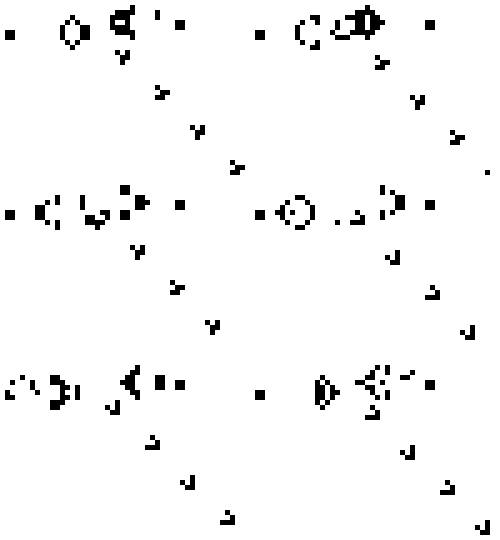
Cellular automata [1] can be fascinating. Since the Bitcoin protocol is a collection of discrete UTXOs with rules for how they move around we can model the UTXO set with cellular automata.
Wonder what kind of recurring patterns we’d see if we did that.
Typically the rules for evolution are deterministic but spending UTXOs can be probabilistic. In that case each time you run the model you’ll see different outcomes but I’m willing to bet you’ll see themes.
1. 

Cellular automaton - Wikipedia
Great to see more silent payment adoption.
View quoted note →
It feels like the angle Saylor is coming from is not helping banks and governments run off with your money but rather to kick as many people off the network as possible so he and his company have less competition for whatever their goals are. In either case, stay paranoid!
And the reason they didn’t kick in people’s doors and point guns for their gold is because it was extremely difficult to know who had gold and how much. With coinbase and social media they have a good idea of who to target and prioritize.
View quoted note →

Backup your full node folks!
In the (hopefully) unlikely event that a determined actor wipes out all the online nodes we need relatively up-to-date offline backups to restore from.
Look at the SolarWinds [1] attack or the XZ backdoor [2]. If an attacker can compromise enough nodes concurrently they can wipe them and force the whole network into a small surface area.
That doesn’t destroy the network but it would cause a major disruption and could make tor analysis easier among other things. It could perhaps also be used to wipe the last N blocks from the chain tip as part of a larger effort.
The more backups we have to restore from the less downtime the network might have.
1.
2. 
2020 United States federal government data breach - Wikipedia

XZ Utils backdoor - Wikipedia
Bitcoin was born into an adversarial environment. It thrives there. It suffers under complacency and apathy.
Bring it on Suits.
Decentralized #lightning question:
is it possible to create a lightning node with an m-of-n UTXO where you have multiple nodes reachable only via Nostr and use FROST to sign the transactions?
Goal: running a decentralized #ecash mint. The idea is that you could have people in multiple jurisdictions all partially responsible for running the mint and if a minority of the group is offline the node still functions. Latency would be much higher but reliability and censorship resistance is greater.
#asknostr #bitcoin #cashu
The #ECB and the Minneapolis #Fed both put out a report recommending to curb bitcoin’s adoption at the same time Saylor, who borrowed billions from banks and institutional investors to buy bitcoin, is suggesting to trust the banks and government.
Nothing to see here.
Banksy should be on Nostr
Banks be like
View quoted note →