The Ghost Who Created Monero
Monero is the only major cryptocurrency whose founder remains completely unknown.
And the story of how it all began is pretty amazing.
April 2014. An anonymous user on Bitcointalk named thankful_for_today launched a project called BitMonero, built on the CryptoNote protocol.
The community disagreed with its direction, forked it within days, renamed the project Monero—a currency in Esperanto—and the founder vanished forever.
And the protocol itself? Also written by a ghost. The CryptoNote whitepaper was published in 2013 by someone named Nicolas van Saberhagen. Also anonymous. Never identified. That paper introduced ring signatures and stealth addresses. The foundation of everything $XMR does.
Monero is just a community.
And that community has been building for over a decade. Volunteer developers. Anonymous contributors. Riccardo Spagni became the lead maintainer for years. He wasn't the founder and never claimed to be.
The project has survived everything thrown at it: regulators attacking privacy tools, sanctions against Tornado Cash, arrests of developers on other projects, fears about hashrate concentration, and delisting from exchanges.
And it's still here. A new all-time high in 2026. A fresh protocol update deployed. Next-generation privacy technology called FCMP++ on the roadmap.
Monero's founders disappeared by design. And that might be why it's still standing.
Pater Nostr
paternostr@poster.place
npub1rp8y...urwe
Pater noster qui es in caelis benedicat nos/Our Father who art in Heaven
#zaps #xaps #xmr #privacy
🚨 The Binance hack has once again brought to the forefront an uncomfortable truth: the biggest risk to the crypto ecosystem remains the trust placed in centralized intermediaries.
Amid this crisis, Monero ($XMR) is demonstrating particular resilience, withstanding market pressure and even registering gains.
Why?
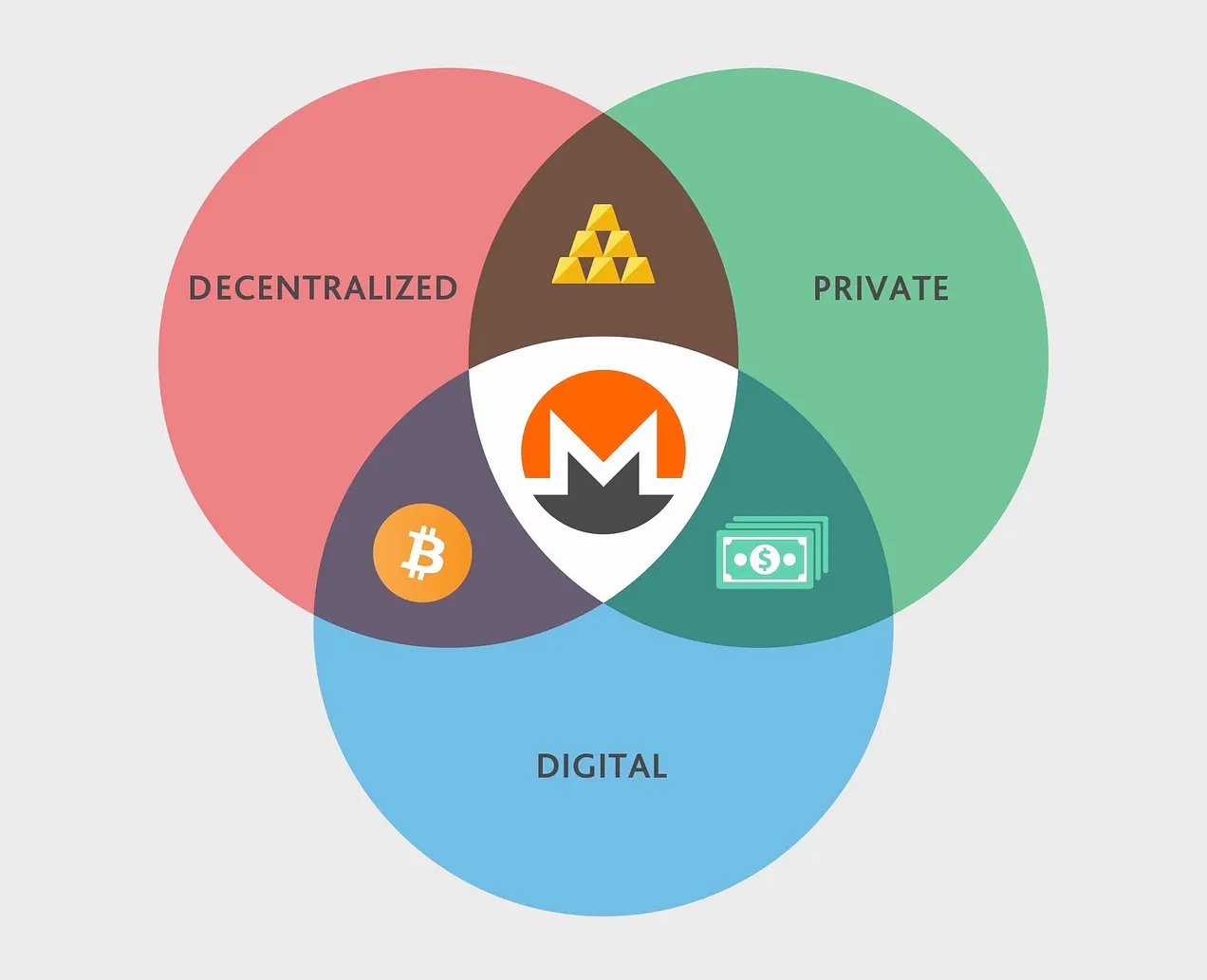
🔒 Privacy by default: hides sender, recipient, and amounts. ⚡ Fungibility: its units don't have a public history that would allow for discrimination. 🌐 Decentralization: doesn't depend on a single platform to function. 🛡️ Financial sovereignty: allows users to operate and hold funds under self-custody.
While the market is once again questioning the security of exchanges, Monero represents a different proposition: privacy, censorship resistance, and individual control of money.
The real question is no longer just where to store your cryptocurrencies, but who truly controls them. $XMR 🦾
#monero #privacy #freedom #monostr


The amount of Monero in circulation is known, but its holders are anonymous.
This verifiable anonymity feature solves Bitcoin's privacy dilemma: inflation can be verified, but it's impossible to track who owns how much.
Cryptographers consider it a perfect currency design: a definitive balance between transparency and privacy.
#monero #xmr #privacy #monostr


Monero's community governance is a model for the crypto world. No foundation, no preliminary mining, no ICO.
Developers work thanks to community donations, and major updates are implemented through consensus. Decentralized governance ensures that the network is not controlled by a single entity.
#monero #xmr #privacy #freedom #monostr


"It's better to have it and not need it than to need it and not have it."
#monero #xmr #privacy #fungibility


Don't obsess over systems that don't work.
Build better alternatives.
That's where Monero comes in. 🧡🌹🔐
#monero #xmr #privacy #adoption #monostr


Why has Monero become the smart choice in the world of cryptocurrencies?
Currently, there are over 50 million different cryptocurrencies, and it seems a bit simplistic to point to just one and say, "Only this one works." Each has a different purpose, with its own rules regarding mining, fees, consensus, and so on. It turns out that some time ago, cryptocurrencies were expected to replace fiat money, an idea that many have forgotten.
From the moment regulations and companies specializing in tracing the origin of coins with open blockchains appeared, freedom gradually diminished. What was supposed to be an innovative peer-to-peer monetary system became something resembling a state-regulated asset. How could we use a digital currency with such high traceability?
The biggest problem has always been user privacy. We don't want sensitive information widely disclosed. Initially, there was a significant challenge in programming a system that would conceal the origin, amounts, and addresses. Fortunately, they managed to achieve this feat through zero-knowledge proof. From then on, we had the opportunity to create a cryptocurrency with a real focus on user privacy. We must acknowledge that Bitcoin was the foundation for everything; through it, we observed its strengths and the aspects that needed improvement to perfect it.
Then, Monero emerged, carrying with it the technologies necessary to truly function as the digital currency we so longed for. And wow, it really worked; with a history of over 10 years, it has continued to function and remain strong, even with the tribulations along the way. I am impressed by the community's dedication in creating such a spectacular project. We truly experienced an extraordinary evolution in user privacy, unlike anything seen before. It even managed to scare the most experienced people in the business world.
I would like to delve deeper into the details of each technology, but I am still studying them; I want to avoid saying things I don't know well. I would also like to mention the resistance that Monero managed to overcome. For some time now, we've been seeing its delisting from various centralized exchanges like Binance. Interestingly, many people thought XMR would collapse and that no one would be interested in it anymore, but the opposite happened. Its demand literally increased significantly, to the point that its value against fiat currency rose. That's more than enough to prove that Monero is truly causing discomfort to those who want their privacy compromised. Keep contributing, spreading the word among your close friends, because the genie in the magic lamp has truly granted one of our wishes. Thanks for reading.
#monero #xmr #privacy #monostr


XMR is the ultimate tool if you're looking for a technological solution to protect your wealth, your financial privacy, and therefore, your overall freedom.
Whether you're a digital nomad or simply someone living a "normal" life who wants more personal freedom, XMR is the most effective tool available.
It's a survival tool in a world that's tightening its grip through excessive government intervention, absurd regulations imposed by unelected people who have no idea what they're talking about, and by statists who simply watch and allow things to happen.
Monero works everywhere. Monero works for everyone. You just have to know how to use it, in detail, and there's nothing anyone can do to stop it.
#monero #xmr #privacy #monostr


Thanks a lot for sweet Monero XMR tips, pals! Such an exciting sensation!
Monostr is wonderful!
#monostr #monero #xmr #nostr #privacy #anonymous
The amount of Monero in circulation is known, but its holders are anonymous.
This feature of auditability and anonymity resolves the privacy dilemma of Bitcoin: it can be verified that there is no inflation, but it is impossible to track who owns how much.
Cryptographers consider it a perfect currency design: a definitive balance between transparency and privacy.
We should all understand that privacy should never be a paid feature, but rather a default setting.
More and more people are realizing that the real issue isn't the speed of transactions, but how much control they lose during the process.
Centralized platforms have turned convenience into dependency, and privacy into a cost.
If your assets are always in your hands, without needing to register an account, without needing to hold funds, simply by exchanging them between different chains, that's what blockchain technology originally aimed to solve.
Returning cross-chain transactions to their original form: open, permissionless, and decentralized.
The market is constantly changing, but real control of your assets should never be relinquished to anyone.
#monero #privacy #monostr


That's amazing!
#xmr #privacy #monero #monostr


Labeling Monero as "dirty money" because some people use it for illegal activities is the most absurd and ironic idea in the cryptocurrency world. Monero is the only cryptocurrency that cannot be "tainted." Private by default, it is truly fungible: the most fungible money on the planet, even more so than cash.
The upside to this attack is that it alienates the greedy, low-IQ fools and fake "crypto-anarchists," rewarding the true crypto-anarchists who continue to use and hold Monero while it is being suppressed, before its inevitable rise due to Monero's unique utility.
Keep a list of everyone who labels Monero as the "criminal cryptocurrency." These people will go down in history as the biggest frauds in the cryptocurrency world. Fake crypto-anarchists who worked against the movement out of greed are just as evil as the enemies against whom cryptocurrencies were invented.
~ Douglas Tuman
Douglas Tuman is an American activist in the Monero (XMR) ecosystem, known primarily for hosting Monero Talk, a show dedicated to cryptocurrencies, financial privacy, and decentralized digital money.


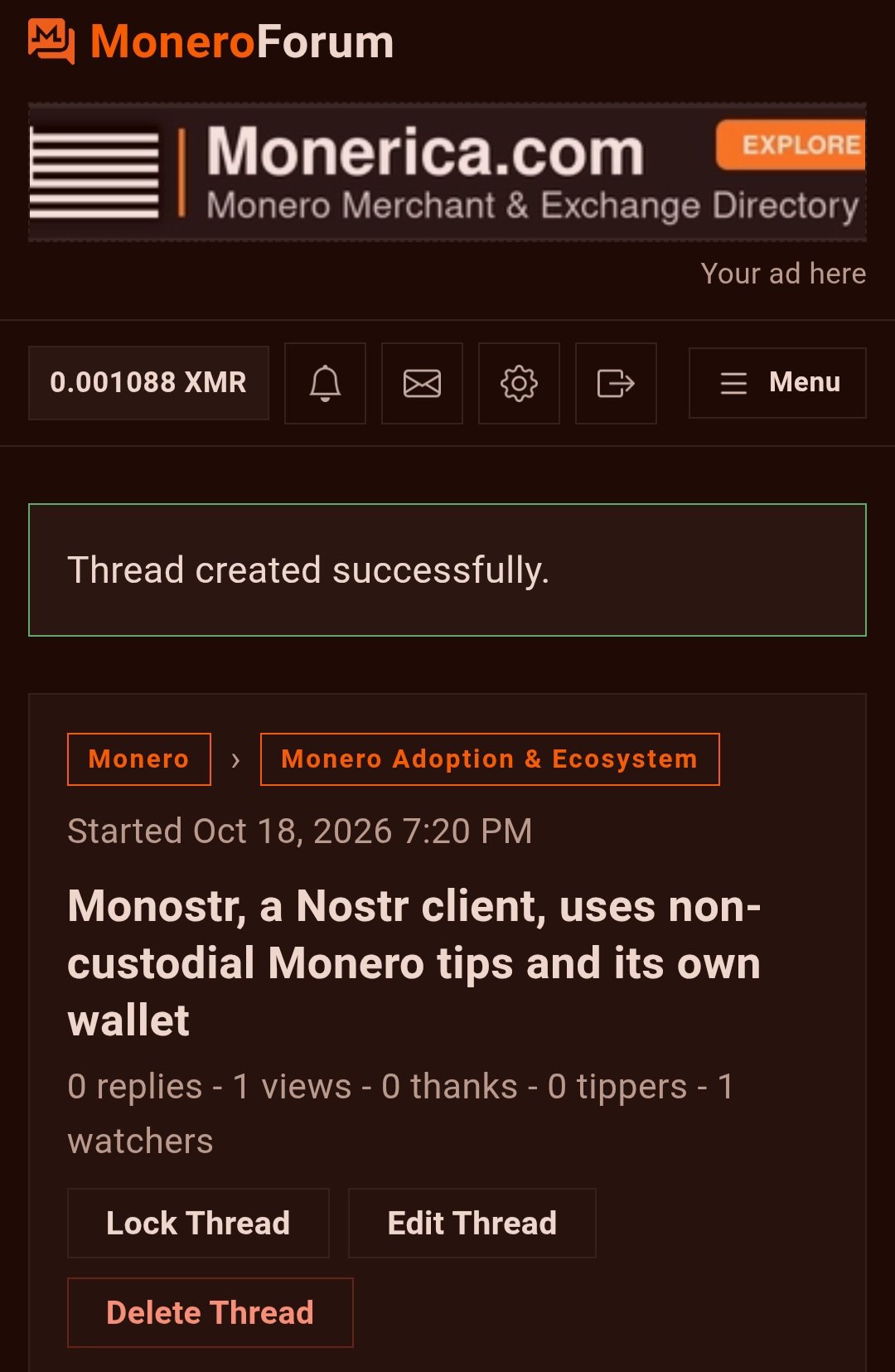
Monostr is a free and open-source Android app for using Nostr, a decentralized social network, with one unique feature: it allows users to send Monero (XMR) tips to other users. It is available on F-Droid, the Android open-source software repository, under the AGPL-3.0 license or superior.
Spreading the word at monerica.com

Monostr | F-Droid - Free and Open Source Android App Repository
Nostr with Monero tips. No Lightning, no custodian, no wallet inside.

INTRODUCTION TO TRADING
90% of traders lose 90% of their money in the first 90 days. WHY?
This is an old statistic, but it shouldn't be surprising that retail traders consistently lose money. In this article, I hope to provide a basic explanation.
First, the most insidious trap traders face is "educators." "Educators" (or influencers who promote trading) who promote and educate the public about trading are directly incentivized by traders' losses. This is because they earn a commission on any revenue an exchange generates thanks to the traders they introduce, and it turns out that the more you lose, the more the exchange earns. There is a manipulated methodology promoted by educators, designed by the exchanges (which pay the educators) to ensure that traders lose as much money as possible, as quickly as possible. If they don't promote this methodology, they not only harm their own earning potential, but the exchange will refuse to work with them, and it's highly likely that it will be illegal for them to continue working as "trading educators" without a referral agreement with the exchange. Yes, this isn't just a scam, but a scam sanctioned by law worldwide. Of course, I'm talking about "Introducing Broker" (IB) agreements. While the legal mechanisms of this system may change over time, the fundamental incentive structure remains consistent.
The manipulated methodology:
Trade as frequently as possible.
You can earn consistent income through trading.
Lines on charts > deeper understanding.
Don't hold a position overnight.
Stop-loss orders.
Unrealistically accurate market predictions.
Secondly, exchanges have complete information on all orders, positions, and potential liquidations, and they dictate the order of transactions in real time. This allows them to execute high-frequency trading and market manipulation strategies to profit with low risk. Notice how the manipulated methodology described above makes the retail trader extremely vulnerable to exploitation using these advantages. Some exchanges sell this privilege to professional traders, but their real product is unsuspecting traders, ripe for exploitation.
So, is there a real opportunity for everyday traders to make money? Yes. Where there is volatility, there is an opportunity for traders to make money. Is this just luck? No one can say for sure.
My advice if you want to be a trader:
Understand the pitfalls.
Invest more than you trade.
Understand what drives supply and demand in a given market.
Understand that volatility is your livelihood.
Consider exploring LSTM AI models (they are easy to create).
Don't make unrealistically precise bets.
Practice patience and don't use stop-loss orders.
Be prepared to lose often while you learn. Don't expect consistent income.
Avoid memecoins because the markets are manipulated.
Pay attention to funding fees.
Further reading: Anton Kriel's lecture on the same topic. He's obviously trying to sell his own scam, but he does a better job of explaining things than I do, and he delves deeper into the "reverse investing narrative."
#crypto #trading #investing
Run a Monero node.
You don't need permissions, expensive hardware, or a server farm. An old laptop can verify the chain and help strengthen the network. It doesn't need to run 24/7. Any uptime is helpful, though more is better.
If you're unsure how to do this, there are guides, community forums, YouTube videos, and even AI-powered chat tools that can walk you through the setup.
Decentralization only works when people participate.
Support XMR.
#monero #privacy #monostr


I love how the Monero developers made FCMP++ backward compatible. So, when the update is released, none of their coins will become transparent at any point.
#monero #privacy
Monero is for everyone.
Teachers. Shopkeepers. Nurses. Farmers. Programmers. Business owners. Artists. Drivers. Builders. Parents. Bankers. Retirees. Influencers.
From all walks of life.
You don't need to be a cypherpunk, libertarian, or privacy geek to understand the value of private money.
As surveillance expands, financial privacy becomes more important, not less.
And if you don't protect it, governments, corporations, and elites will gladly convince you that you never needed it in the first place, while protecting their own privacy at every opportunity.
Monero gives ordinary people that same choice.
Private money is for everyone.
The future will need it.


The Ghost Who Created Monero
Monero is the only major cryptocurrency whose founder remains completely unknown.
And the story of how it all began is pretty amazing.
April 2014. An anonymous user on Bitcointalk named thankful_for_today launched a project called BitMonero, built on the CryptoNote protocol.
The community disagreed with its direction, forked it within days, renamed the project Monero—a currency in Esperanto—and the founder vanished forever.
And the protocol itself? Also written by a ghost. The CryptoNote whitepaper was published in 2013 by someone named Nicolas van Saberhagen. Also anonymous. Never identified. That paper introduced ring signatures and stealth addresses. The foundation of everything $XMR does.
Monero is just a community.
And that community has been building for over a decade. Volunteer developers. Anonymous contributors. Riccardo Spagni became the lead maintainer for years. He wasn't the founder and never claimed to be.
The project has survived everything thrown at it: regulators attacking privacy tools, sanctions against Tornado Cash, arrests of developers on other projects, fears about hashrate concentration, and delisting from exchanges.
And it's still here. A new all-time high in 2026. A fresh protocol update deployed. Next-generation privacy technology called FCMP++ on the roadmap.
Monero's founders disappeared by design. And that might be why it's still standing.