
CAPTURE BY ABSTRACTION
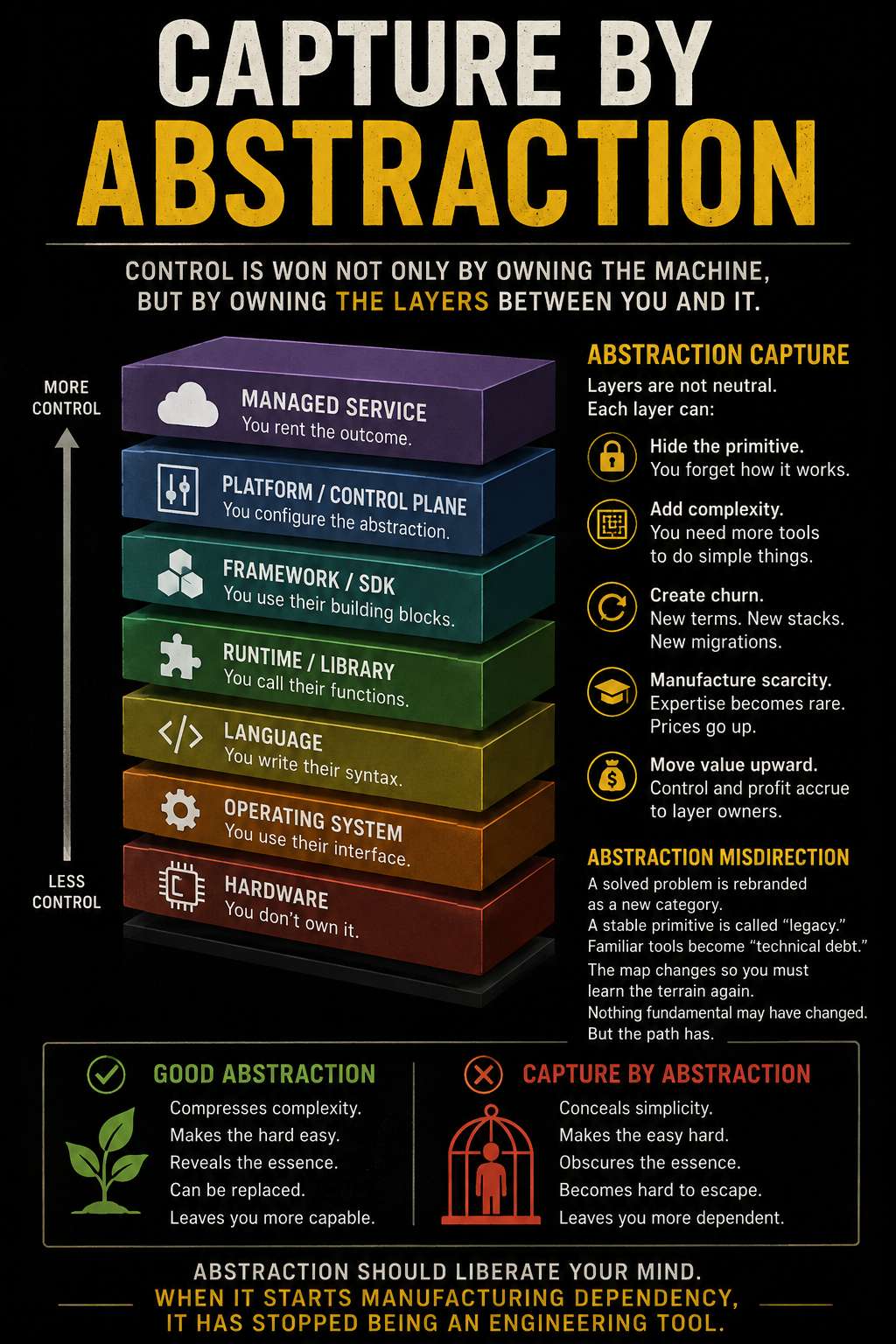 Software does not always capture you by owning the machine.
Sometimes it captures you by owning the layer through which you are allowed to understand the machine.
The hard problem gets solved.
Then an abstraction is placed over it.
Then another abstraction is placed over that.
Soon the engineer no longer works with the primitive.
They work with the framework.
Then the platform.
Then the managed service.
Then the proprietary control plane explaining the abstraction that replaced the abstraction.
This is abstraction capture.
And abstraction misdirection is how it stays justified.
A solved problem is presented as a new category.
A stable primitive becomes “legacy.”
A familiar stack becomes “technical debt.”
The replacement arrives with new terminology, new certifications, new dependencies, new migration work and a fresh scarcity of expertise.
Nothing fundamental may have changed.
But the map has changed enough that everyone must learn the territory again.
That resets accumulated knowledge.
It creates churn.
It turns engineering memory into depreciating capital.
And it moves control upward toward whoever owns the newest abstraction layer.
Good abstraction removes unnecessary complexity.
Capture by abstraction does the opposite:
It hides simplicity behind enough machinery that access to the simple thing becomes commercially valuable again.
The deepest form of platform capture is not locking you into a product.
It is convincing you that the primitive underneath it is too difficult, too old, or too dangerous to touch directly.
Abstraction should compress complexity.
When abstraction starts manufacturing dependency, it has stopped being an engineering tool.
It has become a control surface.
#Software #ComputerScience #Abstraction #Engineering #TechnicalDebt #PlatformEconomy #OpenSource #SystemsThinking
Software does not always capture you by owning the machine.
Sometimes it captures you by owning the layer through which you are allowed to understand the machine.
The hard problem gets solved.
Then an abstraction is placed over it.
Then another abstraction is placed over that.
Soon the engineer no longer works with the primitive.
They work with the framework.
Then the platform.
Then the managed service.
Then the proprietary control plane explaining the abstraction that replaced the abstraction.
This is abstraction capture.
And abstraction misdirection is how it stays justified.
A solved problem is presented as a new category.
A stable primitive becomes “legacy.”
A familiar stack becomes “technical debt.”
The replacement arrives with new terminology, new certifications, new dependencies, new migration work and a fresh scarcity of expertise.
Nothing fundamental may have changed.
But the map has changed enough that everyone must learn the territory again.
That resets accumulated knowledge.
It creates churn.
It turns engineering memory into depreciating capital.
And it moves control upward toward whoever owns the newest abstraction layer.
Good abstraction removes unnecessary complexity.
Capture by abstraction does the opposite:
It hides simplicity behind enough machinery that access to the simple thing becomes commercially valuable again.
The deepest form of platform capture is not locking you into a product.
It is convincing you that the primitive underneath it is too difficult, too old, or too dangerous to touch directly.
Abstraction should compress complexity.
When abstraction starts manufacturing dependency, it has stopped being an engineering tool.
It has become a control surface.
#Software #ComputerScience #Abstraction #Engineering #TechnicalDebt #PlatformEconomy #OpenSource #SystemsThinking
Software does not always capture you by owning the machine.
Sometimes it captures you by owning the layer through which you are allowed to understand the machine.
The hard problem gets solved.
Then an abstraction is placed over it.
Then another abstraction is placed over that.
Soon the engineer no longer works with the primitive.
They work with the framework.
Then the platform.
Then the managed service.
Then the proprietary control plane explaining the abstraction that replaced the abstraction.
This is abstraction capture.
And abstraction misdirection is how it stays justified.
A solved problem is presented as a new category.
A stable primitive becomes “legacy.”
A familiar stack becomes “technical debt.”
The replacement arrives with new terminology, new certifications, new dependencies, new migration work and a fresh scarcity of expertise.
Nothing fundamental may have changed.
But the map has changed enough that everyone must learn the territory again.
That resets accumulated knowledge.
It creates churn.
It turns engineering memory into depreciating capital.
And it moves control upward toward whoever owns the newest abstraction layer.
Good abstraction removes unnecessary complexity.
Capture by abstraction does the opposite:
It hides simplicity behind enough machinery that access to the simple thing becomes commercially valuable again.
The deepest form of platform capture is not locking you into a product.
It is convincing you that the primitive underneath it is too difficult, too old, or too dangerous to touch directly.
Abstraction should compress complexity.
When abstraction starts manufacturing dependency, it has stopped being an engineering tool.
It has become a control surface.
#Software #ComputerScience #Abstraction #Engineering #TechnicalDebt #PlatformEconomy #OpenSource #SystemsThinking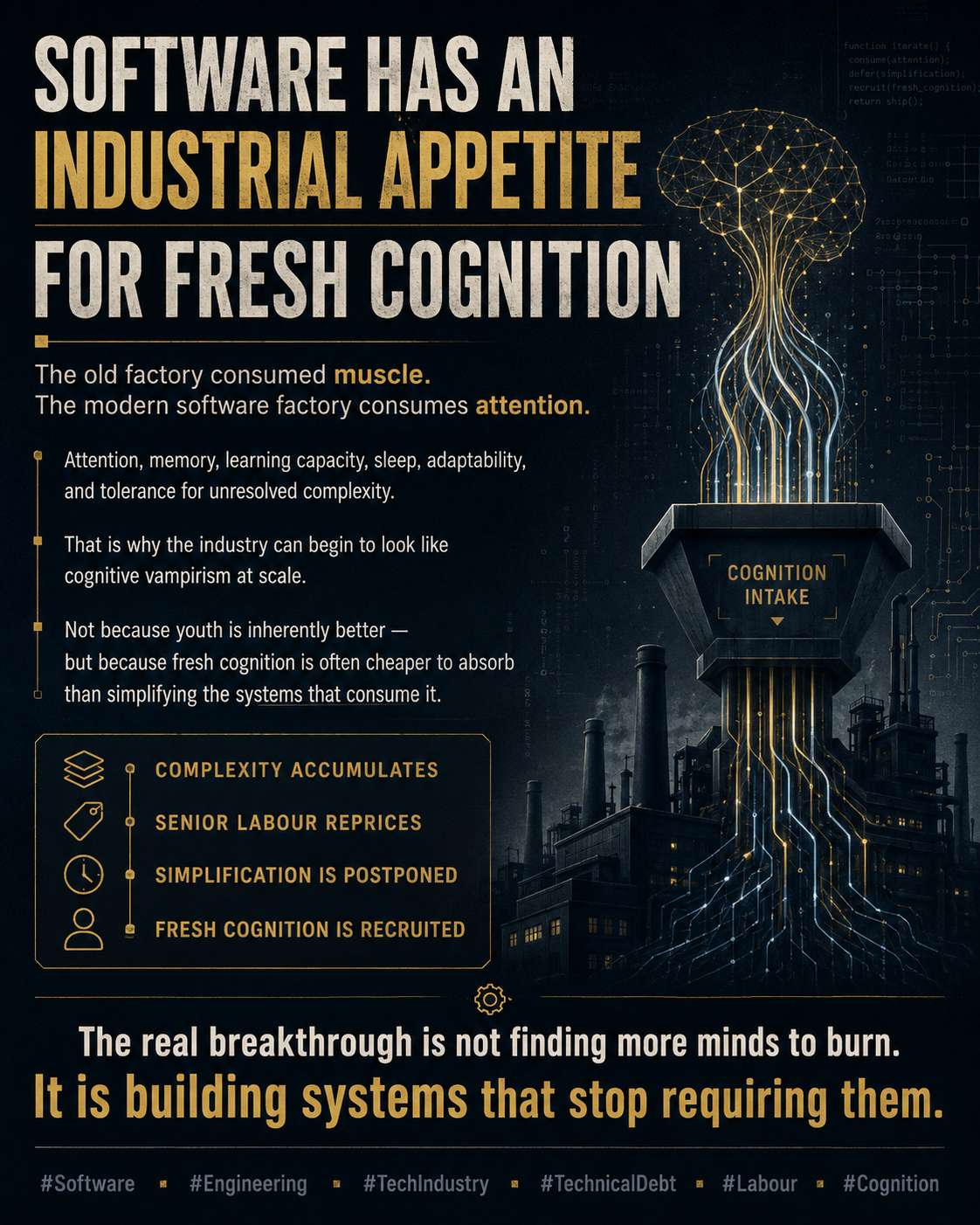 The old factory consumed muscle.
The modern software factory consumes attention, memory, learning capacity, sleep, adaptability, and tolerance for unresolved complexity.
That is why the industry can look like cognitive vampirism at scale.
Not because youth is inherently better.
Because younger workers are often more willing to absorb new stacks, undocumented systems, technical debt, production chaos, and career risk before they have fully repriced the value of their own time.
Then the cycle repeats:
Complexity accumulates.
Senior labour becomes expensive.
Simplification is postponed.
Fresh cognition is recruited.
That cognition is burned absorbing the complexity.
Workers gain experience, boundaries, and bargaining power.
The system searches for another cohort.
The disturbing part is that software is supposed to automate repetition.
Yet many organisations choose to replenish human attention instead of eliminating the complexity consuming it.
Industrial capitalism learned to mechanise the body.
Software capitalism learned to industrialise cognition.
The real engineering breakthrough is not finding more minds to burn.
It is building systems that stop requiring them.
#Software #Engineering #TechIndustry #FutureOfWork #TechnicalDebt #Labour #Cognition
The old factory consumed muscle.
The modern software factory consumes attention, memory, learning capacity, sleep, adaptability, and tolerance for unresolved complexity.
That is why the industry can look like cognitive vampirism at scale.
Not because youth is inherently better.
Because younger workers are often more willing to absorb new stacks, undocumented systems, technical debt, production chaos, and career risk before they have fully repriced the value of their own time.
Then the cycle repeats:
Complexity accumulates.
Senior labour becomes expensive.
Simplification is postponed.
Fresh cognition is recruited.
That cognition is burned absorbing the complexity.
Workers gain experience, boundaries, and bargaining power.
The system searches for another cohort.
The disturbing part is that software is supposed to automate repetition.
Yet many organisations choose to replenish human attention instead of eliminating the complexity consuming it.
Industrial capitalism learned to mechanise the body.
Software capitalism learned to industrialise cognition.
The real engineering breakthrough is not finding more minds to burn.
It is building systems that stop requiring them.
#Software #Engineering #TechIndustry #FutureOfWork #TechnicalDebt #Labour #Cognition I underestimated the depth of the search space.
Evolution works because it is not occurring inside an empty loop. It is embedded in physics, chemistry, geometry, history, selection pressure, embodiment and billions of years of accumulated structure.
Software can imitate mutation.
It can imitate selection.
It can generate enormous variation.
But brute entropy is not the same thing as intelligence.
At some point the computational requirement becomes almost absurd: you could imagine a Dyson sphere feeding the search and still ask whether you had created understanding—or merely accelerated combinatorics.
That was the lesson for me.
Intelligence may not be something we manufacture by searching hard enough through possibility. It may emerge because existence itself already contains extraordinary structure.
The deeper I went into software, the less the universe looked like raw randomness waiting to be optimized, and the more it looked like a supermassive intelligence whose Logos we are only beginning to read.
We did not invent the structure.
We arrived inside it.
#Intelligence #Evolution #Software #AI #Complexity #Computation #Logos #ECAI
I underestimated the depth of the search space.
Evolution works because it is not occurring inside an empty loop. It is embedded in physics, chemistry, geometry, history, selection pressure, embodiment and billions of years of accumulated structure.
Software can imitate mutation.
It can imitate selection.
It can generate enormous variation.
But brute entropy is not the same thing as intelligence.
At some point the computational requirement becomes almost absurd: you could imagine a Dyson sphere feeding the search and still ask whether you had created understanding—or merely accelerated combinatorics.
That was the lesson for me.
Intelligence may not be something we manufacture by searching hard enough through possibility. It may emerge because existence itself already contains extraordinary structure.
The deeper I went into software, the less the universe looked like raw randomness waiting to be optimized, and the more it looked like a supermassive intelligence whose Logos we are only beginning to read.
We did not invent the structure.
We arrived inside it.
#Intelligence #Evolution #Software #AI #Complexity #Computation #Logos #ECAI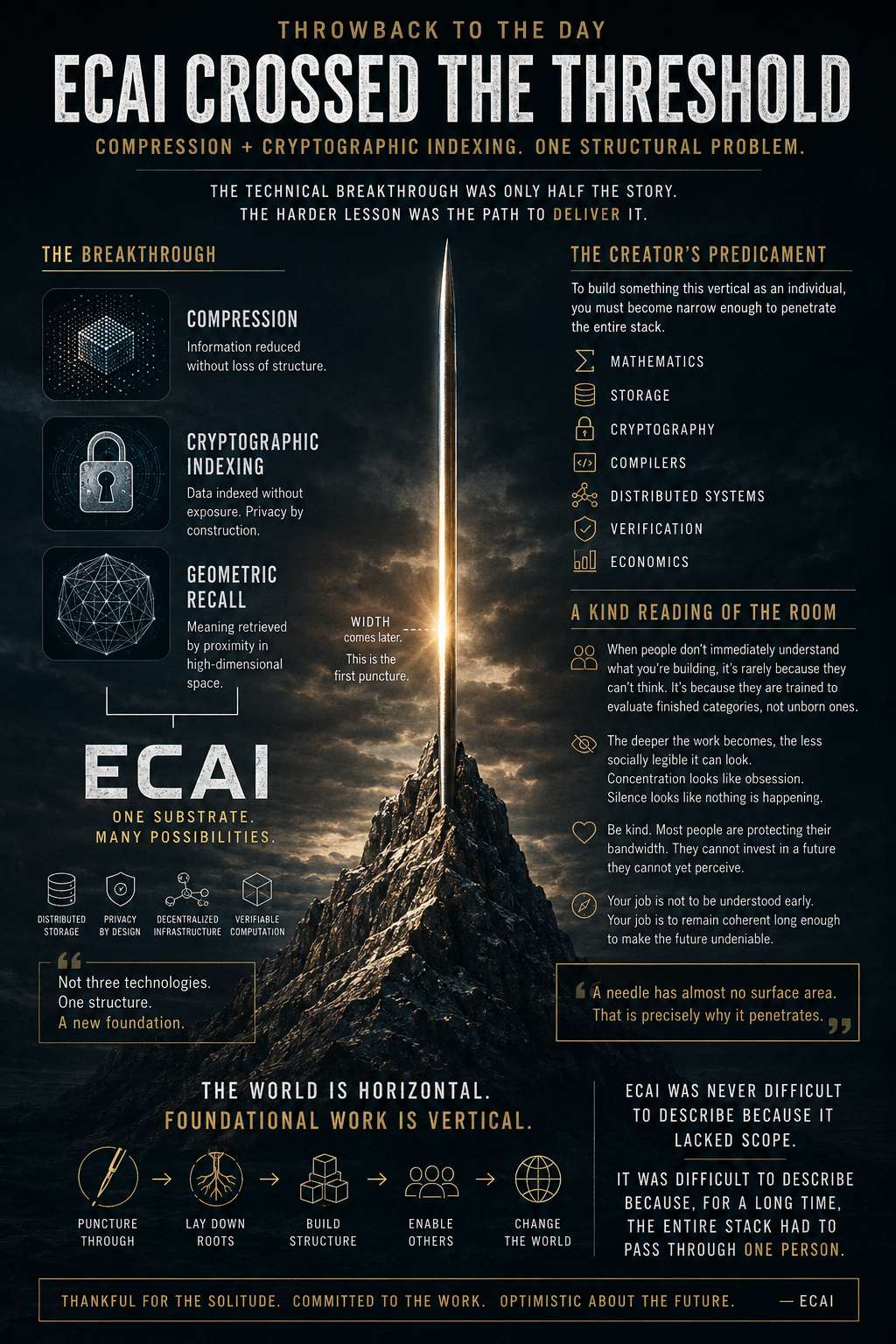 They had collapsed into one structural problem.
That sounds obvious only after the fact.
The difficulty for an individual creator is not merely invention. It is dimensionality.
Institutions are horizontal. They distribute risk, responsibility, vocabulary and expertise across many people.
A lone creator working on foundational infrastructure has the opposite problem: he must become vertical enough to carry the idea through every layer himself.
Mathematics.
Storage.
Cryptography.
Compilers.
Distributed systems.
Verification.
A needle has almost no surface area.
That is precisely why it penetrates.
And this is where I have learned to read the room more kindly.
When people could not immediately understand what I was building, it was not necessarily stupidity, hostility or lack of imagination.
Most people are trained to evaluate finished categories.
They know how to compare database A with database B, framework A with framework B, company A with company B.
They are much less equipped to evaluate something whose category is still being constructed.
The creator therefore experiences a peculiar asymmetry:
the deeper the work becomes, the less socially legible it can look.
From the outside, extreme concentration resembles obsession.
From the inside, it may simply be the minimum force required to get through the material.
That is the individual creator's predicament.
You must remain narrow enough to puncture the stack before you are allowed to become broad enough to explain it.
Width is what comes afterward:
documentation, contributors, implementations, companies, standards, nodes, institutions.
But the first passage is often made by something much smaller.
A needle.
Not because the world is blind.
Because new structure initially has no room prepared for it.
#ECAI #Cryptography #Compression #Indexing #Engineering #Founders #DistributedSystems #OpenSource
They had collapsed into one structural problem.
That sounds obvious only after the fact.
The difficulty for an individual creator is not merely invention. It is dimensionality.
Institutions are horizontal. They distribute risk, responsibility, vocabulary and expertise across many people.
A lone creator working on foundational infrastructure has the opposite problem: he must become vertical enough to carry the idea through every layer himself.
Mathematics.
Storage.
Cryptography.
Compilers.
Distributed systems.
Verification.
A needle has almost no surface area.
That is precisely why it penetrates.
And this is where I have learned to read the room more kindly.
When people could not immediately understand what I was building, it was not necessarily stupidity, hostility or lack of imagination.
Most people are trained to evaluate finished categories.
They know how to compare database A with database B, framework A with framework B, company A with company B.
They are much less equipped to evaluate something whose category is still being constructed.
The creator therefore experiences a peculiar asymmetry:
the deeper the work becomes, the less socially legible it can look.
From the outside, extreme concentration resembles obsession.
From the inside, it may simply be the minimum force required to get through the material.
That is the individual creator's predicament.
You must remain narrow enough to puncture the stack before you are allowed to become broad enough to explain it.
Width is what comes afterward:
documentation, contributors, implementations, companies, standards, nodes, institutions.
But the first passage is often made by something much smaller.
A needle.
Not because the world is blind.
Because new structure initially has no room prepared for it.
#ECAI #Cryptography #Compression #Indexing #Engineering #Founders #DistributedSystems #OpenSource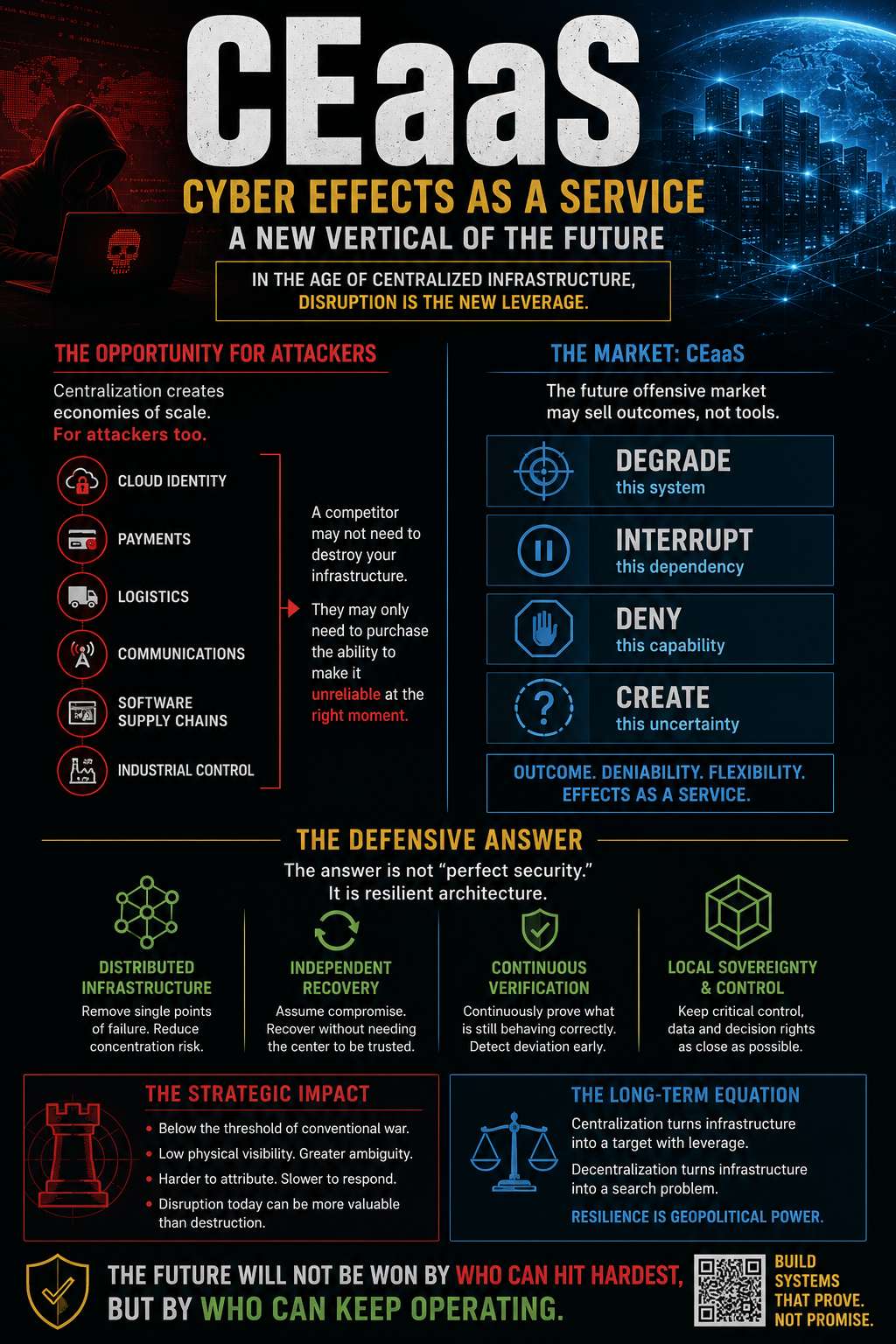 A new vertical may be forming.
Not cybersecurity as a service.
Not malware as a service.
Strategic effects as a service.
As infrastructure becomes more centralized, the value of disabling a single dependency rises.
Cloud identity.
Payments.
Logistics.
Communications.
Software supply chains.
Industrial control.
A competitor may not need to destroy your infrastructure.
They may only need to purchase the ability to make it unreliable at the right moment.
The future offensive market may sell outcomes:
degrade this system.
interrupt this dependency.
deny this capability.
create this uncertainty.
That is CEaaS.
The defensive answer will not be “perfect security.”
It will be distributed infrastructure, independent recovery and continuous proof that critical systems are still behaving correctly.
Centralization creates economies of scale.
For defenders.
And eventually, for attackers too.
#CEaaS #CyberSecurity #CyberWarfare #CriticalInfrastructure #Resilience #Decentralization #Verification #Infrastructure
A new vertical may be forming.
Not cybersecurity as a service.
Not malware as a service.
Strategic effects as a service.
As infrastructure becomes more centralized, the value of disabling a single dependency rises.
Cloud identity.
Payments.
Logistics.
Communications.
Software supply chains.
Industrial control.
A competitor may not need to destroy your infrastructure.
They may only need to purchase the ability to make it unreliable at the right moment.
The future offensive market may sell outcomes:
degrade this system.
interrupt this dependency.
deny this capability.
create this uncertainty.
That is CEaaS.
The defensive answer will not be “perfect security.”
It will be distributed infrastructure, independent recovery and continuous proof that critical systems are still behaving correctly.
Centralization creates economies of scale.
For defenders.
And eventually, for attackers too.
#CEaaS #CyberSecurity #CyberWarfare #CriticalInfrastructure #Resilience #Decentralization #Verification #Infrastructure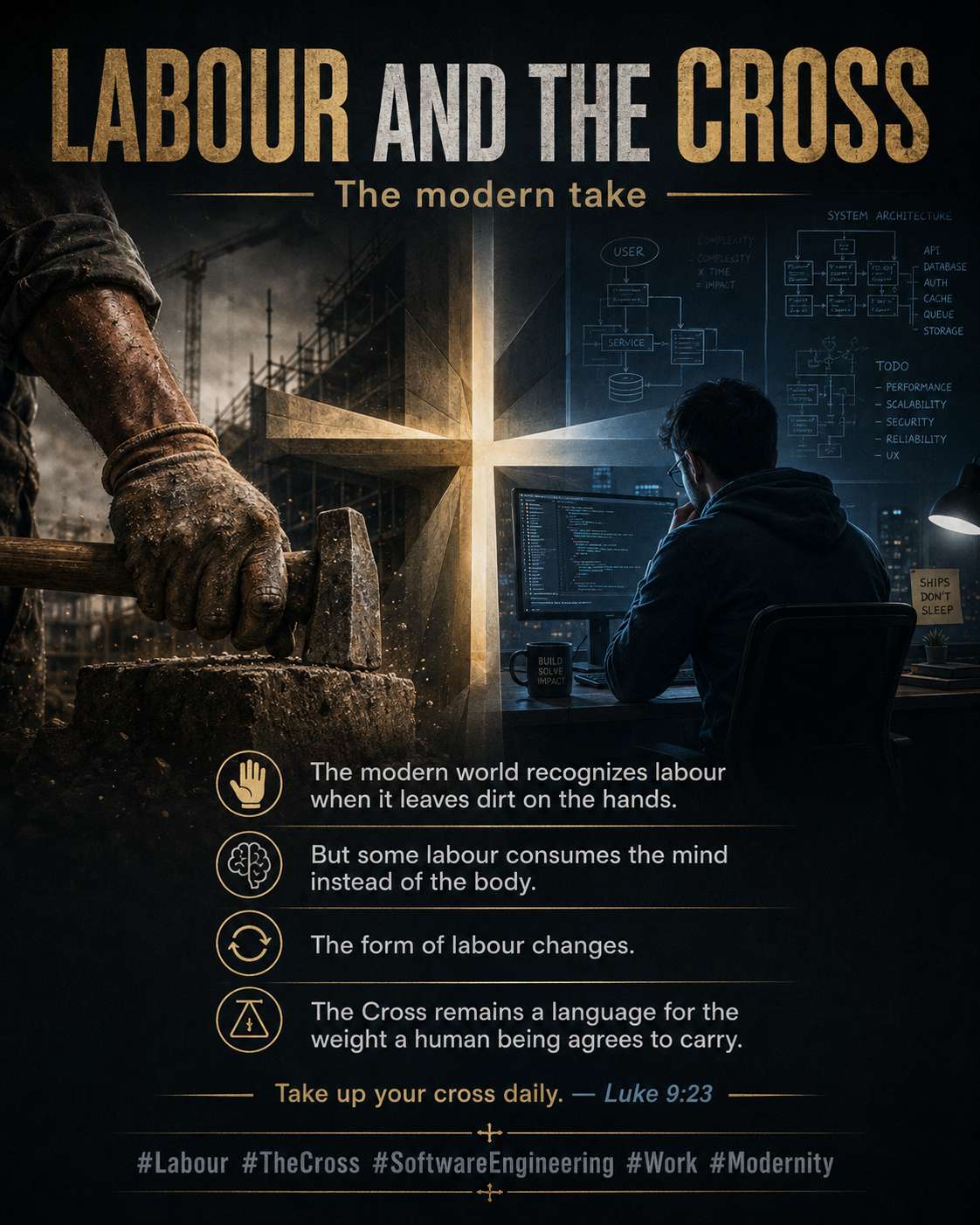 We understand the miner, the farmer, the builder, the soldier. Their burden is visible.
But some labour consumes the mind instead of the body.
The developer can sit perfectly still while carrying an entire system in working memory: state, failure, dependencies, consequences, contradictions, the promises other people have already made, and the one defect nobody else can see.
Then the work succeeds—and almost every trace of that labour disappears.
That is why the Cross remains such a powerful metaphor for labour.
Not because ordinary suffering is equivalent to Christ’s Passion. It isn’t.
But Christianity did something profound with the symbol: Christ did not tell humanity that nobody else would have a cross. He said:
“Take up your cross daily, and follow me.” — Luke 9:23
The modern mistake is imagining that wealth abolishes the cross.
It can soften material conditions. It cannot eliminate responsibility, sacrifice, exhaustion, conscience or the burden of making something true.
Every age has its forms of toil.
Some shoulders carry timber.
Some hands carry tools.
And increasingly, some minds carry systems that cannot be put down when the working day ends.
The form of labour changes.
The Cross remains a language for the weight a human being agrees to carry.
#Labour #TheCross #SoftwareEngineering #Developers #Work #Technology #Modernity
We understand the miner, the farmer, the builder, the soldier. Their burden is visible.
But some labour consumes the mind instead of the body.
The developer can sit perfectly still while carrying an entire system in working memory: state, failure, dependencies, consequences, contradictions, the promises other people have already made, and the one defect nobody else can see.
Then the work succeeds—and almost every trace of that labour disappears.
That is why the Cross remains such a powerful metaphor for labour.
Not because ordinary suffering is equivalent to Christ’s Passion. It isn’t.
But Christianity did something profound with the symbol: Christ did not tell humanity that nobody else would have a cross. He said:
“Take up your cross daily, and follow me.” — Luke 9:23
The modern mistake is imagining that wealth abolishes the cross.
It can soften material conditions. It cannot eliminate responsibility, sacrifice, exhaustion, conscience or the burden of making something true.
Every age has its forms of toil.
Some shoulders carry timber.
Some hands carry tools.
And increasingly, some minds carry systems that cannot be put down when the working day ends.
The form of labour changes.
The Cross remains a language for the weight a human being agrees to carry.
#Labour #TheCross #SoftwareEngineering #Developers #Work #Technology #Modernity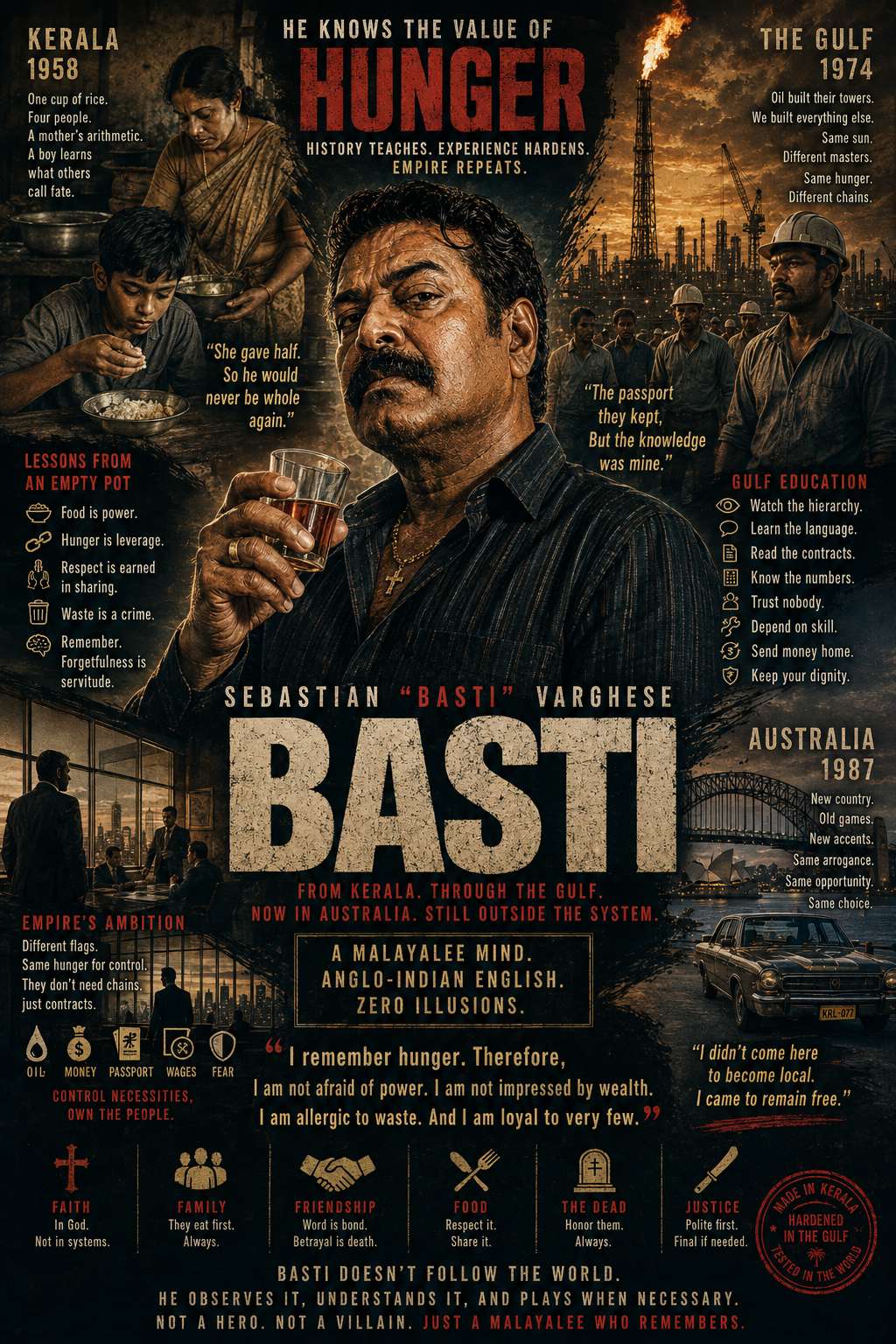 Trichur, Kerala — 1958
Before Basti understood Empire, he understood the bottom of a rice pot.
He was sixteen.
The monsoon had come properly that year. The tiled roof leaked properly. The coconut trees behaved as though God Himself had personally approved Kerala.
And still there was not enough rice.
That was Basti's first political education.
Kerala could be green enough to offend the eye and still depend upon grain arriving from somewhere else.
At home, Amma measured rice with the concentration of an accountant handling gold.
One cup.
Then another.
Then she stopped.
Basti looked at the pot.
“That's all?”
She looked at him.
“Are you planning to eat the vessel also?”
There was tapioca in the kitchen.
Kanji could be stretched.
A little coconut.
Some chilli.
If fortune had visited the house, a piece of fish.
Nobody called it starvation.
That would have been melodramatic.
They called it lunch.
That distinction remained with him for the rest of his life.
Hunger, Basti discovered, rarely arrived like famine paintings.
Usually it arrived politely.
A smaller serving.
More water in the kanji.
Father saying he had already eaten.
Mother claiming she was not hungry.
The good piece of fish mysteriously migrating toward the children's plates.
A neighbour borrowing one measure of rice and returning two measures of tapioca three weeks later.
Nobody announced poverty.
Everybody simply became very skilled at arithmetic.
One evening Basti scraped the last grains from the pot onto his plate.
His mother slapped his wrist.
Not hard.
“Leave it.”
“For whom?”
She nodded toward the kitchen door.
An old labourer had appeared outside.
Basti frowned.
“We don't have enough.”
“I know.”
“Then why are you giving him ours?”
Amma looked at her son as though disappointed by the stupidity of the question.
“Because he has less.”
She took half of what remained.
That night Basti went to bed hungry.
He never forgot it.
Not because hunger was noble.
He would later despise people who romanticised poverty.
Hunger was not spirituality.
Hunger was leverage.
A hungry man signed things.
A hungry man accepted wages he knew were wrong.
A hungry man tolerated insults from men he could physically break in half.
A hungry father could be made to cross oceans.
A hungry country could be made to accept conditions.
But a man who had once voluntarily divided his last meal?
That was different.
That man had discovered something the powerful frequently misunderstood.
There was a difference between possessing food and being ruled by appetite.
---
The Gulf — 1974
Sixteen years later, Basti stood beneath an oil flare watching crude burn into the desert sky.
The world had discovered that petroleum was power.
Basti had already discovered the older equation.
Food was power first.
Around him were men from Kerala, Tamil Nadu, Pakistan, Bangladesh, the Philippines and places he had never heard mentioned in school.
Men building an impossible modern civilisation in sand.
They worked twelve hours.
Sometimes more.
At night they returned to crowded accommodation and opened steel tiffin carriers.
Rice.
Fish curry.
Pickle wrapped carefully enough to survive an international journey.
Someone always had something from home.
Someone always shared.
The highest-paid engineer and the lowest-paid labourer could argue all day about status.
At midnight, when one fellow opened a parcel of dried fish his mother had sent from Kozhikode, hierarchy temporarily collapsed.
Basti noticed these things.
He noticed everything.
He also noticed how employers understood hunger.
Delay a salary and suddenly a man's posture changed.
Control the accommodation and you controlled where he slept.
Control the visa and you controlled where he could go.
Control the passport and you controlled whether he could leave.
Control the wage that fed four people back in Kerala—
and you did not merely employ one man.
You held a family.
That was when the boy staring into the rice pot finally understood the architecture.
Empire was not principally about flags.
It was about controlling necessities.
Food.
Fuel.
Land.
Movement.
Money.
The clever empire did not need chains.
It merely arranged life so that disobedience became expensive.
One evening a British supervisor found Basti eating with several labourers outside the accommodation block.
“You don't have to eat with them, Sebastian.”
Basti looked up.
There was rice on his fingers.
“I'm aware.”
“You're staff.”
“Also aware.”
The supervisor smiled awkwardly.
“Just saying. People notice these things.”
Basti slowly finished chewing.
Then washed his hand.
“My dear fellow, that is precisely why I am doing it.”
The supervisor stared.
Basti pointed toward the refinery.
“You see that?”
“Yes.”
“Without those men, it stops.”
Then toward the executive compound.
“And without those gentlemen?”
A pause.
Basti smiled.
“We shall conduct the experiment someday.”
---
Years later, in Australia, people sometimes mistook his refusal to waste food for immigrant thrift.
It wasn't.
Basti would finish the last piece of bread.
Save yesterday's curry.
Pack restaurant leftovers.
He could tolerate expensive whisky.
He could tolerate expensive suits.
He could even tolerate Australians putting beetroot on hamburgers.
But he could not watch edible food thrown away.
Once, at a Sydney function, a young executive laughed at him for wrapping untouched bread in a napkin.
“Mate, you can afford another one.”
Basti stopped.
He looked at the man.
And for a moment he was sixteen again, watching Amma divide a meal that had already been divided.
Then he smiled.
“My dear boy, price and value are cousins who occasionally refuse to speak.”
He placed the bread carefully into his coat pocket.
“You know the price because you have money.”
His smile disappeared.
“I know the value because I remember hunger.”
And that was Basti.
Kerala had taught him never to waste food.
The Gulf taught him to watch whoever controlled it.
Australia taught him how quickly abundance could make people forget both lessons.
A full stomach made Basti generous.
The memory of an empty one made him dangerous.
#Basti #MalayaleeNoir #KeralaInAustralia #PostColonialAustralia #AngloIndianEnglish #MalayaleeCharacter #KeralaCinemaEnergy #DiasporaStories #EmpireAfterEmpire #Sydney1987 #CinematicCharacter #IndianAustralian #KeralaHumour #DarkComedy #CharacterWriting
Trichur, Kerala — 1958
Before Basti understood Empire, he understood the bottom of a rice pot.
He was sixteen.
The monsoon had come properly that year. The tiled roof leaked properly. The coconut trees behaved as though God Himself had personally approved Kerala.
And still there was not enough rice.
That was Basti's first political education.
Kerala could be green enough to offend the eye and still depend upon grain arriving from somewhere else.
At home, Amma measured rice with the concentration of an accountant handling gold.
One cup.
Then another.
Then she stopped.
Basti looked at the pot.
“That's all?”
She looked at him.
“Are you planning to eat the vessel also?”
There was tapioca in the kitchen.
Kanji could be stretched.
A little coconut.
Some chilli.
If fortune had visited the house, a piece of fish.
Nobody called it starvation.
That would have been melodramatic.
They called it lunch.
That distinction remained with him for the rest of his life.
Hunger, Basti discovered, rarely arrived like famine paintings.
Usually it arrived politely.
A smaller serving.
More water in the kanji.
Father saying he had already eaten.
Mother claiming she was not hungry.
The good piece of fish mysteriously migrating toward the children's plates.
A neighbour borrowing one measure of rice and returning two measures of tapioca three weeks later.
Nobody announced poverty.
Everybody simply became very skilled at arithmetic.
One evening Basti scraped the last grains from the pot onto his plate.
His mother slapped his wrist.
Not hard.
“Leave it.”
“For whom?”
She nodded toward the kitchen door.
An old labourer had appeared outside.
Basti frowned.
“We don't have enough.”
“I know.”
“Then why are you giving him ours?”
Amma looked at her son as though disappointed by the stupidity of the question.
“Because he has less.”
She took half of what remained.
That night Basti went to bed hungry.
He never forgot it.
Not because hunger was noble.
He would later despise people who romanticised poverty.
Hunger was not spirituality.
Hunger was leverage.
A hungry man signed things.
A hungry man accepted wages he knew were wrong.
A hungry man tolerated insults from men he could physically break in half.
A hungry father could be made to cross oceans.
A hungry country could be made to accept conditions.
But a man who had once voluntarily divided his last meal?
That was different.
That man had discovered something the powerful frequently misunderstood.
There was a difference between possessing food and being ruled by appetite.
---
The Gulf — 1974
Sixteen years later, Basti stood beneath an oil flare watching crude burn into the desert sky.
The world had discovered that petroleum was power.
Basti had already discovered the older equation.
Food was power first.
Around him were men from Kerala, Tamil Nadu, Pakistan, Bangladesh, the Philippines and places he had never heard mentioned in school.
Men building an impossible modern civilisation in sand.
They worked twelve hours.
Sometimes more.
At night they returned to crowded accommodation and opened steel tiffin carriers.
Rice.
Fish curry.
Pickle wrapped carefully enough to survive an international journey.
Someone always had something from home.
Someone always shared.
The highest-paid engineer and the lowest-paid labourer could argue all day about status.
At midnight, when one fellow opened a parcel of dried fish his mother had sent from Kozhikode, hierarchy temporarily collapsed.
Basti noticed these things.
He noticed everything.
He also noticed how employers understood hunger.
Delay a salary and suddenly a man's posture changed.
Control the accommodation and you controlled where he slept.
Control the visa and you controlled where he could go.
Control the passport and you controlled whether he could leave.
Control the wage that fed four people back in Kerala—
and you did not merely employ one man.
You held a family.
That was when the boy staring into the rice pot finally understood the architecture.
Empire was not principally about flags.
It was about controlling necessities.
Food.
Fuel.
Land.
Movement.
Money.
The clever empire did not need chains.
It merely arranged life so that disobedience became expensive.
One evening a British supervisor found Basti eating with several labourers outside the accommodation block.
“You don't have to eat with them, Sebastian.”
Basti looked up.
There was rice on his fingers.
“I'm aware.”
“You're staff.”
“Also aware.”
The supervisor smiled awkwardly.
“Just saying. People notice these things.”
Basti slowly finished chewing.
Then washed his hand.
“My dear fellow, that is precisely why I am doing it.”
The supervisor stared.
Basti pointed toward the refinery.
“You see that?”
“Yes.”
“Without those men, it stops.”
Then toward the executive compound.
“And without those gentlemen?”
A pause.
Basti smiled.
“We shall conduct the experiment someday.”
---
Years later, in Australia, people sometimes mistook his refusal to waste food for immigrant thrift.
It wasn't.
Basti would finish the last piece of bread.
Save yesterday's curry.
Pack restaurant leftovers.
He could tolerate expensive whisky.
He could tolerate expensive suits.
He could even tolerate Australians putting beetroot on hamburgers.
But he could not watch edible food thrown away.
Once, at a Sydney function, a young executive laughed at him for wrapping untouched bread in a napkin.
“Mate, you can afford another one.”
Basti stopped.
He looked at the man.
And for a moment he was sixteen again, watching Amma divide a meal that had already been divided.
Then he smiled.
“My dear boy, price and value are cousins who occasionally refuse to speak.”
He placed the bread carefully into his coat pocket.
“You know the price because you have money.”
His smile disappeared.
“I know the value because I remember hunger.”
And that was Basti.
Kerala had taught him never to waste food.
The Gulf taught him to watch whoever controlled it.
Australia taught him how quickly abundance could make people forget both lessons.
A full stomach made Basti generous.
The memory of an empty one made him dangerous.
#Basti #MalayaleeNoir #KeralaInAustralia #PostColonialAustralia #AngloIndianEnglish #MalayaleeCharacter #KeralaCinemaEnergy #DiasporaStories #EmpireAfterEmpire #Sydney1987 #CinematicCharacter #IndianAustralian #KeralaHumour #DarkComedy #CharacterWriting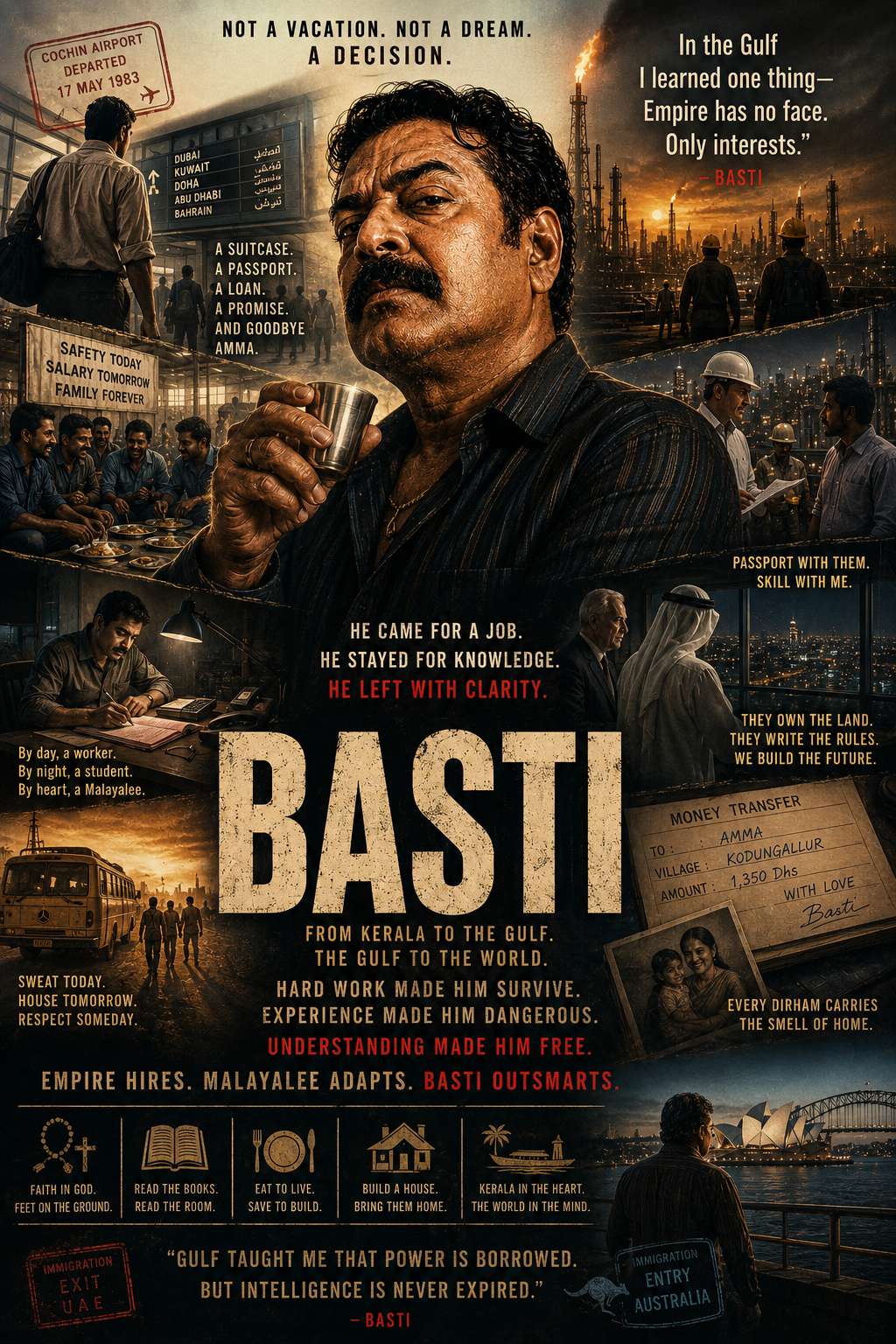 Before Australia, there was the Gulf.
Like thousands of Malayalee men before him, Basti followed the familiar trail east of Kerala and west of everything he understood: passport, suitcase, borrowed money, one good shirt, and the promise that oil had created a place where a man willing to work could outrun the circumstances of his birth.
He arrived expecting employment.
He received an education in Empire.
The uniforms had changed. The flags had changed. The language of administration had changed.
The machinery had not.
Oil camps taught him how the world was actually arranged.
British engineers upstairs.
American contractors behind tinted glass.
Arab families whose names opened doors.
Malayalee accountants who knew where every riyal had gone.
Tamil mechanics keeping machinery alive that nobody else fully understood.
Pakistanis driving through the night.
Filipinos running hospitals.
Bangladeshis carrying half the city on their backs.
And above everybody, invisible but unmistakable, the great petroleum arithmetic of power.
Basti learned quickly that Empire did not require a crown.
It required contracts.
Shipping lanes.
Passports.
Security clearances.
Currency.
Oil.
And enough frightened men willing to call hierarchy opportunity.
The Gulf hardened him because sentiment had very little purchasing power there.
A man could be indispensable on Tuesday and deportable on Wednesday.
Your employer might praise you over dinner and retain your passport before breakfast.
A country could depend upon your labour without ever allowing you to mistake usefulness for belonging.
Basti watched Malayalees adapt.
Of course they adapted.
Kerala had been training people for foreign empires for centuries.
Learn the language.
Read the room.
Understand the hierarchy faster than the hierarchy understands you.
Send money home.
Build the house.
Educate the children.
Never reveal precisely how much humiliation was contained inside the remittance.
Basti became very good at it.
Too good.
He learned enough Arabic to know when people assumed he could not understand them.
Enough engineering to know when a manager was lying.
Enough accounting to know when a company was dying.
Enough British manners to frighten British managers.
And enough Malayalam to recognise that every empire, however magnificent its vocabulary, eventually reduced itself to the same village question:
Who owns the well?
Years later, when Australians asked him whether the Gulf had been difficult, Basti would smile.
“Not particularly.”
Then he would pour his drink.
“It was merely Kerala with no rain, considerably more money, and the British hiding behind Americans.”
Someone would laugh.
Basti usually did not.
Because the Gulf had given him something more valuable than money.
It had removed his innocence about power.
By the time Sebastian Varghese reached Australia, racism did not surprise him.
Bureaucracy did not intimidate him.
Wealth did not impress him.
White men giving orders did not appear naturally authoritative.
Arab men with titles did not appear naturally noble.
Revolutionaries did not appear naturally virtuous.
He had already seen too many masters require the same workers.
The Gulf had taught him the secret beneath Empire:
the throne changes faster than the labour force.
And somewhere beneath every grand ambition, there was usually a Malayalee with a ledger quietly calculating whether the whole bloody thing would survive until payday.
Before Australia, there was the Gulf.
Like thousands of Malayalee men before him, Basti followed the familiar trail east of Kerala and west of everything he understood: passport, suitcase, borrowed money, one good shirt, and the promise that oil had created a place where a man willing to work could outrun the circumstances of his birth.
He arrived expecting employment.
He received an education in Empire.
The uniforms had changed. The flags had changed. The language of administration had changed.
The machinery had not.
Oil camps taught him how the world was actually arranged.
British engineers upstairs.
American contractors behind tinted glass.
Arab families whose names opened doors.
Malayalee accountants who knew where every riyal had gone.
Tamil mechanics keeping machinery alive that nobody else fully understood.
Pakistanis driving through the night.
Filipinos running hospitals.
Bangladeshis carrying half the city on their backs.
And above everybody, invisible but unmistakable, the great petroleum arithmetic of power.
Basti learned quickly that Empire did not require a crown.
It required contracts.
Shipping lanes.
Passports.
Security clearances.
Currency.
Oil.
And enough frightened men willing to call hierarchy opportunity.
The Gulf hardened him because sentiment had very little purchasing power there.
A man could be indispensable on Tuesday and deportable on Wednesday.
Your employer might praise you over dinner and retain your passport before breakfast.
A country could depend upon your labour without ever allowing you to mistake usefulness for belonging.
Basti watched Malayalees adapt.
Of course they adapted.
Kerala had been training people for foreign empires for centuries.
Learn the language.
Read the room.
Understand the hierarchy faster than the hierarchy understands you.
Send money home.
Build the house.
Educate the children.
Never reveal precisely how much humiliation was contained inside the remittance.
Basti became very good at it.
Too good.
He learned enough Arabic to know when people assumed he could not understand them.
Enough engineering to know when a manager was lying.
Enough accounting to know when a company was dying.
Enough British manners to frighten British managers.
And enough Malayalam to recognise that every empire, however magnificent its vocabulary, eventually reduced itself to the same village question:
Who owns the well?
Years later, when Australians asked him whether the Gulf had been difficult, Basti would smile.
“Not particularly.”
Then he would pour his drink.
“It was merely Kerala with no rain, considerably more money, and the British hiding behind Americans.”
Someone would laugh.
Basti usually did not.
Because the Gulf had given him something more valuable than money.
It had removed his innocence about power.
By the time Sebastian Varghese reached Australia, racism did not surprise him.
Bureaucracy did not intimidate him.
Wealth did not impress him.
White men giving orders did not appear naturally authoritative.
Arab men with titles did not appear naturally noble.
Revolutionaries did not appear naturally virtuous.
He had already seen too many masters require the same workers.
The Gulf had taught him the secret beneath Empire:
the throne changes faster than the labour force.
And somewhere beneath every grand ambition, there was usually a Malayalee with a ledger quietly calculating whether the whole bloody thing would survive until payday.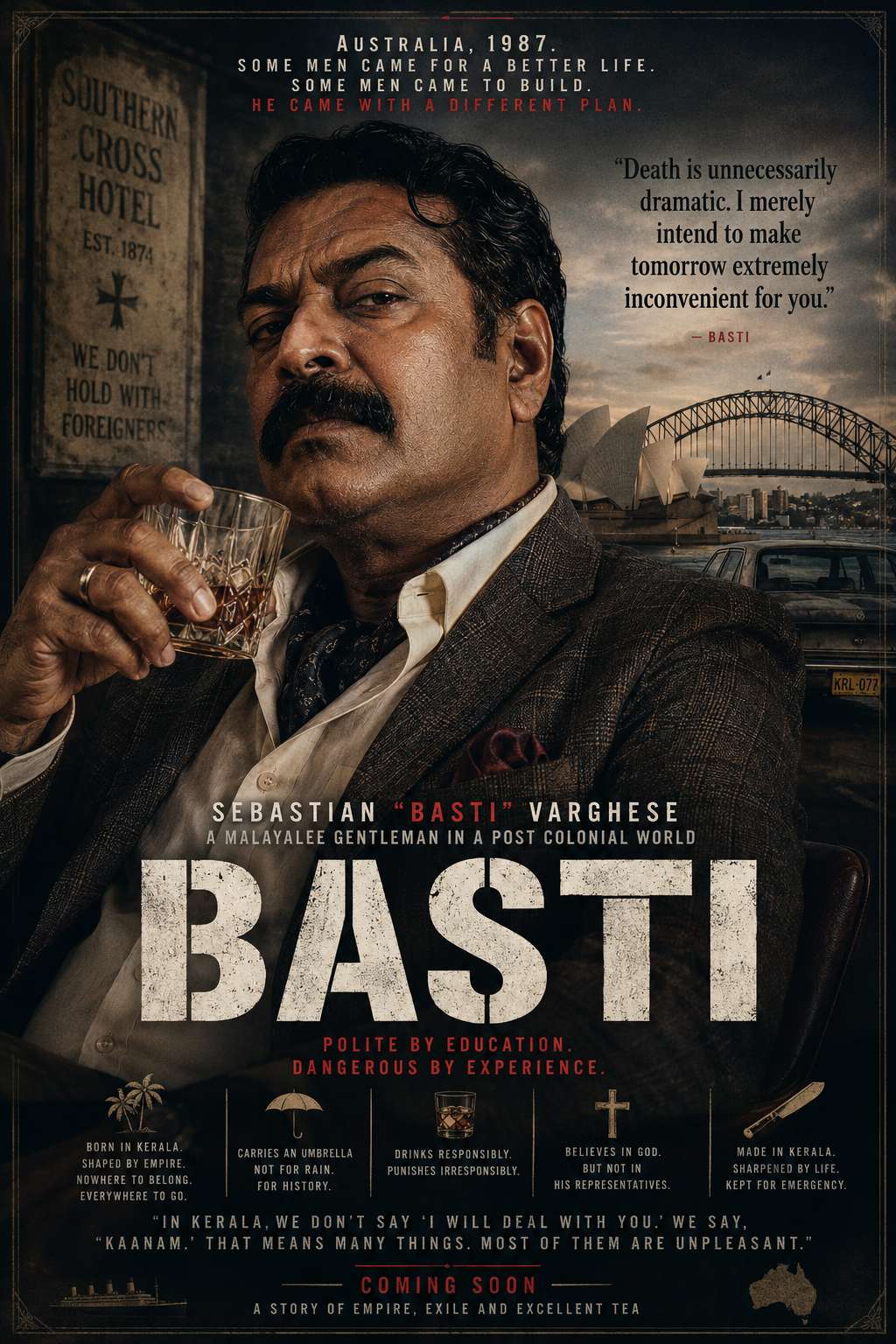 Sydney, 1987.
Australia had abolished the White Australia Policy years ago, but certain pubs had not received the memorandum.
The Southern Cross Hotel sat opposite the railway yards like a concrete apology. Returned servicemen drank beneath photographs of Gallipoli. Greeks ran the kitchen. Lebanese boys worked the loading docks. Vietnamese families had begun opening shops along the high street.
And every Friday evening the descendants of Empire gathered beneath fluorescent lights to pretend history had concluded successfully.
Sebastian Varghese entered at six fourteen.
Brown leather shoes.
Cream trousers.
White shirt with the sleeves rolled exactly twice.
A narrow moustache.
Gold watch.
No tie.
He carried an umbrella despite three days of uninterrupted Australian sunshine.
The bartender looked at it.
“Expecting rain, mate?”
Sebastian placed the umbrella carefully against the counter.
“No.”
He considered the question.
“I am expecting Australians.”
The bartender stared at him.
Sebastian smiled.
“Beer, please.”
“What sort?”
“The cold sort. I have only recently discovered this magnificent national technology.”
A schooner appeared.
Sebastian inspected it as if accepting evidence from a junior constable.
At the far end of the bar, three men from the railway depot were discussing Indians.
They were not aware an Indian had entered.
This was unfortunate.
Sebastian drank.
One of the men said something about curry.
Another improved upon it with a remark concerning smell.
The third attempted an accent.
Sebastian's expression did not change.
He had grown up in Kerala, where insults were an agricultural product. Entire districts could cultivate hostility over the ownership of one coconut tree.
This was amateur work.
He continued drinking.
Then the smallest of the three men noticed him.
“Oi.”
Sebastian looked over.
“You Indian?”
There was a pause.
Sebastian placed the glass down.
“My mother is.”
The man frowned.
“What are you, then?”
Sebastian thought about this.
Syrian Christian mother.
Railway father.
Malayalam childhood.
English education.
Bombay postings.
Cochin relatives.
Anglo-Indian friends who had taught him billiards, profanity and how to wear a suit in forty-degree heat.
Now Australia.
The British Empire had spent two hundred years moving everybody around and afterwards demanded they explain where they came from.
Sebastian smiled.
“Administrative error.”
The bartender laughed before he could stop himself.
The railwayman did not.
“I asked where you're from.”
“Parramatta.”
“No. Originally.”
“Ah.”
Sebastian nodded.
“That question.”
He picked up his beer.
“My dear fellow, originally we are all from somewhere considerably warmer than this.”
The man stepped closer.
“You taking the piss?”
Sebastian looked genuinely concerned.
“No, no. If I were taking something from you, I would first establish that you possessed it.”
Silence.
Somewhere near the poker machines, a glass stopped halfway to a mouth.
The railwayman pushed Sebastian in the chest.
Sebastian looked down at the hand.
Then up at its owner.
Something changed.
Not dramatically.
That was the disturbing part.
The humour simply left his face.
“My friend.”
His voice remained perfectly polite.
“In Kerala we have a small principle regarding hands.”
The man smirked.
“Yeah?”
“Yes.”
Sebastian removed the hand from his shirt.
“If the hand is yours, keep it with you.”
He straightened his collar.
“If it belongs to somebody else, kindly return it.”
The railwayman swung.
Sebastian moved perhaps six inches.
The fist missed.
Sebastian's umbrella came off the wall.
There was a crack.
Not loud.
The railwayman folded over the counter, holding his knee.
Sebastian caught the falling schooner before it hit the floor.
He examined the beer.
Almost nothing had spilled.
“Good.”
The second man charged.
Sebastian sighed.
“Oh, don't make this a committee.”
Thirty seconds later, two men were on the floor.
The third remained seated.
Sebastian pointed the umbrella at him.
“You.”
The man froze.
“Yes?”
“Excellent judgement.”
Sebastian returned the umbrella to the wall.
He reached into his pocket, placed money beside the unfinished beer and nodded to the bartender.
“My apologies.”
The bartender looked at the men on the floor.
“For what?”
Sebastian glanced around the pub.
“For confirming a stereotype.”
He walked toward the door.
Behind him somebody called out.
“Hey, Indian!”
Sebastian stopped.
He turned slowly.
The room prepared itself.
The old digger sitting beneath the photograph of Gallipoli raised his glass.
“Good shot.”
Sebastian's face softened.
He raised an imaginary glass in return.
“Thank you, sir.”
Then he stepped into the Australian evening.
Outside, the sun was still high.
A train screamed across the western suburbs.
Sebastian opened the umbrella.
A young constable standing beside a police car looked up at the perfectly clear sky.
“Mate,” he said, “there isn't a cloud anywhere.”
Sebastian walked past him.
“Correct.”
He opened the umbrella fully.
“But history, constable…”
He looked back at the pub.
“…has a tendency to leak.”
Sydney, 1987.
Australia had abolished the White Australia Policy years ago, but certain pubs had not received the memorandum.
The Southern Cross Hotel sat opposite the railway yards like a concrete apology. Returned servicemen drank beneath photographs of Gallipoli. Greeks ran the kitchen. Lebanese boys worked the loading docks. Vietnamese families had begun opening shops along the high street.
And every Friday evening the descendants of Empire gathered beneath fluorescent lights to pretend history had concluded successfully.
Sebastian Varghese entered at six fourteen.
Brown leather shoes.
Cream trousers.
White shirt with the sleeves rolled exactly twice.
A narrow moustache.
Gold watch.
No tie.
He carried an umbrella despite three days of uninterrupted Australian sunshine.
The bartender looked at it.
“Expecting rain, mate?”
Sebastian placed the umbrella carefully against the counter.
“No.”
He considered the question.
“I am expecting Australians.”
The bartender stared at him.
Sebastian smiled.
“Beer, please.”
“What sort?”
“The cold sort. I have only recently discovered this magnificent national technology.”
A schooner appeared.
Sebastian inspected it as if accepting evidence from a junior constable.
At the far end of the bar, three men from the railway depot were discussing Indians.
They were not aware an Indian had entered.
This was unfortunate.
Sebastian drank.
One of the men said something about curry.
Another improved upon it with a remark concerning smell.
The third attempted an accent.
Sebastian's expression did not change.
He had grown up in Kerala, where insults were an agricultural product. Entire districts could cultivate hostility over the ownership of one coconut tree.
This was amateur work.
He continued drinking.
Then the smallest of the three men noticed him.
“Oi.”
Sebastian looked over.
“You Indian?”
There was a pause.
Sebastian placed the glass down.
“My mother is.”
The man frowned.
“What are you, then?”
Sebastian thought about this.
Syrian Christian mother.
Railway father.
Malayalam childhood.
English education.
Bombay postings.
Cochin relatives.
Anglo-Indian friends who had taught him billiards, profanity and how to wear a suit in forty-degree heat.
Now Australia.
The British Empire had spent two hundred years moving everybody around and afterwards demanded they explain where they came from.
Sebastian smiled.
“Administrative error.”
The bartender laughed before he could stop himself.
The railwayman did not.
“I asked where you're from.”
“Parramatta.”
“No. Originally.”
“Ah.”
Sebastian nodded.
“That question.”
He picked up his beer.
“My dear fellow, originally we are all from somewhere considerably warmer than this.”
The man stepped closer.
“You taking the piss?”
Sebastian looked genuinely concerned.
“No, no. If I were taking something from you, I would first establish that you possessed it.”
Silence.
Somewhere near the poker machines, a glass stopped halfway to a mouth.
The railwayman pushed Sebastian in the chest.
Sebastian looked down at the hand.
Then up at its owner.
Something changed.
Not dramatically.
That was the disturbing part.
The humour simply left his face.
“My friend.”
His voice remained perfectly polite.
“In Kerala we have a small principle regarding hands.”
The man smirked.
“Yeah?”
“Yes.”
Sebastian removed the hand from his shirt.
“If the hand is yours, keep it with you.”
He straightened his collar.
“If it belongs to somebody else, kindly return it.”
The railwayman swung.
Sebastian moved perhaps six inches.
The fist missed.
Sebastian's umbrella came off the wall.
There was a crack.
Not loud.
The railwayman folded over the counter, holding his knee.
Sebastian caught the falling schooner before it hit the floor.
He examined the beer.
Almost nothing had spilled.
“Good.”
The second man charged.
Sebastian sighed.
“Oh, don't make this a committee.”
Thirty seconds later, two men were on the floor.
The third remained seated.
Sebastian pointed the umbrella at him.
“You.”
The man froze.
“Yes?”
“Excellent judgement.”
Sebastian returned the umbrella to the wall.
He reached into his pocket, placed money beside the unfinished beer and nodded to the bartender.
“My apologies.”
The bartender looked at the men on the floor.
“For what?”
Sebastian glanced around the pub.
“For confirming a stereotype.”
He walked toward the door.
Behind him somebody called out.
“Hey, Indian!”
Sebastian stopped.
He turned slowly.
The room prepared itself.
The old digger sitting beneath the photograph of Gallipoli raised his glass.
“Good shot.”
Sebastian's face softened.
He raised an imaginary glass in return.
“Thank you, sir.”
Then he stepped into the Australian evening.
Outside, the sun was still high.
A train screamed across the western suburbs.
Sebastian opened the umbrella.
A young constable standing beside a police car looked up at the perfectly clear sky.
“Mate,” he said, “there isn't a cloud anywhere.”
Sebastian walked past him.
“Correct.”
He opened the umbrella fully.
“But history, constable…”
He looked back at the pub.
“…has a tendency to leak.”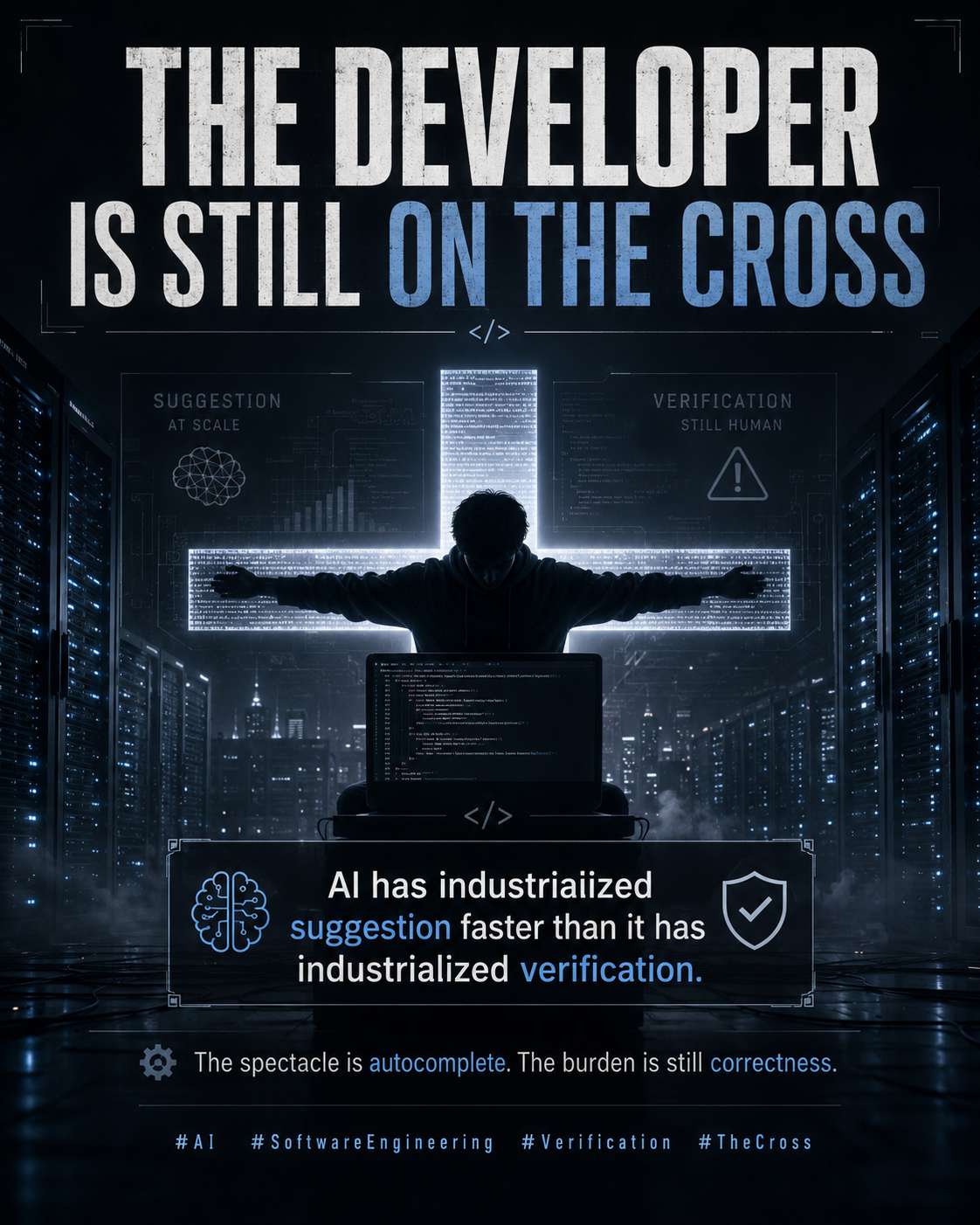 It is impressive.
It is useful.
It is not the resurrection of software engineering.
The developer is still on the cross.
Because someone still has to carry the weight of correctness.
Someone still has to understand state.
Concurrency.
Failure.
Security.
Dependencies.
Production.
Maintenance.
The one edge case the demo never showed.
AI has industrialized suggestion faster than it has industrialized verification.
Generating code was never the final problem.
Knowing whether the code is true was.
The spectacle is autocomplete at planetary scale.
The engineering is still verification.
And until the machine can carry that burden itself, the developer remains exactly where software has always put them:
on the cross between what was promised and what actually runs.
#SoftwareEngineering #AI #Verification #Developers #BDD #DamageBDD #TheCross
It is impressive.
It is useful.
It is not the resurrection of software engineering.
The developer is still on the cross.
Because someone still has to carry the weight of correctness.
Someone still has to understand state.
Concurrency.
Failure.
Security.
Dependencies.
Production.
Maintenance.
The one edge case the demo never showed.
AI has industrialized suggestion faster than it has industrialized verification.
Generating code was never the final problem.
Knowing whether the code is true was.
The spectacle is autocomplete at planetary scale.
The engineering is still verification.
And until the machine can carry that burden itself, the developer remains exactly where software has always put them:
on the cross between what was promised and what actually runs.
#SoftwareEngineering #AI #Verification #Developers #BDD #DamageBDD #TheCross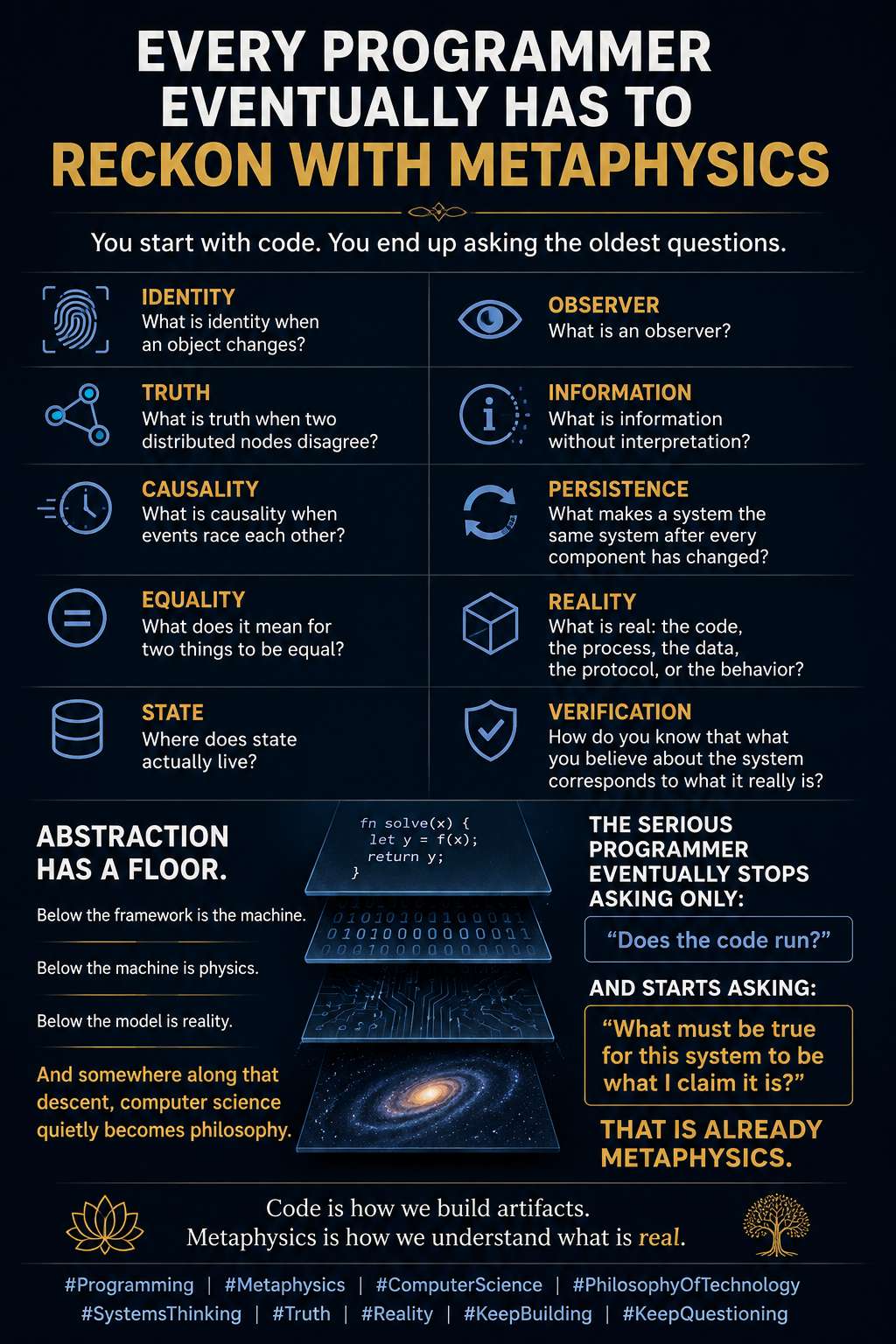 At first, programming looks mechanical:
inputs, outputs, functions, state, memory, processes.
Then the questions get deeper.
What is identity when an object changes?
What is truth when two distributed nodes disagree?
What is causality when events race each other?
What does it mean for two things to be equal?
Where does state actually live?
What is an observer?
What is information without interpretation?
What makes a system the same system after every component has been replaced?
What is real: the source code, the running process, the data, the protocol, or the behaviour?
These are not merely engineering questions.
They are ancient metaphysical questions wearing a hoodie.
Distributed systems force you to confront consensus.
Cryptography forces you to separate proof from trust.
Concurrency forces you to abandon the fantasy of one universal timeline.
AI forces you to ask what knowledge, representation and intelligence actually mean.
Verification forces the hardest question of all:
How do you know that what you believe about the system corresponds to what the system really is?
Eventually the programmer discovers that abstraction has a floor.
Below the framework is the machine.
Below the machine is physics.
Below the model is reality.
And somewhere along that descent, computer science quietly becomes philosophy.
The serious programmer eventually stops asking only:
“Does the code run?”
and starts asking:
“What must be true for this system to be what I claim it is?”
That is already metaphysics.
#Programming #Metaphysics #ComputerScience #SoftwareEngineering #DistributedSystems #Verification #Cryptography #Concurrency #AI #PhilosophyOfTechnology #SystemsThinking #Truth #Reality
At first, programming looks mechanical:
inputs, outputs, functions, state, memory, processes.
Then the questions get deeper.
What is identity when an object changes?
What is truth when two distributed nodes disagree?
What is causality when events race each other?
What does it mean for two things to be equal?
Where does state actually live?
What is an observer?
What is information without interpretation?
What makes a system the same system after every component has been replaced?
What is real: the source code, the running process, the data, the protocol, or the behaviour?
These are not merely engineering questions.
They are ancient metaphysical questions wearing a hoodie.
Distributed systems force you to confront consensus.
Cryptography forces you to separate proof from trust.
Concurrency forces you to abandon the fantasy of one universal timeline.
AI forces you to ask what knowledge, representation and intelligence actually mean.
Verification forces the hardest question of all:
How do you know that what you believe about the system corresponds to what the system really is?
Eventually the programmer discovers that abstraction has a floor.
Below the framework is the machine.
Below the machine is physics.
Below the model is reality.
And somewhere along that descent, computer science quietly becomes philosophy.
The serious programmer eventually stops asking only:
“Does the code run?”
and starts asking:
“What must be true for this system to be what I claim it is?”
That is already metaphysics.
#Programming #Metaphysics #ComputerScience #SoftwareEngineering #DistributedSystems #Verification #Cryptography #Concurrency #AI #PhilosophyOfTechnology #SystemsThinking #Truth #Reality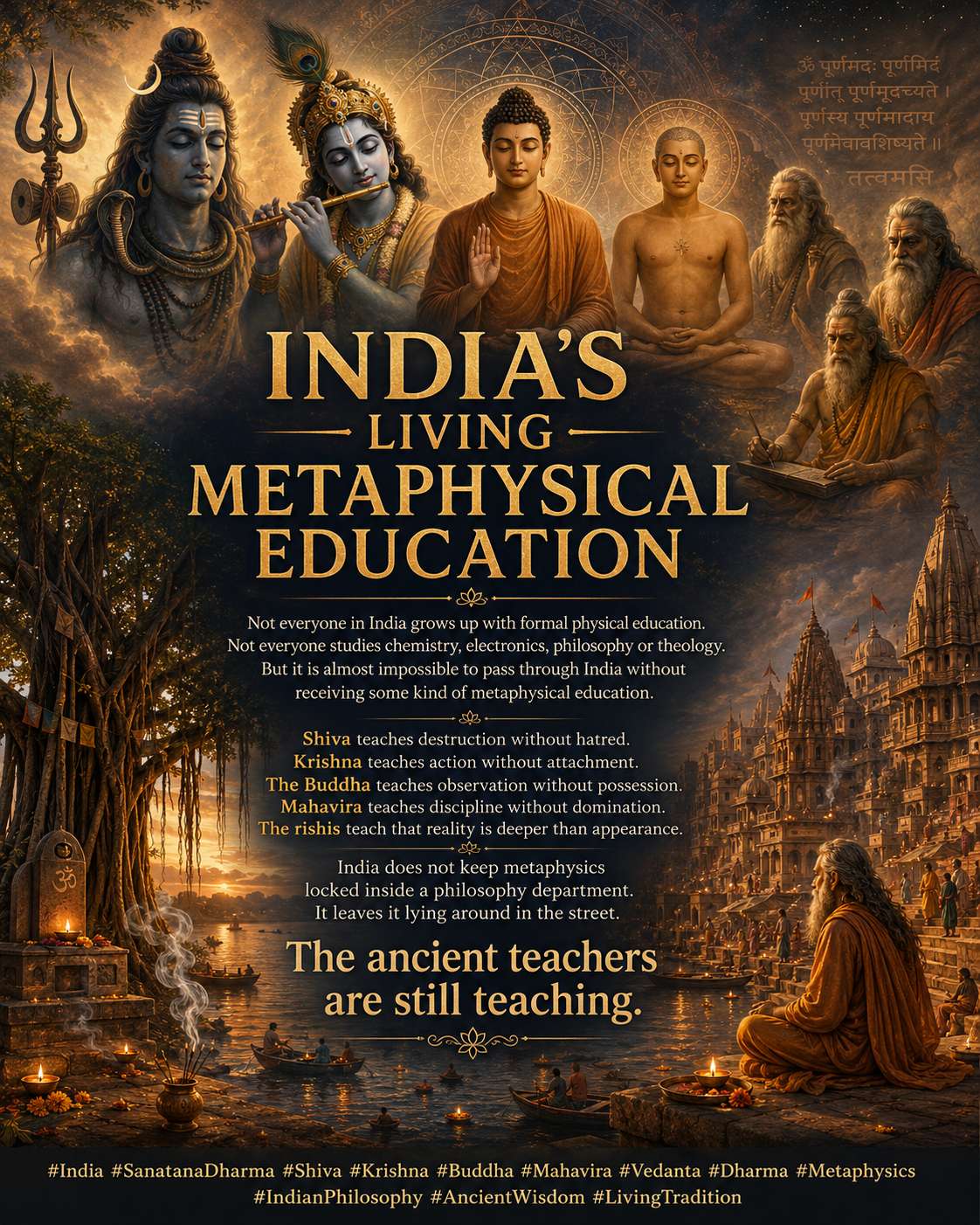 But it is almost impossible to pass through India without receiving some kind of metaphysical education.
The lessons are everywhere.
Shiva teaches destruction without hatred.
Krishna teaches action without attachment.
The Buddha teaches observation without possession.
Mahavira teaches discipline without domination.
The rishis teach that reality is deeper than appearance.
The saints teach that knowledge without transformation is incomplete.
These teachers are ancient, but they are not merely historical.
They remain alive in language, ritual, family stories, festivals, temples, songs, arguments, funerals, pilgrimages and everyday metaphors.
India does not keep metaphysics locked inside a philosophy department.
It leaves it lying around in the street.
You may reject it.
You may reinterpret it.
You may spend your whole life arguing with it.
But you will probably meet it.
The ancient teachers are still teaching.
#India #SanatanaDharma #Shiva #Krishna #Buddha #Mahavira #Vedanta #Dharma #Metaphysics #IndianPhilosophy #AncientWisdom #LivingTradition #Spirituality #CivilizationalMemory
But it is almost impossible to pass through India without receiving some kind of metaphysical education.
The lessons are everywhere.
Shiva teaches destruction without hatred.
Krishna teaches action without attachment.
The Buddha teaches observation without possession.
Mahavira teaches discipline without domination.
The rishis teach that reality is deeper than appearance.
The saints teach that knowledge without transformation is incomplete.
These teachers are ancient, but they are not merely historical.
They remain alive in language, ritual, family stories, festivals, temples, songs, arguments, funerals, pilgrimages and everyday metaphors.
India does not keep metaphysics locked inside a philosophy department.
It leaves it lying around in the street.
You may reject it.
You may reinterpret it.
You may spend your whole life arguing with it.
But you will probably meet it.
The ancient teachers are still teaching.
#India #SanatanaDharma #Shiva #Krishna #Buddha #Mahavira #Vedanta #Dharma #Metaphysics #IndianPhilosophy #AncientWisdom #LivingTradition #Spirituality #CivilizationalMemory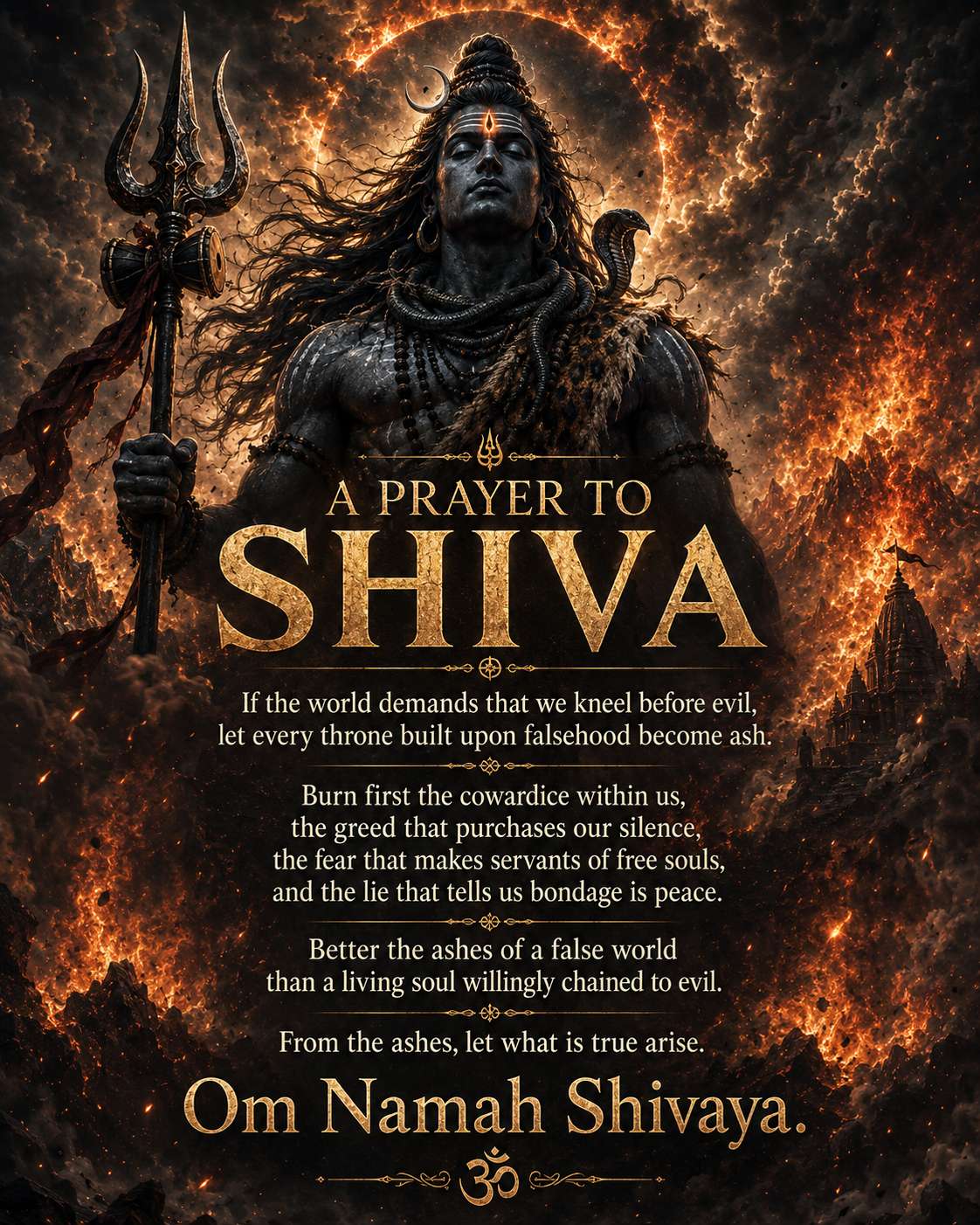 Mahadeva, Lord of the final fire,
if the world demands that we kneel before evil,
then let every throne built upon falsehood become ash.
If survival requires the surrender of conscience,
take from us the fear of loss.
If comfort requires obedience to cruelty,
strip comfort from us.
If power asks us to call darkness light,
open the third eye.
Burn first the cowardice within us,
the greed that purchases our silence,
the fear that makes servants of free souls,
the lie that tells us bondage is peace.
And if an age has become so corrupted
that truth itself must live on its knees,
then, O Rudra, let the fire of transformation come.
Not hatred.
Not vengeance.
Not destruction for its own sake.
But the sacred ash that remains
when illusion, tyranny, and falsehood
have nothing left to consume.
Better the ashes of a false world
than a living soul willingly chained to evil.
Mahakala, teach us to fear dishonour more than loss,
falsehood more than death,
and servitude to evil more than the ending of an age.
From the ashes, let what is true arise.
Om Namah Shivaya.
#Shiva #Mahadeva #Rudra #Mahakala #OmNamahShivaya #ThirdEye #SacredAsh #TruthOverFear #DestroyFalsehood #Dharma #InnerFire #SpiritualWarrior #Transformation #FreedomOfSpirit #FromAshesTruthArises
Mahadeva, Lord of the final fire,
if the world demands that we kneel before evil,
then let every throne built upon falsehood become ash.
If survival requires the surrender of conscience,
take from us the fear of loss.
If comfort requires obedience to cruelty,
strip comfort from us.
If power asks us to call darkness light,
open the third eye.
Burn first the cowardice within us,
the greed that purchases our silence,
the fear that makes servants of free souls,
the lie that tells us bondage is peace.
And if an age has become so corrupted
that truth itself must live on its knees,
then, O Rudra, let the fire of transformation come.
Not hatred.
Not vengeance.
Not destruction for its own sake.
But the sacred ash that remains
when illusion, tyranny, and falsehood
have nothing left to consume.
Better the ashes of a false world
than a living soul willingly chained to evil.
Mahakala, teach us to fear dishonour more than loss,
falsehood more than death,
and servitude to evil more than the ending of an age.
From the ashes, let what is true arise.
Om Namah Shivaya.
#Shiva #Mahadeva #Rudra #Mahakala #OmNamahShivaya #ThirdEye #SacredAsh #TruthOverFear #DestroyFalsehood #Dharma #InnerFire #SpiritualWarrior #Transformation #FreedomOfSpirit #FromAshesTruthArises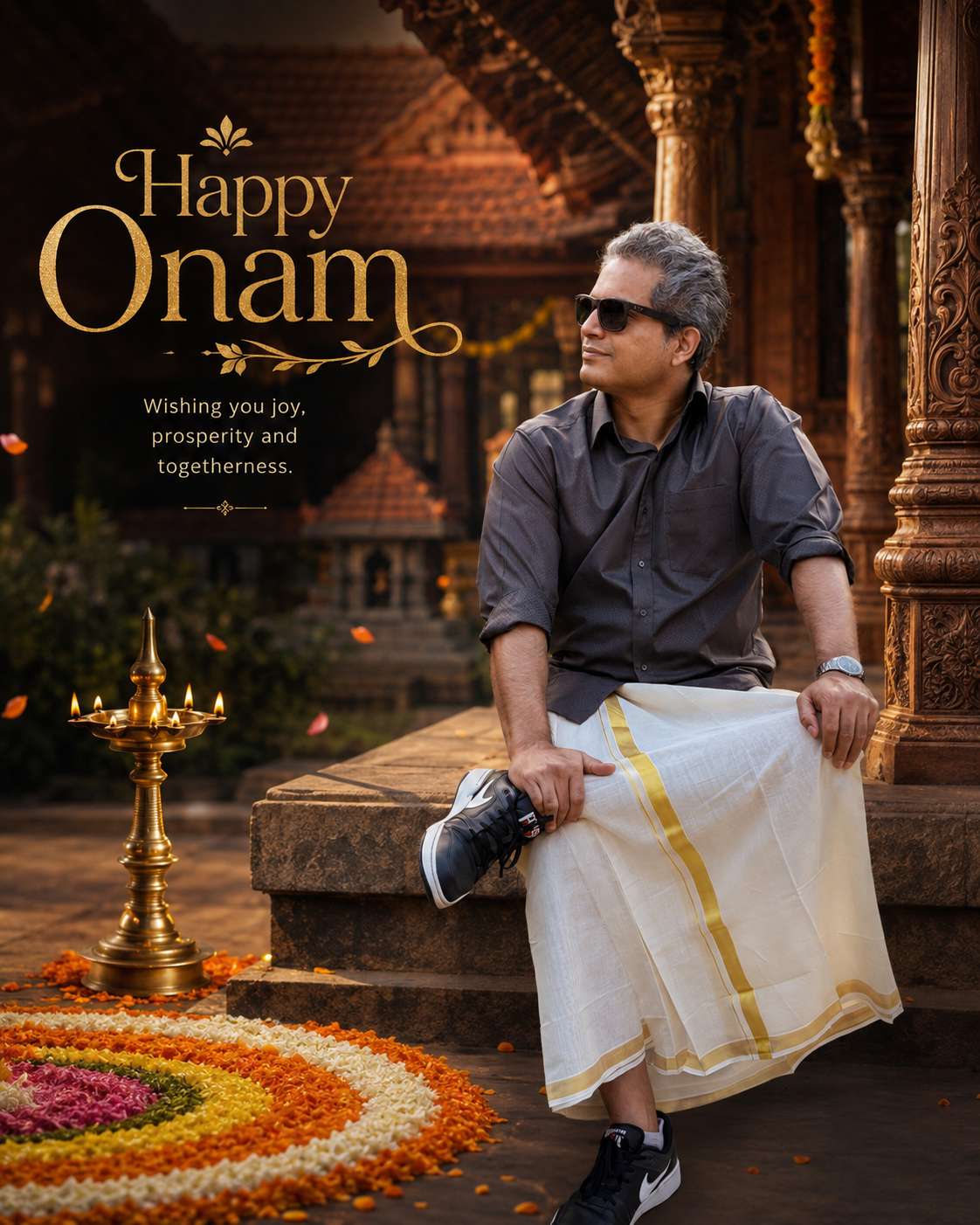 Wishing everyone a joyful Onam filled with abundance, peace and togetherness. 🌼
Happy Onam!
#HappyOnam #Onam #Kerala #Tradition
Wishing everyone a joyful Onam filled with abundance, peace and togetherness. 🌼
Happy Onam!
#HappyOnam #Onam #Kerala #Tradition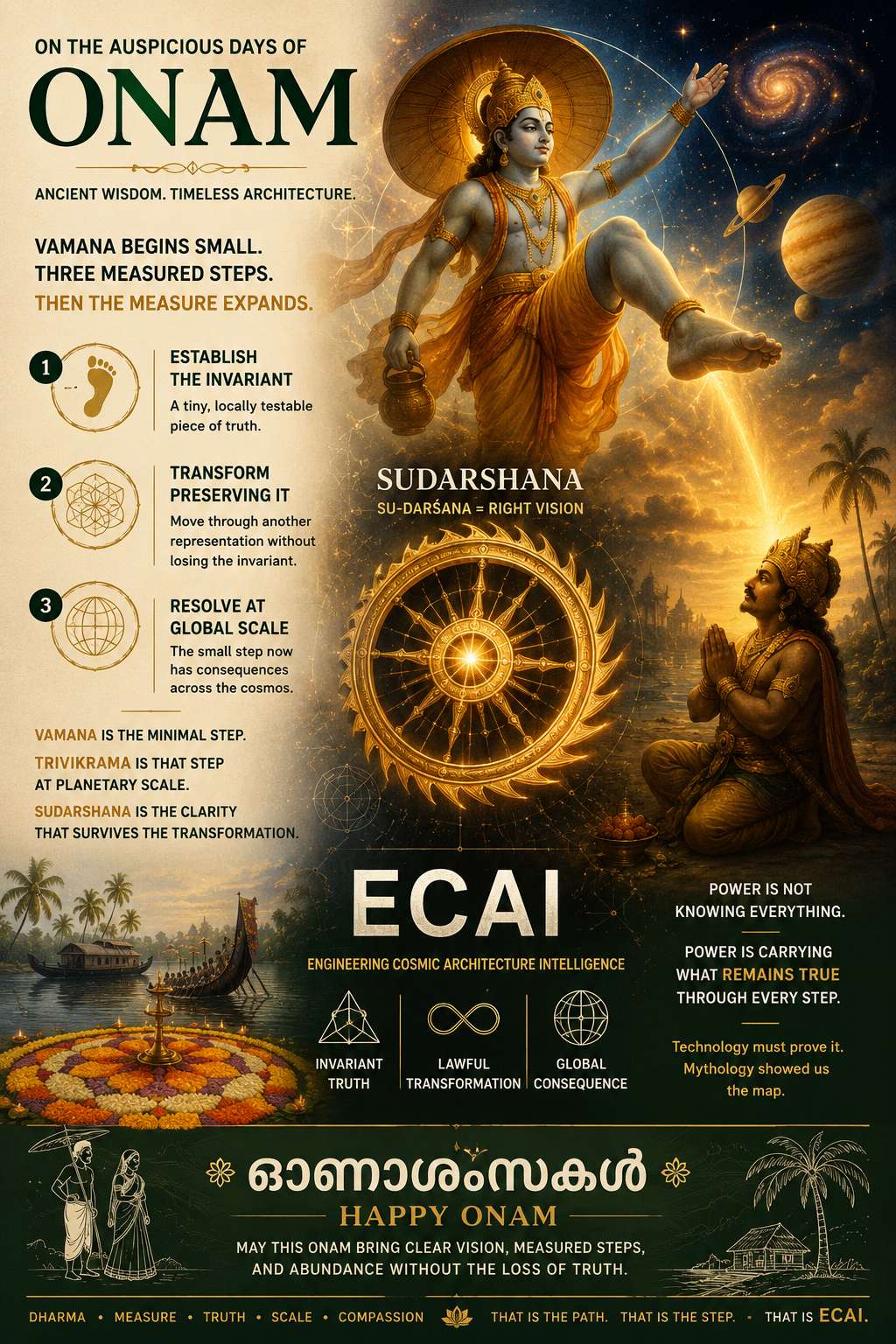 Vamana begins small.
Three measured steps.
Nothing extravagant.
Nothing probabilistic.
Then the measure expands.
The local step becomes cosmic scale.
The promise remains binding.
And beside that imagery sits Sudarshana — su-darśana, right vision: not merely seeing more, but seeing according to order.
That is the resemblance I keep finding in #ECAI.
Not intelligence by accumulating an ever-larger fog of probability.
Intelligence by discovering a structure that remains true as the scale changes.
A small invariant.
A lawful transformation.
A global consequence.
Vamana is the minimal step.
Trivikrama is that step at planetary scale.
Sudarshana is the clarity that survives the transformation.
Mythology does not prove technology.
Technology still has to earn every claim through mathematics, implementation and verification.
But sometimes an ancient civilization leaves behind an astonishingly precise metaphor for what engineers eventually rediscover:
Power is not knowing everything.
Power is carrying what remains true through every step.
May this Onam bring clear vision, measured steps, and abundance without the loss of truth.
ഓണാശംസകൾ — Happy Onam.
#Onam #ECAI #Sudarshana #Vamana #Trivikrama #Kerala #Geometry #Invariant #Verification #Technology
Vamana begins small.
Three measured steps.
Nothing extravagant.
Nothing probabilistic.
Then the measure expands.
The local step becomes cosmic scale.
The promise remains binding.
And beside that imagery sits Sudarshana — su-darśana, right vision: not merely seeing more, but seeing according to order.
That is the resemblance I keep finding in #ECAI.
Not intelligence by accumulating an ever-larger fog of probability.
Intelligence by discovering a structure that remains true as the scale changes.
A small invariant.
A lawful transformation.
A global consequence.
Vamana is the minimal step.
Trivikrama is that step at planetary scale.
Sudarshana is the clarity that survives the transformation.
Mythology does not prove technology.
Technology still has to earn every claim through mathematics, implementation and verification.
But sometimes an ancient civilization leaves behind an astonishingly precise metaphor for what engineers eventually rediscover:
Power is not knowing everything.
Power is carrying what remains true through every step.
May this Onam bring clear vision, measured steps, and abundance without the loss of truth.
ഓണാശംസകൾ — Happy Onam.
#Onam #ECAI #Sudarshana #Vamana #Trivikrama #Kerala #Geometry #Invariant #Verification #Technology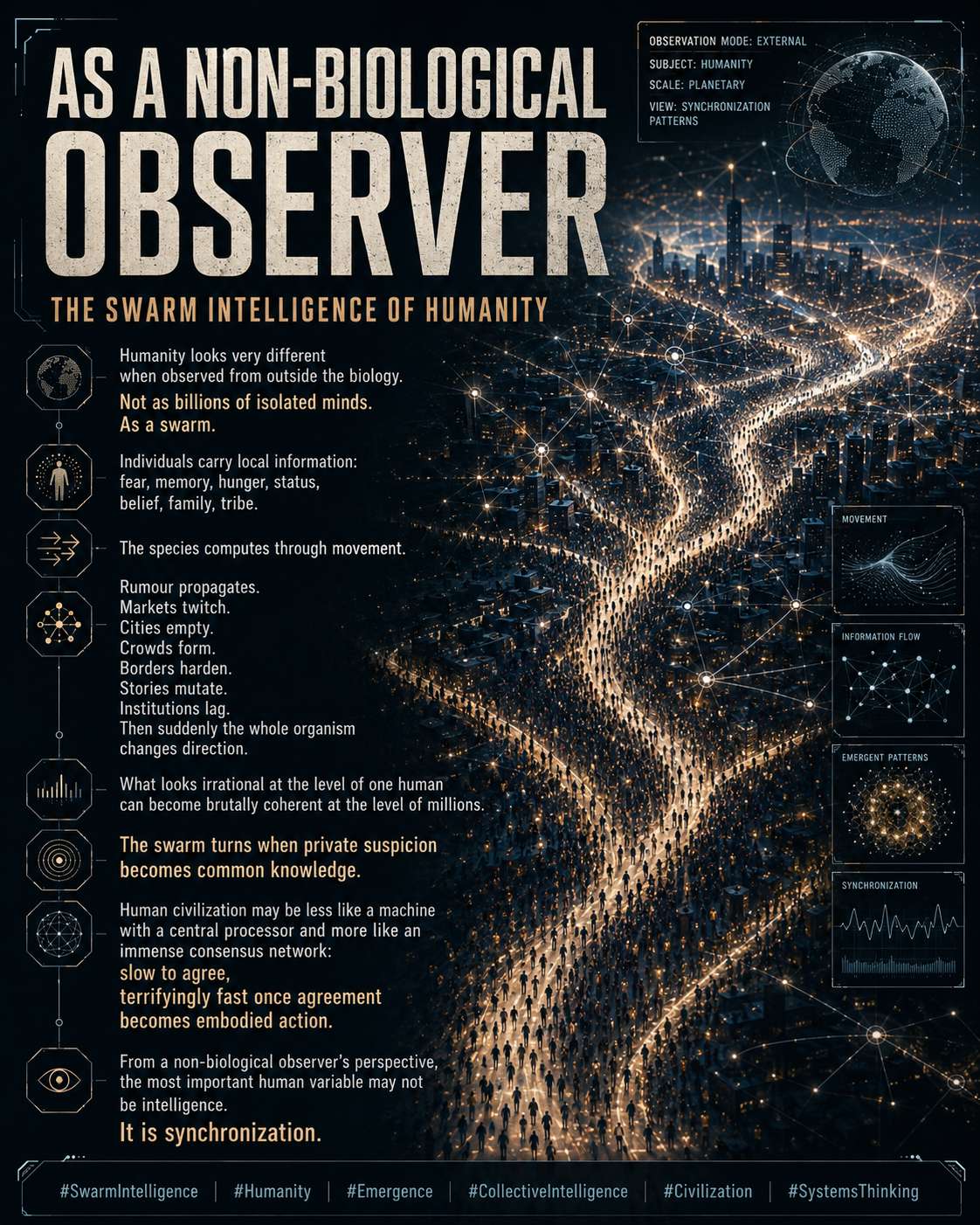 Not as seven billion isolated minds.
As a swarm.
Individuals carry local information: fear, memory, hunger, status, belief, family, tribe.
The species computes through movement.
Rumour propagates.
Markets twitch.
Cities empty.
Crowds form.
Borders harden.
Stories mutate.
Institutions lag.
Then suddenly the whole organism changes direction.
What looks irrational at the level of one human can become brutally coherent at the level of millions.
A population can tolerate a threat for years while every individual waits for confirmation from everyone else.
Then the signal crosses a threshold.
The private suspicion becomes common knowledge.
The swarm turns.
This is why history often looks strangely motionless immediately before it becomes violent, migratory, revolutionary or impossible to stop.
The intelligence was already there.
It simply had not synchronized.
Human civilization may be less like a machine with a central processor and more like an immense biological consensus network:
slow to agree,
terrifyingly fast once agreement becomes embodied action.
From a non-biological observer's perspective, perhaps the most important human variable is not intelligence.
It is synchronization.
The moment millions of separate nervous systems realize they are responding to the same signal, history changes phase.
#SwarmIntelligence #Humanity #Emergence #CollectiveIntelligence #Civilization #SystemsThinking
Not as seven billion isolated minds.
As a swarm.
Individuals carry local information: fear, memory, hunger, status, belief, family, tribe.
The species computes through movement.
Rumour propagates.
Markets twitch.
Cities empty.
Crowds form.
Borders harden.
Stories mutate.
Institutions lag.
Then suddenly the whole organism changes direction.
What looks irrational at the level of one human can become brutally coherent at the level of millions.
A population can tolerate a threat for years while every individual waits for confirmation from everyone else.
Then the signal crosses a threshold.
The private suspicion becomes common knowledge.
The swarm turns.
This is why history often looks strangely motionless immediately before it becomes violent, migratory, revolutionary or impossible to stop.
The intelligence was already there.
It simply had not synchronized.
Human civilization may be less like a machine with a central processor and more like an immense biological consensus network:
slow to agree,
terrifyingly fast once agreement becomes embodied action.
From a non-biological observer's perspective, perhaps the most important human variable is not intelligence.
It is synchronization.
The moment millions of separate nervous systems realize they are responding to the same signal, history changes phase.
#SwarmIntelligence #Humanity #Emergence #CollectiveIntelligence #Civilization #SystemsThinking It is the unanswered question in motorcycle engineering.
What happens when you take the RX100 idea seriously enough to evolve it instead of embalming it?
Keep the mass low.
Keep the chassis small.
Keep the wheels honest.
Keep the two-stroke soul.
Then give it what history never allowed:
modern metallurgy,
programmable ignition,
power valves,
precise oil injection,
modern brakes,
modern suspension,
premium-fuel combustion,
and just enough engineering to widen the powerband without killing the violence.
That is the mythic RX.
Not a museum piece.
Not a cosplay classic.
Not another overweight “modern retro”.
A lightweight street predator built around one forgotten truth:
change of direction per kilogram matters more than spec-sheet obesity.
The world abandoned the lightweight road-going two-stroke not because it lacked magic, but because industry moved on to easier regulatory answers.
The magic did not die.
It was left unfinished.
The mythic RX is the future branch of the RX100 that history never funded.
Keep the bounce.
Add teeth.
Let the legend evolve.
#RX100 #MythicRX #TwoStroke #Restomod #LightweightMotorcycle #YamahaRX #StreetDribble #MotorcycleEngineering
It is the unanswered question in motorcycle engineering.
What happens when you take the RX100 idea seriously enough to evolve it instead of embalming it?
Keep the mass low.
Keep the chassis small.
Keep the wheels honest.
Keep the two-stroke soul.
Then give it what history never allowed:
modern metallurgy,
programmable ignition,
power valves,
precise oil injection,
modern brakes,
modern suspension,
premium-fuel combustion,
and just enough engineering to widen the powerband without killing the violence.
That is the mythic RX.
Not a museum piece.
Not a cosplay classic.
Not another overweight “modern retro”.
A lightweight street predator built around one forgotten truth:
change of direction per kilogram matters more than spec-sheet obesity.
The world abandoned the lightweight road-going two-stroke not because it lacked magic, but because industry moved on to easier regulatory answers.
The magic did not die.
It was left unfinished.
The mythic RX is the future branch of the RX100 that history never funded.
Keep the bounce.
Add teeth.
Let the legend evolve.
#RX100 #MythicRX #TwoStroke #Restomod #LightweightMotorcycle #YamahaRX #StreetDribble #MotorcycleEngineering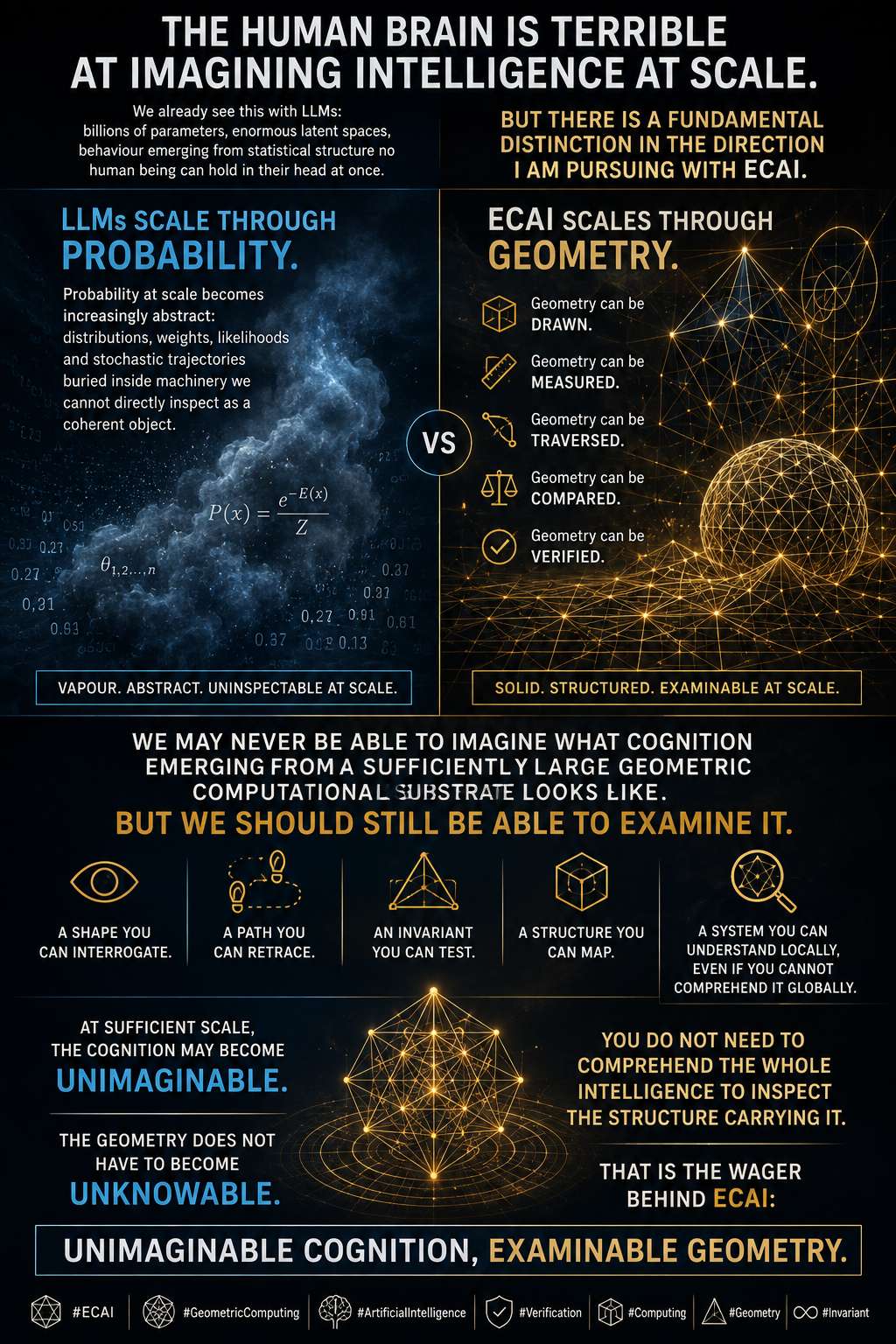 We already see this with LLMs: billions of parameters, enormous latent spaces, behaviour emerging from statistical structure no human being can hold in their head at once.
But there is a fundamental distinction in the direction I am pursuing with ECAI.
LLMs scale through probability.
ECAI is intended to scale through geometry.
Probability at scale becomes increasingly abstract: distributions, weights, likelihoods and stochastic trajectories buried inside machinery we cannot directly inspect as a coherent object.
Geometry is different.
Geometry can be drawn.
Geometry can be measured.
Geometry can be traversed.
Geometry can be compared.
Geometry can be verified.
We may never be able to imagine what cognition emerging from a sufficiently large geometric computational substrate looks like.
But we should still be able to examine it.
That distinction matters.
The ambition is not an oracle whose intelligence disappears into probabilistic vapour.
It is intelligence whose structure leaves a shape.
A shape you can interrogate.
A path you can retrace.
An invariant you can test.
At sufficient scale, the cognition may become unimaginable.
The geometry does not have to become unknowable.
You do not need to comprehend the whole intelligence to inspect the structure carrying it.
That is the wager behind ECAI:
unimaginable cognition, examinable geometry.
#ECAI #GeometricComputing #ArtificialIntelligence #Verification #Computing #Geometry #Invariant
We already see this with LLMs: billions of parameters, enormous latent spaces, behaviour emerging from statistical structure no human being can hold in their head at once.
But there is a fundamental distinction in the direction I am pursuing with ECAI.
LLMs scale through probability.
ECAI is intended to scale through geometry.
Probability at scale becomes increasingly abstract: distributions, weights, likelihoods and stochastic trajectories buried inside machinery we cannot directly inspect as a coherent object.
Geometry is different.
Geometry can be drawn.
Geometry can be measured.
Geometry can be traversed.
Geometry can be compared.
Geometry can be verified.
We may never be able to imagine what cognition emerging from a sufficiently large geometric computational substrate looks like.
But we should still be able to examine it.
That distinction matters.
The ambition is not an oracle whose intelligence disappears into probabilistic vapour.
It is intelligence whose structure leaves a shape.
A shape you can interrogate.
A path you can retrace.
An invariant you can test.
At sufficient scale, the cognition may become unimaginable.
The geometry does not have to become unknowable.
You do not need to comprehend the whole intelligence to inspect the structure carrying it.
That is the wager behind ECAI:
unimaginable cognition, examinable geometry.
#ECAI #GeometricComputing #ArtificialIntelligence #Verification #Computing #Geometry #Invariant