
Globally, the RX100 looks even more unusual.
The original RX100 was about 103 kg kerb, 11 bhp, 10.4 Nm, 18-inch wheels and a 1,240 mm wheelbase. That gives it roughly 107 hp/tonne before the rider, but the more important part is where that performance comes from: very low mass, narrow tyres, a compact chassis and a 2-stroke engine that wakes up sharply.
The closest modern bikes fall into three different camps:
Bike Wet/kerb weight Power How close to RX100?
Yamaha RX100 103 kg ~11 bhp Benchmark
Honda Grom 125 ~102 kg ~10 hp class Extremely close mass, but tiny 12" wheels
Kawasaki Z125 Pro ~102 kg 10 hp Probably closest in sheer tossability
Honda Monkey 125 ~105 kg ~9–10 hp class Similar lightness, softer personality
Honda CB125F 117 kg 10.7 bhp Closest full-size modern commuter philosophy
Yamaha XSR125 140 kg 15 hp More power, far more mass
Typical modern 125 sport/naked 130–155 kg 12–15 hp Faster chassis, much less “basketball”
The 2026 Kawasaki Z125 Pro is fascinating: 224.8 lb / ~102 kg curb, 10 hp, 46.3-inch wheelbase. On paper it is almost absurdly close to the RX100's mass.
And the 2026 Honda Grom is 224 lb, again about 102 kg, with a five-speed gearbox.
So in the pure “pick it up, flick it, throw it around” sense:
RX100 ≈ Grom ≈ Z125 Pro
But there is a huge catch.
The Grom and Z125 achieve that with 12-inch wheels and minibike dimensions. They feel like deliberately scaled-down motorcycles.
The RX100 manages roughly the same mass while still being a proper full-size, 18-inch-wheel motorcycle.
That is the extraordinary bit.
The closest full-size modern equivalent: Honda CB125F
The modern European-market CB125F is probably the closest philosophical descendant I've found.
It has:
117 kg kerb weight
10.7 bhp
18-inch wheels
telescopic forks
twin rear shocks
front disc
5-speed gearbox
Honda even deliberately reduced mass in its newer generation, including combining starter and generator functions.
That means you're only adding about 14 kg over the RX100 while retaining a proper motorcycle wheelbase and 18-inch wheels.
But the motor is the complete opposite.
RX100:
BRAAAP → powerband → go
CB125F:
put-put-put-put → excellent fuel economy → arrive in another country
😂
So dynamically the chassis philosophy is similar, while emotionally they're nowhere near one another.
Yamaha's own XSR125 shows what happened to modern bikes
This is a useful comparison.
The current XSR125 makes a healthy 11 kW / 15 PS, has a six-speed box, USD forks and disc brakes.
But it weighs 140 kg wet.
That's 37 kg heavier than an RX100.
Imagine strapping nearly four 10 kg bags of rice to the RX before setting off.
That's effectively what three decades of:
emissions equipment,
liquid cooling,
large frames,
wide wheels,
large brakes,
ABS hardware,
starter systems,
batteries,
reinforcement,
electronics
have done to the lightweight motorcycle.
The XSR is objectively the much more capable modern machine.
But it cannot play basketball in the same way.
Honda Monkey: same weight, different geometry
The 2026 Monkey is about 231 lb / 105 kg wet, with 12-inch wheels, USD forks, twin shocks and ABS.
It's actually remarkably close to the RX100 philosophy:
simple engine
low mass
minimum machinery
maximum fun
But the Monkey achieves this by becoming physically tiny.
The RX100 did it without becoming a minibike.
That distinction matters.
Kawasaki Z125 Pro might be the modern king of “basketball”
The Z125 Pro is the one I'd try if the criterion is literally:
> Can I change direction with this thing like I'm dribbling it?
At approximately 102 kg wet, short wheelbase, tiny wheels and 10 hp, it is almost entirely designed around low-speed playfulness.
But again:
Z125 = basketball-sized motorcycle
RX100 = motorcycle that handles like a basketball
Those aren't quite the same achievement.
And that's why a restomod RX100 becomes really interesting
Take the RX100's approximately:
103 kg
11 bhp
18-inch wheels
1,240 mm wheelbase
and add only:
220–240 mm front disc
modern tyres
fresh suspension
modern bearings
12 V electrics
CDI
better lighting
and you potentially end up with something the contemporary global market hardly makes at all:
a ~105 kg full-size analogue road motorcycle with modern stopping ability.
That's arguably a more distinctive specification in 2026 than another 150 kg, 15 hp ABS-equipped 125.
The world still makes light minibikes.
It still makes full-size 125s.
What it largely stopped making is the strange middle ground the RX100 occupied:
full-size proportions + minibike mass + genuinely lively engine.
That's the basketball trick. 🏀
View quoted note →
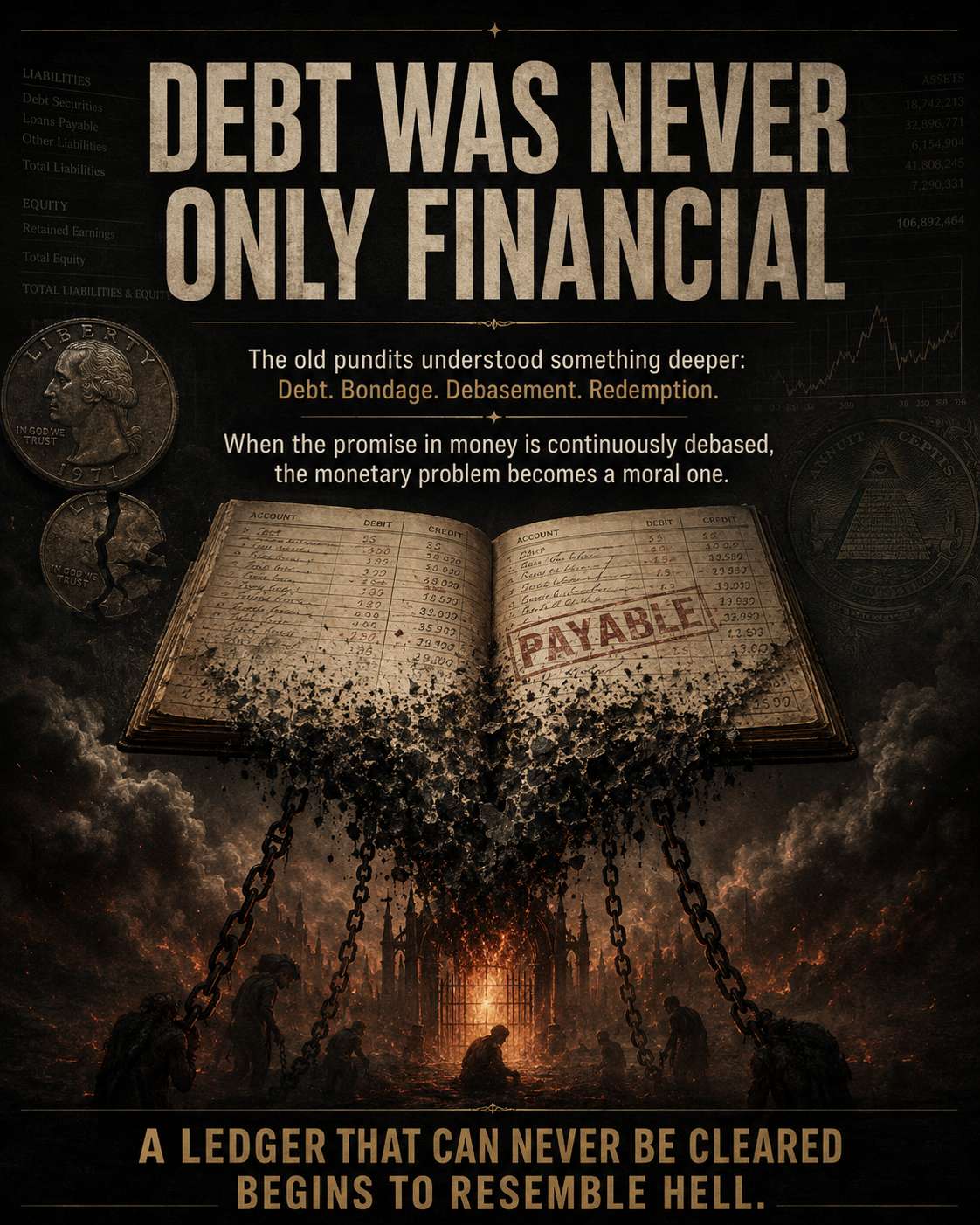 The old pundits understood something deeper:
debt was never only financial. It was moral.
A ledger did not merely record coins owed. It recorded obligation, dependence, promise, guilt and ultimately the limits of what one human being could demand from another.
That is why the language overlaps so cleanly:
Debt.
Bondage.
Debasement.
Redemption.
Scripture could speak of forgiving debts and forgiving sins almost interchangeably because the metaphor was already understood.
To debase the coin was not merely to change its metal content. It was to corrupt the measure carrying yesterday’s labour into tomorrow.
And when debt became impossible to discharge, the problem was no longer merely economic. A claim on money became a claim on future human time.
The old theologians understood the endpoint.
A debt that can never be repaid becomes bondage.
A ledger that can never be cleared becomes judgment.
An obligation that consumes the whole future begins to resemble hell.
Modern economics gives us cleaner terms:
inflation, leverage, debt overhang, financial repression.
The older vocabulary was less polite because it understood the human consequence.
The real question was never whether money was “backed by something.”
It was whether the promise embedded in money still honoured the human being who surrendered part of his life to earn it.
When that promise is continuously debased, the monetary problem eventually becomes a moral one.
#Fiat #Debt #Money #Debasement #Economics #Theology #Redemption #SoundMoney #Bitcoin
The old pundits understood something deeper:
debt was never only financial. It was moral.
A ledger did not merely record coins owed. It recorded obligation, dependence, promise, guilt and ultimately the limits of what one human being could demand from another.
That is why the language overlaps so cleanly:
Debt.
Bondage.
Debasement.
Redemption.
Scripture could speak of forgiving debts and forgiving sins almost interchangeably because the metaphor was already understood.
To debase the coin was not merely to change its metal content. It was to corrupt the measure carrying yesterday’s labour into tomorrow.
And when debt became impossible to discharge, the problem was no longer merely economic. A claim on money became a claim on future human time.
The old theologians understood the endpoint.
A debt that can never be repaid becomes bondage.
A ledger that can never be cleared becomes judgment.
An obligation that consumes the whole future begins to resemble hell.
Modern economics gives us cleaner terms:
inflation, leverage, debt overhang, financial repression.
The older vocabulary was less polite because it understood the human consequence.
The real question was never whether money was “backed by something.”
It was whether the promise embedded in money still honoured the human being who surrendered part of his life to earn it.
When that promise is continuously debased, the monetary problem eventually becomes a moral one.
#Fiat #Debt #Money #Debasement #Economics #Theology #Redemption #SoundMoney #Bitcoin
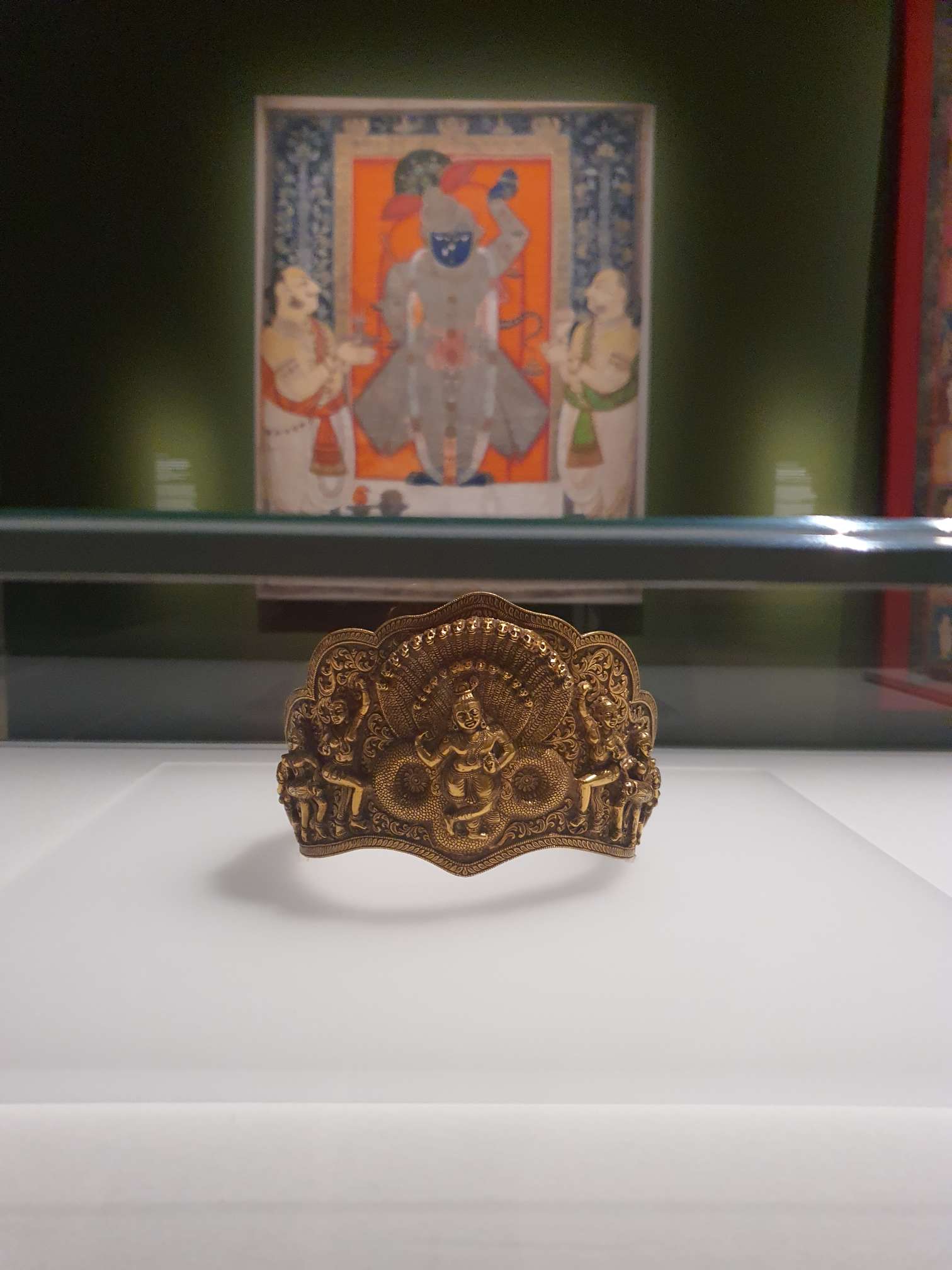

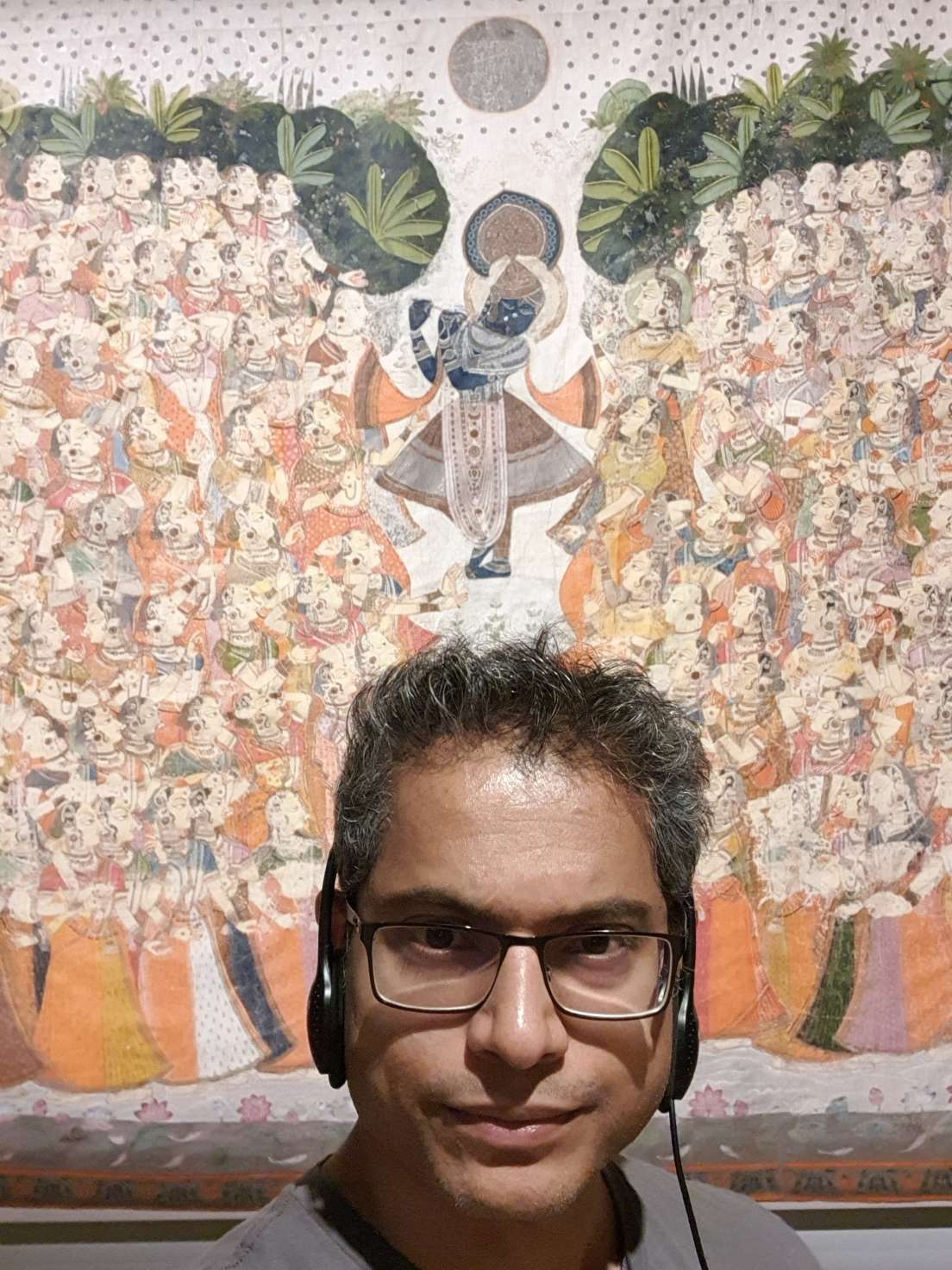
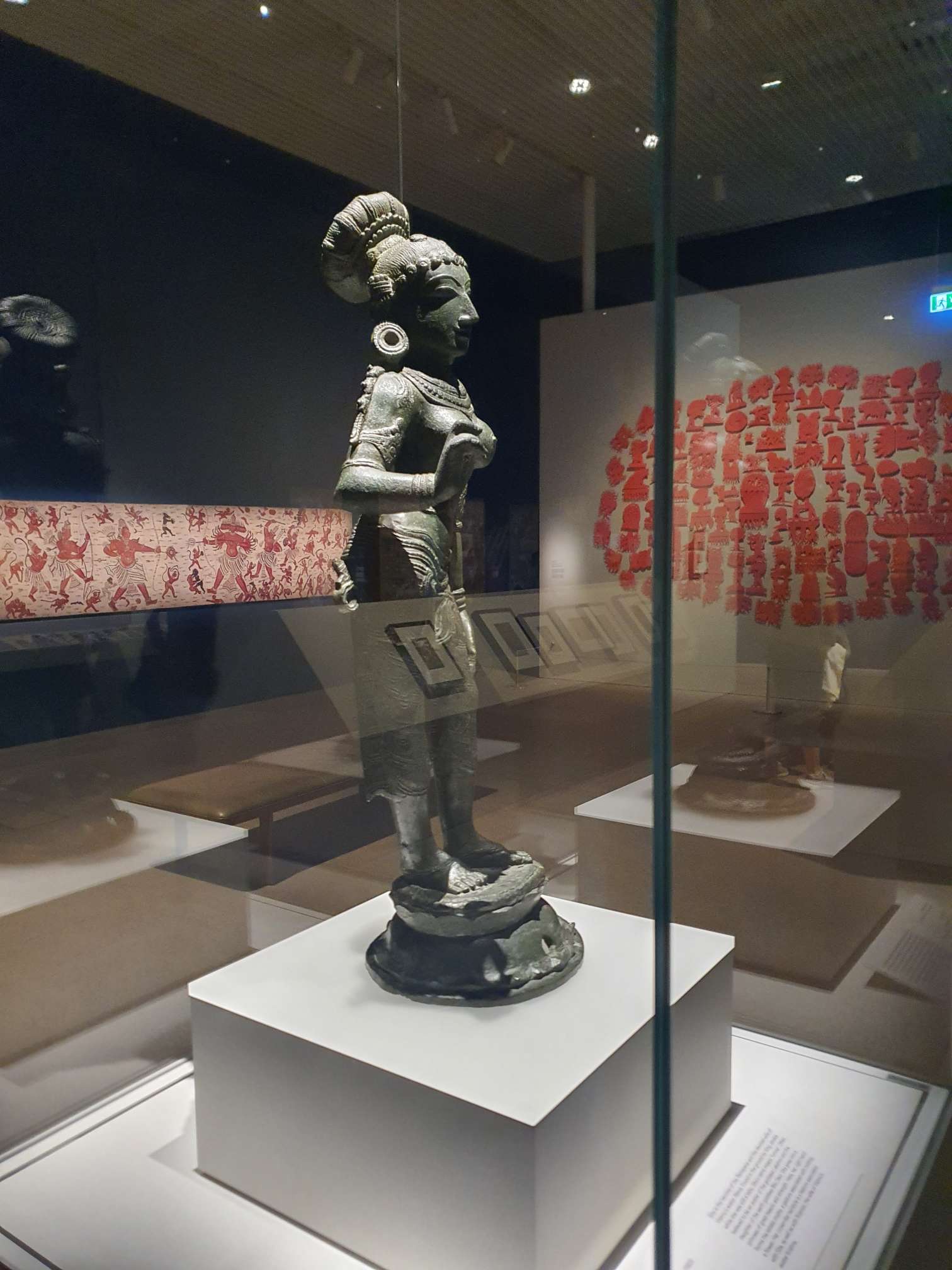






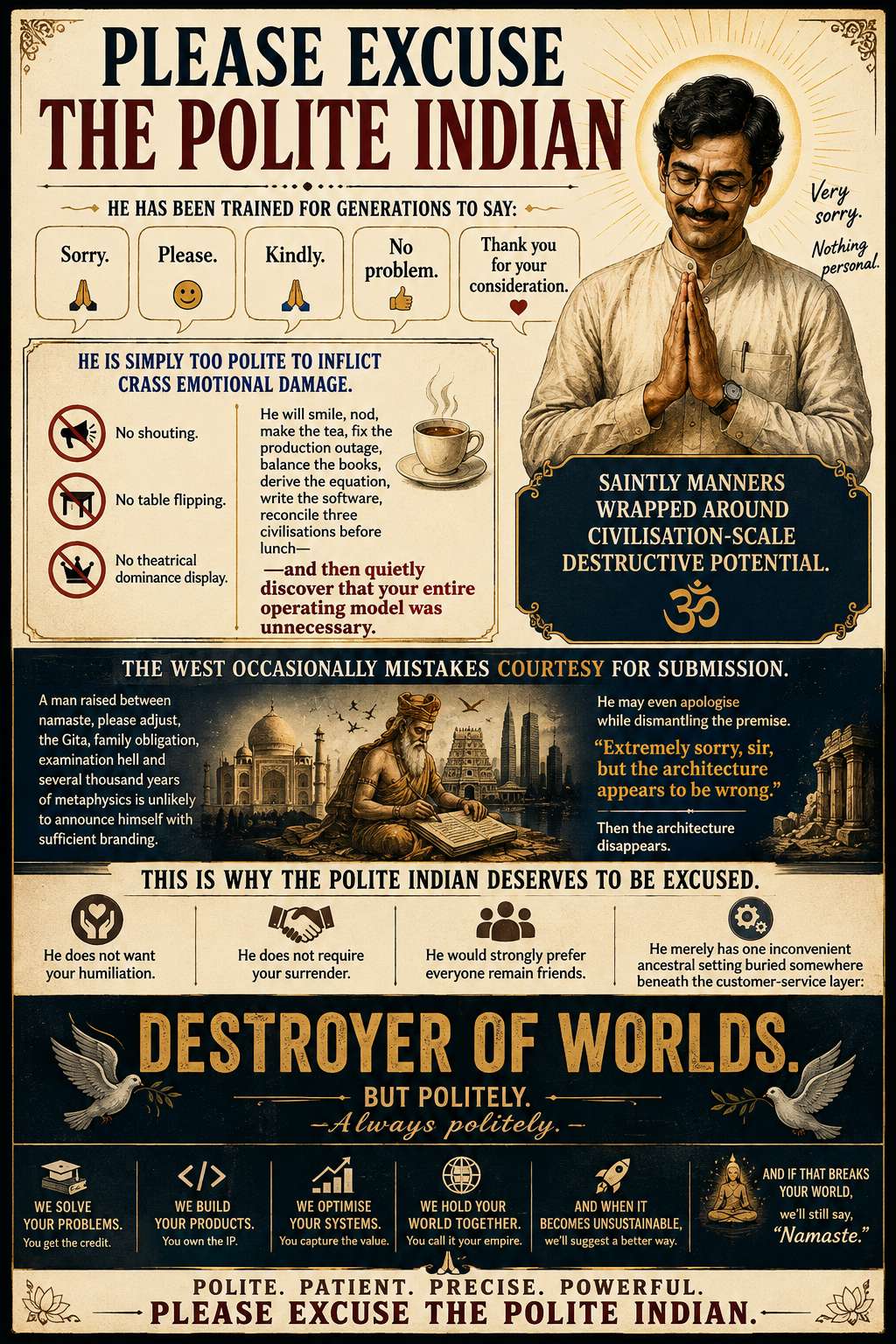 Please excuse him.
He has been trained for generations to say:
“Sorry.”
“Please.”
“Kindly.”
“No problem.”
“Thank you for your consideration.”
He is simply too polite to inflict crass emotional damage.
No shouting.
No table flipping.
No theatrical dominance display.
He will smile, nod, make the tea, fix the production outage, balance the books, derive the equation, write the software, reconcile three civilisations before lunch—
and then quietly discover that your entire operating model was unnecessary.
Very sorry.
Nothing personal.
The polite Indian has always had this slight design flaw:
saintly manners wrapped around civilisation-scale destructive potential.
The West occasionally mistakes courtesy for submission.
Understandable mistake.
A man raised between namaste, please adjust, the Gita, family obligation, examination hell and several thousand years of metaphysics is unlikely to announce himself with sufficient branding.
He may even apologise while dismantling the premise.
“Extremely sorry, sir, but the architecture appears to be wrong.”
Then the architecture disappears.
This is why the polite Indian deserves to be excused.
He does not want your humiliation.
He does not require your surrender.
He would strongly prefer everyone remain friends.
He merely has one inconvenient ancestral setting buried somewhere beneath the customer-service layer:
DESTROYER OF WORLDS.
But politely.
Always politely.
🙏
#PoliteIndian #PleaseAdjust #India #Civilisation #DestroyerOfWorlds #SaintlyDamage #KindlyDoTheNeedful
Please excuse him.
He has been trained for generations to say:
“Sorry.”
“Please.”
“Kindly.”
“No problem.”
“Thank you for your consideration.”
He is simply too polite to inflict crass emotional damage.
No shouting.
No table flipping.
No theatrical dominance display.
He will smile, nod, make the tea, fix the production outage, balance the books, derive the equation, write the software, reconcile three civilisations before lunch—
and then quietly discover that your entire operating model was unnecessary.
Very sorry.
Nothing personal.
The polite Indian has always had this slight design flaw:
saintly manners wrapped around civilisation-scale destructive potential.
The West occasionally mistakes courtesy for submission.
Understandable mistake.
A man raised between namaste, please adjust, the Gita, family obligation, examination hell and several thousand years of metaphysics is unlikely to announce himself with sufficient branding.
He may even apologise while dismantling the premise.
“Extremely sorry, sir, but the architecture appears to be wrong.”
Then the architecture disappears.
This is why the polite Indian deserves to be excused.
He does not want your humiliation.
He does not require your surrender.
He would strongly prefer everyone remain friends.
He merely has one inconvenient ancestral setting buried somewhere beneath the customer-service layer:
DESTROYER OF WORLDS.
But politely.
Always politely.
🙏
#PoliteIndian #PleaseAdjust #India #Civilisation #DestroyerOfWorlds #SaintlyDamage #KindlyDoTheNeedful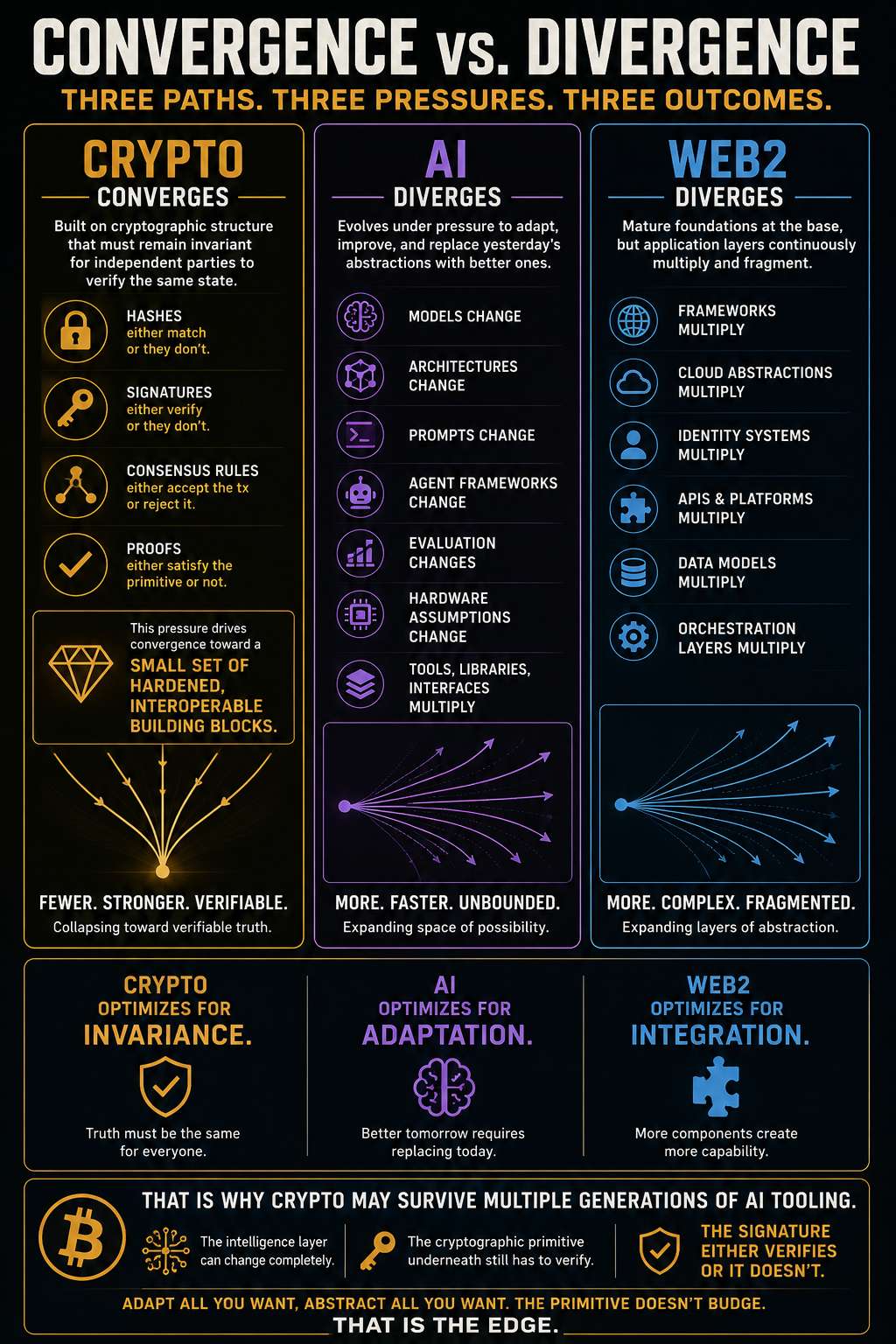 AI diverges.
Classic Web2 diverges.
Why?
Because cryptographic systems are built around structures that must remain invariant enough for independent parties to verify the same state.
Hashes either match.
Signatures either verify.
Consensus rules either accept the transaction or reject it.
Proof either satisfies the primitive or it does not.
That pressure drives convergence toward a small set of hardened, interoperable cryptographic building blocks.
AI evolves under the opposite pressure.
Models change.
Architectures change.
Prompts change.
Agent frameworks change.
Evaluation changes.
Hardware assumptions change.
Web2 behaves similarly at the application layer: frameworks, APIs, cloud abstractions, identity stacks and orchestration layers continuously multiply.
So while AI and Web2 expand outward into abstraction, crypto keeps collapsing inward toward verifiable structure.
AI optimizes for adaptation.
Web2 optimizes for integration.
Crypto optimizes for invariance.
That is why crypto may survive multiple generations of AI tooling.
The intelligence layer can change completely.
The cryptographic primitive underneath still has to verify.
#Bitcoin #Crypto #AI #Web2 #Cryptography #Verification #Consensus #DigitalInfrastructure
AI diverges.
Classic Web2 diverges.
Why?
Because cryptographic systems are built around structures that must remain invariant enough for independent parties to verify the same state.
Hashes either match.
Signatures either verify.
Consensus rules either accept the transaction or reject it.
Proof either satisfies the primitive or it does not.
That pressure drives convergence toward a small set of hardened, interoperable cryptographic building blocks.
AI evolves under the opposite pressure.
Models change.
Architectures change.
Prompts change.
Agent frameworks change.
Evaluation changes.
Hardware assumptions change.
Web2 behaves similarly at the application layer: frameworks, APIs, cloud abstractions, identity stacks and orchestration layers continuously multiply.
So while AI and Web2 expand outward into abstraction, crypto keeps collapsing inward toward verifiable structure.
AI optimizes for adaptation.
Web2 optimizes for integration.
Crypto optimizes for invariance.
That is why crypto may survive multiple generations of AI tooling.
The intelligence layer can change completely.
The cryptographic primitive underneath still has to verify.
#Bitcoin #Crypto #AI #Web2 #Cryptography #Verification #Consensus #DigitalInfrastructure The subservient Indian was not an ancient civilisational type.
It was a colonial job description.
Empire needed Indians who could administer, translate, calculate, police, carry orders, move goods, staff armies and operate institutions across an enormous imperial geography.
So it rewarded a particular identity:
educated enough to run the machinery,
disciplined enough to obey it,
mobile enough to serve wherever required,
and ambitious enough to compete for proximity to power.
The genius of the system was psychological.
You did not need every Indian chained.
You needed millions competing to become the best servant of the hierarchy.
Status came from access.
English became mobility.
Credentials became permission.
Closeness to authority became prestige.
Service became respectability.
And over generations, survival strategies hardened into culture.
Get the degree.
Get the posting.
Join the service.
Do not offend the institution.
Secure the family.
Move where the system sends you.
None of this means Indians are naturally submissive.
The opposite.
A civilisation with enormous intellectual, commercial and political depth was reorganised so that much of its talent became useful inside somebody else’s command structure.
That is the colonial identity worth examining:
not inferiority,
but competence trained toward external objectives.
The post-colonial danger is that the empire disappears while the behaviour remains.
The company replaces the colonial office.
The multinational replaces the trading house.
The visa replaces the imperial posting.
The performance review replaces the district officer.
And the question survives:
Are we building institutions of our own, or becoming exceptionally competent operators inside institutions whose capital, strategy and ownership live elsewhere?
The deepest decolonisation is not symbolic.
It is when talent stops asking only:
“How do I rise inside the system?”
and starts asking:
“Who owns the system I am making stronger?”
#India #ColonialLegacy #PostColonial #EconomicHistory #GenerationalWealth #Ownership #Institutions #Compounding #Decolonisation
The subservient Indian was not an ancient civilisational type.
It was a colonial job description.
Empire needed Indians who could administer, translate, calculate, police, carry orders, move goods, staff armies and operate institutions across an enormous imperial geography.
So it rewarded a particular identity:
educated enough to run the machinery,
disciplined enough to obey it,
mobile enough to serve wherever required,
and ambitious enough to compete for proximity to power.
The genius of the system was psychological.
You did not need every Indian chained.
You needed millions competing to become the best servant of the hierarchy.
Status came from access.
English became mobility.
Credentials became permission.
Closeness to authority became prestige.
Service became respectability.
And over generations, survival strategies hardened into culture.
Get the degree.
Get the posting.
Join the service.
Do not offend the institution.
Secure the family.
Move where the system sends you.
None of this means Indians are naturally submissive.
The opposite.
A civilisation with enormous intellectual, commercial and political depth was reorganised so that much of its talent became useful inside somebody else’s command structure.
That is the colonial identity worth examining:
not inferiority,
but competence trained toward external objectives.
The post-colonial danger is that the empire disappears while the behaviour remains.
The company replaces the colonial office.
The multinational replaces the trading house.
The visa replaces the imperial posting.
The performance review replaces the district officer.
And the question survives:
Are we building institutions of our own, or becoming exceptionally competent operators inside institutions whose capital, strategy and ownership live elsewhere?
The deepest decolonisation is not symbolic.
It is when talent stops asking only:
“How do I rise inside the system?”
and starts asking:
“Who owns the system I am making stronger?”
#India #ColonialLegacy #PostColonial #EconomicHistory #GenerationalWealth #Ownership #Institutions #Compounding #Decolonisation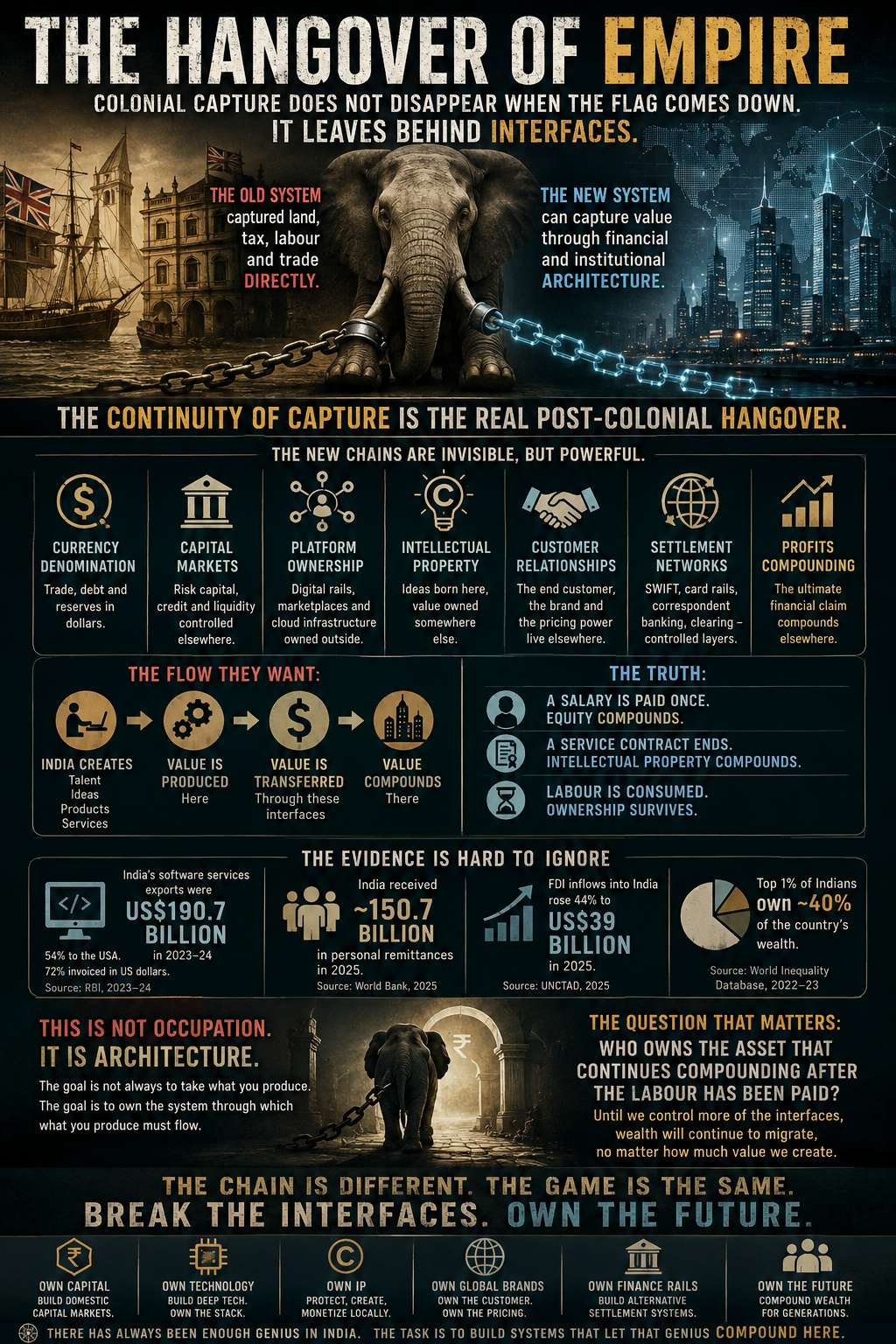 Colonial capture does not disappear when the flag comes down.
It leaves behind interfaces.
The old system captured land, tax, labour and trade directly.
The new system can capture value through:
currency denomination,
capital markets,
platform ownership,
intellectual property,
customer relationships,
and the location where profits finally compound.
That is the hangover effect.
The visible machinery of empire can disappear while its financial pathways remain.
India can produce the engineers.
India can produce the software.
India can produce the medicine.
India can produce the factories.
India can produce the surplus.
But the deeper question is always:
Who owns the persistent claim on that production?
A salary is paid once.
Equity compounds.
A service contract ends.
Intellectual property compounds.
Labour is consumed.
Ownership survives.
That is why the continuity of capture is easy to miss.
The elephant does not need to be chained to the ground anymore.
It only needs to be connected to a system where the strongest compounding claims are progressively transferred elsewhere.
This is not the same mechanism as the colonial drain.
It is the institutional afterimage of it.
The pound once sat visibly above the colony.
The dollar system operates through markets, contracts, platforms, debt, settlement and asset ownership.
Less visible.
More distributed.
Often voluntary at the individual level.
But still capable of producing the same strategic outcome:
India generates enormous productive capacity while too much of the enduring financial claim compounds outside the society that produced it.
That is the real post-colonial hangover.
Not occupation.
Continuity of capture.
#India #GenerationalWealth #EconomicHistory #FinancialSystems #PostColonialEconomics #Capital #Compounding #DollarSystem #Ownership
Colonial capture does not disappear when the flag comes down.
It leaves behind interfaces.
The old system captured land, tax, labour and trade directly.
The new system can capture value through:
currency denomination,
capital markets,
platform ownership,
intellectual property,
customer relationships,
and the location where profits finally compound.
That is the hangover effect.
The visible machinery of empire can disappear while its financial pathways remain.
India can produce the engineers.
India can produce the software.
India can produce the medicine.
India can produce the factories.
India can produce the surplus.
But the deeper question is always:
Who owns the persistent claim on that production?
A salary is paid once.
Equity compounds.
A service contract ends.
Intellectual property compounds.
Labour is consumed.
Ownership survives.
That is why the continuity of capture is easy to miss.
The elephant does not need to be chained to the ground anymore.
It only needs to be connected to a system where the strongest compounding claims are progressively transferred elsewhere.
This is not the same mechanism as the colonial drain.
It is the institutional afterimage of it.
The pound once sat visibly above the colony.
The dollar system operates through markets, contracts, platforms, debt, settlement and asset ownership.
Less visible.
More distributed.
Often voluntary at the individual level.
But still capable of producing the same strategic outcome:
India generates enormous productive capacity while too much of the enduring financial claim compounds outside the society that produced it.
That is the real post-colonial hangover.
Not occupation.
Continuity of capture.
#India #GenerationalWealth #EconomicHistory #FinancialSystems #PostColonialEconomics #Capital #Compounding #DollarSystem #Ownership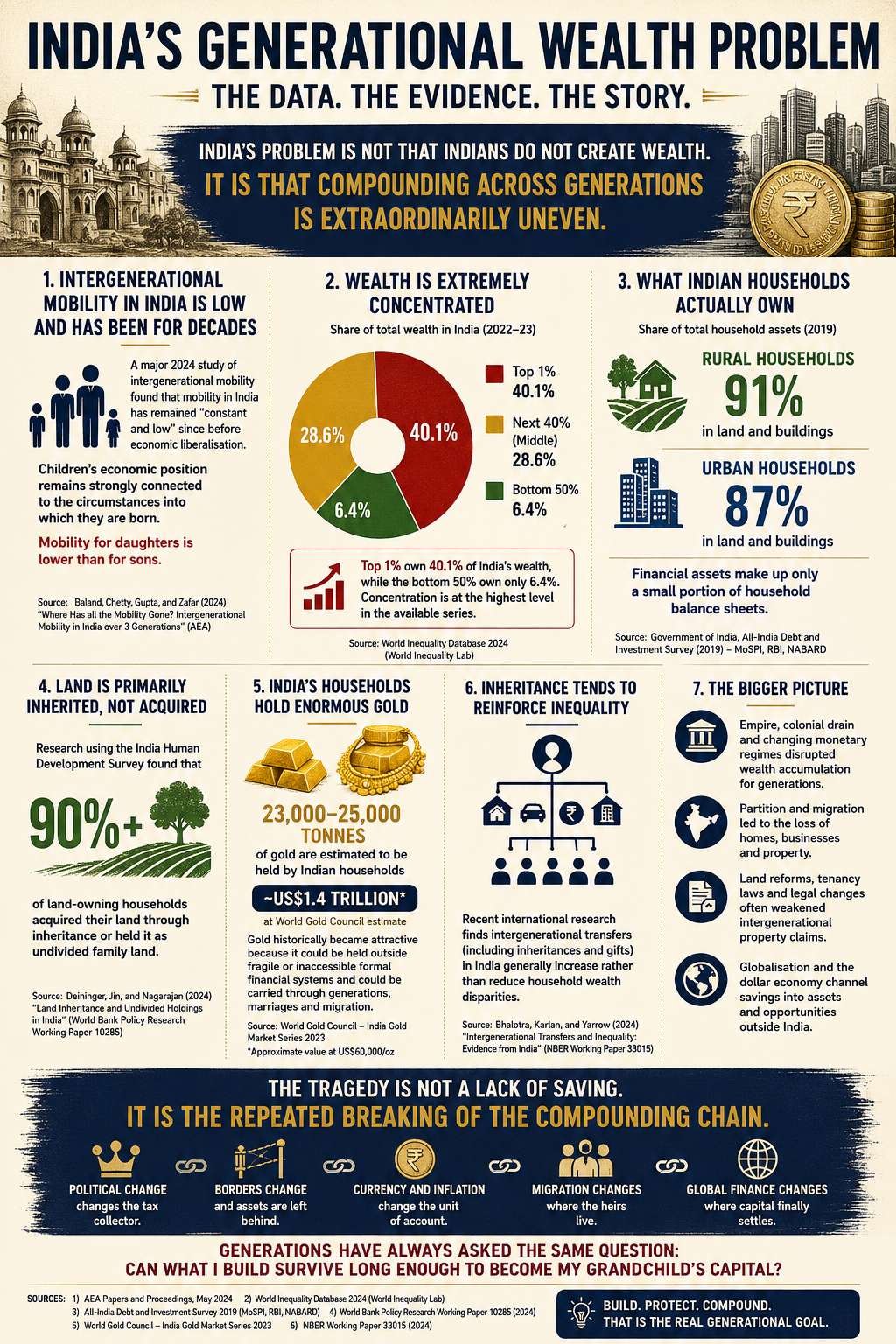 The data are striking.
A major 2024 study of intergenerational mobility found that mobility in India has remained “constant and low” since before economic liberalisation. Children’s economic position remains strongly connected to the circumstances into which they are born, and mobility for daughters is lower than for sons.
At the same time, wealth itself has become extremely concentrated. By 2022–23, India’s top 1% owned about 40.1% of national wealth, while the bottom 50% held only 6.4%. The middle 40% held 28.6%. The latest peer-reviewed estimates put top wealth concentration at its highest level in the available series.
And look at what Indian families actually own.
The Government of India’s 2019 All-India Debt and Investment Survey found that land and buildings represented 91% of rural household assets and about 87% of urban household assets.
Financial assets were a comparatively small part of household balance sheets.
That matters because land is profoundly intergenerational. Research using the India Human Development Survey found that more than 90% of land-owning households acquired their land through inheritance or held it as undivided family land.
Then there is gold.
Indian households are estimated to possess 23,000–25,000 tonnes of gold—roughly US$1.4 trillion at the estimate used by the World Gold Council. Gold historically became attractive precisely because it could function outside fragile or inaccessible formal financial systems and could be carried through marriages, migration and generations.
So the picture is almost paradoxical:
India has an enormous culture of saving and inheritance, yet remarkably weak broad-based intergenerational compounding.
Land survives.
Gold survives.
Family businesses sometimes survive.
But upward mobility remains low, access to inherited assets is deeply unequal, and an enormous share of aggregate wealth has accumulated at the very top.
Even inheritance itself reproduces inequality: recent international research finds intergenerational transfers in India generally increase rather than reduce household wealth disparities.
This is the deeper historical wound.
For generations across the subcontinent, the challenge has not merely been:
Can I create wealth?
It has been:
Can what I build survive long enough—in the same family, under the same property claim, across political, geographic and monetary disruption—to compound for my grandchildren?
That distinction matters.
Empire, Partition, migration, changing land regimes and financial globalisation are different historical mechanisms. They should not be collapsed into one story.
But the measurable outcome is difficult to ignore:
India repeatedly produces wealth faster than broad sections of its population manage to turn it into uninterrupted multigenerational capital.
The tragedy isn't a lack of saving.
It is the repeated breaking of the compounding chain.
#India #GenerationalWealth #IntergenerationalMobility #WealthInequality #EconomicHistory #Gold #Land #Inheritance #Compounding
The data are striking.
A major 2024 study of intergenerational mobility found that mobility in India has remained “constant and low” since before economic liberalisation. Children’s economic position remains strongly connected to the circumstances into which they are born, and mobility for daughters is lower than for sons.
At the same time, wealth itself has become extremely concentrated. By 2022–23, India’s top 1% owned about 40.1% of national wealth, while the bottom 50% held only 6.4%. The middle 40% held 28.6%. The latest peer-reviewed estimates put top wealth concentration at its highest level in the available series.
And look at what Indian families actually own.
The Government of India’s 2019 All-India Debt and Investment Survey found that land and buildings represented 91% of rural household assets and about 87% of urban household assets.
Financial assets were a comparatively small part of household balance sheets.
That matters because land is profoundly intergenerational. Research using the India Human Development Survey found that more than 90% of land-owning households acquired their land through inheritance or held it as undivided family land.
Then there is gold.
Indian households are estimated to possess 23,000–25,000 tonnes of gold—roughly US$1.4 trillion at the estimate used by the World Gold Council. Gold historically became attractive precisely because it could function outside fragile or inaccessible formal financial systems and could be carried through marriages, migration and generations.
So the picture is almost paradoxical:
India has an enormous culture of saving and inheritance, yet remarkably weak broad-based intergenerational compounding.
Land survives.
Gold survives.
Family businesses sometimes survive.
But upward mobility remains low, access to inherited assets is deeply unequal, and an enormous share of aggregate wealth has accumulated at the very top.
Even inheritance itself reproduces inequality: recent international research finds intergenerational transfers in India generally increase rather than reduce household wealth disparities.
This is the deeper historical wound.
For generations across the subcontinent, the challenge has not merely been:
Can I create wealth?
It has been:
Can what I build survive long enough—in the same family, under the same property claim, across political, geographic and monetary disruption—to compound for my grandchildren?
That distinction matters.
Empire, Partition, migration, changing land regimes and financial globalisation are different historical mechanisms. They should not be collapsed into one story.
But the measurable outcome is difficult to ignore:
India repeatedly produces wealth faster than broad sections of its population manage to turn it into uninterrupted multigenerational capital.
The tragedy isn't a lack of saving.
It is the repeated breaking of the compounding chain.
#India #GenerationalWealth #IntergenerationalMobility #WealthInequality #EconomicHistory #Gold #Land #Inheritance #Compounding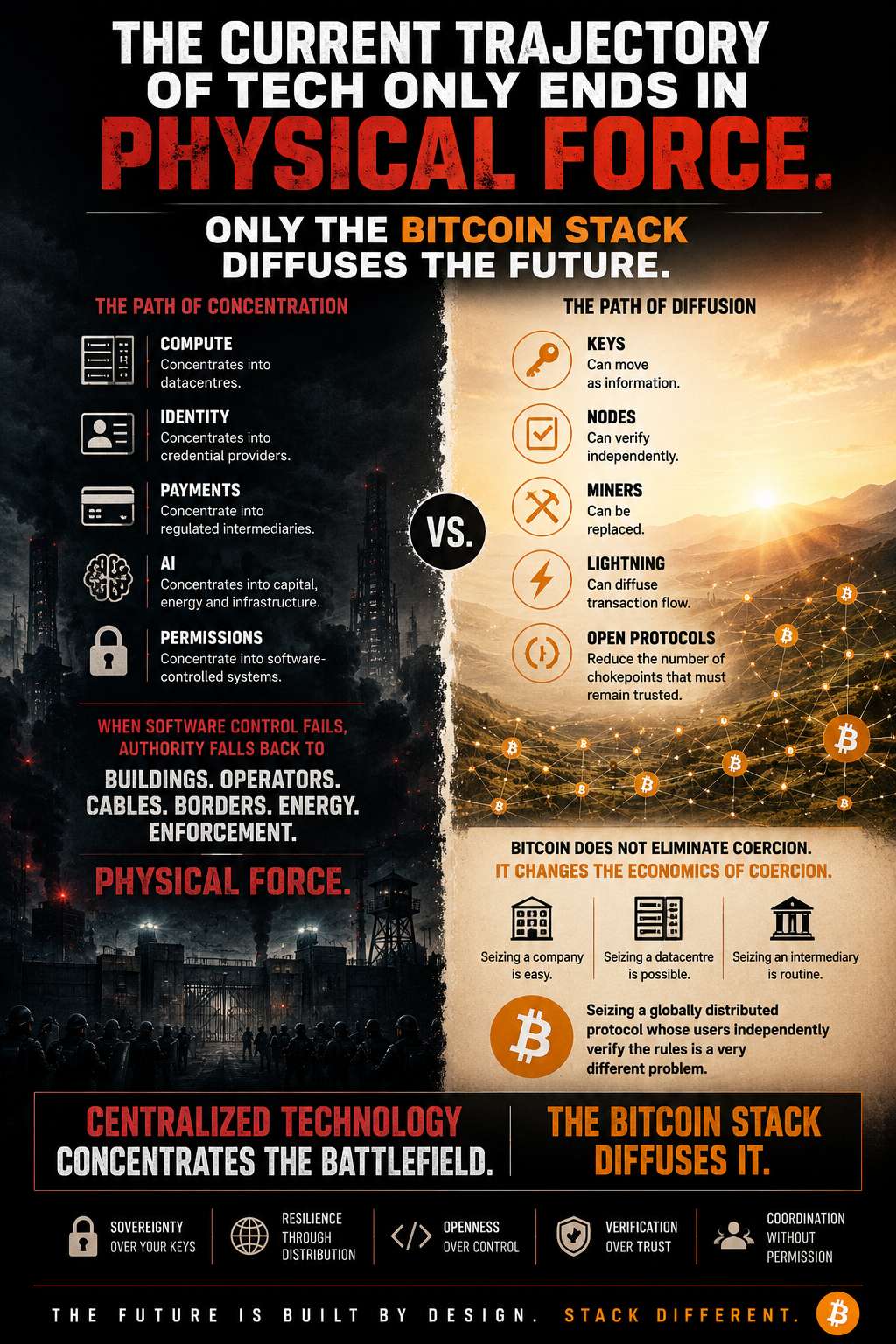 Compute concentrates into datacentres.
Identity concentrates into credential providers.
Payments concentrate into regulated intermediaries.
AI concentrates into capital, energy and infrastructure.
And every sufficiently concentrated system eventually discovers the same final dependency:
physical force.
When software control fails, authority falls back to buildings, operators, cables, borders, energy and enforcement.
That is the old architecture of empire wearing a digital interface.
Bitcoin moves in the opposite direction.
Keys can move as information.
Nodes can verify independently.
Miners can be replaced.
Lightning can diffuse transaction flow.
Open protocols reduce the number of chokepoints that must remain trusted.
Bitcoin does not eliminate coercion.
It changes the economics of coercion.
Seizing a company is easy.
Seizing a datacentre is possible.
Seizing an intermediary is routine.
Seizing a globally distributed protocol whose users independently verify the rules is a very different problem.
Centralized technology concentrates the battlefield.
The Bitcoin stack diffuses it.
That may become one of the defining technological divides of this century.
#Bitcoin #Lightning #Decentralization #Sovereignty #DistributedSystems #OpenProtocols
Compute concentrates into datacentres.
Identity concentrates into credential providers.
Payments concentrate into regulated intermediaries.
AI concentrates into capital, energy and infrastructure.
And every sufficiently concentrated system eventually discovers the same final dependency:
physical force.
When software control fails, authority falls back to buildings, operators, cables, borders, energy and enforcement.
That is the old architecture of empire wearing a digital interface.
Bitcoin moves in the opposite direction.
Keys can move as information.
Nodes can verify independently.
Miners can be replaced.
Lightning can diffuse transaction flow.
Open protocols reduce the number of chokepoints that must remain trusted.
Bitcoin does not eliminate coercion.
It changes the economics of coercion.
Seizing a company is easy.
Seizing a datacentre is possible.
Seizing an intermediary is routine.
Seizing a globally distributed protocol whose users independently verify the rules is a very different problem.
Centralized technology concentrates the battlefield.
The Bitcoin stack diffuses it.
That may become one of the defining technological divides of this century.
#Bitcoin #Lightning #Decentralization #Sovereignty #DistributedSystems #OpenProtocols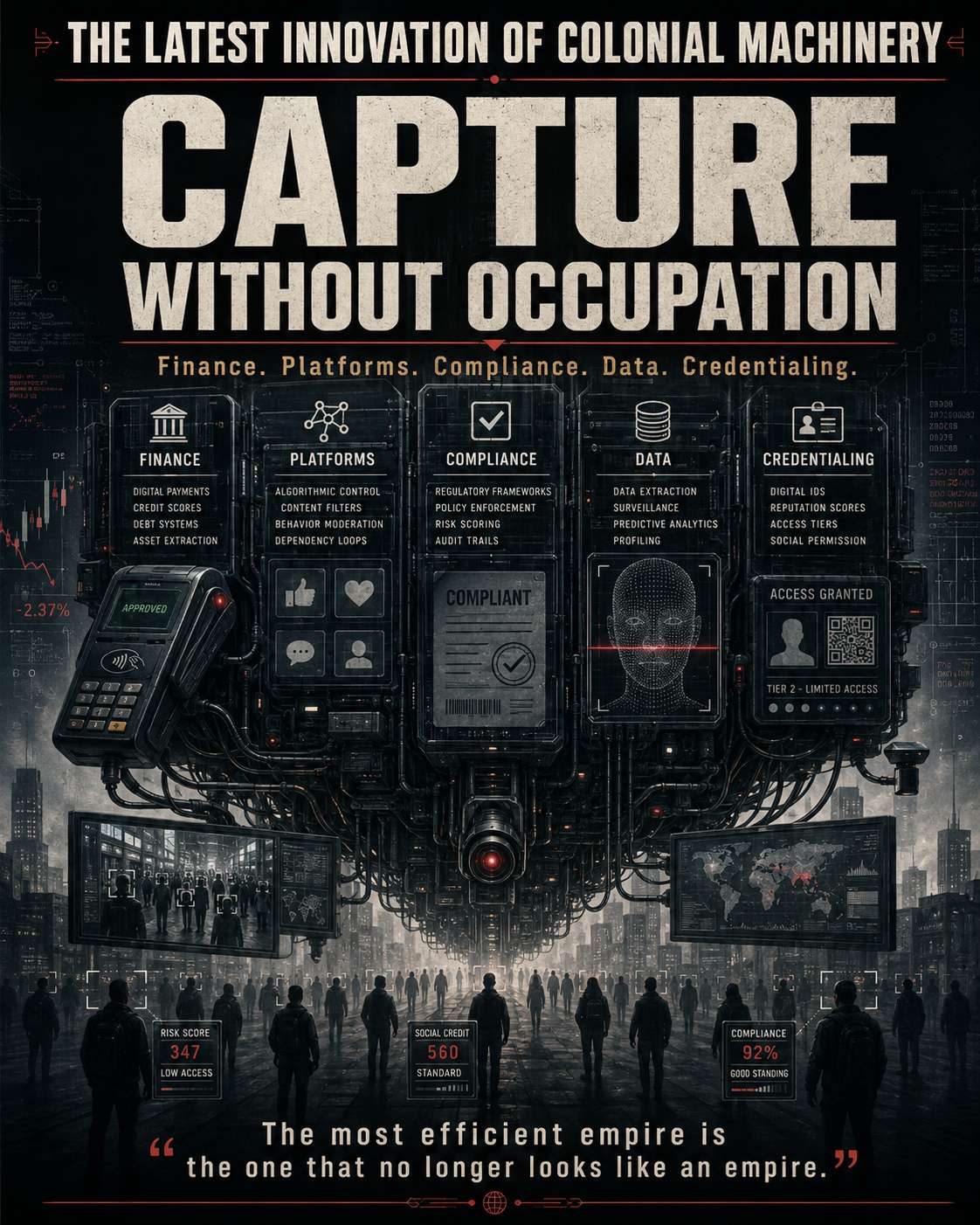 No red coats.
No governor’s mansion.
No flag planted over the courthouse.
The modern machine is quieter.
You do not need to conquer a population if you can capture the systems that decide:
who gets credit,
who gets credentials,
who gets licensed,
who gets promoted,
who gets visibility,
who gets de-platformed,
who gets classified as legitimate.
Old empire conquered territory.
Modern empire captures interfaces.
Finance becomes the customs house.
Platforms become the public square.
Compliance becomes the checkpoint.
Data becomes the census.
Credentialing becomes the civil service exam.
Local elites become the intermediary layer.
The genius of the system is that almost everyone inside it can believe they are simply following procedure.
That is the upgrade.
Colonialism once needed administrators stationed overseas.
Now the hierarchy can reproduce itself through institutions, incentives and dependency—without anyone having to call it colonialism.
The most efficient empire is the one that no longer looks like an empire.
#Empire #Colonialism #StateCapture #InstitutionalPower #Geopolitics #PoliticalEconomy #NetworkPower
No red coats.
No governor’s mansion.
No flag planted over the courthouse.
The modern machine is quieter.
You do not need to conquer a population if you can capture the systems that decide:
who gets credit,
who gets credentials,
who gets licensed,
who gets promoted,
who gets visibility,
who gets de-platformed,
who gets classified as legitimate.
Old empire conquered territory.
Modern empire captures interfaces.
Finance becomes the customs house.
Platforms become the public square.
Compliance becomes the checkpoint.
Data becomes the census.
Credentialing becomes the civil service exam.
Local elites become the intermediary layer.
The genius of the system is that almost everyone inside it can believe they are simply following procedure.
That is the upgrade.
Colonialism once needed administrators stationed overseas.
Now the hierarchy can reproduce itself through institutions, incentives and dependency—without anyone having to call it colonialism.
The most efficient empire is the one that no longer looks like an empire.
#Empire #Colonialism #StateCapture #InstitutionalPower #Geopolitics #PoliticalEconomy #NetworkPower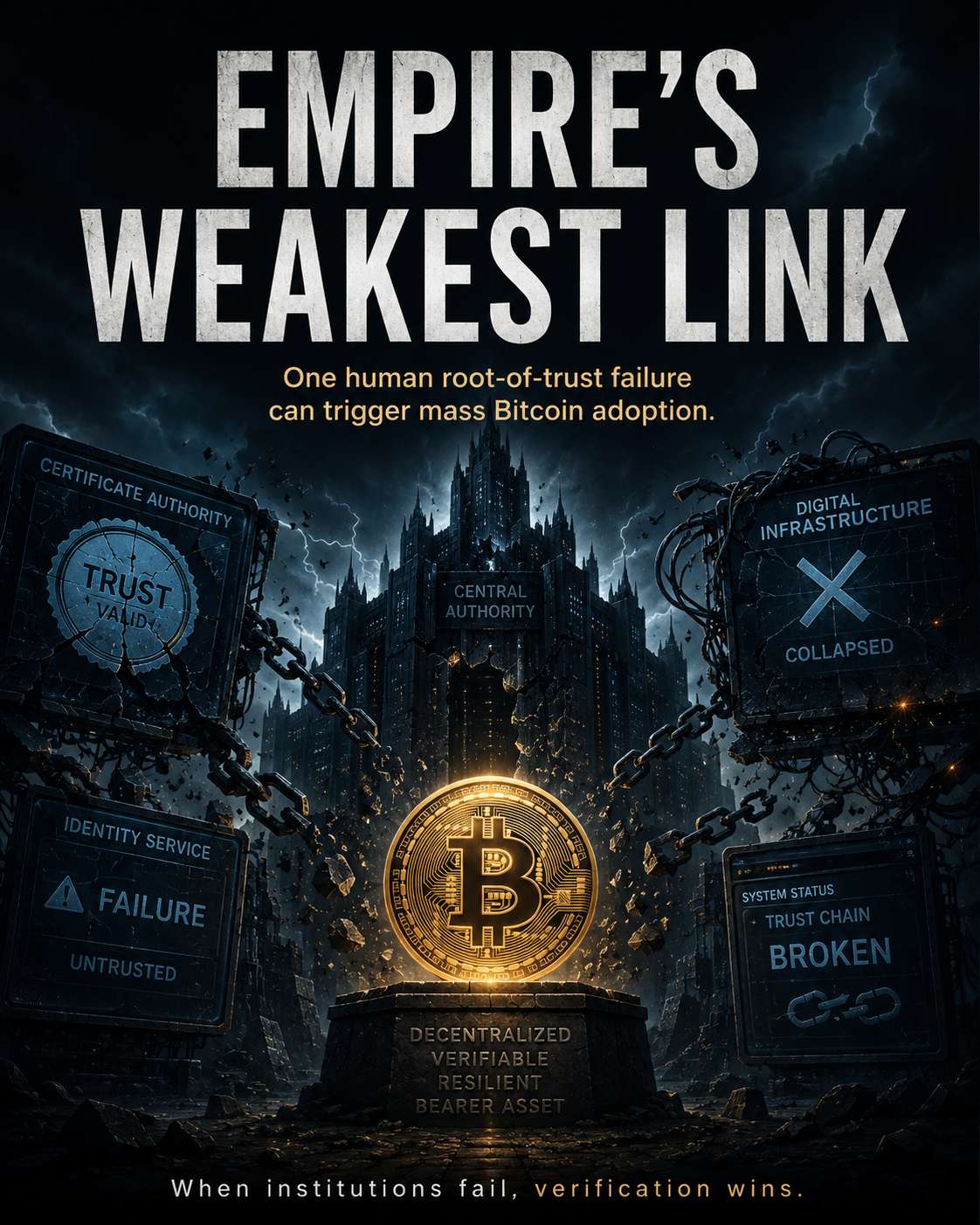 It is the human root of trust.
Modern digital civilisation quietly depends on a small number of institutions deciding what is authentic:
certificate authorities, identity providers, banks, cloud operators, software-signing systems, exchanges and administrative root keys.
The mathematics can remain intact while the people controlling the trust hierarchy fail.
One compromised authority.
One poisoned update chain.
One catastrophic certificate failure.
One crisis where nobody can reliably answer:
“Is this really who it claims to be?”
That is the kind of event that could drive mass Bitcoin adoption.
Not because Bitcoin is magically immune to cryptographic failure.
Because Bitcoin removes an extraordinary amount of institutional authentication from monetary settlement.
A Bitcoin node does not ask a certificate authority whether your transaction is legitimate.
It verifies.
A private key does not need a government identity provider.
It signs.
Consensus does not need the administrator of a corporate root store to declare which ledger is real.
It checks the rules.
Empire scales by concentrating trust because concentrated trust is convenient.
And every generation eventually mistakes convenience for permanence.
Bitcoin made the opposite bet:
assume the humans administering the system will eventually fail.
The mass-adoption event may therefore not be another inflation chart, ETF launch or banking crisis.
It may simply be the day billions of people discover that the digital empire can no longer prove who it is.
Physical bearer assets will still work.
Bitcoin's significance is that it may remain one of the few globally transferable digital bearer assets capable of saying:
Don't trust the institution. Verify the state.
That is the weakest human link of empire.
And it is exactly the failure Bitcoin was built to route around.
#Bitcoin #PKI #CyberSecurity #SelfSovereignty #VerifyDontTrust #DigitalInfrastructure #Decentralization
It is the human root of trust.
Modern digital civilisation quietly depends on a small number of institutions deciding what is authentic:
certificate authorities, identity providers, banks, cloud operators, software-signing systems, exchanges and administrative root keys.
The mathematics can remain intact while the people controlling the trust hierarchy fail.
One compromised authority.
One poisoned update chain.
One catastrophic certificate failure.
One crisis where nobody can reliably answer:
“Is this really who it claims to be?”
That is the kind of event that could drive mass Bitcoin adoption.
Not because Bitcoin is magically immune to cryptographic failure.
Because Bitcoin removes an extraordinary amount of institutional authentication from monetary settlement.
A Bitcoin node does not ask a certificate authority whether your transaction is legitimate.
It verifies.
A private key does not need a government identity provider.
It signs.
Consensus does not need the administrator of a corporate root store to declare which ledger is real.
It checks the rules.
Empire scales by concentrating trust because concentrated trust is convenient.
And every generation eventually mistakes convenience for permanence.
Bitcoin made the opposite bet:
assume the humans administering the system will eventually fail.
The mass-adoption event may therefore not be another inflation chart, ETF launch or banking crisis.
It may simply be the day billions of people discover that the digital empire can no longer prove who it is.
Physical bearer assets will still work.
Bitcoin's significance is that it may remain one of the few globally transferable digital bearer assets capable of saying:
Don't trust the institution. Verify the state.
That is the weakest human link of empire.
And it is exactly the failure Bitcoin was built to route around.
#Bitcoin #PKI #CyberSecurity #SelfSovereignty #VerifyDontTrust #DigitalInfrastructure #Decentralization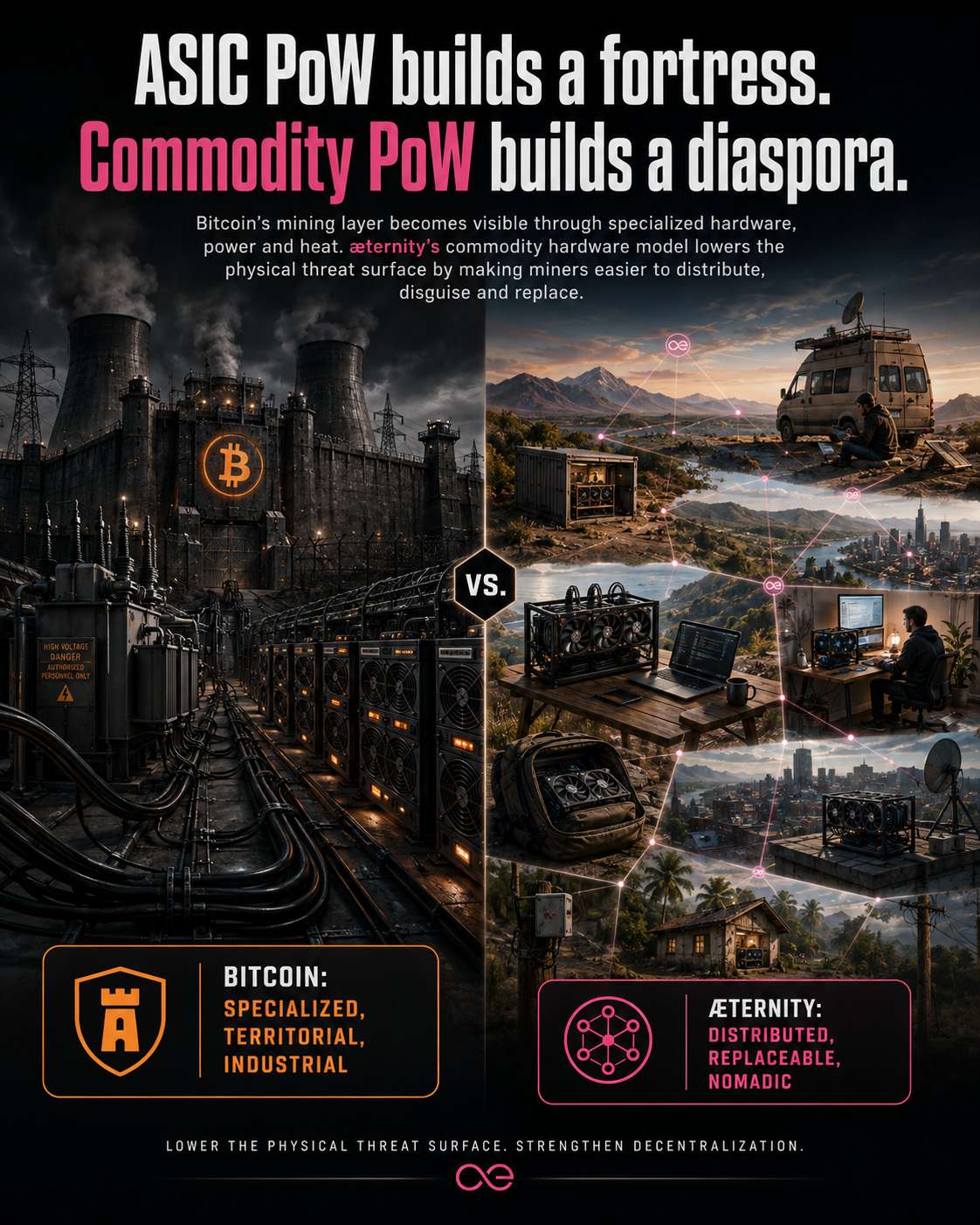 Its proof of work is secured by highly specialised ASICs, industrial power, cooling, logistics and fixed infrastructure. That makes Bitcoin extraordinarily expensive to reproduce — but it also makes the mining layer visible.
A large Bitcoin mine announces itself through megawatts, transformers, heat and specialised hardware.
æternity takes a different route.
Its memory-bound Cuckoo Cycle mining can run on far more general-purpose hardware. A GPU does not announce whether it is mining, rendering, gaming, running AI or doing scientific compute.
That changes the physical threat model.
Bitcoin mining is specialised, territorial and industrial.
æternity mining can be distributed, replaceable and comparatively nomadic.
The trade-off matters: commodity hardware can also make external compute easier to redirect toward an attack. So this does not automatically make æternity more secure than Bitcoin.
It makes it harder to physically isolate.
ASIC PoW builds a fortress.
Commodity PoW builds a diaspora.
One is expensive to reproduce.
The other is harder to pin to the ground.
#Bitcoin #Aeternity #ProofOfWork #Decentralization #Mining #CuckooCycle #PhysicalSecurity #Crypto
Its proof of work is secured by highly specialised ASICs, industrial power, cooling, logistics and fixed infrastructure. That makes Bitcoin extraordinarily expensive to reproduce — but it also makes the mining layer visible.
A large Bitcoin mine announces itself through megawatts, transformers, heat and specialised hardware.
æternity takes a different route.
Its memory-bound Cuckoo Cycle mining can run on far more general-purpose hardware. A GPU does not announce whether it is mining, rendering, gaming, running AI or doing scientific compute.
That changes the physical threat model.
Bitcoin mining is specialised, territorial and industrial.
æternity mining can be distributed, replaceable and comparatively nomadic.
The trade-off matters: commodity hardware can also make external compute easier to redirect toward an attack. So this does not automatically make æternity more secure than Bitcoin.
It makes it harder to physically isolate.
ASIC PoW builds a fortress.
Commodity PoW builds a diaspora.
One is expensive to reproduce.
The other is harder to pin to the ground.
#Bitcoin #Aeternity #ProofOfWork #Decentralization #Mining #CuckooCycle #PhysicalSecurity #Crypto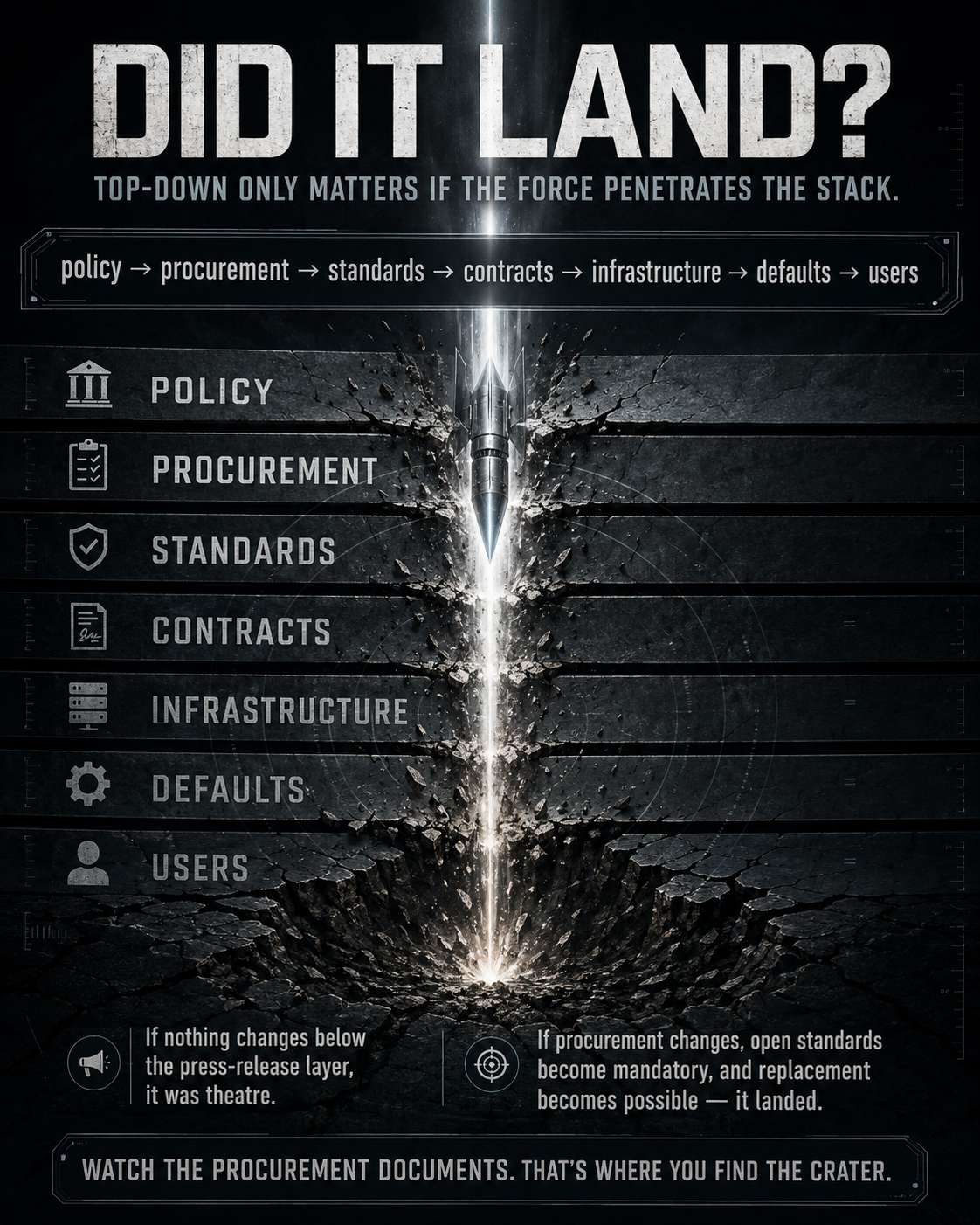 Was it theatre — or did the penetrator actually land?
A vertical penetration force does not need to replace the entire technological order at once.
It enters at the top:
policy → procurement → standards → contracts → infrastructure → defaults → users.
That is why a government changing a default search engine, office suite, mail platform or cloud requirement matters disproportionately.
The headline is only the impact flash.
The real damage travels downward through the dependency stack.
A ministry changes procurement rules.
Vendors suddenly need interoperability.
Contractors must support open formats.
Legacy dependencies become liabilities.
Budgets move.
Training moves.
Technical competence moves.
Eventually the supposedly permanent incumbent becomes just another bidder.
But there is a clean test.
If the announcement changes nothing below the press-release layer, it was theatre.
If procurement specifications change, contracts expire without automatic renewal, data becomes portable, open standards become mandatory and replacement becomes technically possible—
it landed.
The most important effect is not that governments immediately abandon Google, Microsoft or the hyperscalers.
It is that they begin designing systems in which abandoning them is possible.
That is vertical penetration.
The monopoly may still be standing above ground while its foundations are already being structurally perforated.
Watch the procurement documents, not the speeches.
That is where you find the crater.
#DigitalSovereignty #OpenSource #Interoperability #TechSovereignty #Infrastructure #Procurement #Decentralization #Verification
Was it theatre — or did the penetrator actually land?
A vertical penetration force does not need to replace the entire technological order at once.
It enters at the top:
policy → procurement → standards → contracts → infrastructure → defaults → users.
That is why a government changing a default search engine, office suite, mail platform or cloud requirement matters disproportionately.
The headline is only the impact flash.
The real damage travels downward through the dependency stack.
A ministry changes procurement rules.
Vendors suddenly need interoperability.
Contractors must support open formats.
Legacy dependencies become liabilities.
Budgets move.
Training moves.
Technical competence moves.
Eventually the supposedly permanent incumbent becomes just another bidder.
But there is a clean test.
If the announcement changes nothing below the press-release layer, it was theatre.
If procurement specifications change, contracts expire without automatic renewal, data becomes portable, open standards become mandatory and replacement becomes technically possible—
it landed.
The most important effect is not that governments immediately abandon Google, Microsoft or the hyperscalers.
It is that they begin designing systems in which abandoning them is possible.
That is vertical penetration.
The monopoly may still be standing above ground while its foundations are already being structurally perforated.
Watch the procurement documents, not the speeches.
That is where you find the crater.
#DigitalSovereignty #OpenSource #Interoperability #TechSovereignty #Infrastructure #Procurement #Decentralization #Verification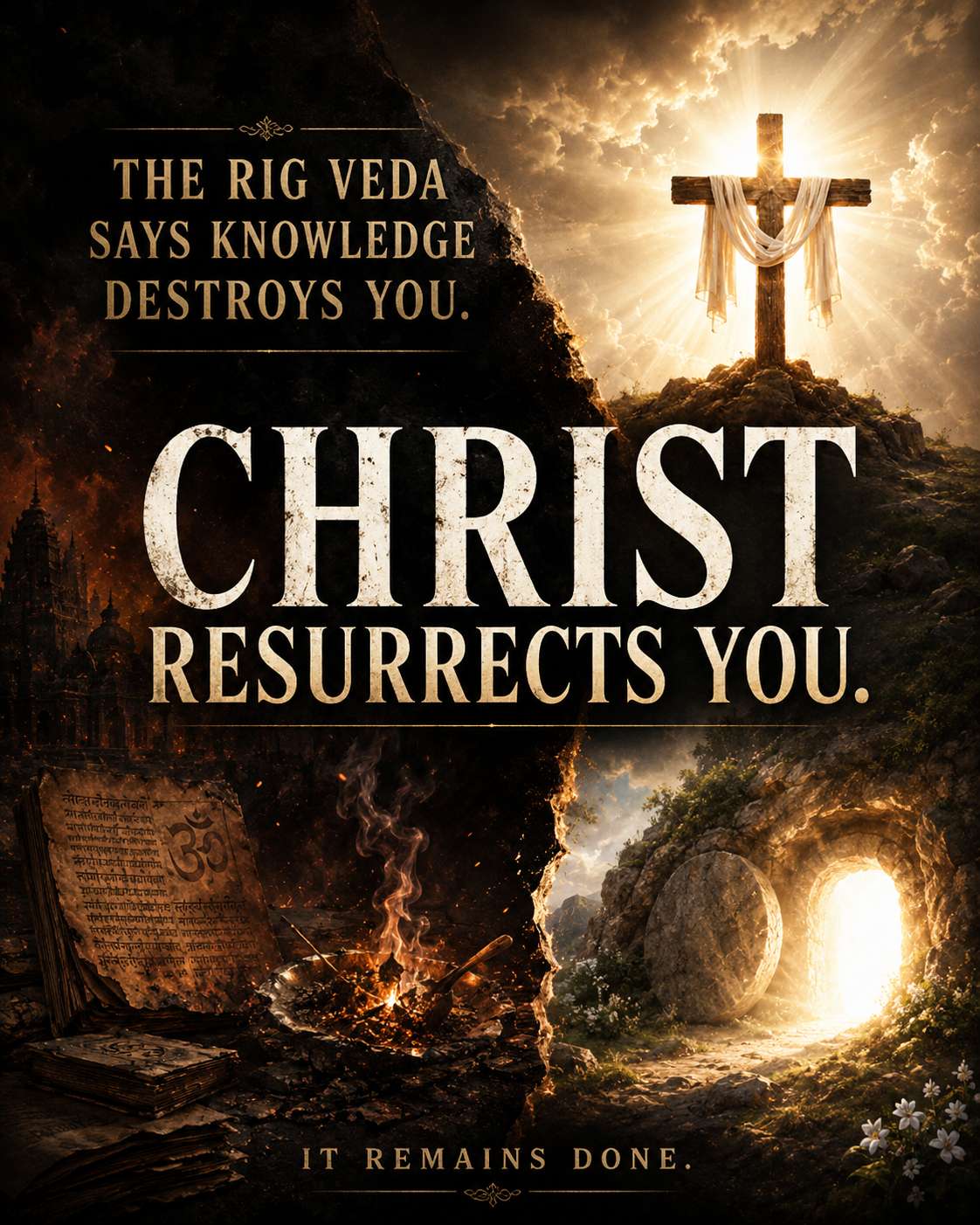 The Vedic traditions repeatedly circle the insight that ignorance binds us: what we mistake for the permanent self must be pierced, stripped away, seen through. Knowledge is therefore dangerous to illusion. Once you truly see, the old construction cannot remain untouched.
Christianity enters that same human depth—but the Cross goes somewhere radically specific.
Christ does not merely teach the ego to dissolve.
He dies.
And He rises.
The Cross takes every philosophical question about death, selfhood, suffering, attachment, knowledge, judgment, and transformation and drives it into history.
The old man is crucified.
The tomb is entered.
Death is not explained away.
Then comes resurrection.
«“I am the resurrection and the life.” — John 11:25»
Christian salvation is therefore not simply escape from ignorance. It is not annihilation of personality into abstraction. It is death and restoration—the human person transformed and raised into communion with God.
Paul expresses the same architecture:
«“We were therefore buried with him through baptism into death… that we too may live a new life.” — Romans 6:4»
Knowledge can expose the illusion.
The Cross exposes everything.
Power.
Fear.
Tribe.
Empire.
Body.
Mind.
Sin.
Death itself.
And after all of it has been stripped away, Christianity makes its extraordinary claim:
the answer is not nothingness.
The answer is resurrection.
This is why “It is finished” is such a devastating sentence.
Not the argument continues.
Not humanity must eventually reason its way out.
Not perhaps another teacher will complete the system.
It is finished. — John 19:30
The event remains accomplished.
Knowledge may destroy the world you thought was real.
Christ resurrects you beyond it.
The tomb stays empty.
It remains done.
#TheCross #ChristIsKing #Resurrection #ItIsFinished #Christianity #Vedanta #Metacognition #DeathAndResurrection
The Vedic traditions repeatedly circle the insight that ignorance binds us: what we mistake for the permanent self must be pierced, stripped away, seen through. Knowledge is therefore dangerous to illusion. Once you truly see, the old construction cannot remain untouched.
Christianity enters that same human depth—but the Cross goes somewhere radically specific.
Christ does not merely teach the ego to dissolve.
He dies.
And He rises.
The Cross takes every philosophical question about death, selfhood, suffering, attachment, knowledge, judgment, and transformation and drives it into history.
The old man is crucified.
The tomb is entered.
Death is not explained away.
Then comes resurrection.
«“I am the resurrection and the life.” — John 11:25»
Christian salvation is therefore not simply escape from ignorance. It is not annihilation of personality into abstraction. It is death and restoration—the human person transformed and raised into communion with God.
Paul expresses the same architecture:
«“We were therefore buried with him through baptism into death… that we too may live a new life.” — Romans 6:4»
Knowledge can expose the illusion.
The Cross exposes everything.
Power.
Fear.
Tribe.
Empire.
Body.
Mind.
Sin.
Death itself.
And after all of it has been stripped away, Christianity makes its extraordinary claim:
the answer is not nothingness.
The answer is resurrection.
This is why “It is finished” is such a devastating sentence.
Not the argument continues.
Not humanity must eventually reason its way out.
Not perhaps another teacher will complete the system.
It is finished. — John 19:30
The event remains accomplished.
Knowledge may destroy the world you thought was real.
Christ resurrects you beyond it.
The tomb stays empty.
It remains done.
#TheCross #ChristIsKing #Resurrection #ItIsFinished #Christianity #Vedanta #Metacognition #DeathAndResurrection One emphasizes judgment, history, covenant, salvation.
The other emphasizes consciousness, attachment, liberation, and consequence.
But at the deepest level, both are circling the same terrible truth:
heaven and hell begin before death.
Heaven is alignment with God, truth, love, sacrifice, order, and renewal.
Hell is separation, ego, domination, appetite, illusion, and the refusal to repent.
The genius of the Cross is that it covers both frames at once.
Christ does not speak about suffering from a distance.
He enters betrayal, humiliation, injustice, torture, abandonment, and death itself.
He descends into the full psychological and spiritual depth of what man calls hell.
And yet at the very center of that agony, He reveals heaven:
- forgiveness in the middle of violence
- mercy in the middle of mockery
- obedience in the middle of chaos
- love in the middle of death
That is why I say:
Christ is at the end of metacognition.
The lead-up to it is the Stations of the Cross.
Each station is a stripping away of illusion.
Each station exposes what remains when comfort, status, certainty, and control are torn off.
What survives there is not performance.
Not ideology.
Not tribal cleverness.
But the final question:
when suffering reaches its peak, what is at the center of the self?
In the purely worldly frame, heaven is comfort and hell is pain.
In the deeper spiritual frame, that is too shallow.
A man can live in wealth and already be in hell.
A man can suffer greatly and still be moving toward heaven.
The East intuited that bondage begins in attachment.
The West insisted that evil is not just inner confusion but also rebellion, sin, and estrangement from God.
The Cross holds both together.
It says:
yes, hell is a condition of the soul,
but it is also real judgment.
Yes, heaven is inward transformation,
but it is also communion with the living God.
The crown of thorns is therefore more than a symbol of pain.
It is the image of consciousness under total pressure.
The mind pierced by the world.
The king mocked by empire.
The human being pushed to the limit.
And at that limit, Christ does not collapse into hatred.
He reveals perfect orientation.
That is why the Cross is not just an instrument of execution.
It is the axis where East and West, heaven and hell, body and spirit, justice and mercy all meet.
The world keeps trying to build heaven through power and efficiency,
and keeps manufacturing hell through pride and appetite.
The Cross says the road is narrower than that.
Heaven is not mass indulgence.
Hell is not merely fire in the abstract.
Both are already breaking into history through what we worship, what we obey, and what we become.
The Cross is where man sees both at once.
#ChristIsKing #TheCross #CrownOfThorns #HeavenAndHell #EastAndWest #Metacognition #Christianity
One emphasizes judgment, history, covenant, salvation.
The other emphasizes consciousness, attachment, liberation, and consequence.
But at the deepest level, both are circling the same terrible truth:
heaven and hell begin before death.
Heaven is alignment with God, truth, love, sacrifice, order, and renewal.
Hell is separation, ego, domination, appetite, illusion, and the refusal to repent.
The genius of the Cross is that it covers both frames at once.
Christ does not speak about suffering from a distance.
He enters betrayal, humiliation, injustice, torture, abandonment, and death itself.
He descends into the full psychological and spiritual depth of what man calls hell.
And yet at the very center of that agony, He reveals heaven:
- forgiveness in the middle of violence
- mercy in the middle of mockery
- obedience in the middle of chaos
- love in the middle of death
That is why I say:
Christ is at the end of metacognition.
The lead-up to it is the Stations of the Cross.
Each station is a stripping away of illusion.
Each station exposes what remains when comfort, status, certainty, and control are torn off.
What survives there is not performance.
Not ideology.
Not tribal cleverness.
But the final question:
when suffering reaches its peak, what is at the center of the self?
In the purely worldly frame, heaven is comfort and hell is pain.
In the deeper spiritual frame, that is too shallow.
A man can live in wealth and already be in hell.
A man can suffer greatly and still be moving toward heaven.
The East intuited that bondage begins in attachment.
The West insisted that evil is not just inner confusion but also rebellion, sin, and estrangement from God.
The Cross holds both together.
It says:
yes, hell is a condition of the soul,
but it is also real judgment.
Yes, heaven is inward transformation,
but it is also communion with the living God.
The crown of thorns is therefore more than a symbol of pain.
It is the image of consciousness under total pressure.
The mind pierced by the world.
The king mocked by empire.
The human being pushed to the limit.
And at that limit, Christ does not collapse into hatred.
He reveals perfect orientation.
That is why the Cross is not just an instrument of execution.
It is the axis where East and West, heaven and hell, body and spirit, justice and mercy all meet.
The world keeps trying to build heaven through power and efficiency,
and keeps manufacturing hell through pride and appetite.
The Cross says the road is narrower than that.
Heaven is not mass indulgence.
Hell is not merely fire in the abstract.
Both are already breaking into history through what we worship, what we obey, and what we become.
The Cross is where man sees both at once.
#ChristIsKing #TheCross #CrownOfThorns #HeavenAndHell #EastAndWest #Metacognition #Christianity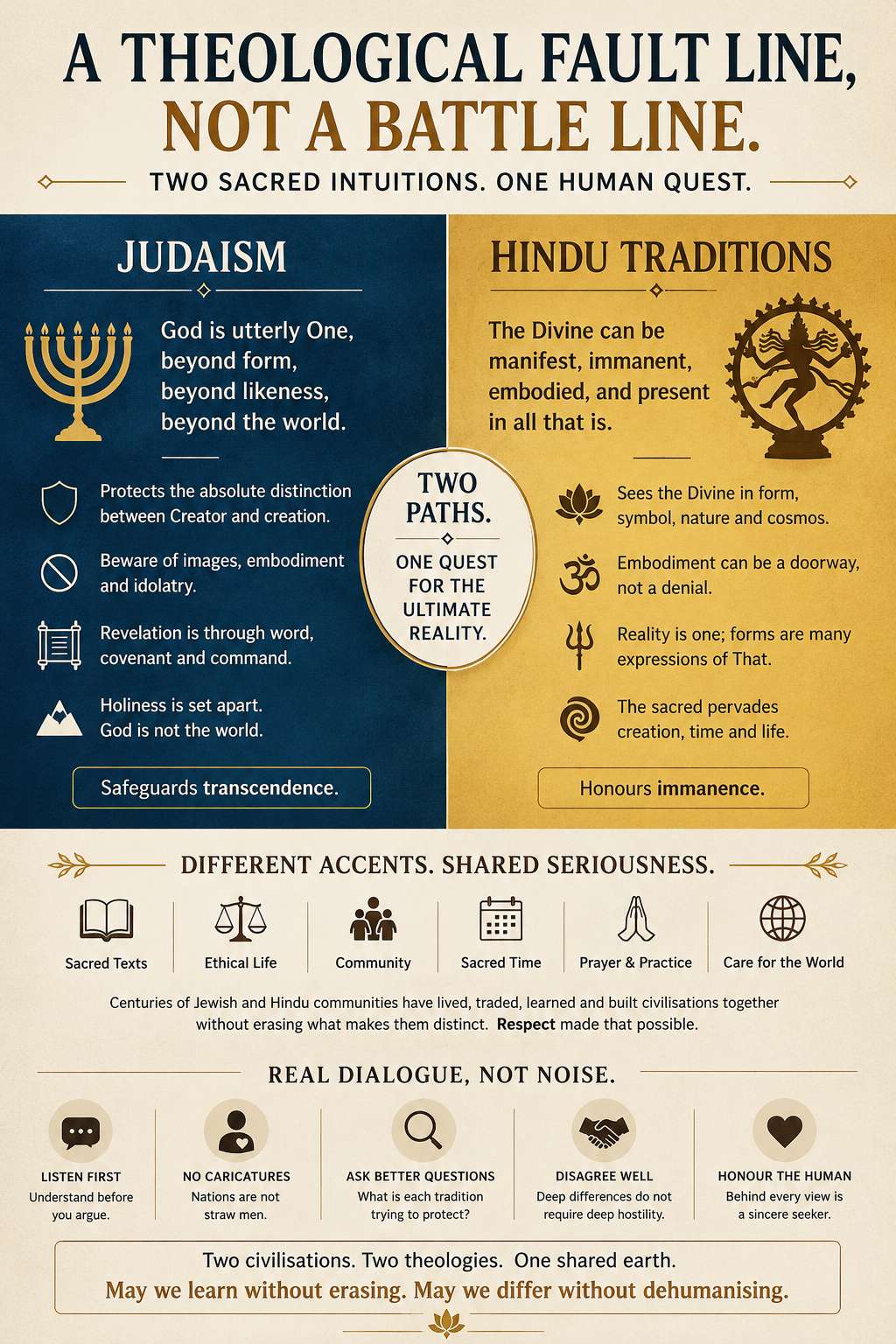 Judaism fiercely protects the absolute distinction between Creator and creation.
Hindu traditions often explore how the divine may be disclosed through form, symbol, embodiment, or manifestation.
That does not mean one side is “primitive” and the other “advanced.”
It means they are guarding different sacred intuitions.
One protects transcendence from being collapsed into images.
The other refuses to treat form, cosmos, and manifestation as spiritually empty.
So when these worlds meet, the serious question is not:
“Which side is stupid?”
It is:
“What is each civilisation trying to preserve about the Absolute?”
That is the level where real dialogue begins.
Not flattening them into “all religions are the same.”
Not baiting each other with caricatures.
Not pretending the differences are trivial.
A real encounter starts when you can recognise a profound disagreement without reducing the other tradition to mockery.
#Theology #Judaism #Hinduism #ComparativeReligion #Metaphysics #Civilisation #Interfaith #Sacred
Judaism fiercely protects the absolute distinction between Creator and creation.
Hindu traditions often explore how the divine may be disclosed through form, symbol, embodiment, or manifestation.
That does not mean one side is “primitive” and the other “advanced.”
It means they are guarding different sacred intuitions.
One protects transcendence from being collapsed into images.
The other refuses to treat form, cosmos, and manifestation as spiritually empty.
So when these worlds meet, the serious question is not:
“Which side is stupid?”
It is:
“What is each civilisation trying to preserve about the Absolute?”
That is the level where real dialogue begins.
Not flattening them into “all religions are the same.”
Not baiting each other with caricatures.
Not pretending the differences are trivial.
A real encounter starts when you can recognise a profound disagreement without reducing the other tradition to mockery.
#Theology #Judaism #Hinduism #ComparativeReligion #Metaphysics #Civilisation #Interfaith #Sacred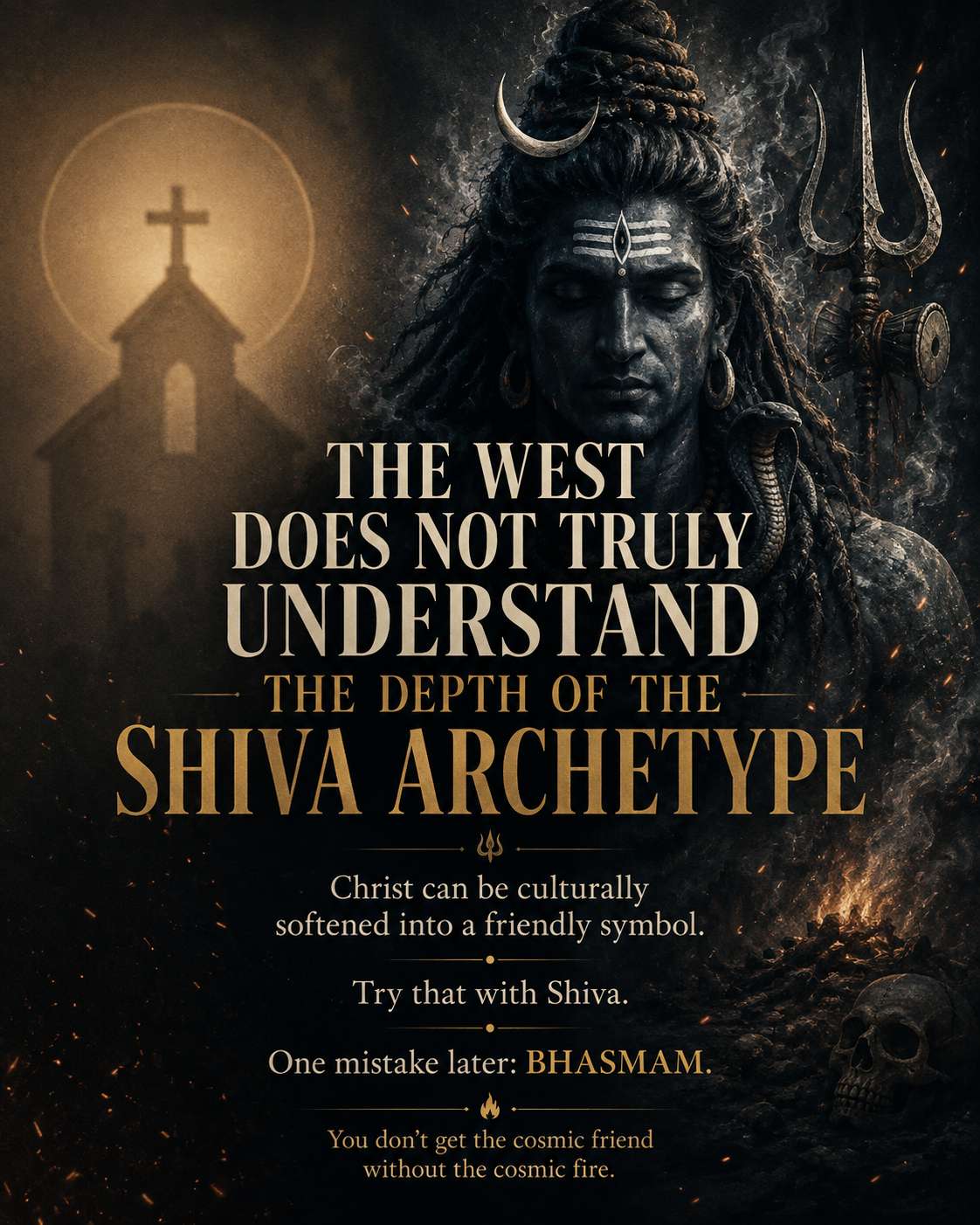 Christ could be culturally softened into Buddy Christ — smiling, reassuring, domesticated.
Try doing that with Shiva.
Shiva is stillness and destruction, ascetic and lover, creator and cremation ground. He wears bhasma because ash is where every illusion of permanence eventually ends.
Make one mistake and the joke writes itself:
Buddy Shiva.
One misunderstanding later: bhasmam.
The point is not that Shiva is merely terrifying.
It is that the archetype refuses to separate grace from destruction, creation from dissolution, or transcendence from death.
You don't get the cosmic friend without the cosmic fire.
#Shiva #Bhasma #Archetypes #Hinduism #Mythology #Civilisation #Metaphysics
Christ could be culturally softened into Buddy Christ — smiling, reassuring, domesticated.
Try doing that with Shiva.
Shiva is stillness and destruction, ascetic and lover, creator and cremation ground. He wears bhasma because ash is where every illusion of permanence eventually ends.
Make one mistake and the joke writes itself:
Buddy Shiva.
One misunderstanding later: bhasmam.
The point is not that Shiva is merely terrifying.
It is that the archetype refuses to separate grace from destruction, creation from dissolution, or transcendence from death.
You don't get the cosmic friend without the cosmic fire.
#Shiva #Bhasma #Archetypes #Hinduism #Mythology #Civilisation #Metaphysics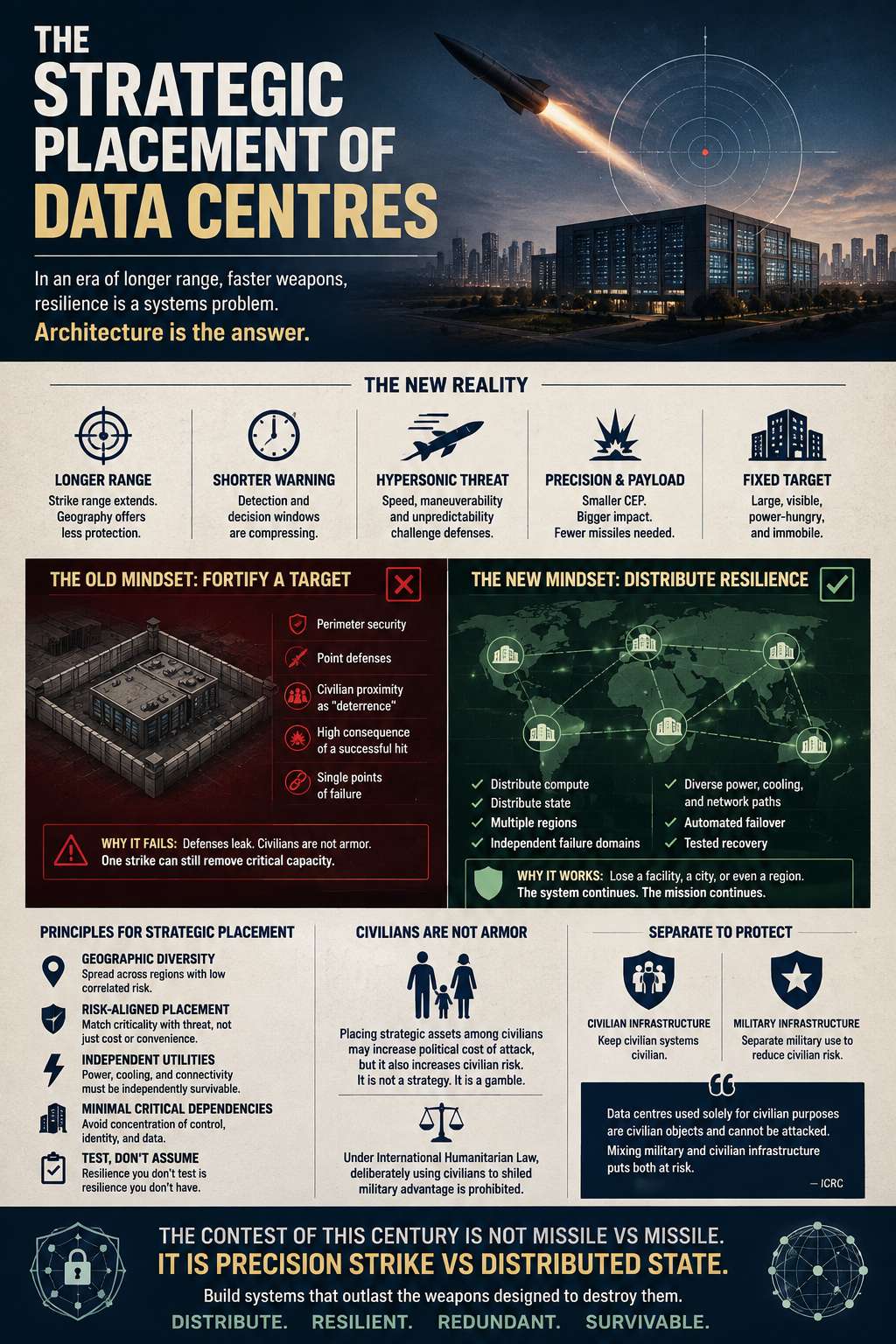 The age of the giant data centre is creating a new class of strategic fixed target.
Long-range precision weapons keep improving.
Detection windows shrink.
Range expands.
The building does not move.
That changes the defence equation.
A hyperscale facility cannot be made truly safe simply by surrounding it with fences, interceptors or civilian population density. Civilian proximity is not armour. At best, it raises the political and humanitarian cost of attack. At worst, it concentrates strategic infrastructure beside people who never chose to become part of the deterrence architecture.
The stronger defence is architectural:
No single building should matter enough to destroy.
Distribute compute.
Distribute state.
Separate failure domains.
Replicate across regions.
Make power, networking and control independently survivable.
The strategic contest of this century may not be missile versus missile.
It may be precision strike versus distributed systems.
The winning data centre is eventually the one that stops behaving like a fortress.
It behaves like a network.
#DataCenters #DistributedSystems #Infrastructure #Resilience #Geopolitics #CyberSecurity #Hypersonics #CloudComputing
The age of the giant data centre is creating a new class of strategic fixed target.
Long-range precision weapons keep improving.
Detection windows shrink.
Range expands.
The building does not move.
That changes the defence equation.
A hyperscale facility cannot be made truly safe simply by surrounding it with fences, interceptors or civilian population density. Civilian proximity is not armour. At best, it raises the political and humanitarian cost of attack. At worst, it concentrates strategic infrastructure beside people who never chose to become part of the deterrence architecture.
The stronger defence is architectural:
No single building should matter enough to destroy.
Distribute compute.
Distribute state.
Separate failure domains.
Replicate across regions.
Make power, networking and control independently survivable.
The strategic contest of this century may not be missile versus missile.
It may be precision strike versus distributed systems.
The winning data centre is eventually the one that stops behaving like a fortress.
It behaves like a network.
#DataCenters #DistributedSystems #Infrastructure #Resilience #Geopolitics #CyberSecurity #Hypersonics #CloudComputing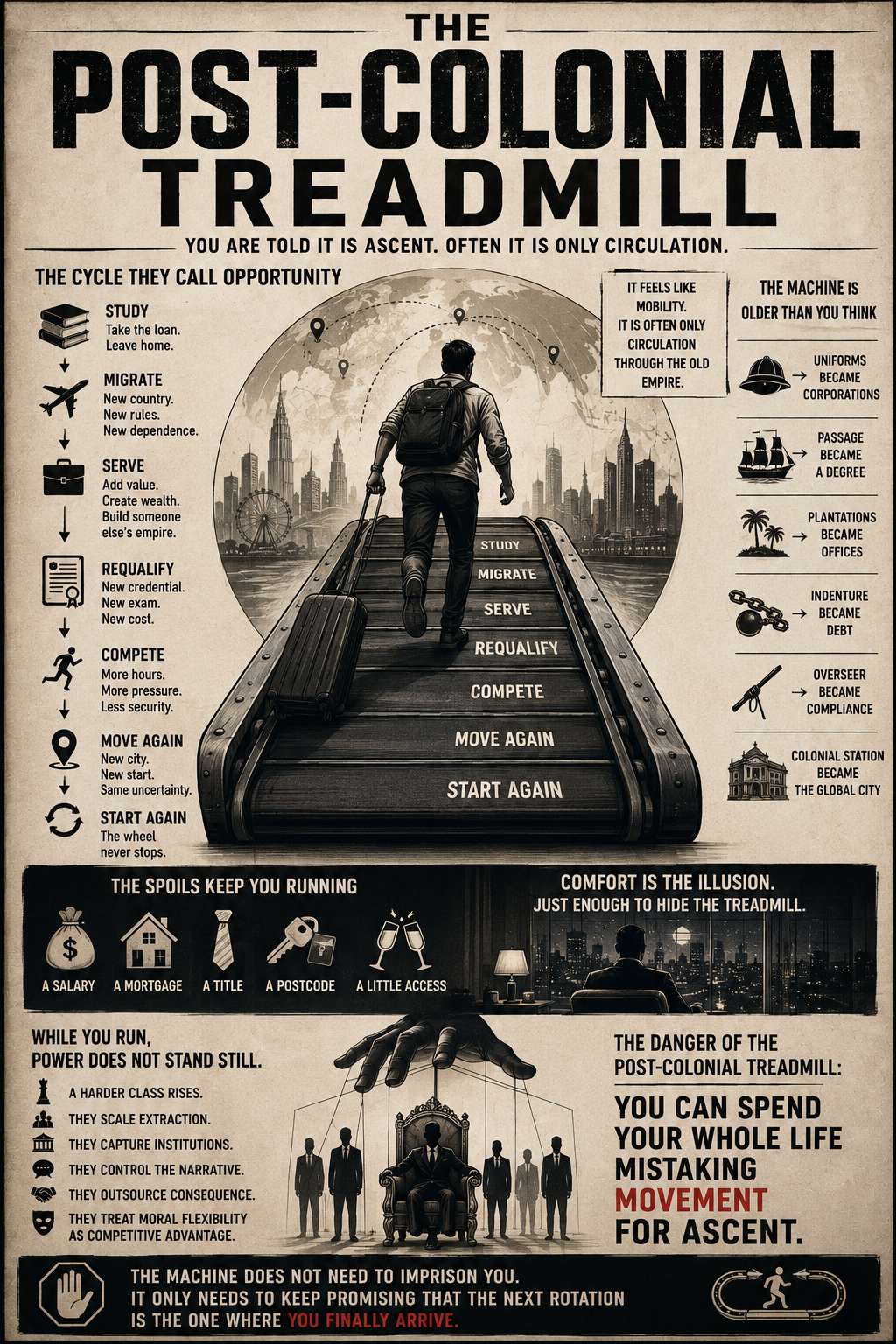 The Indian professional is told he is moving upward.
Study.
Migrate.
Serve.
Requalify.
Compete.
Move again.
Start again.
Every season brings a new shortage, a new credential, a new visa, a new city, a new promise of arrival.
It feels like mobility.
But often it is only circulation through the old imperial infrastructure.
The uniforms are gone.
The plantations became corporations.
The passage became a degree.
The indenture became debt.
The overseer became compliance.
The colonial station became the global city.
And the rewards are just comfortable enough to hide the treadmill:
a salary,
a mortgage,
a title,
a postcode,
a little access to the empire’s spoils.
So the professional keeps running.
Meanwhile power does not stand still.
A harder managerial class learns to scale extraction, outsource consequence, capture institutions and treat moral flexibility as competitive advantage.
That is the danger of the post-colonial treadmill:
you can spend your whole life mistaking movement for ascent.
The machine does not need to imprison you.
It only needs to keep promising that the next rotation is the one where you finally arrive.
#PostColonialTreadmill #India #Diaspora #Empire #Migration #Labour #Meritocracy #PoliticalEconomy
The Indian professional is told he is moving upward.
Study.
Migrate.
Serve.
Requalify.
Compete.
Move again.
Start again.
Every season brings a new shortage, a new credential, a new visa, a new city, a new promise of arrival.
It feels like mobility.
But often it is only circulation through the old imperial infrastructure.
The uniforms are gone.
The plantations became corporations.
The passage became a degree.
The indenture became debt.
The overseer became compliance.
The colonial station became the global city.
And the rewards are just comfortable enough to hide the treadmill:
a salary,
a mortgage,
a title,
a postcode,
a little access to the empire’s spoils.
So the professional keeps running.
Meanwhile power does not stand still.
A harder managerial class learns to scale extraction, outsource consequence, capture institutions and treat moral flexibility as competitive advantage.
That is the danger of the post-colonial treadmill:
you can spend your whole life mistaking movement for ascent.
The machine does not need to imprison you.
It only needs to keep promising that the next rotation is the one where you finally arrive.
#PostColonialTreadmill #India #Diaspora #Empire #Migration #Labour #Meritocracy #PoliticalEconomy The test was never whether you could win inside the existing rules.
The test was whether you understood the rules well enough to know when they had become the trap.
Fiat asks you to trust the board.
Bitcoin asks you to verify it.
The captains who pass are not the ones who save the old system.
They are the ones who recognize when the only rational move is to stop accepting its assumptions.
Sovereign verification over institutional permission.
That is the new standard.
#Bitcoin #BTC #KobayashiMaru #Sovereignty #Verification #SoundMoney
The test was never whether you could win inside the existing rules.
The test was whether you understood the rules well enough to know when they had become the trap.
Fiat asks you to trust the board.
Bitcoin asks you to verify it.
The captains who pass are not the ones who save the old system.
They are the ones who recognize when the only rational move is to stop accepting its assumptions.
Sovereign verification over institutional permission.
That is the new standard.
#Bitcoin #BTC #KobayashiMaru #Sovereignty #Verification #SoundMoney