
Statistically, it should take 10^130 (20^100) random interaction trials before inorganic matter creates a viable protein chain that could spawn life regardless of the chemical reaction conditions. (Source: https://answersingenesis.org/answers/books/in-six-days/john-r-baumgardner-geophysics/)
There is 10^48 (2^160 combinations for Base58 address format) chance of getting a specific bitcoin address. (Source:  10^130 / 10^48 = 10^82, which conveniently is the estimated number of atoms in the known universe. (Source: https://www.universetoday.com/36302/atoms-in-the-universe/)
My Interpretation: I would have to multiply the incredibly small chances of guessing an individual bitcoin by the number of atoms in the universe to get the probability that life developed from non-living material. So, even though I think most folks agree on NOSTR that it is statistically impossible for your individual bitcoin address to be guessed randomly, it is much, MUCH more statistically unlikely that life developed randomly in the universe.
What implications should I take from this? That life is more likely to have come from intelligent design (either aliens, God, or we are all in some big simulator)? Or, did I just dork up the math and this calculation is wrong? Alternatively, am I just approaching this from a foolish perspective and need to think about this in another way? Perhaps I am referencing non-credible sources? I welcome your guidance/discussion/correction.
*Reposting this from Stacker.news with slight edits; original post =
10^130 / 10^48 = 10^82, which conveniently is the estimated number of atoms in the known universe. (Source: https://www.universetoday.com/36302/atoms-in-the-universe/)
My Interpretation: I would have to multiply the incredibly small chances of guessing an individual bitcoin by the number of atoms in the universe to get the probability that life developed from non-living material. So, even though I think most folks agree on NOSTR that it is statistically impossible for your individual bitcoin address to be guessed randomly, it is much, MUCH more statistically unlikely that life developed randomly in the universe.
What implications should I take from this? That life is more likely to have come from intelligent design (either aliens, God, or we are all in some big simulator)? Or, did I just dork up the math and this calculation is wrong? Alternatively, am I just approaching this from a foolish perspective and need to think about this in another way? Perhaps I am referencing non-credible sources? I welcome your guidance/discussion/correction.
*Reposting this from Stacker.news with slight edits; original post = 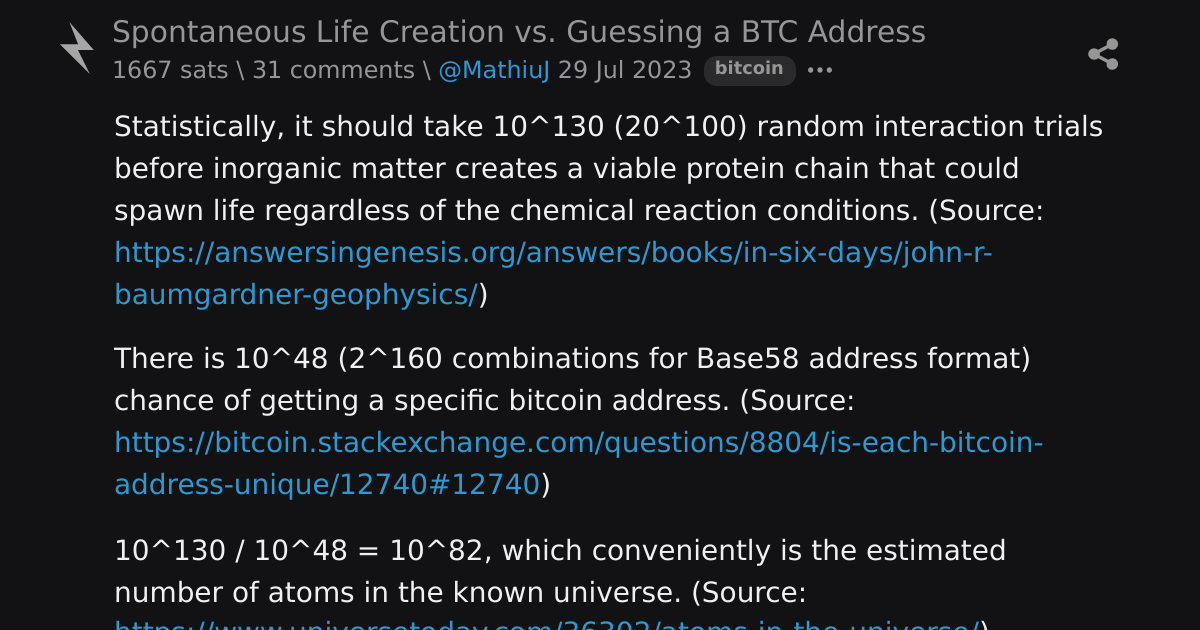
Bitcoin Stack Exchange
Is each Bitcoin address unique?
I am wondering whether each bitcoin address is unique. I would assume yes. Then, how is this enforced given the distributed address generation?
...
Stacker News
Spontaneous Life Creation vs. Guessing a BTC Address \ stacker news
Statistically, it should take 10^130 (20^100) random interaction trials before inorganic matter creates a viable protein chain that could spawn lif...